


Good morning! Let us begin with the number, because the number is the story: one in five. That is the share of Justice Department lawyers who were on the payroll at the end of 2024 and had walked out the door by this spring, out of a workforce of roughly ten thousand. Picture the hallway: this office empty, that one too, the nameplate pried off, the institutional memory gone to Denver to work for a state attorney general who still runs the kind of department the federal government used to run before it decided it would rather be a grievance machine with letterhead.
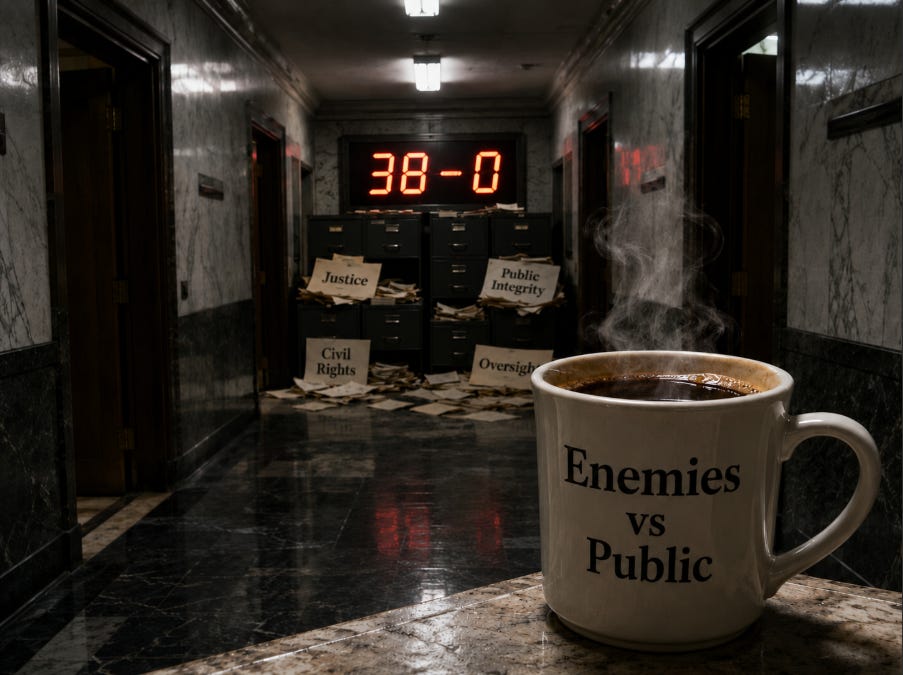
It is worse than a fifth, because the bleeding is not evenly spread. The divisions that did the load-bearing work, public integrity, civil rights, have been, in the careful clinical phrasing of people who loved the place, “utterly ravaged.” What is left is a skeleton crew hunkered down in fear and loathing, plus a fresh intake hired the way you staff a failing franchise: signing bonuses, kids straight out of law school, warm bodies pulled from other corners of government.
The Olympian institution that once made careers now offers a résumé line you have to explain. Worked at DOJ, yes, under that crowd. The trap is elegant in its way: the place is too tainted to attract the people who could fix it, which guarantees it stays tainted. An immune system that has learned to reject its own healthy cells.
Here is the part that outlasts any one administration. For generations, when a Justice Department lawyer stood up in court and told a judge something was so, the judge believed it. That presumption was earned month after month by attorneys who understood that the duty of candor mattered more than winning the case in front of them.
That trust is now being spent like a trust-fund kid’s inheritance. Judge after judge has begun calling DOJ lawyers out for telling them things that were not true. You do not get that back on an election cycle.
What is it all for? You needn’t wonder. Week after week, the reprisal machine runs pedal to the metal: criminal referrals aimed at Democrats, demands to reopen the Hunter Biden laptop, investigations launched wherever the President’s grievance points that morning. The department no longer has to tell you who its enemies are. It shows you, by what it still has time to do.
If you want the governing philosophy in the man’s own words, he supplied it this week on Truth Social, between a post claiming he scored 30 out of 30 on a cognitive exam and “looks 14 years younger than he is,” the same post conceding he has put on fourteen pounds, the involuntary honesty leaking through the propaganda like grease through a paper bag.
The philosophy: “In the last two weeks I’ve taken out many bad Political ‘Leaders’ and Pundits.” He then listed them, a senator, a congressman, a secretary of state, a late-night host, and tallied the result: “My score, for two weeks, is 38-0.”
Thirty-eight and oh. A won-lost record. He is keeping a scoreboard of the people he has destroyed, losing to none of them, and he would like applause. This is not a man hiding the project. This is a man narrating it into a microphone.
The reprisal track is the part they perform loudly. The monetization track they would rather you not graph.
So let’s graph it. In February, somewhere between one and five million dollars of Dell stock turns up in the President’s portfolio; shortly after, he is on television telling America to buy a Dell computer; shortly after that, Dell lands a $9.7 billion Pentagon contract and the stock jumps. In March, between two and seven million dollars in Apple is purchased, and on the same day one of those buys clears, he praises Apple from a podium. Fifty thousand in Thermo Fisher, bought the day he toured its facility. Shares in the UFC’s parent company added in March; weeks later, he is hosting a UFC spectacle on the White House lawn and calling it the hottest ticket in America.
The Trump Organization’s defense is a small masterpiece of saying nothing. Neither the President nor his family, it assures us, has any role in “selecting, directing, approving, influencing or soliciting” these trades, and receives “no advance notice.”
Read it twice. Every verb may be doing legal work. None of them answer the obvious question. You do not need to direct the trade if someone else knows, in advance, where the President will speak and whether he will say something nice. The denial is engineered to be technically accurate and substantively irrelevant, a conflict of interest that practically asks whether it comes in gold leaf.
The framers did not imagine this, because even their worst-case scenarios had a little dignity. The emoluments clauses reach foreign and state governments; it did not occur to them to ban a president from front-running his own announcements, because it did not occur to them that a president would. They wagered the republic on the character of the officeholder. This week, we are watching the wager lose.
While the state is being pointed at the President’s friends and enemies, it is also simply walking off the job it was built to do.
The ATF used to enforce gun-trafficking laws. Now, per ProPublica’s reporting, something close to 1,800 of its roughly 2,500 agents have been pulled onto immigration duty, chasing the undocumented instead of the straw purchasers feeding the Iron Pipeline. Trafficking referrals are down. Dealer license revocations are down sixty-nine percent. The administration has invited revoked dealers to reapply, settling court cases one by one and handing licenses back with little explanation. Zero tolerance, repealed. The welcome mat, rolled back out.
The image that ought to stay with you is an inspector named Terrence Robinson, six years on the job in Baltimore, ordered last summer to spend his hours scouring gun-dealer sales records for buyers with “foreign-sounding names” to hand off to Homeland Security.
Sit with that. The man whose job was to keep trafficked guns off the street was reassigned to mine the gun-buyer database for immigrants. The two tracks, punish the disfavored, abandon the public, collapsed into a single afternoon’s task. He quit.
“I didn’t sign up to be an immigration person,” he said.
The competent leaving, again, because the mission inverted under them.
The cost will not show up on time to be useful at the next election, which is the genius of it. A trafficked gun can take years to surface at a crime scene. The gains of the last few years may mask the pullback for a while; the bill arrives later, quietly, one shooting at a time. The pipeline does not stop flowing because no one is watching it. The guns just stop being intercepted.
There was, this week, exactly one piece of counter-evidence, one place the machine hit something it could not push through. I wrote about it at length, so I’ll be brief: the billion-dollar “anti-weaponization” fund, the taxpayer-backed pity jar for the President’s grievance economy, appears to be dead for now.
Not because anyone in the building grew a conscience. Let’s not get carried away. Because the courts leaned in, Democrats laid a trap, and roughly two dozen House Republicans, connoisseurs of looking concerned while doing nothing, finally found a vote too ugly to cuddle in public. Hubris collided with math.
It tells you something that this is the exception. Everywhere else in this dispatch, the machine is running unobstructed: the department gutted, the scoreboard kept, the portfolio fattened, the inspectors reassigned. In one place, the system pushed back hard enough to matter.
So we mark it. Sometimes democracy does not arrive on a white horse. Sometimes it shows up as a federal judge, a procedural trap, a panicked caucus meeting, and a bunch of Republican senators suddenly remembering they would prefer not to explain why they voted to fund a billion-dollar pity jar for the insurrection-adjacent.
We take the wins where we can get them.
So that is the home front: a Justice Department hollowed of one in five of its lawyers; gun-trafficking inspectors reassigned to comb sales records for foreign-sounding names; a president keeping a public scoreboard of the enemies he has “taken out,” 38 and 0.
Run together, these are not separate scandals. They are one decision, made over and over: take the expensive, competent, public-serving capacity of the state and point it somewhere else. Toward the favored project and away from the public it was built to protect.
Once you have seen the pattern at home, you cannot unsee it abroad. The instrument is different, warheads instead of inspectors, a nuclear umbrella instead of a prosecutor’s discretion, but the logic is identical. Pull the costly commitment, backfill with whatever is cheaper and more aligned, and call the substitution strength. At home, the expensive thing withdrawn is competence, and the cheap backfill is loyalty. In Europe this week, the expensive thing being withdrawn is conventional defense, and the cheap backfill is the bomb.
Which brings us to the war. At 5:57 Monday evening, the President of the United States announced that the war was over. He had spoken to Netanyahu, who turned his troops around, “Thank you Bibi!” and to representatives of Hezbollah, who had agreed to stop shooting. “Let’s see how long that lasts,” he wrote. “Hopefully it will be for ETERNITY!”
Eternity lasted about forty minutes.
By the time the post had finished circulating, Hezbollah had claimed multiple strikes on Israeli targets. The Israeli military was intercepting rockets out of southern Lebanon before the hour was out. And the announcement had been hollow before he ever made it: Netanyahu’s own office had said hours earlier that the IDF would continue to operate as planned, including strikes on Beirut if Hezbollah did not stand down. Hezbollah had reportedly already refused the partial truce the President was describing as accepted. Itamar Ben-Gvir had told him, in public, that it was “time to say no to Trump.”
The ceasefire was announced by one man, relayed by the Lebanese embassy in Washington on his say-so, contradicted by the Israeli prime minister within the hour, and refuted by the rockets themselves.
We watched the spectacle of peacemaking staged over a war that did not pause to watch. The President later described the contradiction to ABC News as “a little glitch today, but I turned that one around very quickly.” A shooting war, narrated as a customer-service hiccup.
Strip away the announcement and here is the week as the ground recorded it. Israeli forces took Beaufort Castle, the ancient hilltop fort above the Litani, for the first time in twenty-six years, advancing under a screen of white phosphorus. Its military value in the age of drones may be slight. Its symbolic value was the point: a flag planted in a war that had been deadlocked for weeks.
In northern Iraq, in the Kurdish region’s Erbil province, two missiles struck the headquarters of an Iranian Kurdish opposition party late Sunday night. The Kurdistan Region has absorbed hundreds of drone and missile attacks since the war began, Iran and its proxies striking dissident groups across the border, through a ceasefire that exists, apparently, only on paper. Schrödinger’s truce: in force and violated at once, depending on which clause you read.
On Sunday, at an air base in that same Erbil province, an American soldier and a British soldier died. U.S. and U.K. officials described it as a training exercise and released little else. The deaths fell on the same night, in the same province, as confirmed Iranian missile fire, though that fire was aimed at Kurdish opposition bases and no official has connected the two. The proximity is real, the link is not established.
Markets, for their part, rendered a verdict. Brent crude settled near $95 a barrel, well above where it stood before the war, while the S&P, Dow, and Nasdaq all closed at fresh records. The war is a line item. The crisis is somebody else’s.
Here is the part worth sitting with. The United States is, by its own account, waging this war to keep a nuclear weapon out of the wrong hands. That is the premise. An Iranian bomb is intolerable because it lowers the threshold, invites the cascade, and puts more fingers near the trigger.
On the same Tuesday morning, multiple outlets reported that Washington is in quiet talks to expand the deployment of American nuclear weapons into more European countries, beyond the existing six, toward NATO’s eastern flank: Poland, the Baltics, the capitals closest to Russia’s border. Defense News called it “a remarkable proliferation in nuclear sharing.”
The weapons would remain under American control. This is not, in the treaty sense, handing Warsaw a bomb. The administration’s defenders have a serious argument: extended deterrence under U.S. authority is the thing that has kept allies from building their own arsenals for seventy years. Forward deployment, on that view, is nonproliferation, the mechanism that keeps allies non-nuclear by lending them the umbrella.
Grant that argument its full weight, and the timing still gives the game away. The expansion is being floated now, mid-war, mid-withdrawal, not as considered strategy but as reassurance: a cheaper substitute for the conventional troops and weapons systems this administration is pulling out of Europe to pivot toward Asia. The nuclear umbrella is being offered to paper over the things being taken away. Fewer soldiers, more warheads, closer to Russia, as a budget maneuver dressed as resolve.
Which tells you what the premise was all along. Nuclear weapons are an existential danger when Iran might acquire them and a convenient instrument of statecraft when they offset a spreadsheet. The danger is real when it belongs to the adversary and manageable when it serves the moment.
One thing has proven certain and that is there is no unified philosophy. Just the attic, raided for whatever fits. We will know more by evening. With this administration, we always do, and it is never what was promised the night before.
We have progressed so little in the history of this earth. War is always about resources, especially land. I believe that if we let women run governments, our world would look much different, and our lives would be much better. My heart is broken.
That phrase from All the President's Men keeps recurring to me: "Follow the money."
Isn't that what it comes down to?
Mega-corp CEOs, hedge fund managers, oil execs... it just goes on and on. Different clothes (nuclear weapons, fracking, insider trading) but the same old grift.
At what point do they have enough wealth, "they" being wannabe-trillionaires?
When they have more than they could spend in five lifetimes? Ten? When they can buy a city, or space travel?
How much is enough?