

The sudden drop in oil prices did not happen because the war magically stopped or because the physical dangers to shipping and supply suddenly vanished. It happened because the messaging changed. After days of reckless chest-thumping that helped send crude screaming upward, the White House and its allies finally seemed to realize that markets are not impressed by macho improv. Traders had been hearing about strikes on energy-related infrastructure, blithe talk about not caring about oil prices, and a general atmosphere of escalation without any visible concern for the economic fallout. That is how you get panic pricing. Then, once oil spiked into the danger zone, the tone abruptly shifted. Suddenly there was talk of keeping the Strait of Hormuz open, protecting tankers, waiving some oil-related sanctions, discussing emergency reserve releases, and describing the conflict as limited, controlled, and nearing completion. The battlefield had not fundamentally changed, just the language had.
Matt Randolph makes this point. Messaging matters in commodity markets because perception can move prices long before fundamentals fully catch up. If policymakers sound like they are casually playing chicken with the global energy system, traders will price in the worst-case scenario. If those same policymakers coo everything is under control and supply will keep flowing, the market will ease off, at least for a while. There’s a catch, however, because messaging is a sedative, not a cure. It buys time, but it does not reopen shipping lanes, restore damaged infrastructure, or guarantee safe passage through a chokepoint. If the physical risks remain, markets eventually wake back up.
This is where Trump becomes the perfect messenger for confusion because he cannot simply reassure without also threatening, boasting, exaggerating, and wandering off into unrelated fantasies. He wants to calm markets, terrify enemies, flatter himself, justify escalation, and campaign against Democrats all in the same breath. The result is a style of communication so bloated and contradictory that it often sounds like several alternate realities fighting for custody of the same microphone.
Which brings us to today’s press conference, a near-perfect example of why Trump messaging is both politically useful and intellectually radioactive. Trump came out to announce, for roughly the fourteenth time, that Iran has been completely, totally, extra-completely obliterated, except also the war is still going, also more targets remain, also he might hit those later, also this is somehow both “very complete” and “just the beginning.” So the basic message was: mission accomplished, but keep the bombs warm.
He bragged that Iran’s navy is now basically an artificial reef, boasting that “most of Iran’s naval power power has been sunk. It’s on the bottom of the sea,” and then adding, with his usual mix of swagger and improv, “It’s almost 50 ships. I was just notified it’s 51 ships. I didn’t know they had that many.” He insisted “they have no navy, they have no air force,” that “their missile capability is down to about 10% maybe less,” and that the drone network was being wiped out because “their drone manufacturing’s been hit starting today” and “they’re being hit one after another.” Even the leadership, in his telling, had been erased so thoroughly that he seemed to marvel at it in real time, saying “we’ve taken out the leadership twice and maybe three times” and later declaring that “two levels of leadership are gone.” The chest-thumping was relentless: “We have the greatest military in the world. We have the greatest equipment in the world by far,” and the whole operation, naturally, was “a military success the likes of which people haven’t seen.” If a brass band could talk, this would have been the speech.He also kept insisting Iran was mere weeks away from nuclear capability, that it would have used the weapon almost immediately, and that without his brilliance the whole Middle East would already be under Iranian control. So once again, the justification was presented as simultaneously urgent, absolute, unverifiable, and suspiciously convenient.
On oil, he tried to pivot into market-soothing mode, insisting that “the straight of Hormuz is going to remain safe,” because “we have a lot of Navy ships there” and “the US Navy and its partners will escort tankers through the straight” if necessary. He said the administration was “also waiving certain oil related sanctions to reduce prices,” adding, “we’re going to take those sanctions off till this straightens out.” He promised that “the result will be lower oil prices, oil and gas prices for American families,” and summed up the whole war as “just an excursion into something that had to be done.” Then came one of the more surreal lines of the evening: “We have Venezuela now as our new partner, great partner,” a sentence that deserves to be framed and hung in a museum labeled Things MAGA Would Have Screamed About Under Literally Any Other President. Trump went on to rave that Venezuela “worked out so wonderful” and called it “a massive source of oil, gas, everything,” because nothing says coherent wartime energy policy like improvising petro-state partnerships in the middle of a victory monologue.
Then the Q and A dissolved into its usual swamp of contradictions. Asked whether the war was over or just beginning, he essentially said both, insisting “the big risk on that war has been over for three days” while also saying “we’re going to go further” and that “the rest is going to be a determination as to my attitude.” When asked about civilian casualties at a girls’ school, he dodged, said he had not seen the report, and floated the absurd possibility that “whether it’s Iran or somebody else” was responsible because “a tomahawk is very generic” and “numerous other nations have tomahawks.” Asked how many American deaths he was willing to accept, he responded with the grisly bit of stagecraft that “every single one” of the grieving parents told him: “Finish the job, sir. Please finish the job.” It was classic Trump: contradiction, deflection, and then a sentimental flourish jammed into the machinery of escalation. The broader shape of the news conference matched that same pattern: he spoke as if the conflict was already largely decided, while leaving himself room to widen it whenever he pleased.
He also wandered into his usual hobbyhorse territory, because no Trump appearance is complete until he crams a little culture-war pamphlet into the middle of a military briefing. He said he would not sign legislation without the “Save America Act,” then spun off into demands for “voter ID,” “confirmation that this voter is a citizen of the United States of America,” “no mail-in ballot scams,” “no men in women sports,” and “no transgender mutilization of our children.” In other words, regional war, possible tanker escorts, threatened devastation of Iran’s infrastructure, and somehow we still had to stop for the full right-wing grievance sampler platter. The remarkable thing about Trump is not just that he changes the subject, but that he always changes it to the exact same subject.
There was also the regime-change flirting. He called Iran’s new leadership choice “disappointing,” said he preferred “the idea of internal,” and started musing aloud about what kind of replacement would be more useful to Washington. He invoked Iraq as the cautionary tale, “they turned into ISIS,” while praising his supposed Venezuela formula as the smarter model, all of it delivered with the breezy confidence of a man workshop-testing governments from a resort microphone. Not quite a formal declaration of overthrow, more like imperial Yelp reviewing: bad choice, weak management, disappointing succession plan, would recommend a more compliant local replacement next time. That improvisational approach has become one of the defining features of his public messaging on Iran, which even outside this specific event has repeatedly blurred the line between military goals, deterrence talk, and open-ended political redesign.
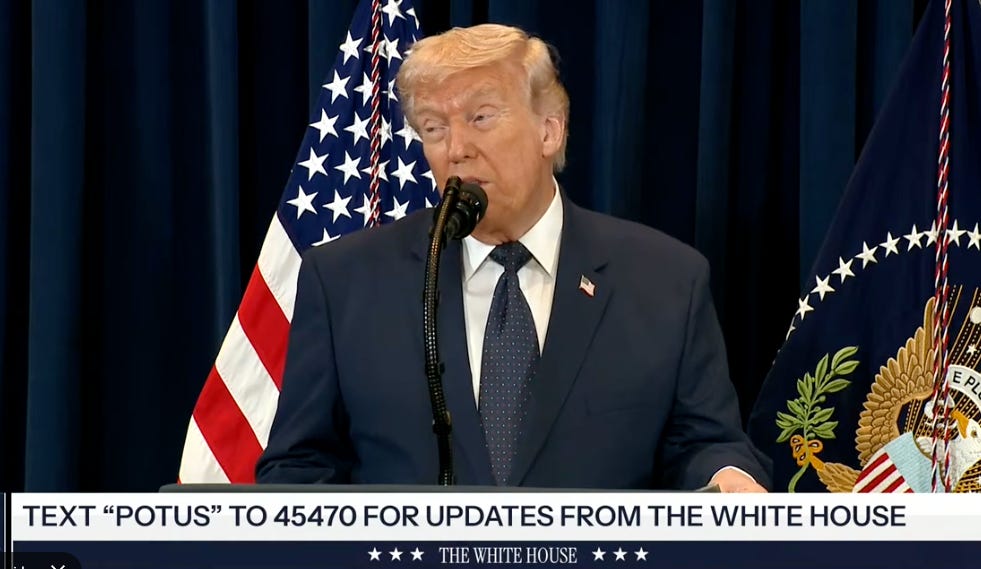
Trump wanted to project total dominance, calm the oil markets, justify indefinite escalation, and sell the whole thing as a dazzling historic triumph, all at once. The result was a rambling blend of Top Gun fan fiction, strongman branding, market therapy, and open-ended war talk. He keeps insisting the war is basically over while describing, in loving detail, all the ways he is prepared to expand it.
No Trump spectacle is complete without a sidecar of ego merchandising, so this all unfolds at the same time his organization is reportedly trademarking “Trump 250” for America’s semi-quincentennial and slapping his name onto institutions like the Kennedy Center. It is almost too perfect: while the administration tries to lower oil prices through strategic messaging, Trump is still compulsively branding the republic like a distressed golf resort. Even the patriotic garnish has his surname on it. Consider it the olive in the martini, a tiny, absurd reminder that with Trump, every war, market tremor, and national milestone eventually gets rerouted through the same gaudy gift shop.
Lies, buffoonery and fantasies, as if he alone dictates the flow of events. His sycophantic and/or imbecilic enablers prefer blather to what’s real, and those who find him easy to manipulate couldn’t ask for more. We the rest of humanity must bear the consequences of his self-obsession, ignorance and incompetence.
Nothing comes from Trump’s words except how great I am & how lucky you have me as your savior. Or, what a vile, stinky lowlife that you are; good riddance (unless you’d like to give me a $1B gift).