


A few weeks ago, I wrote about a health care system shaped by scarcity, distance, and denial, about what happens when care gives way to paperwork, when the road becomes part of the diagnosis, when insurance becomes less a promise than a maze, and when ordinary people are left standing at the counter, on the phone, or at the mailbox trying to prove they deserve help.
At the time, I was thinking about patients I had known through my years working in health care, especially in a federally qualified health center, where the failures of the system arrived as bills that should not have existed, as patients who thought they were covered until the claim came back wrong, and as families who had done everything they were supposed to do and still found themselves punished by rules they had never been taught.
I knew those stories were real, I had seen them and carried them. Then the denial letter came to my house; Oregon Health Plan denied the MRI my 8-month-old son’s doctor ordered for him. He has a vascular birthmark on his upper spine, between his shoulder blades. It has grown since we first noticed it. It used to be flat, and now it is raised and larger. He is a baby, so he can’t tell us if something feels strange beneath the skin, can’t say if there is pressure or pain, can’t explain whether something in his tiny body feels different than it did before. He can only laugh, reach, babble, press his warm little face into me, and trust that the adults around him will know when something needs to be checked.
His doctor said one of the things it could indicate is a tethered cord or another underlying spinal abnormality, and so the MRI was ordered not because I am anxious, not because we are inventing catastrophe, and not because anyone is trying to waste medical resources for fun, but because a clinician looked at a changing vascular mark on my baby’s spine and said, in effect, we need to see what is happening underneath.
The system looked at that same baby and said no. There is a particular kind of coldness to a denial letter, because it is written in the language of procedure while landing in the middle of a life. It doesn’t arrive with a person who has looked into your child’s face, it doesn’t sit beside you while you wonder what happens if the doctor is right to be concerned, and it doesn’t explain how a mother is supposed to weigh the possibility of something being wrong with her baby’s spine against the fact that her family is also losing its home.
It simply says no, or not medically necessary, or not approved, or some other phrase polished smooth enough that nobody has to admit what it means. What it means is that we may have to choose between paying out of pocket for a test meant to look at our baby’s spine and holding onto the money we need to find housing.
What it means is that in the same week I am trying to imagine where my children will sleep next, I am also trying to imagine whether we can afford to know what is happening inside my youngest son’s body. What it means is that the machinery of American life has become very good at turning basic safety into a series of impossible calculations.
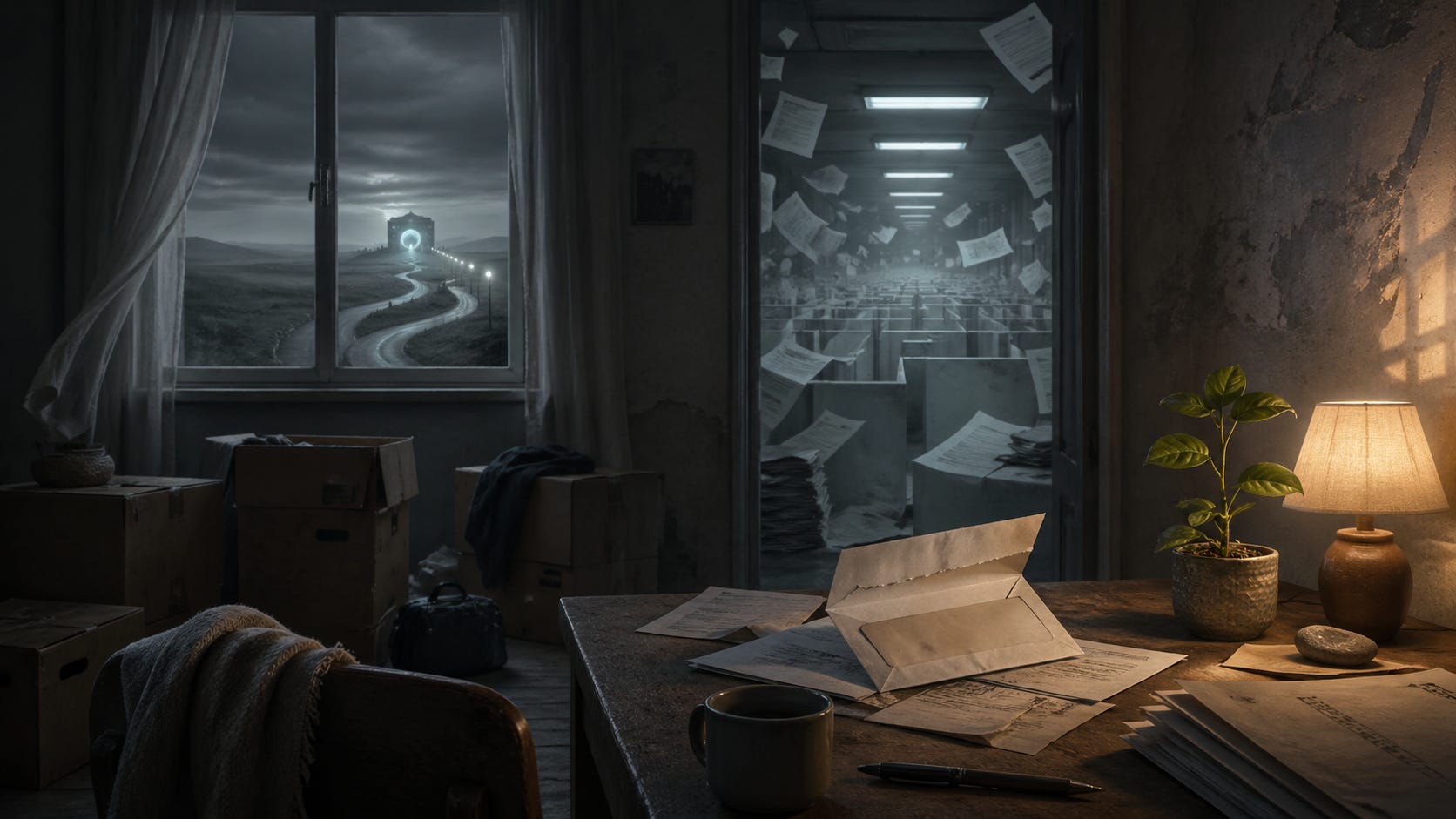
Housing is treated like an investment vehicle before it’s treated like shelter, health care is treated like a cost center before it’s treated like care; and childhood is treated as something families are expected to protect privately, with whatever money, time, energy, transportation, stability, and institutional literacy they happen to have left after the system is finished extracting from them.
And then, when people break under the weight of all that, we are told to be resilient. I have been thinking a lot about that word lately, because resilience is one of those words America loves to hand to people it has no intention of helping. It sounds generous until you notice how often it is used as a substitute for justice. Be resilient when the rent goes up, be resilient when your home is sold, be resilient when the insurance denies the test, when the hospital closes, when the doctor leaves, when the form is wrong, when the phone tree loops you back to the beginning, and when your child needs care and the system responds as if care were a luxury item you failed to budget for.
There is a difference between resilience and abandonment, and I am tired of watching this country confuse the two. Yesterday, I wrote about hope, although I admitted that my own hope had been growing thin. I wrote about cleaning the house we have lived in for ten years so it could be photographed and listed for sale, about all the life we have pressed into these walls, about folding newborn clothes while I was in labor, about septic water and road trips and paint and children growing in rooms we thought we would keep longer than this. I wrote about sea turtle eggs being moved out of the path of bulldozers on Florida beaches, about careful hands in the sand, and about people who understood that fragile life sometimes must be lifted gently and carried somewhere safer.
I keep returning to that image now, because I understand the eggs differently today. I understand what it means to have something small and beloved lying in the path of something larger, louder, and almost entirely indifferent. I understand what it means to look at a future that cannot protect itself and think, “not this one, not my baby, not this fragile life, not if I can help it.”
That is what parenting feels like right now, not in the soft-focus way people sometimes talk about motherhood, but in the actual, grinding, sacred labor of standing between your children and whatever machine happens to be coming next. Sometimes the machine is a housing market that treats the place your children learned to crawl as an asset to be liquidated. Sometimes it is an insurance system that treats a doctor-ordered MRI for an infant as a request to be denied. Sometimes it is the larger machinery of capitalism itself, which has trained us to accept that everything essential must first prove its profitability before it is allowed to exist. But a child’s spine is not a luxury, a home is not a luxury, and the chance to know whether your baby is all right is not a luxury.
There are people who will say this is just how the system works, as if that makes it less obscene. They will say there is an appeal process, as if an appeal process is the same thing as care. They will say there are rules, as if rules cannot be written to protect budgets instead of people. They will say resources are limited, as if the richest country on earth has no choice but to make parents argue for imaging while billionaires argue about tax rates from homes large enough to get lost in.
I know we will appeal, I know we will call, I know we will ask the doctor to write whatever needs to be written, to explain again that this is a growing vascular birthmark on an infant’s spine, to say again that a tethered cord or another spinal abnormality is part of the concern, to put into the proper language what every parent already understands without needing a billing code, which is that when something about a baby’s body changes and a doctor says we should look, we should be allowed to look.
But I also know that the fight itself is part of the harm. The hours, the fear, the sleep lost to imagining possibilities you are trying not to imagine, and the way money begins to haunt every decision all matter, because suddenly every dollar has two shadows. One shadow is housing, the other is health care. One is the place your children will sleep, and the other is the picture that might tell you whether your baby’s spine is safe.
Nobody should have to hold those things in the same pair of hands and decide which one can be risked. And still, almost like he knew I needed it, the baby laughs, that’s the part that keeps undoing me. He laughs with his whole body, as babies do, as if joy has not yet learned to ration itself. He laughs without knowing about denial letters, without knowing about OHP or prior authorizations or the way grown adults in distant offices can decide whether his spine is allowed to be seen. He laughs because his siblings are funny, because someone made a face, because the dog moved weirdly, because the world is still new enough to surprise him into delight.
And when I see that sweet baby laugh, I remember why I cannot surrender to despair, even when despair would be easier. When I see my daughter being brilliant, curious, sharp, and alive with her own strange light, I remember that the future is not an abstract political category. It is standing in my kitchen asking impossible questions while wearing mismatched socks. When I see my oldest son being creative, building whole worlds from whatever is in front of him, I remember that children are always making life out of the materials we give them, even when the materials are not enough, even when the adults have failed to make the world as safe as it should be.
This is where hope becomes difficult enough to be honest. Hope is not pretending the system is kinder than it is, hope is not calling a denial letter a misunderstanding when it is part of a pattern, hope is not being grateful for crumbs, or quiet about cruelty, or patient with systems that have mistaken delay for management and denial for prudence. Hope is the refusal to let the machinery have the last word.
It’s the appeal filed anyway, it’s the doctor who orders the MRI, it’s the parent who takes pictures of the birthmark and writes down dates and makes another call. It’s the neighbor who says “we have boxes if you need them,” the friend who sends a listing, and the reader who understands that policy is not somewhere far away from the body, because policy is what decides whether the baby gets the scan, whether the family keeps the house, whether the road to care is short enough to survive.
Hope is a hand in the sand, yes, but sometimes it’s also a hand on the phone, a hand opening the mail, a hand measuring a birthmark on a baby’s back, a hand packing a box in a house you were not ready to leave. Sometimes hope is looking at everything coming for your children and saying, “not this one, not alone, not without a fight.”
I don’t know yet what the MRI will show, because the system has decided we are not allowed to know that easily. I don’t know yet where we will live, because the market has decided that a decade of memories and unfortunate timing don’t equate to value. I don’t know how many more times families are supposed to absorb these blows and still be congratulated for surviving them.
But I know this. A country that makes parents choose between medical care and housing is not suffering from a shortage of resources; it’s suffering from a shortage of moral imagination. A country that treats a baby’s MRI as optional, a family’s housing as precarious, and a parent’s fear as an administrative inconvenience has built something cruel and called it normal.
And if I continue to hope, it’s not because I have mistaken this cruelty for something smaller than it is, it’s because my children are still here, still laughing, still brilliant, still creating, still asking from us a future worthy of them.
So, I will make the calls, I will file the appeal, I will pack the boxes, I will hold the baby, I will watch his back, and I will look at my children and remember that every system telling us to give up was built by people, which means it can be challenged by people, changed by people, and one day, if we are brave enough, replaced by people who understand that care is not a privilege and shelter is not a prize. Maybe that is what hope is when the world has stopped being gentle. Not certainty, comfort, or a guarantee that the fragile thing will be safe. Maybe hope is the stubborn, trembling act of choosing to become careful hands anyway; after all, the future is counting on us.
Shanley. I've stopped holding my breath and biting my trembling lower lip to tell you that we want to help. We = two 70 year old, retired, well off couple. Why? Oh that. Because we're all just walking each other home. Because we can. Because baby boy Hurt needs an MRI. Not sure how we can get in touch off the public comments page, but I'm resourceful. I'll figure it out. Until then, laugh with him, touch his spot and declare that it is just a birthmark, make the appointment. Maybe give me the dr's contact info so we can figure out the logistics. Until then, breathe and believe. D
I keep trying to find a way to answer these comments, and I keep coming back to the same feeling; amazement.
I was writing, not with expectations, but with the hope of helping to expose what an extractive and capitalist economy does to people, I was writing about fear and love; and you all answered with care.
I wrote about denial letters, impossible choices, housing instability, and the brutal little calculations families are forced to make when care and shelter are treated as privileges instead of promises, you all answered by refusing to let me and my family stand inside that alone. That is no small thing, and I am deeply in awe of your kindness.
Every Sunday, I write about hope for humanity. I go looking through the news for the stories that suggest we may not be a lost species after all, the small acts of courage and mercy and decency that remind me people are still capable of choosing one another. And then you all showed me that hope firsthand, you became the story I am always searching for.
There is a kind of hope that doesn’t announce itself brightly, it doesn’t fix everything, it doesn’t erase the denial letter or pack the boxes or make the MRI suddenly approved. But it changes the room, it reminds the frightened people inside it that they are seen, that their child matters, that their family matters, that the future is not only being shaped by cruelty and indifference. That is what you have all done here, and I just could not be more grateful for the kindness and love from each of you.
Many of you have asked me to create a GoFundMe, and I am humbled by that, and honestly still trying to learn how to receive it, I’ve always been kind of an independent gal. But because the offers have come with so much tenderness and practical love, I have created one and linked it here: https://gofund.me/75a928dab
Funds will go toward our baby’s MRI and related medical costs if insurance continues to deny or delay care, and toward the urgent housing and moving expenses our family is facing.
Please know that your kindness has already become part of the story, as proof that even inside systems built to isolate and exhaust people, we can still reach for each other. Thank you for being careful hands, like the ones making nests for sea turtle eggs, or relocating tortoises, or jumping into a freezing lake to save a baby when you can’t swim, or bringing white rhinos back home, you all embody each and every one of my Sunday reminders that hope for humanity may still exist after all. Thank you for helping me and my family remember that hope can be communal and thank you for refusing to let the machinery have the last word.