


Good morning! One of the more remarkable stories developing this week isn’t something Donald Trump has said. It’s something he hasn’t done.
Trump has been unusually absent from public view for days. Reporters have spent the week staring at closed-press schedules, lengthy stretches of executive time, and a single mysterious pre-taped interview, while White House surrogates fill the airwaves on his behalf. Yet at the very same time, Trump’s Truth Social account has been operating like a caffeinated intern who just discovered the copy-and-paste function. Endorsements. Foreign policy declarations. Personnel announcements. Immigration crackdowns. Attacks on opponents. Everything, that is, except an actual unscripted appearance.
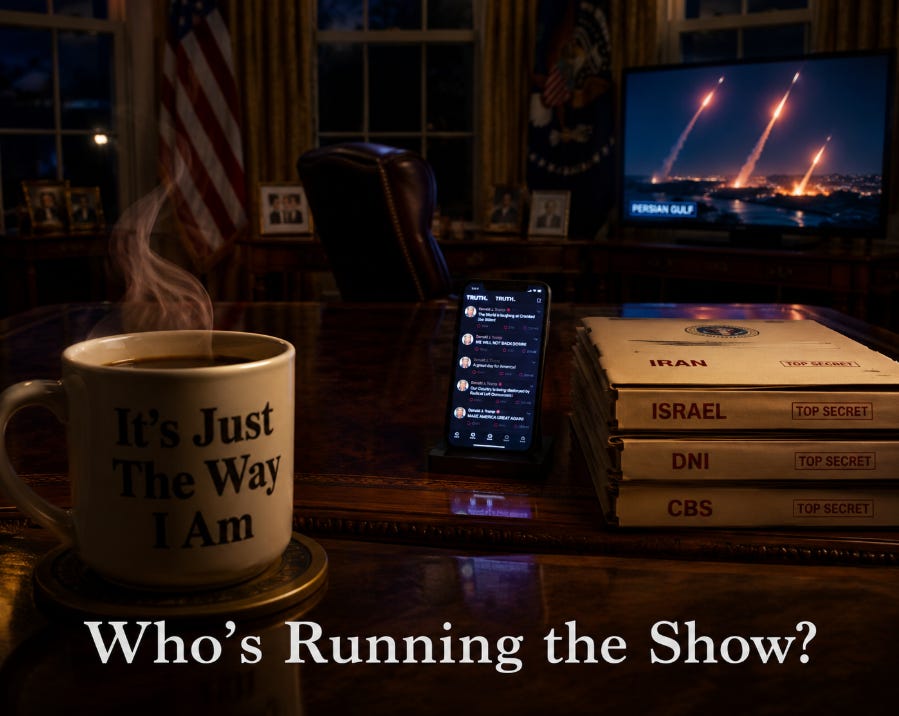
It turns out we now know what that mysterious pre-tape was. While reporters searched for clues, the White House had simply handed the president to Miranda Devine of the New York Post for the better part of an hour on her Pod Force One podcast, taped Tuesday afternoon in the Roosevelt Room and released the next morning. Trump said the quiet part out loud: “I shouldn’t be here right now. I’m supposed to be someplace else, but I’m doing it because it’s you.”
So the president wasn’t avoiding cameras. He was avoiding questions. That is a very different story, and frankly a more interesting one.
An hour of friendly airtime is not concealment; it is curation. Devine did ask questions, but they were the kind that hand the subject an exit rather than a challenge. When Trump described giving an answer and then revising it twenty minutes later, she offered him the flattering interpretation that this might be a tactic to keep the Iranians “off balance.” He declined the lifeline: “No, it’s just the way I am. It changes.” A president who will talk at length to the one interviewer guaranteed not to press him, while declining every venue where he might actually be pressed, is making a choice about accountability, not about visibility.
There is no evidence Trump is facing an imminent medical catastrophe. The physical released last month reported lab values within normal ranges, and the more lurid corners of the internet have gotten well ahead of what the record supports. But the questions about his fitness are not coming only from the fever swamp. Jonathan Reiner, the cardiologist who once cared for Vice President Cheney, has publicly flagged Trump’s repeat coronary scan and what he called episodes of excessive daytime somnolence, and has called for a bipartisan congressional inquiry into presidential fitness. In April, thirty-six physicians and mental health professionals, including specialists affiliated with Harvard, Columbia, Tufts, and George Washington, entered a statement into the Congressional Record invoking their professional duty to warn, arguing that the president’s condition has deteriorated and that the risk is uniquely acute because he remains commander in chief. They were careful to note they had not examined him. That caution is precisely what separates a serious intervention from a YouTube diagnosis, and it is why the questions deserve a hearing.
Which brings us to the issue. When the president becomes unusually scarce while simultaneously making decisions that affect wars, intelligence agencies, financial markets, and foreign governments, questions naturally arise. Those questions are what happens when the most powerful office in the world becomes harder to observe than Bigfoot, at a moment when the world seems determined to catch fire.
The so-called ceasefire in the Middle East remains one of the more impressive imaginary constructs in modern diplomacy. Overnight, the United States struck Iran’s strategic Qeshm Island. Iran answered with missiles and drones aimed at Kuwait and Bahrain. Kuwait now reports that a terminal at its international airport was hit, killing one person and wounding dozens, with significant material damage. The Revolutionary Guard has declared that the only safe passage through the Strait of Hormuz is the route it designates, and that any vessel violating it will be targeted. Oil has climbed past ninety-seven dollars a barrel. Regional governments are on edge.
All the while, Washington insists the ceasefire remains in effect. At this point the ceasefire exists primarily in official statements. On the ground, in the air, and at sea, several military organizations appear to be engaged in a spirited debate about that assessment using drones, missiles, artillery, and naval forces. The Wall Street Journal, no one’s idea of a partisan outlet, called it the most intense fighting in months and noted the obvious: the exchange began when the United States disabled an empty tanker it said was trying to breach the American blockade and load oil at Iran’s Kharg Island. The “self-defense strikes” came after. When the Journal and Al Jazeera independently describe the same contradiction, it stops being a partisan read and becomes simply the shape of the thing.
The Strait of Hormuz remains the economic tripwire. Every threatened tanker, every launched missile, every fresh warning from Tehran nudges the world one step closer to another inflation shock. If oil keeps climbing, this stops being a foreign policy story. It becomes a gas-price story, a grocery-store story, and finally a political one.
In the Devine interview, Trump offered his own assessment of all this, and it is worth setting beside the morning’s casualty reports. Iran’s military, he said, was “virtually wiped out” after three days of bombing back in February. That same wiped-out military killed a civilian at a Gulf airport overnight. He also confirmed, on the record, the blockade he called “amazing,” the same blockade whose enforcement set off this week’s exchange.
As if the picture weren’t complicated enough, Axios reported that Trump erupted at Benjamin Netanyahu during a recent phone call over Israel’s escalating operations in Lebanon, warning that further escalation could isolate Israel and derail the Iran negotiations. The quotes were colorful enough that they will not be repeated on Sunday morning television without extensive editing.
Trump confirmed the substance himself to Devine. Asked directly whether he had told Netanyahu, in essence, that he was crazy and that Trump had kept him out of jail, the president answered: “I did. I wouldn’t say angry. I was a little bit perturbed.” So the leak is no longer two anonymous officials; it is the president’s own account, with “perturbed” doing heroic work.
The significance is that Trump appears to be spending his time trying to stop one ally from blowing up negotiations with one adversary, while simultaneously trading fire with that same adversary in the Persian Gulf. Call it crisis management. It is worth noting, too, that even granting Trump’s telling, the Lebanese bombing continued anyway, including a strike that killed two paramedics in an ambulance in the Tyre district. The story the White House prefers is one of a president who reined Netanyahu in. The ordnance suggests the leverage has limits.
Which brings us to one of the more astonishing personnel announcements of the week. As missiles fly over the Gulf, Trump has named Bill Pulte to serve as acting Director of National Intelligence.
For those unfamiliar with Pulte’s national security credentials, that is because there aren’t any. He is a real-estate heir and the country’s housing finance regulator, having appointed himself chairman of Fannie Mae and Freddie Mac. What he does not possess is any background in intelligence, counterterrorism, military affairs, foreign policy, or espionage. The defense offered by the White House was not competence but proximity: Pulte is, in the words of one official, trusted by the president.
Housing finance today, the intelligence community tomorrow. By next week, perhaps the Secretary of Agriculture can oversee NASA and a golf course superintendent can run the Joint Chiefs.
The reaction was bipartisan, and the silence was the loudest part of it. Mark Warner, the ranking Democrat on the Senate Intelligence Committee, warned that Trump had chosen someone with a demonstrated eagerness to use the machinery of government for political retribution, not an idle charge, given that Pulte’s signature act as housing regulator was a mortgage-fraud probe of a Federal Reserve governor that became the pretext for an attempted firing. But the more telling response came from the Republican who chairs that same committee. Asked about Pulte, Tom Cotton offered four words: “I have no observations on the matter.” When the chairman of the intelligence committee cannot summon a single sentence in support of the new acting head of the intelligence community, the sentence he declines to say tells you everything.
Our colleagues across the Atlantic put it more bluntly, as foreign correspondents tend to when covering American affairs. Simon Marks, reporting for LBC from Washington, described a government with “no interest in qualifications” for a post like this one, where “the real qualification you’ve got to have is complete loyalty to the boss.” The studio summary was tidier still: reward loyalty, and excuse criminality where loyalty is part of the bargain.
The same pattern appears elsewhere. Todd Blanche has confirmed the administration is abandoning its proposed $1.8 billion “anti-weaponization” compensation fund. That is the good news, and the part Senate Republicans were happy to be seen opposing, freighted as it was with the prospect of paying January 6th defendants.
The bad news is the part that survives: the extraordinary agreement shielding Trump, his family, and affiliated businesses from ongoing IRS scrutiny of previously filed returns, a benefit, by one congressional estimate, worth around a hundred million dollars. The public giveaway gets dropped. The private benefit stays. Marks, again, cut to it from London: the immunity “may be far more valuable to him than that weaponization fund was ever going to be.”
Funny how that works.
Speaking of institutions under pressure, the biggest domestic story that may not yet be getting the attention it deserves comes from CBS News.
Veteran journalist Scott Pelley didn’t simply get fired. He detonated a grenade on his way out the door. In a written statement, Pelley accused new management of instructing him to inject falsehoods and unverified claims into politically sensitive reporting. He alleged that politicians had been invited to choose their own correspondents for interviews. He described, in his telling, a newsroom overtaken by incompetence and political pressure, and said the network’s new owner was casting the program aside “apparently to curry a moment of favor with the Trump administration.” These remain Pelley’s allegations, contested by a management that says he was fired for insubordination after a hostile staff meeting. But they are specific, and they are falsifiable, which is more than can be said for most exit statements.
Most strikingly, Pelley made these accusations in defense of a program that wasn’t failing. 60 Minutes remains one of the most successful broadcasts in television and just posted a nine percent jump in viewership. If the program wasn’t broken, why was it being fixed?
The view from abroad sharpens the question. Marks, reporting again for LBC, laid out a detail that answers the usual “we were only seeking balance” defense. When Sharyn Alfonsi’s investigation into the administration’s deportation flights to a Salvadoran prison was held back, the stated reason was that it needed a voice from the Trump administration. The administration had been asked for one, and had declined to provide it, and the piece stayed buried anyway. You cannot demand the other side’s participation as a condition and then shelve the story after that side refuses. Rather than an editorial standard, that is a pretext.
There is also a wrinkle that should concern audiences well beyond the United States. CBS remains BBC News’s formal American editorial partner, a relationship that involves sharing reporting resources and content. The BBC maintains its own extensive U.S. reporting operation, but it also relies on material produced by a network now facing serious questions about editorial independence. Whether those concerns ultimately prove justified or not, the potential consequences extend beyond CBS itself. Media capture rarely remains confined to a single institution. Through partnerships, syndication agreements, and shared reporting networks, the effects can ripple outward into organizations that never participated in the original bargain.
Students of democratic backsliding will recognize the shape of this. Media capture rarely begins with padlocks on newsroom doors. It begins with ownership changes, new management, editorial pressure, and the quiet removal of those who object. The institution remains standing. The logo stays the same. The audience may not notice anything different. Until, suddenly, it does.
It is worth adding that the man Pelley says CBS fired him to please spent Tuesday afternoon, in that friendly podcast taping, calling Pelley “a stiff” and “part of this gang of crooked, stupid people.” Whatever one makes of the timing, the alignment of interests is not subtle.
This is why independent journalism matters. Not because independent journalists are always right, and not because corporate journalists are always wrong, but because a healthy democracy requires multiple centers of information, multiple institutions capable of telling powerful people things they would rather not hear. When every institution begins bending toward political power, the public eventually discovers that reality itself has become negotiable.
There is plenty to say about yesterday’s election results, and we will. But they deserve a dedicated look rather than a paragraph wedged between missile exchanges and the dismantling of a newsroom. We’ll take that up separately in the coming days.
For now, the larger question remains. Who is running the show? Because from Washington to Tehran, from CBS News to the intelligence community, from the briefing room to the Strait of Hormuz, the people making the decisions seem increasingly insulated from scrutiny, even as the consequences of those decisions become harder and harder to ignore.
Stay safe out there. And keep asking questions, especially the ones nobody wants to answer.
Hi Mary, I just subscribed to your newsletter. I’ve been a free-loader for quite sometime and read what you have to say every morning after feeding my many Yorkies and one fat orange cat. Sometimes, it makes me sad to see how messed up our government has become under the direction of these powerful men. I worry about us older American citizens relying on our social security income. I worry about our children and young grandchildren who are facing a dismal future of uncertainty. And I’m shocked at the similarities of what is happening now in the United States to the history of Germany and the atrocities of Fascism. But, I pray we can stand up to these madmen and evil people and overcome the darkness with light. Thank you for all the work you do and May you be blessed with good health and the energy to keep reporting. Peace and love, Jeannie
The current administration is comprised of people so immoral, depraved, evil and despicable that they need to be voted out as soon as possible. However, the more I learn about the Democratic Party, the more I'm concerned about them regaining power. They don't seem to be making good choices and decisions in my view. I'm watching a few personal favorites who perhaps haven't shown all their cards yet, but I'm hoping there's a little integrity still floating around in the swamp.
I believe it's been made clear that PAC (Political Action Committee) financial support has to be 100% stopped. Corporate donations need strong and enforced rules. And personal donations need some form of scrutiny and approval. The point being no one should be able to 'buy' politicians ... and that's, of course, an impossible dream.
Tax amnesty for Trump, his family, and his businesses is as much a travesty as the $1.776B slush fund was. It deserves equal push back. I don't hear any indication that there is appropriate indignation about that.