


Good morning! Welcome to another episode of What Fresh Constitutional Fire Is This? Today’s theme comes courtesy of Donald Trump himself, who managed to summarize his governing philosophy with a clarity usually reserved for hostage notes and accidentally unmuted Zoom calls.
As Trump left for Beijing, a reporter asked whether Americans’ financial pain was motivating him to make a deal with Iran. Inflation is back. The war bill is exploding. Oil markets are twitching like a cat in a thunderstorm. And Trump’s answer was: “Not even a little bit.” Then, just to make sure nobody mistook cruelty for concision, he added, “I don’t think about Americans’ financial situation. I don’t think about anybody.”
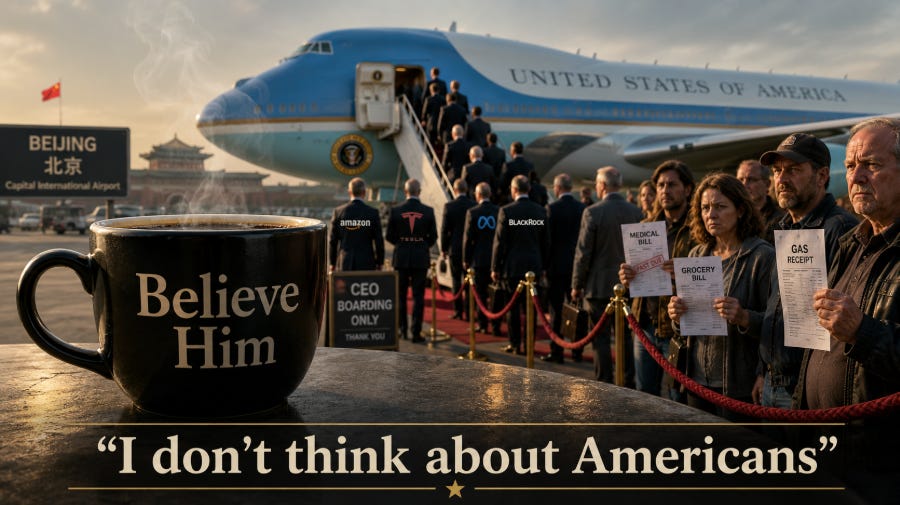
There it is. No need for a think tank panel. No need for a 900-page Project 2025 appendix. No need for a New York Times “five people familiar with the president’s thinking” reconstruction. The man just told us. He does not think about Americans. He does not think about anybody. He thinks about domination, revenge, personal enrichment, television lighting, and whether the new ballroom is big enough for the next autocracy cosplay gala.
Because subtlety is dead and buried somewhere under the East Wing rubble, Trump paired that declaration with another revealing performance: sneering at a Black woman reporter who dared ask about his White House ballroom project. “You dumb person,” he said. “You are not a smart person.” Then, because racism and misogyny apparently needed a cameo in the same scene, he added, “I know you don’t mind dirt.” The question was about cost, accountability, and hypocrisy. Trump answered by making it personal, which is what he does whenever the public money trail gets too close to his gold-plated comfort zone.
The timing would be stunning if we were still capable of being stunned. Trump made these remarks while threatening to restart the war with Iran if Tehran does not accept his terms. He insisted Iran is “very much under control” and said the U.S. would either make a deal or Iran would be “decimated.” This would be a little more reassuring if the administration’s own intelligence picture did not appear to be screaming into a pillow.
According to the New York Times, classified U.S. intelligence assessments say Iran still has operational access to 30 of its 33 missile sites along the Strait of Hormuz, retains roughly 70 percent of its prewar missile stockpile, still has about 70 percent of its mobile launchers, and has regained access to about 90 percent of its underground missile storage and launch facilities nationwide. Trump keeps saying Iran’s military is gone, while U.S. intelligence is apparently saying Iran still has missiles, launchers, underground facilities, and access to the oil chokepoint that helps determine what families pay to drive to work.
The sales pitch now goes like this: Iran is “decimated,” except not really. The war is “under control,” except the ceasefire is fraying. The enemy is finished, except it still has substantial missile capability. The president is protecting Americans, except he just said their financial situation does not matter to him. The intelligence community apparently missed the memo. Or read it, classified it, and watched it get ignored anyway in a White House press gaggle.
Alas, the bill is already here, and it is not written in invisible ink. The Pentagon now estimates the Iran war has cost about $29 billion, up $4 billion in two weeks. The Pentagon’s acting comptroller told lawmakers that the new figure includes updated repair and replacement costs and operational costs for keeping forces in the conflict zone. And that is before we even get to the fact that the administration’s record-setting defense budget request does not include the Iran war.
Pete Hegseth went to Congress to defend the budget and somehow managed to make “trust me, bro” sound like official Pentagon doctrine. Lawmakers pressed him on the supplemental funding request, the condition of U.S. munitions stockpiles, and how the administration plans to pay for more war. Hegseth refused to give clear answers on timing and objected to questions about depleted munitions, saying the issue had been “foolishly and unhelpfully overstated.”
This is the part where we are supposed to feel comforted, because the Pentagon has plenty of everything it needs, except answers, money, a strategy, a timeline, and maybe several years’ worth of critical munitions.
The Washington Post’s rundown of the hearings made clear that frustration is no longer confined to Democrats. Republicans joined in pressing Hegseth and Gen. Dan Caine about the war’s costs, the administration’s plan to reopen the Strait of Hormuz, and what exactly the endgame is supposed to be. Susan Collins said it seemed as though there had been “a different plan, almost daily.” Lindsey Graham complained, “No wonder this damn thing is going nowhere.” Rep. Ken Calvert asked for the supplemental request sooner rather than later. Rep. Harold Rogers warned that Iran does not need to be a peer military to cause serious problems, especially if the United States is burning through munitions and air defenses.
That last point should be engraved over the entrance to every hearing room in Washington: Iran does not need to defeat the United States to damage it. It only needs to make the war expensive, make the strait unsafe, make oil markets panic, and make the administration choose between escalation and humiliation. Not a glorious victory, but a trap with a Pentagon invoice attached.
The $29 billion estimate may still be understating the real cost. That figure does not include damage Iran has caused to American bases. A prior Washington Post analysis found Iranian forces had damaged or destroyed at least 228 U.S. structures or pieces of equipment since the war began, including aircraft, hangars, barracks, fuel depots, radar, and air-defense equipment. The invoice, in other words, has a second page.
Trump calls this “under control.” Congress, oil markets, U.S. intelligence, and basic arithmetic appear to disagree.
The regional picture is deteriorating in ways that make the domestic cost argument look almost quaint. A war fought over oil is now threatening to ignite the entire basin that produces it. The Guardian reports that the UAE secretly launched a major attack on Iran during the conflict, including a strike on Lazan Island shortly before the April 7 ceasefire, meaning one of the Gulf’s most consequential players may already be a retaliatory target if the ceasefire collapses. Kuwait has accused members of Iran’s Islamic Revolutionary Guards Corps of attempting attacks on Bubiyan Island, a strategically positioned piece of territory at the mouth of the waterway connecting Kuwait to the Gulf.
Saudi figures are now warning that a broader war could threaten oil facilities, desalination plants, the hajj, and the Vision 2030 projects that represent the kingdom’s entire bet on a post-oil future. That last detail deserves a moment’s pause. Threatening the hajj is not a diplomatic abstraction, it is potentially destabilizing to every majority-Muslim government in the world simultaneously.
The war Trump describes as clean, controlled, and basically won is metastasizing. The Strait remains closed. The Gulf states are being pulled in. And the ceasefire holding it all together was described by Trump himself as being on life support.
Now, because history has a sick sense of humor, Trump has arrived in Beijing. The Financial Times reports that he landed in China demanding that Xi Jinping “open up” China to American business. That, he said, would be his “very first request.” De-escalating Iran could wait. Stabilizing oil markets could wait. Reassuring Taiwan, untangling rare earths, managing AI chip competition, addressing the global economic fallout from his own trade chaos, all of it could wait. The first ask was for China to become more hospitable to corporate America.
Naturally, he brought along a billionaire sampler platter: Stephen Schwarzman of Blackstone, Larry Fink of BlackRock, Elon Musk, Tim Cook, Boeing’s Kelly Ortberg, Meta’s Dina Powell McCormick, and Nvidia’s Jensen Huang, among others. The summit is clouded by Iran, Taiwan, trade, tech, rare earths, and AI competition, but Trump’s public posture is basically: “President Xi, please open the market so these brilliant people can work their magic.”
Trump says he does not think about Americans’ financial situation. But he does think about Larry Fink’s, Stephen Schwarzman’s, Elon Musk’s, Tim Cook’s, Boeing’s, Meta’s, and Nvidia’s. Those financial situations made it all the way onto Air Force One.
The Nvidia detail is especially instructive. Jensen Huang was reportedly not on the original list of business leaders traveling to China. Then Trump saw reports that Huang was not coming, called him, and invited him personally. Huang flew to Alaska and boarded Air Force One during a refueling stop because the presidential aircraft now offers emergency pickup service for semiconductor executives with China-market dreams.
This is not just weird optics. Nvidia’s chips are central to the global AI race, and sales to China have been a major national-security flashpoint. Huang has spent nearly a year lobbying officials in Washington and Beijing to allow Nvidia to sell AI chips to China. Trump previously approved sales of an older generation of Nvidia chips and even planned for the U.S. government to take a cut of those sales, though Beijing has not approved the purchases. Some Republicans and administration officials have pushed back against more advanced chip sales for national-security reasons.
Air Force One apparently had time for a midair pickup of the Nvidia CEO, but Trump had “not even a little bit” of time to think about Americans paying war-inflated gas prices.
Then there is Hegseth’s presence in Beijing, which already felt unusual because the Financial Times notes he is the first U.S. defense secretary to accompany a president on a China trip. Under a different administration, that would be a significant diplomatic signal. Under this one, it arrives with a large side order of crusader cosplay.
The Guardian reports that Hegseth is scheduled to headline a National Mall faith rally this weekend alongside far-right and Christian nationalist figures, including speakers who have called the Democratic platform “demonic,” defended torture, promoted election-denial rhetoric, and said they would die in the fight to overturn the 2020 election. The lineup reportedly includes no Muslims, no representatives of historically Black churches, no Indigenous faith leaders, and no mainline Protestants.
The same reporting notes Hegseth’s own writings foreground anti-Muslim rhetoric, crusader imagery, and the idea of a U.S. military “taking sides” in a coming American civil war. He has hosted monthly Christian prayer services at the Pentagon, and during one service after the Iran war began, he prayed that God would “break the teeth” of U.S. enemies.
So the man Trump brought to Beijing to project credibility is also widely regarded as the least qualified person ever to hold the office, a defense secretary who spent Tuesday stonewalling his own party’s appropriators about war costs and munitions levels, and whose weekend calendar involves headlining a Christian nationalist rally on the National Mall. The same administration is threatening to restart bombing Iran, insisting the enemy is “decimated” despite intelligence suggesting otherwise, and asking Congress to fund a conflict it still cannot explain.
Trump brought CEOs to Beijing to sell access. He brought Hegseth to sell strength. But Hegseth’s weekend schedule suggests something else entirely: this administration is not just militarizing foreign policy. It is consecrating it.
Trump’s own financial situation, meanwhile, appears to be receiving very careful attention. The New York Times reports that Justice Department officials are discussing a potential settlement of Trump’s lawsuit against the IRS, which could involve the government providing taxpayer funds or another public benefit to the president. One possible term under review: the IRS dropping audits of Trump, his family members, and his businesses.
Read that again slowly, preferably away from sharp objects. Trump sued the IRS, an agency he now oversees. His own Justice Department is reportedly exploring whether to settle the suit. One option under discussion could protect Trump and his family businesses from audits. IRS procedures call for mandatory audits of the president and vice president’s annual tax returns, and federal law prohibits a president from ordering the start or conclusion of an audit of a specific taxpayer.
The judge overseeing the case has not been passive about any of this. She has already questioned whether a genuine legal controversy can exist when Trump controls the agency he is suing, appointed six independent lawyers to investigate the conflict of interest, and set a hard deadline requiring both sides to explain whether they are genuinely in conflict. According to the Times, officials have been exploring a settlement before that deadline arrives, which would allow the arrangement to take effect before she can rule on whether the lawsuit is even legitimate.
Trump does not think about Americans’ financial situation. He does, however, appear deeply invested in Trump’s financial situation. Funny how that works.
Because no Trump-era news day is complete without a senior official turning congressional oversight into community theater for grievance addicts, we also have Kash Patel. We have not picked on Kash in a while, and thankfully Congress remembered to check whether the FBI director was still out there doing FBI-director-adjacent things.
Patel was pressed at a hearing over allegations about excessive drinking, unexplained absences, and his conduct at the bureau. Rather than projecting calm institutional leadership, he denied the allegations, pointed to his lawsuit against The Atlantic, and turned the exchange into another MAGA grievance scrum. This is apparently what passes for reassuring the public that the FBI is in steady hands: less J. Edgar Hoover, more podcast host who just found out the green room ran out of Celsius.
Kash deserves his own section today because he is not merely comic relief. He is part of the larger pattern. These people treat oversight as a personal insult. Hegseth cannot explain the war bill. Trump insults reporters who ask about public spending. The Justice Department may settle Trump’s personal IRS suit. Kash Patel gets questioned by Congress and responds as if accountability is a form of targeted harassment. The FBI director was there to justify his budget. He left reminding everyone why oversight exists.
Which brings us, mercifully, to Heather Cox Richardson, who has been saying out loud what a lot of us have been watching with increasing alarm: Trump is not okay. She pointed to his overnight posting patterns, the AI slop, the obsessive demands for arrests, the fixation on the Russia investigation, and the way he keeps circling back to the people who exposed or investigated his ties to Russian operatives.
That observation matters because this is not gossip. Whether the person threatening to restart a war with Iran, flying to Beijing with billionaires, and brushing off Americans’ financial pain is operating from anything resembling stability is not a parlor game. War powers depend on it. Markets respond to it. And the people of Tehran, sleeping in parks because they cannot distinguish earthquakes from airstrikes, are living inside the answer.
HCR’s broader question is even more important: why are Republicans still going along with this? Her answer cuts past the usual excuses about primaries and mean tweets. She argues that Republicans still clinging to Trump have accepted the idea that Democratic governance itself is illegitimate, that if majorities elect Democrats, that outcome must be blocked, undermined, or structurally prevented.
That is the connective tissue between Trump’s redistricting brag, his openness to sending National Guard or ICE to voting locations, his terror of a Democratic House with subpoena power, and the GOP’s willingness to keep funding the whole circus. They are not waiting for Trump to become normal. They are trying to preserve power long enough to make normal voters irrelevant.
HCR also ties the economic story together: the Iran war, Trump’s ballroom, tax cuts for the wealthy, cuts to Medicaid and SNAP, the rising debt, and the larger question of what Republicans are doing with public money. That question may define the summer. Americans are being asked to pay for the war, pay for higher gas prices, pay for the debt from tax cuts for the rich, brace for cuts to programs they rely on, and somehow also pay for Trump’s vanity projects and personal legal escape hatches.
Trump said he does not think about Americans. Today’s news is the receipt.
Fuel prices are up and the war bill is climbing, but Americans are not on his mind. The Pentagon dodges questions about munitions and costs, but Americans are not on his mind. Iran retains most of its missiles and the Strait stays closed, but Americans are not on his mind. He boards Air Force One with billionaires and flies to Beijing to open markets for corporate America, but Americans are not on his mind. His Justice Department quietly explores a settlement that could immunize him from financial scrutiny, but Americans are not on his mind. His party rigs maps, dodges oversight, and works methodically to make democratic accountability harder to enforce, but Americans are not on his mind.
Trump finally told the truth. He does not think about Americans’ financial situation. The only surprise is that anyone in his party still thinks Americans will not eventually notice who keeps getting the plane rides, the settlements, the ballroom, the market access, and the protection, and who keeps getting the bill.
I'm not even going to ask if this can get more disastrous. Of course it can.
Worrying about the Maggots, David is a waste of time. There are so many more of the rest of us and that is what matters. Getting all of us motivated, activated and using our collective anger to turn this ship around is where our attention should be razor focused. Justin Pearson, Tennessee representative, gave a fiery speech a few days ago regarding the massive gerrymander there in particular to Memphis, that should anyone not have seen/heard it, should! It will inspire the will to fight for what is right and not back down. Look him up and "We Are Still Here". It is riveting!! So, make calls, write emails, protest even if there isn't an organized event, don't be silent!!! It is up to us. This is OUR AMERICA!!!! We must fight for our freedoms, the right to vote for everyone, and a government that is by and for the people!! NO TO FASCISM!!!!!!!!!