

Good morning! The line of the morning belongs, as so many cursed relics of this era do, to Donald Trump. Asked about his new framework with Iran, the president offered what may be the most honest summary yet of his foreign policy doctrine: “Nobody knows what it is, but it’s very strong.”
He meant the Iran deal. He could have meant the G7. He could have meant the American alliance system, or the entire operating theory of the postwar order, now wobbling along under the management of men who keep calling a memorandum an achievement because the alternative is admitting the superpower has become a vibes-based protection racket.
Trump’s bilateral with Egyptian President Abdel Fattah el-Sisi was billed, at least notionally, as a discussion of Egypt, the Nile, and the Grand Ethiopian Renaissance Dam. It began there, briefly. Trump said Egypt had been treated “very unfairly” over the Ethiopian dam, complained that “the Nile is getting a little emptier than it should be,” and insisted he had once had the whole thing settled before, naturally, a “rigged election” ruined everything. It is always important, when discussing one of the world’s most delicate transboundary water disputes, to remember that the true upstream actor is Joe Biden.
Sisi, for his part, performed the familiar diplomatic incense ritual. He praised Trump’s “marvelous management” of the Middle East crisis, congratulated him for “restoring peace,” thanked him for understanding Egypt’s position on the dam, and then noted that world leaders had surrounded Trump at dinner and barely let him enjoy his meal. Trump accepted this observation in the spirit intended: as confirmation that he was the human centerpiece around which the summit revolved, a kind of all-you-can-eat buffet of deference.
From there, the meeting veered into the Iran framework, where Trump explained that the deal was “very strong,” that Iran would “never have a nuclear weapon,” that the market loved it, that oil had come “tumbling down,” and that the Strait of Hormuz would be fully open in the next day or two. Details, as ever, were for smaller men. “Nobody knows what it is,” he said, “but it’s very strong.” This is the kind of sentence that should be engraved over the entrance to the second Trump administration’s Situation Room.
It was also the sentence that explained the G7. The leaders gathered in France were not dealing with a hegemon in the old sense. A hegemon supplies order. It disciplines allies and adversaries alike through predictability, capacity, and a credible commitment to the system it dominates. What Europe encountered instead was something stranger and more degraded: a former hegemon still strong enough to wreck the room, no longer steady enough to organize it, and sufficiently pleased by applause that everyone spent the summit trying to keep the chandelier from falling by complimenting the arsonist on his lighting design.
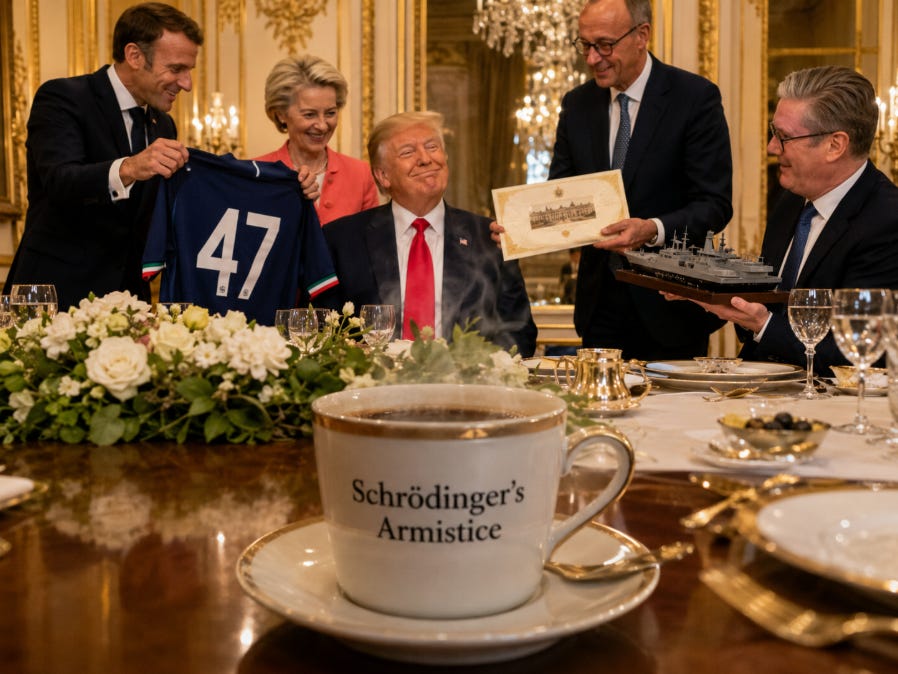
That is the real meaning of the flattery. Chancellor Friedrich Merz presented Trump with a soccer jersey numbered 47 and announced that they were “on the same team.” Emmanuel Macron dangled a Versailles dinner, a gesture so subtle it arrived wearing ermine. Ursula von der Leyen congratulated Trump on a framework whose text he still has not released, calling it proof that “that’s how diplomacy delivers,” while conceding in the same breath that it might “perhaps even ultimately” address the nuclear question it was supposedly launched to resolve.
Call it appeasement of a demolition crew. Europe is not flattering Trump because America remains the indispensable organizer of the system. Europe is flattering Trump because America remains indispensable to the system’s collapse. The United States is no longer reliably hegemonic, but it is still catastrophically load-bearing. It cannot necessarily build the bridge; it can still cut the cables. It may not guarantee European security; it can still blow a hole through it. It may not be able to impose regional order in the Middle East; it can still start a war, half-finish it, declare peace, and leave everyone else to find the mines.
That is what made the Hormuz cleanup so revealing. Trump spent the week describing the Strait as already open, toll-free, and permanently secured. Meanwhile Macron and Starmer were pledging minesweepers to help reopen it, which suggests that reality, stubborn little Marxist that it is, had not received the president’s press release. The allies are quietly absorbing the labor of making Trump’s triumph function. They are dressing repair work as respect. They are treating the mess as a joint success because saying “cleanup” would imply someone made it.
The cleanup is not buying the pivot Europe needed. The entire hope behind the G7 courtship was that praise might be converted into policy: indulge Trump on Iran, applaud the framework, help stabilize Hormuz, and perhaps in return get him to move on Ukraine or pressure Moscow. But there was little evidence of that. Trump again described Ukraine as distant, someone else’s problem, “thousands of miles away,” while reserving his warmth for the Gulf leaders who backed the Iran campaign rather than the Europeans absorbing its consequences.
General Sir Richard Shirreff warned this week that Europe needed to use the summit to tell Trump plainly that he had blundered in Iran and that allied help came at a price: support for Ukraine, pressure on Russia, seriousness about the security order he keeps treating like a subscription service he forgot to cancel. His fear was that the G7 would instead dissolve into “pussyfooting to placate Trump,” a tableau of leaders flattering him just enough to keep him in the tent until the criticism passed. The bleak update is that even this may have overestimated the leverage of flattery. That is Shirreff’s worst case with one final turn he did not name: the allies pay the tribute, and still do not get the bargain.
All of this would be merely grotesque if the Iran framework itself looked stable. It does not. Trump said the memorandum is not final. He said if he does not like it, the United States will “go back to shooting” at Iran and “dropping bombs on their head.” So the ceasefire is not peace; it is a probationary pause enforced by the president’s mood ring. Iran is supposed to “behave,” a word Trump used with the tone of a landlord discussing a tenant, while the world is supposed to treat the arrangement as a diplomatic breakthrough because equities rallied and oil futures unclenched.
The problem is that the deal appears to rely on ambiguity as its main adhesive. Washington gets to say Iran will never have a nuclear weapon. Tehran gets to say the blockade is lifting and Hormuz is reopening. Markets get to say supply is coming back. European leaders get to say diplomacy worked. Trump gets to say he dominated. Everyone gets a trophy, provided nobody reads the card too closely.
Lebanon is the fuse. Iran has accused Israel of dozens of truce violations and warned of a harsh response if attacks continue. Israeli strikes in southern Lebanon have reportedly slowed but not stopped. Families are trying to return to shattered villages while drones and artillery remind them that ceasefires in this region often arrive with footnotes written in shrapnel. The Trump administration wants the Iran framework to stand as proof of presidential mastery; Israel appears to be testing whether it can make facts on the ground outrun the text no one has seen.
Inside Israel, the reaction has been almost as telling as the agreement. Officials are reportedly describing a “crisis of trust” with Washington, with concern that the United States is withholding details of the deal for fear Israel might leak them or mount a campaign against them. Danny Danon, Israel’s ambassador to the United Nations, called the agreement “very bad” for Israel. The fear in Israeli security circles is that the framework may require a fuller withdrawal from southern Lebanon than the Israeli army is prepared to carry out.
So here is the shape of the triumph: Iran is conditionally pacified, unless Israel keeps striking Lebanon; Israel is supposedly America’s closest regional ally, unless Washington is hiding the text from it; Europe is applauding diplomacy, while sending equipment to clean up the battlefield; and Trump is promising peace, unless he decides to resume bombing. Nobody knows what it is, but it’s very strong.
The same moral architecture is visible at home. The Guardian reports that January 6 defendants, including men convicted of assaulting police officers, are pursuing millions of dollars in claims through the Federal Tort Claims Act. The Trump administration’s proposed $1.776 billion “anti-weaponization fund” drew bipartisan backlash, especially from Republicans who did not particularly want to explain to their constituents why taxpayers should compensate people caught on video attacking cops. But the project may not be dead. It may simply have found a quieter pipe.
The FTCA route has the advantage of looking boring. It converts the question from “Should violent January 6 defendants receive government payouts?” into “How should the Justice Department handle individual tort claims?” That dullness is the disguise. The same administration that pardoned these defendants may now have discretion over whether to settle with them. So far that discretion cuts both ways: in at least one case, that of a man sentenced to six years for assaulting police with bear spray, the Justice Department is contesting the claim and seeking dismissal. But discretion that can be exercised is also discretion that can be withheld, and the department has already shown it will decline to defend the government when the plaintiff is the president himself, when Trump sued the IRS for $10 billion, the justice department did not contest the suit. The same Judgment Fund that would have supplied the abandoned slush fund can, in theory, be reached through claims dressed in the beige cardigan of administrative process.
This is the domestic version of the same inversion. Rioters become victims. Prosecutions become torts. Pardons become down payments. A failed public slush fund returns wearing a suit and carrying a form. Not every claim will succeed; the department is fighting some of them, but it has been invited to choose which of the president’s friends it stops defending itself against. The shield is discretionary, which is the point of it.
Taken together, the morning’s stories are are about the redistribution of consequence away from the people who caused the damage and toward the institutions still trying to function around them.
Europe cleans up the Strait of Hormuz and calls it alliance management. Prosecutors may be asked to compensate men they once convicted and call it justice. Markets reward an Iran deal no one has seen and call it confidence. Trump threatens to resume bombing and calls it peace. The United States no longer behaves like a hegemon, but it still demands hegemonic tribute. It no longer reliably supplies order, but it can still punish those who refuse to pretend it does.
That is the actual post-hegemonic bargain on display: America cannot be trusted to lead, but it is too dangerous to ignore; too erratic to follow, but too powerful to abandon; too diminished to command the old obedience, but still capable of making everyone pay for its improvisations. So allies flatter. Markets cheer. Lawyers file. The president boasts. And the system, having lost the empire’s discipline, keeps paying the empire’s maintenance fees.
Nobody knows what it is. But apparently, it’s very strong.
You wisely acknowledge that Trump unhinged, with Congress and the Supreme Court majority in his pocket, still has the power and derangement to blow the whole world up should he become too bored with “peace” abroad and smash-and-grab governance at home.
Nonetheless, the G7 fawners and ring kissers are wrong to appease him - their hypocritical shows of respect are weakness to him and everyone else. Hitler held the same sway over other governments in his day, and how did that work out? Megalomaniacal sadists like Trump require resolute pushback without flinching. The only true leader on the planet currently is Ukraine’s Zelensky.
As usual, a perfect description of the NOW we find ourselves in...
They should teach your substack essays in journalism school as the best example of political commentary--or least there should be some kind of prize (a la The Edgar or The Booker) for the kind of writing you do: "The Menckie"..?
So, obviously, at this point we all understand that Trump is a sleazy, lying, impulsive, immoral gambler--which seems fitting for a former owner of casinos, if not exactly for the elected leader of a major world power with nuclear weapons... Of course, you'd expect a gambler to use insider information whenever he can get it, and The Don (and his twisted children) DO use insider info to make their illegal/immoral billions--
And it remains vitally important for commentators like you to keep calling Trump and his henchmen on their many crimes—can’t let that go… For you and the rest of us to give up—give in to moral fatigue, would be just what these criminals want—so we have to keep calling them on their manifold sins..
But I want to offer a suggestion… At this point in the big carny show, is it possible NOT to act/say/write that we are “surprised” by Trump’s immoral, insane behavior? –That it’s “shocking” when we see him bend, break and ignore all civilized rules of behavior?
In a way, this “surprise” and “shock” implies a certain foolish naivete—and even signals a weird kind of acceptance in the game Trump is playing… He NEEDS us to be constantly shocked that he acts the way he does. If he was routinely treated as an inmate on locked ward or a child who needs to spend some time in his room, we'd all be better off...
I think the best solution is the one you’ve arrived at in your column—a combination of somewhat ironic but still morally offended, modified outrage—You report the facts and his words/behavior with some amusement, but never lose track that he is, essentially, lying—that he is an overgrown sadistic child who lies whenever he opens his mouth. … What I’m suggesting is not giving in to Trump derangement syndrome—but always reminding people that He is the one who’s deranged and we are the ones keeping the grown-up boat afloat and headed toward the coast of sanity…