


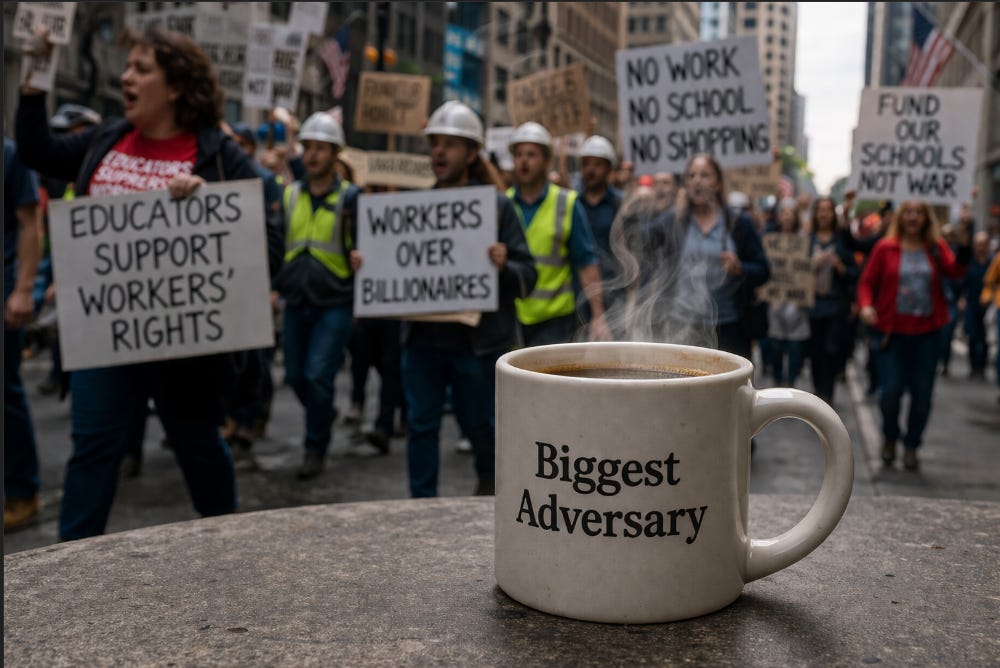
Good morning! May Day arrives this year not as a quaint nod to labor history, but as a live experiment in what happens when the people who actually keep the system running decide, at least for a day, to stop. Across the country, more than 500 unions, student groups, and community organizations are calling for no work, no school, and no shopping, a coordinated refusal aimed squarely at what organizers describe as a billionaire takeover of government. Tens of thousands of students are expected to walk out, entire school districts are closing because staff won’t show up, and the message, subtle as a brick through a boardroom window, is that the economy isn’t some abstract force of nature. It’s people; and people have agency.
If there’s a single thread running through everything this week, war, profits, policy, and now protest, it’s this: we have built an economy, and increasingly a government, that treats extracting value as the highest form of intelligence and contributing back as optional. We celebrate the cleverness of paying as little tax as possible, we admire the efficiency of squeezing costs out of supply chains, and we reward the ability to turn public systems into private gain. Every so often, reality taps us on the shoulder and says: you do realize someone has to pay for all this, right?
Enter economist Richard Wolff, who, politely, methodically, and with the patience of someone who has watched this movie before, points out that what we’re experiencing isn’t a mysterious breakdown. It’s the bill coming due. For decades, corporations chased profit by stretching production across the globe, building long, fragile supply chains not because technology required it, but because labor was cheaper elsewhere and profits were higher. As Wolff put it, “This is a wonderful example of what in economics is called the difference between private cost and social cost.” The catch? Corporations didn’t account for the costs they didn’t have to pay: political instability, environmental damage, chokepoints like the Strait of Hormuz, or what happens when a war interrupts the whole delicate arrangement. “The corporation doesn’t do that because it doesn’t count the costs it does not have to cover,” Wolff explained. Those costs didn’t disappear; they were outsourced to all of us.
Now we’re living with it. Energy shocks ripple through economies, fertilizer prices spike, food costs rise, industries stall, workers lose jobs, and suddenly the “efficient” system looks a lot like a house of cards built on the assumption that nothing would ever go wrong.
This is the oldest trick in the book: privatize the profits, socialize the risk. When the bets pay off, the gains flow upward. When they don’t, when the supply chain snaps, when the climate bill comes due, when the war drives up energy prices, the costs are distributed across everyone who didn’t get a dividend check.
Which brings us to oil. While households are adjusting to higher prices, cutting back, and discovering new and exciting ways to make pasta feel like a luxury item, oil and gas companies are having what can only be described as a banner year. War has been very, very good for business. Profits are soaring, dividends are rising, and buybacks are doubling, all thanks to an energy shock driven by conflict in the Middle East. Naturally, this has revived calls for windfall taxes, those radical, borderline unthinkable ideas where companies that profit from global crises might be asked to share a portion of those gains with the people absorbing the damage. European finance ministers argued that such a tax would “send a clear message that those who profit from the consequences of war must do their part to ease the burden on the general public.” Industry, predictably, is horrified: BP’s chief executive called a broader windfall tax a “highly flawed response” to the war in Iran.
Nothing says “free market” like insisting profits are sacred but losses are a group project. And just in case anyone thought this dynamic was limited to corporations, Washington is here to remind us that the same logic applies at the highest levels of government.
Today marks the 60-day deadline under the War Powers Resolution for Congress to authorize the use of force in Iran. You may remember Congress, the branch of government theoretically responsible for declaring war. Their response to this looming constitutional moment? They went on vacation. Republicans, after weeks of mild throat-clearing about oversight, have decided to defer to Trump, while the administration argues that the law doesn’t apply because the war is… vibes-based, apparently.
Defense Secretary Pete Hegseth offered the administration’s magical pause-button theory: “We are in a ceasefire right now, which our understanding means, the 60-day clock pauses or stops.” Sen. Susan Collins, to her credit, was not buying the constitutional jazz hands, warning that “the president’s authority as commander-in-chief is not without limits,” and that the 60-day deadline is “not a suggestion, it is a requirement.” Sen. Adam Schiff was even more direct: “Ceasing to use some forces while using others does not somehow stop the clock.”
It’s a bold legal theory: if you simply redefine reality, accountability disappears. Not everyone in Congress is thrilled with this approach, but enthusiasm for actually doing something about it remains… limited. Rep. Adam Smith captured the mood with bleak efficiency: “Is the expectation that the Trump administration is going to follow the law? I do not have that expectation.” Which is how you end up with a system where corporations don’t pay for the risks they create, and the government doesn’t enforce the laws that are supposed to constrain it.
There was at least one room in Washington yesterday where someone tried to ask questions. If Pete Hegseth thought the Senate would be a friendlier stage, someone forgot to tell the senators. What started as a routine pitch for a $1.5 trillion “Department of War” budget quickly unraveled into a full-blown credibility audit, with Democrats, and a few increasingly uneasy Republicans, methodically dismantling the administration’s “historic success” narrative. The problem, as Sen. Jack Reed put it with admirable restraint, is that the war Hegseth keeps describing doesn’t appear to exist anywhere outside his talking points. Reed called Hegseth’s claims “dangerously exaggerated” and went further, accusing him of telling Trump “what he wants to hear instead of what he needs to hear,” with “bold assurances of success” that do a disservice to both the commander in chief and the troops risking their lives. Sen. Elissa Slotkin put it more plainly: “Until the Strait of Hormuz is open, I don’t think we can credibly say that with any seriousness.” The regime is intact, the nuclear program remains viable, Americans are paying at the pump, and Hegseth insists the real problem isn’t the strategy, the costs, or the outcomes, it’s the critics. As he put it, the “biggest adversary” is the “defeatist words of congressional Democrats and some Republicans.” A bold position for anyone, but it lands a little differently when you’re asking Congress to hand you roughly $1.5 trillion and not ask too many follow-ups.
Then there’s the part where things went from uncomfortable to genuinely alarming. Asked by Slotkin whether he would refuse an illegal order to deploy troops to seize ballots in a future election, Hegseth tried to dodge, deflect, and finally landed on the carefully lawyered, “I’ve never been ordered to do anything illegal and I won’t,” which is not exactly the ringing defense of constitutional limits one hopes for from a Defense Secretary. Sen. Mark Kelly pressed him on his “no quarter, no mercy” rhetoric, reminding him that under the Pentagon’s own law-of-war framework, “no quarter” means legitimate surrender can be refused or detainees executed. Hegseth would only say, “We fight to win and we follow the law.” By the end, the through line was hard to miss: a secretary far more comfortable projecting strength than explaining strategy, far quicker to attack critics than answer questions, and now asking to manage a budget so large it requires commas most of us don’t use in daily life, while treating basic oversight like a hostile act.
This is what “billionaire takeover of government” looks like when you zoom in past the slogan and into the spreadsheet. And if you are looking for a cleaner, almost textbook example of how all of this comes together, public power, private gain, and the polite fiction that none of it is connected, you don’t have to look much further than Kazakhstan.
A shell company backed by Donald Trump Jr. and Eric Trump has merged into a mining venture tied to up to $1.6 billion in U.S. government-backed support for tungsten extraction, a resource suddenly very important to national security. The timeline is… tidy. Investment, merger, government backing, strategic asset. And while there is, of course, “no suggestion” that anyone knew anything or influenced anything, the company’s CEO has already credited direct assistance from Trump and top officials in securing the project.
The phrase “no suggestion of wrongdoing” starts to feel like a legal incantation, something you say out loud in the hope that reality will politely comply.
There’s a version of this story where the billionaires are the protagonists, the builders, the job creators, the indispensable engines of everything. It’s a compelling narrative, and they’ve spent considerable money making sure you’ve heard it. But today offers a useful corrective.
The fruit gets picked, the patients get treated, the children get taught, the trucks get loaded, the power stays on, and the country functions because of people whose names don’t appear on Forbes lists. Not because of the people who own the orchards, the hospitals, the school management companies, or the logistics platforms, but because of the people who actually show up every single day. When they don’t, as today is demonstrating, the machine doesn’t run itself. It just stops.
The oligarchs have money, influence, lawyers, lobbyists, and a surprisingly large number of senators. What they don’t have is the ability to pick up and run the country without the people they’ve spent decades telling don’t have power. May Day exists, has always existed, to make that point visible, to turn an invisible truth into an undeniable one, at least for a day.
After a week of war profiteering, fragile systems, vanishing accountability, and increasingly creative interpretations of both law and reality, people across the country are being asked to do something remarkably simple: stop.
No work. No school. No shopping. Three words that, taken together, are a minor inconvenience or a fairly precise description of what keeps the whole arrangement running, depending on which side of a dividend check you’re on.
More than 500 unions, student groups, and community organizations are behind today’s actions, coordinated under the banner of May Day Strong, with over 3,000 events planned from Los Angeles to Boston. The demands are specific: tax the rich, abolish ICE, end the war, protect the vote, keep billionaires out of the machinery of government. But underneath the platform is a simpler argument, if the economy depends on labor, consumption, and compliance, and it does, then withdrawing all three, even briefly, is more than symbolic. It’s a reminder. A correction. A moment where the abstract becomes concrete.
We’ve spent years normalizing a system that privatizes profit and socializes risk. The people marching today didn’t invent that critique; they’re just the ones currently absorbing the bill for it — in gutted schools, in ICE raids on their neighbors, in healthcare priced like a luxury item and wages priced like an afterthought.
The question May Day is asking, quietly in some places, loudly in others, is what happens when the people carrying that risk decide they’ve had enough.
Maybe this is why I keep coming back to the language of vassals and vassal states, a framework I’ve been wrestling with for weeks now. I finally started reading Yanis Varoufakis’ Technofeudalism: What Killed Capitalism for research, which has of course triggered the inevitable round of edits in my draft, because I enjoy giving myself homework, it seems.
Once you start looking through that lens, the pattern is hard to unsee. Workers become disposable inputs. Nations become resource territories. Public institutions become enforcement arms for private wealth. The powerful extract rent, demand loyalty, and call it freedom.
Maybe May Day is not just about labor in the narrow sense. Maybe it is about refusing the role assigned to us in this new feudal order: taxpayer, consumer, worker, subject, collateral damage. Maybe it is about remembering that the people being asked to absorb the risk, pay the bills, fight the wars, staff the schools, stock the shelves, drive the buses, and keep the lights on are not serfs. If the lords of extraction have forgotten that, May Day seems like a very good time to remind them.
Marz and I send our love and appreciation for you all.
We all have hands on a huge economic cudgel— we need to pay for mortgages, utilities, groceries, medications — the things we truly need to survive. But how much of our monthly spending goes to real needs? Streaming services, new clothing, meals at Cracker Barrel, Olive Garden, McDonald’s and hundreds of other corporate chains, sports tickets, movie tickets, golf memberships, more junk plastic toys for the kids, and dozens of other things we spend money on out of choice. Or boredom. Most of that money goes right into the pockets of execs and shareholders. If millions of us stopped that spending, even for a month, the loss of profits would be felt and might help to get bigger, wealthier voices sounding off to Washington. It takes a small bit of effort to search out the truly independent merchants in our communities and spend money with them if we need to spend. Those merchants and their employees will be genuinely grateful. Use the public library. Walk or bike in parks and on trails and enjoy the peace and beauty. There are many free options for entertainment and fitness. We did something similar last year, on a smaller scale, to protest DEI obliteration— let’s do it again —“bigly”— to show we don’t accept rule by the oligarchy but demand to live with our constitutional rights protecting us.
I've gotta get dressed to go march. Thanks for reminding me of the reasons I'm putting on my most comfortable shoes.