


Donald Trump’s seizure of Nicolás Maduro was supposed to be a moment of dominance, a choreographed spectacle of American power, a perp walk broadcast to the world, a president once again pretending to be the sheriff of the hemisphere. Instead, it has become an object lesson in what happens when imperial impulse collides with incompetence, when bravado substitutes for strategy, and when a kakistocracy mistakes coercion for foresight.
The administration’s original claim was breathtaking in its candor. Trump said the United States would “run” Venezuela. Not influence it, not pressure it, not guide a transition, run it. Thirty million people, a sovereign nation, reduced to a management problem. Oil flows would be arranged, leadership would be selected, and the rest would simply fall into line.
Within hours, senior Republicans were scrambling to walk it back. Marco Rubio insisted there was no invasion, no occupation, no war. Tom Cotton said there were “questions to be answered.” Jim Jordan reassured the public that he trusted Trump’s instincts, which is more of a confession than a defense. The phrase “we will run Venezuela” was suddenly treated like a verbal typo rather than the most honest articulation of the administration’s worldview.
For those applauding the removal of Nicolás Maduro, it’s worth pausing to note what has actually happened. The United States did not end dictatorship in Venezuela; it simply swapped one strongman arrangement for another, but this time thinking Washington held the leash.
Reality asserted itself in Caracas almost immediately. Much of Maduro’s security detail lay dead. The Venezuelan military activated nationwide. Delcy Rodríguez, a loyalist technocrat quietly floated weeks earlier by U.S. officials as a “workable” successor, was recognized as interim president by the defense minister. Not as Washington’s proxy, but as the face of a regime now rallying around the language of sovereignty and resistance to imperial attack.
The result was not relief or renewal, but fear. Streets emptied, and supermarkets filled, and parents kept children home. Rumors of a second wave spread faster than facts. Across the border, Colombia mobilized troops in anticipation of instability and refugees. This is what “stability” looks like when it’s imposed at gunpoint.
The White House, seemingly stunned that kidnapping a head of state might provoke complications, quickly pivoted from triumph to threat. Rodríguez was warned she would “pay a very big price” if she failed to accommodate U.S. demands. Fifteen thousand American troops were kept on standby in the Caribbean. A naval “quarantine” was announced to choke Venezuela’s oil exports until compliance was achieved.
Elections, it turned out, were not part of the immediate plan. Democracy would have to wait. Order first, and sovereignty would be conditional. Freedom, as always, would be delivered at some later, unspecified date, once everyone learned to behave properly.
This is where the lack of foresight becomes unmistakable. There is no articulated endgame beyond pressure for its own sake. No explanation of how starving a country into submission produces legitimacy. No plan for regional destabilization, refugee flows, or the nationalist backlash that inevitably follows humiliation. Just “multiple levers,” vague warnings, and the quiet hope that force will substitute for governance.
International reaction has been swift and unusually unified. Spain, Brazil, Chile, Colombia, Mexico, and Uruguay issued a joint statement warning that the U.S. action “constitutes an extremely dangerous precedent for peace and regional security.” Not a misunderstanding, or a mere disagreement, but a goddamn precedent. The kind that makes every small and medium power wonder whether sovereignty is now conditional on Washington’s mood.
The European Union called for restraint. Britain refused to condemn the attack but refused to endorse it. The Pope, an American, no less, reminded the world that Venezuela must remain independent and that the good of its people should prevail over all other considerations, which is Vatican shorthand for “this is morally indefensible.” Even allies seemed less concerned with cheering the United States than with making sure they weren’t standing too close when the consequences arrived.
Then there’s Cuba. As the Venezuelan operation faltered, administration rhetoric began to drift. Rubio repeatedly described the Cuban government as a “huge problem” and hinted darkly that it was “in a lot of trouble,” blaming Cuban intelligence for propping up Maduro’s internal security. No details, or evidence, just enough narrative scaffolding to suggest that Venezuela is not the end of the story, but the opening act.
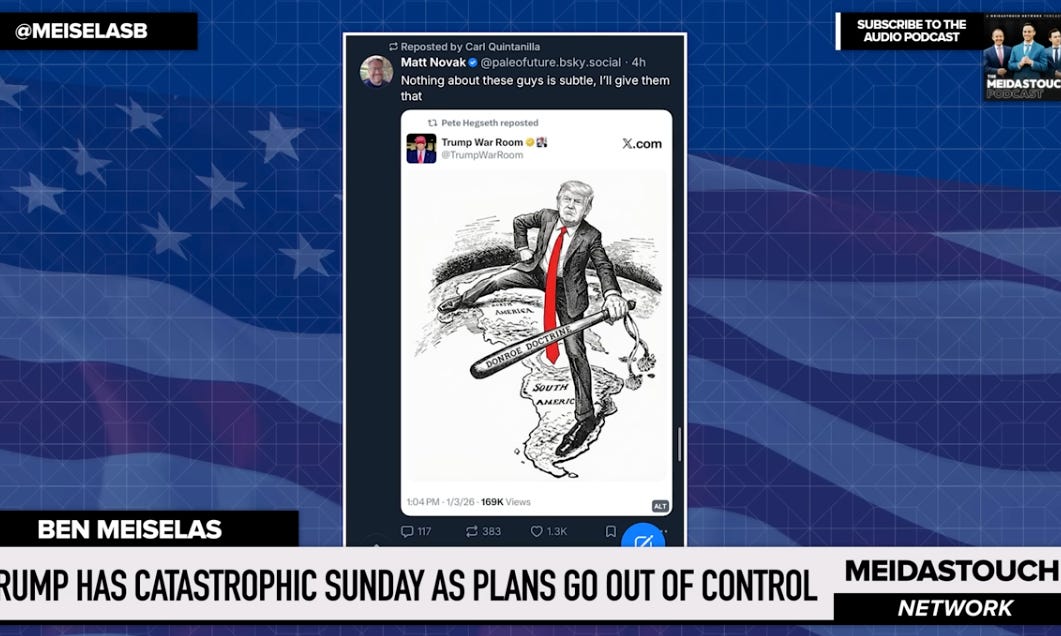
This is how escalation is laundered. First, a “law enforcement action.” Then a “quarantine.” Then a secondary enemy blamed for resistance. Each step framed as reluctant necessity, none acknowledged as choice. The Monroe Doctrine, (newly dubbed the Donroe Doctrine), reemerges not as history, but as cosplay, Trump literally posting images of himself standing atop the hemisphere, branding it with his name.
The most damning detail in all of this isn’t Trump’s bluster or Rubio’s legal gymnastics. It’s the absence of planning for the day after. There is no serious pathway to democracy being offered, only compliance. No respect for Venezuelan political agency, only assessments of which elites might be pliable. The opposition figures who actually won votes are dismissed as inconvenient. The military hierarchy that sustained dictatorship is courted as a partner, while oil shipments are seized in the name of freedom.
This is hubris stripped of competence. Power exercised as impulse, justified after the fact, and abandoned rhetorically the moment it attracts scrutiny.
The world is not reacting because the United States acted. It is reacting because the United States acted without restraint, without legitimacy, and without any visible idea of what comes next. Empires can survive many things. What they rarely survive is confusing intimidation for strategy and spectacle for governance.
Venezuela has now become a warning, not about socialism, or authoritarianism, or oil, but about what happens when a superpower run by an idiot decides it can pick and choose who leads other people, and then discovers that the future does not, in fact, obey threats.
It is imperative to know which person(s) in Trump World cooked up the idea of invading Venezuela. Did one of the sponsors from the fossil fuel industry give an extra special big gift for building the $400 million gilded ballroom? Did anyone vote for this? Trump, “a president for peace”. It’s all utterly illegal and we will have hell to pay. Does anyone on this planet think that our November elections will be safe if the results do not favor Trump? Death by a thousand cuts. Where is the rest of our Government? Our fearless leaders? Hello Mike Johnson, are you okay with this insanity? John Thune? And Democrats ? Instead of your endless requests for donations, do something. There is a mad man loose.
The plan is to follow Putin in violating the International Treaty of respecting the sovereignty of nations and instead practicing "the sphere of influence" and power which provides that powerful dictatorships can invade and exploit other countries. Donald is also threatening Cuba, Mexico, Greenland, and any other country that could provide resources like Ukraine. This administration is so perverse and out of control. Power, control and greed.