


There are moments in politics when euphemism becomes cowardice, this is one of them. When an American president talks about obliterating a nation’s bridges, power plants, and civilian infrastructure, we are not hearing “toughness.” We are hearing the language of ruin. We are hearing a man flirt, out loud, with the destruction of civilian life on a massive scale. Legal experts and humanitarian organizations have warned that deliberate attacks on essential civilian infrastructure can violate the laws of war because those systems keep civilians alive. AP reported this week that experts said Trump’s threats against Iran’s power plants and bridges could amount to war crimes, and the International Committee of the Red Cross has warned that attacks on essential infrastructure are attacks on civilians.
Look at this through the humanitarian lens first, because that is where conscience begins. A bridge is not just concrete, and a power plant is not just steel. A grid is dialysis, refrigeration, water treatment, emergency surgery, infant incubators, and the difference between order and panic. When politicians talk like demolition contractors with nuclear codes, it is ordinary people who pay the bill in blood, heat, thirst, darkness, displacement, and grief. “A whole civilization will die tonight” is not a policy. It is a threat against human beings. And no American should let that kind of language pass as merely dramatic, it is morally grotesque.
Now use the military lens. The most dangerous fantasy in Washington is the fantasy of the clean strike: the idea that you can smash a country hard enough to “solve” it, then walk away draped in flags and certainty. History has treated that fantasy like a chew toy. Congress’s own constitutional framework gives it, not the president alone, the power to declare war, and the Constitution Annotated calls that clause a central element of Congress’s war powers. Yet the Senate recently blocked an Iran war powers resolution that would have directed the removal of U.S. forces from unauthorized hostilities against Iran, even as House Democrats advanced their own version to force congressional authorization within thirty days. In other words: Congress knows the danger here. Some members are trying to stop it. Others are hiding behind silence while the executive branch stretches war-making power past the breaking point.
And militarily, this kind of rhetoric is not brilliant chess. It is gasoline. Threatening to devastate civilian infrastructure does not magically create peace-loving rubble. It invites retaliation, regional escalation, attacks on U.S. personnel and allies, and a wider conflict whose end point nobody can honestly promise. Even current reporting shows officials and analysts disputing rosy claims about how decisively Iran has been degraded, warning that Tehran retains offensive capacity and is adapting. That is what happens in real wars: the map gets messier, the enemy gets meaner, the mission gets fuzzier, and the body count gets longer. Swagger is not a strategy. It is what you use when you do not have one.
Then there is the economic lens, the one that always arrives a few beats after the cheering starts. The Strait of Hormuz remains one of the most critical energy chokepoints on Earth. The U.S. Energy Information Administration says roughly 20 million barrels per day moved through it in 2024, about 20% of global petroleum liquids consumption, while the IEA says a similar volume moved through it in 2025. When the region convulses, the shock does not stay politely overseas. It lands at gas stations, grocery stores, shipping lanes, heating bills, insurance markets, and family budgets. AP has already reported that the current confrontation is rattling oil markets and broader confidence. So even people who imagine this as someone else’s war will meet it at the pump, at the checkout line, and in a slower, more anxious global economy. Empire always sends an invoice home.
This is the deeper damage Trump is doing to the United States. He is not just endangering Iranians. He is degrading us. He is teaching Americans to confuse cruelty with clarity, recklessness with leadership, and maximum threat with maximum patriotism. He is shrinking the moral imagination of the country until the destruction of civilians can be packaged as resolve. He is telling the world that the United States, the nation that claims to champion law and democracy, may instead be governed by impulse, grievance, and a man who seems to think international order is a reality show where the loudest threat wins. Our alliances weaken under that pressure. Our credibility weakens under that pressure. Our democracy weakens under that pressure. Even allied leaders have publicly criticized the instability and inconsistency of Trump’s messaging around Iran and collective security.
And so the call to action cannot be vague. It cannot be a candle and a shrug. It has to be loud, immediate, and relentless. Call Congress, then call again. Call your senators, call your representative, flood their offices. Tell them Congress must reclaim its constitutional authority and pass a war powers resolution now. Tell them unauthorized war is illegal, immoral, and intolerable. Tell Democratic offices to move faster and speak more clearly. Tell Republican offices this is the moment to cross the aisle, to remember that their oath was to the Constitution, not to one man’s appetite for destruction. Ask them, directly, whether they support congressional authorization before any broader war with Iran. Ask them whether they support attacks on civilian infrastructure. Make them answer in words plain enough to survive daylight. The Constitution gives Congress war powers for a reason: because war is too grave to be left to one person’s temper, ego, or late-night apocalyptic posting.
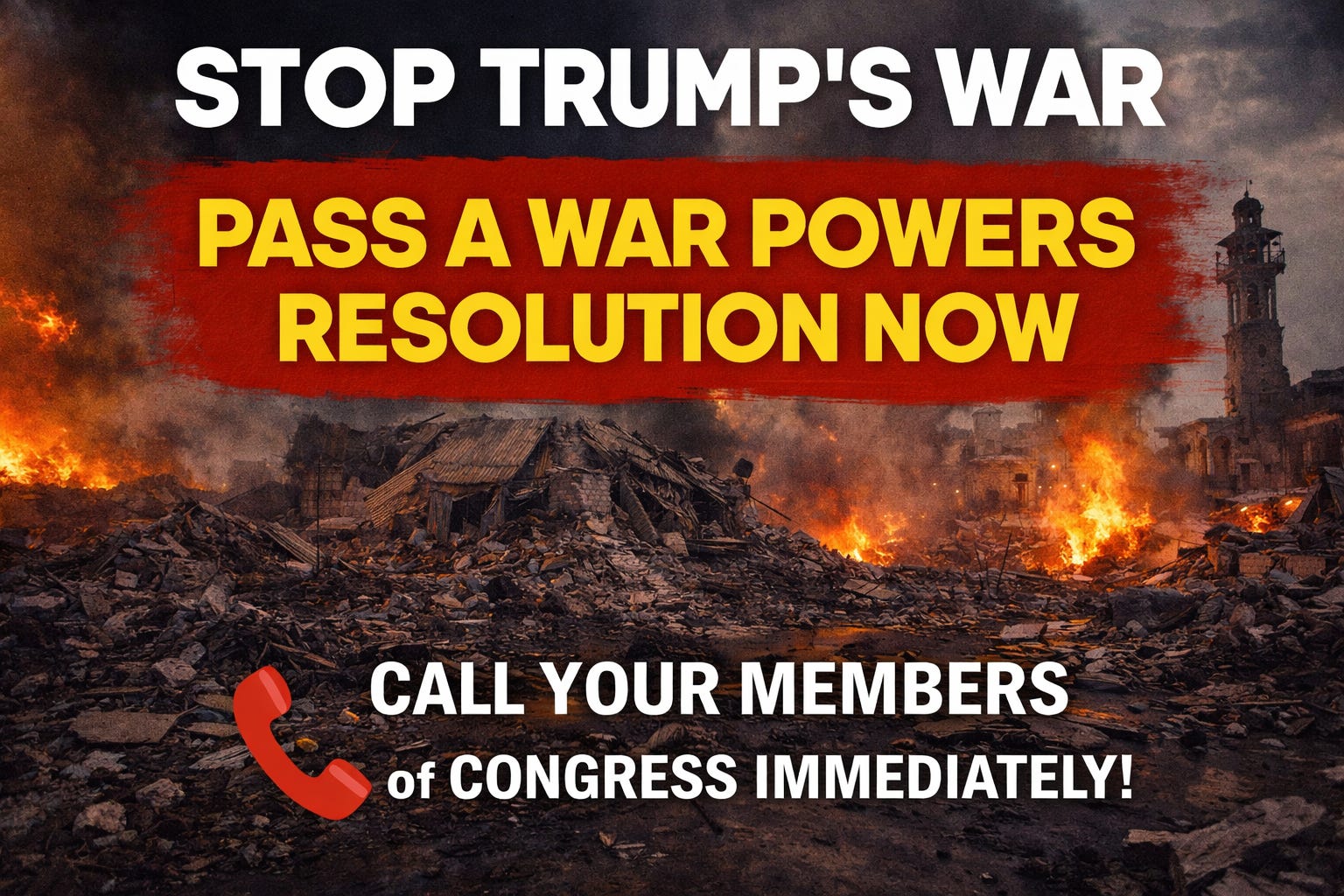
This is urgent. Not abstractly urgent, not historically urgent, urgent in the old-fashioned sense of the word: do it now, because people could die while you wait for better branding. The decent majority in this country needs to act like a majority. We do not need more commentators admiring the mushroom cloud’s lighting. We need citizens who understand that democracy is not self-executing, peace is not self-preserving, and constitutional limits are only real if the public demands they be enforced.
War powers resolution now. Calls now. Pressure now. Because if Americans do not raise their voices while there is still time, history will record that when the language of annihilation entered our politics, too many people mistook it for strength and too many elected officials mistook silence for safety.
This civilizational erasure, this proposed annihilation of human history, is a development from the unpreparedness of the US army for massive archaeological looting in the first days of the Iraq War, which occurred, but is not a break from it, only an intensification. These are crimes against humanity, and against future children and the future ability of the entire species to thrive that parallel genocide, along an entirely new line. We could call it the erasure of the future. Horrible beyond belief. No country can legitimately have such power. No single human being even less so. It all reminds me of the Cold War and how the winning arguments against mutual nuclear destruction were about the erasure of all history and all meaning, past and future and present, even if made in the name of the present.
I’ve been experiencing a bit of “Bay of Pigs” 1950s PTSD viewing this last flood of threats and intimidation in the name of Hegseth’s right wing religious version of a Crusade. Underlying the language of wiping a civilization, of annihilation, bombing and supposed strength in executing these unhinged plans is the unchangeable fact that death always wins. Always. Shanley-another well done piece.