

Today’s roundup is sponsored by:

Good morning! Let’s start in the Strait of Hormuz, because that’s where we’re doing our Monday morning brinkmanship now. Overnight, Donald Trump announced what he is calling “Project Freedom,” a plan to “guide” stranded commercial ships through one of the most dangerous waterways on Earth. It was framed, of course, as a humanitarian gesture, a noble effort to help crews running low on supplies.
Iran’s response was refreshingly direct: any U.S. warship entering the Strait will be attacked, and just like that, we’ve moved from “rescue mission” to “live-fire geopolitical standoff” before most people had their first cup of coffee.
The details are exactly as comforting as you’d expect. The U.S. is deploying a full military posture, destroyers, aircraft, drones, thousands of personnel, into a narrow, heavily mined chokepoint where Iran has spent decades preparing for this exact scenario. As analyst Matt Randolph warned, Iran’s “entire asymmetric doctrine was built around exactly this situation,” learning how to neutralize American naval superiority in a confined waterway.
Before we get to the military reality, it’s worth pausing on the name itself. Trump’s earlier military campaign was called Operation Epic Fury. It had hit its 60-day deadline under the War Powers Act, requiring congressional authorization that the White House has been disinclined to seek. The administration’s position is that Operation Epic Fury effectively ended or paused when the ceasefire took effect on April 7th. Simon Marks of LBC flagged the implication: by repainting the conflict as Project Freedom, fresh name, fresh operation, the administration may be attempting to restart the clock entirely, buying another 60 days before Congress gets a say. A fresh name, a fresh operation, and, conveniently, a 60-day clock that starts from zero. Congress, as usual, is invited to watch.
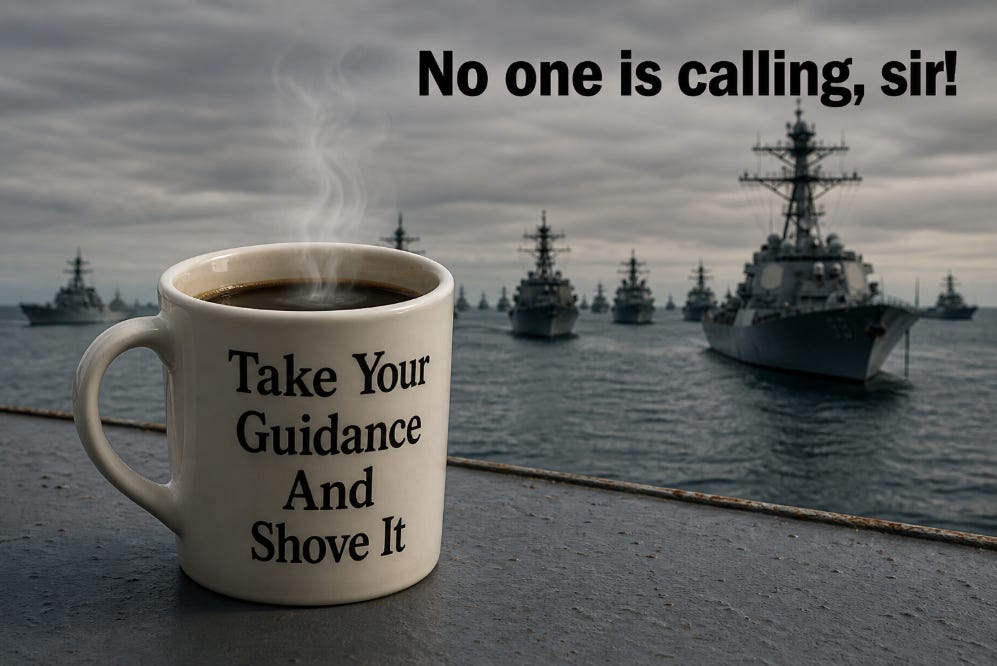
Which may also explain why the operational content is so thin. This is not, it turns out, actually an escort mission. After the announcement, the White House clarified that the Navy won’t necessarily be shepherding ships through danger so much as offering guidance. CENTCOM advised commercial ships to “consider routing via Oman territorial waters” the southern corridor, away from the shipping lanes Iran has mined and to coordinate with Omani authorities by radio. So to be precise: Project Freedom is a humanitarian rescue operation backed by 15,000 troops, 100 aircraft, and multiple destroyers, in which U.S. warships will not be escorting anyone through the part of the strait that is mined, and commercial ships should call ahead to Oman. The name remains Project Freedom.
This semantic deflation from “escort” to “guide” to “coordinate with Omani authorities via radio” reflects a genuine military reality that defense analysts have been describing for months. The IRGC Navy, Iran’s asymmetric force, distinct from its conventional navy, has spent decades building precisely for this moment, oriented around shore-based anti-ship cruise missiles, naval mines, fast attack craft, and drone swarms, all designed to operate in the confined geography of the strait, where supertankers have essentially zero room to maneuver. Iran is estimated to possess between 5,000 and 6,000 mines. Pentagon officials have privately briefed lawmakers that Iran retains thousands of ballistic missiles and drones. The Stimson Center noted this week that the IRGC Navy “remains largely intact” despite months of U.S. and Israeli strikes.
Trump’s public position is that Iran has “no navy, no air force, nothing left.” One of these claims is being made in classified congressional briefings. The other is being posted on Truth Social.
The plan, then, is to guide commercial ships through a narrow, contested waterway seeded with explosives that even the people who placed them can’t fully map, while both sides exchange threats and deny missile strikes in real time. This is what is being called a humanitarian gesture.
Which might explain why commercial shipping companies are responding with the maritime equivalent of ghosting. Captain Raman Kapoor commands an oil tanker that has been stranded in the Persian Gulf since February 28th. He spoke to Al Jazeera on Monday morning, live from the Gulf, in the measured tones of a professional who has been waiting 65 days for someone to tell him something concrete. His company had issued clear written instructions: do not attempt to transit. He was waiting for those instructions to change. They had not changed.
“None of the ships will try to become hero,” he said. “They will show their courage to pass through the strait until unless it is declared officially that it is safe to transit.”
He wanted confirmation that the mines had been removed. He wanted clearance from maritime authorities. He wanted instructions from his company’s office, which in turn would need guidance from owners, managers, charterers, lawyers, and risk managers, all the unglamorous institutional machinery that actually moves cargo around the world, and that is currently declining to be shepherded through a mined waterway by a Truth Social post.
“It is going to take time,” Captain Kapoor said. “Nobody would dare at the moment pass through.”
He didn’t say it as a criticism. He said it as a fact. Captain Kapoor is waiting for someone to tell him it’s safe. No one has.
Now widen the lens, because this isn’t just a U.S.-Iran story anymore. China has stepped in and essentially told Washington to take its sanctions and shove them. Beijing issued a blocking ban prohibiting recognition, enforcement, or compliance with U.S. sanctions on five Chinese companies tied to Iranian petroleum transactions.
China’s foreign ministry has been blunt about the principle involved: Beijing “opposes unilateral sanctions that have no basis in international law” and are not authorized by the U.N. Security Council.
Basically, a polite diplomatic way of saying: you don’t get to unilaterally decide how the global energy system works.
While Trump is trying to force ships through Hormuz, China is quietly dismantling the sanctions regime that helped create the standoff in the first place.
And this is a good moment to pause and thank today’s sponsor, Ground News, because frankly, this is exactly the kind of story that makes you realize how necessary it is to see more than one version of the news.
The China sanctions piece, and the story about the seized Iranian ship crew being evacuated to Pakistan, both came to us through Ground News. Which matters, because neither one is just a stray side plot. China telling Washington that U.S. sanctions do not get to govern the entire planet is not a side plot. Pakistan suddenly becoming part of the fallout from a seized Iranian vessel is not a side plot. These are the threads that turn “Trump announces dramatic boat thing” into something much larger, and much more dangerous.
That is what I like about Ground News. It doesn’t just show you a headline and send you on your way. It shows you who is covering a story, who isn’t, how different outlets are framing it, and what political or ownership interests may be sitting quietly behind the coverage.
Their Vantage plan gives you the deeper tools: ownership details, bias and factuality ratings, advanced filters, alternative media sources, and a look at your own news blind spots, which is rude but useful.


And given the current situation; ships stranded, oil markets wobbling, governments posturing, and everyone pretending this is fine; useful is good.
You can get 40% off Ground News Vantage by using our link:
If all of this still feels distant, let’s talk about how quickly it stops being distant. Airlines have already cut millions of seats. Flights are being canceled. Routes are being reshuffled or downsized because jet fuel costs have doubled and, more importantly, because airlines are suddenly worried about something they haven’t had to worry about in decades: not having enough fuel to get back. Not “fuel is expensive.”
“Fuel might not be there.”
The Strait of Hormuz doesn’t just move oil; it moves the modern world. When it seizes up, everything from shipping lanes to airline schedules wobbles.
First, the tankers stop. Then the planes. Then the routes vanish from the map. And somewhere along the way, a geopolitical standoff turns into a very practical question: how exactly do you get out?
And that is the humiliation hiding inside the chest-thumping. Trump keeps insisting Iran has been “neutered,” stripped of meaningful military capacity, and beaten into submission. But if Iran can still keep the Strait effectively closed, rattle oil markets, strand ships, disrupt global aviation, and force the U.S. into a risky, improvised “guidance” operation that captains don’t seem eager to use, then the scoreboard is not exactly reading “total dominance.”
Simon Marks made that point sharply, noting that this plays into German Chancellor Friedrich Merz’s argument that Iran has humiliated the United States, and may be continuing to do so.
While we are risking U.S. sailors’ lives to reopen a fossil fuel chokepoint, a new study just delivered a blunt, almost clinical diagnosis about the consequences of burning those fuels. New Orleans is done.
Researchers now say the city has reached a “point of no return,” and could be surrounded by the Gulf within decades. Not centuries, but decades. Even if we stopped emissions today, the trajectory doesn’t change. The only question left is how long it takes.
“In paleo-climate terms, New Orleans is gone,” one expert said. “The question is how long it has.”
Let that sit for a second. We can mobilize destroyers, drones, aircraft, and 15,000 service members to keep oil flowing through a narrow strait halfway around the world.
Yet when an American city is literally sinking into the consequences of that oil, suddenly it’s all “complex tradeoffs” and “difficult conversations” and “maybe we should start thinking about relocation at some point in the next few decades.”
We can fight a war to preserve the system. We just can’t change it.
The gap between posture and reality isn’t unique to the Persian Gulf. The Department of Justice has quietly lost more than a quarter of its lawyers, thousands of people and decades of institutional knowledge out the door, replaced with younger, less experienced hires and an openly ideological recruitment push. Different theater, same architecture
Former DOJ fraud chief Andrew Weissmann put the institutional damage even more plainly: “So many people are leaving because they don’t have a voice any more to say: ‘don’t bring these cases that are not righteous.’”
That’s the heart of it. The people who used to say “no, we don’t bring that case” are leaving. The people being hired now are being told, essentially, this is your moment if you align with the mission.
Just to round things out, because no morning is complete without a little absurdity and schadenfreude to take the edge off, Trump finally got the PGA Tour back to his Doral course, the gold statue, the branding, the full production. The biggest names skipped it and the stands were thin. He announced the event and the event declined to perform accordingly.
Somewhere in the Strait of Hormuz, a tanker captain is waiting since February for conditions to ensure safe passage. He was not waiting for a Truth Social post or a gold statue or a 15,000-person military force that would not be escorting him anywhere. He was waiting for the mines to be cleared and for someone with actual authority over the waterway to tell him it was safe to move. That is still, as of this writing, the situation.
Through all of this, the brinkmanship, the bluster, the slow-motion collapse of systems we once assumed were stable, it’s worth remembering why we do this work in the first place. Not just to track the chaos, but to make sense of it, to connect the dots, and to remind each other that none of this is abstract. It’s all very, very real.
Marz and I also want to thank all of you for the birthday wishes. It meant a lot, truly. Many of you have asked for pictures, and I promise I’ll share some in the notes… assuming he cooperates, which, as always, remains the real wildcard.
Take care of yourselves today. Stay grounded, stay informed, and maybe keep an eye on the exits, just in case.
In the middle of war, economic chaos, and global instability, it’s honestly impressive that Donald Trump still finds the time to golf, redesign ballrooms, dream up vanity projects like the “Arc d’Trump,” and fire off lengthy screeds at anyone who’s ever looked at him sideways.
You’d think running a country would be a full-time job, right?
Oh... maybe that explains why everything is fu**ed up...
As usual, the best political commentary available... the best combination of fact and great writing... Thank-you-as always...
I keep reading, in your posts and elsewhere, that all the "polls" show Trump and his policies headed straight down hill; and his actions, not-thought-out and slapdash as they are, are becoming increasingly costly for the average person... Even his "Trump accounts" and his other petty bribes and chicken-shit gifts to Americans at tax time don't have the effect he hoped they would...
So, what leaves is the big run-away freight train--loaded with TNT--headed straight for us and due to hit voting sites in early November... Trump and John Roberts (dressed in a black robe so as not to look like 1930's Chicago gangster)--AND the jelly-fish-like brain-frozen fools in the Republican Senate and House... AND the governors and legislatures in Southern states-- All combining to blow-up the 2026 mid-term elections... They understand that if the vote was cast and recorded fairly, an impeachment would be the inevitable result so they are doing everything they can to wreck the election.
How to prevent this is the real question--because otherwise, this will be the last election!