

Good morning! …a girl can’t even leave on a short road trip without Friday night chaos taking over. Marz and I take one little break from the news cycle, one!, and wake up in the wee hours to discover the United States and Israel have launched a “massive and ongoing operation” against Iran, complete with presidential regime-change rhetoric, ballistic missile retaliation across the Gulf, and what sounds suspiciously like the opening act of a regional war. So much for easing back in gently, or bothering to get congressional authorization.
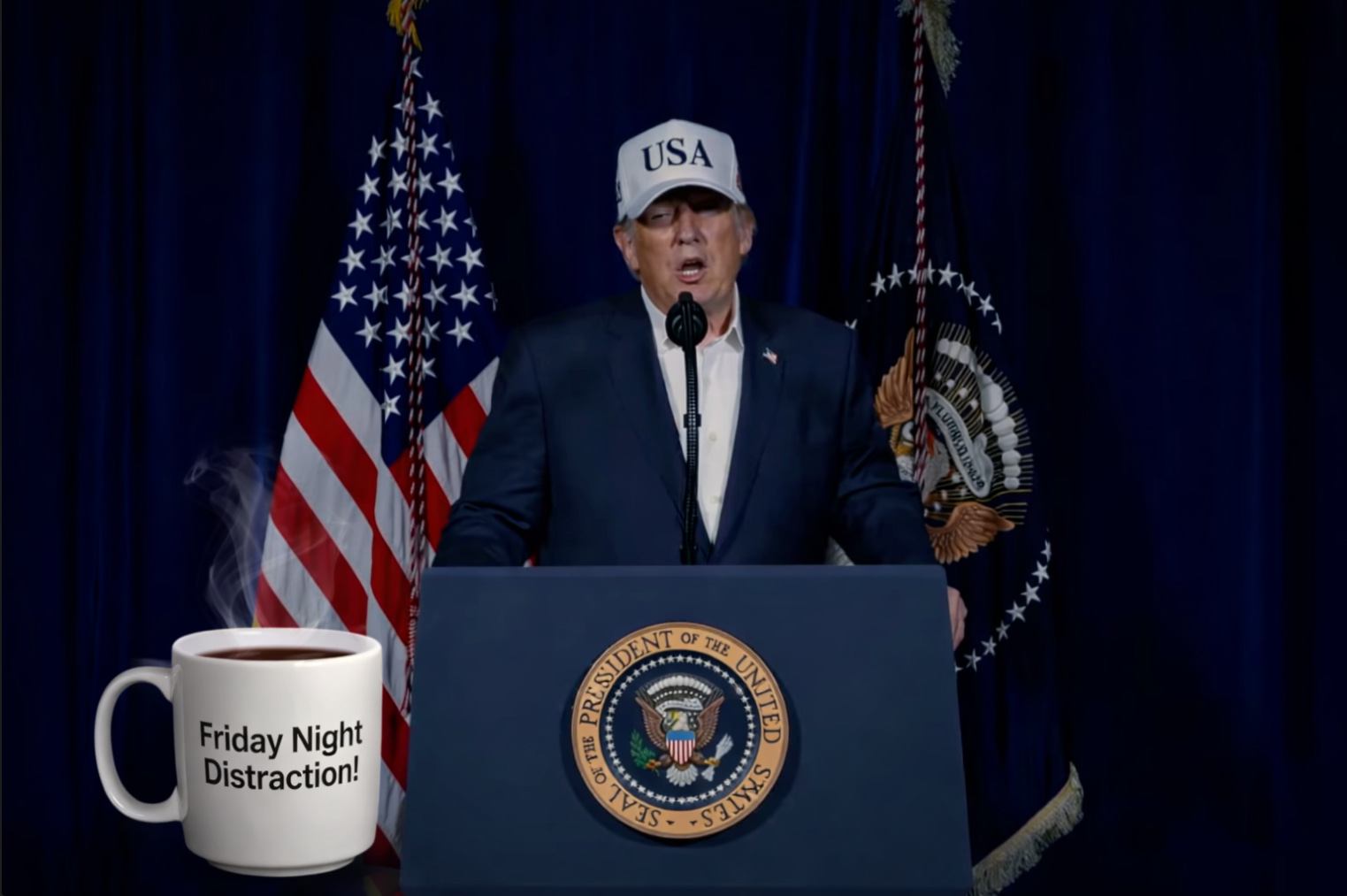
From his Mar-a-Lago lectern, because of course, Donald Trump announced “major combat operations,” promising to obliterate Iran’s missile industry, annihilate its navy, neutralize its proxies, and, as a side quest, encourage the Iranian people to overthrow their government. You know, light weekend stuff. Just your standard Saturday morning “take over your institutions” speech.
It’s quite the pivot for a man who campaigned on ending “endless wars.” The Financial Times captured the whiplash perfectly: the president who once railed against Iraq and Afghanistan is now openly floating regime change in Tehran. And not in a coy, diplomatic, “we support democratic aspirations” sort of way. No, this was full “when we are finished, take over your government, it will be yours to take.” Subtle as a cruise missile.
The opening wave reportedly struck leadership compounds and strategic military targets. Satellite imagery shows damage at high-security sites in Tehran. Iran insists its supreme leader is alive, and Israel says it targeted gatherings of senior officials. Tehran says it will “teach aggressors a lesson.” Translation: this is not symbolic, nor a one-night air raid. This is an escalation ladder with several rungs already snapped.
And retaliate they did. Iran launched missiles toward Israel, with interceptions reported over Jordan. Strikes were reported in Bahrain, Qatar, the UAE and Saudi Arabia. One person in the Emirates was killed by falling debris. There are still unverified claims of a school strike inside Iran. The United Nations Security Council is convening. Britain has planes “in the sky” in what Prime Minister Keir Starmer described as “coordinated regional defensive operations,” while insisting that “this is the route back to the negotiating table.” The European Union’s Ursula von der Leyen warned that “it is of the utmost importance that there is no further escalation.” London, Paris and Berlin were careful to add: “We did not participate in these strikes.” China says it is “highly concerned.” And Russia, of all players, is calling the operation reckless and unlawful while warning about nuclear safety at the Russian-assisted Bushehr plant. When Moscow is the one talking about restraint, you know something’s off.
The White House calculation appears to be shock without occupation. Break the hard power quickly, and avoid boots on the ground. No Iraq 2.0, instead a short, decisive blow that cripples missile capacity and forces the regime into either capitulation or collapse. That is a coherent theory of coercion, and also a high-stakes gamble that depends on things remaining contained. Containment is a fragile word in a region where everyone hosts someone’s base and everyone has someone else’s proxy.
The domestic political math is equally delicate. A Quinnipiac poll last month showed strong majorities opposing military intervention and favoring congressional approval before any strike. Congress did not authorize this one. The War Powers Resolution is apparently being treated as decorative wallpaper. Parts of the president’s own “no new wars” base are watching oil prices like hawks. If Hormuz wobbles and gas spikes before midterms, foreign policy becomes kitchen-table politics real fast.
In the middle of this kinetic drama, the quieter structural stories keep piling up like unpaid parking tickets. At the Department of Homeland Security, a $250,000 public relations contract was awarded to a Trump-aligned consulting firm after a bid window that was open for roughly the lifespan of a mayfly. The contract language reportedly required a track record of promoting Trump administration policies. In writing. Federal procurement rules call for impartiality and avoidance of even the appearance of conflict of interest. Instead, we get what Jessica Tillipman, associate dean for government procurement law studies at George Washington University, called a “blazing red flag of procurement integrity concern.” She added, “I’ve been doing this over 20 years. I have never seen something like it.” Apparently “complete impartiality” now means “preferably someone who already likes us.”
In AI land, the Pentagon moved to label Anthropic a “supply chain risk” after the company resisted loosening guardrails around domestic surveillance and autonomous weapons. Hours later, OpenAI announced a classified deal with the Defense Department, complete with assurances about safety principles and human responsibility in the use of force. The message to Silicon Valley seemed clear: negotiate too hard, and you’re out; align quickly, and you’re in. Nothing signifies “free enterprise” like a little executive branch pressure during wartime.
All of this is unfolding while the president expands his foreign intervention footprint, Yemen, Venezuela, international waters, now Iran, and proposes increasing the defense budget by 50 percent. The “avoid over learning the lessons of the past” doctrine is in full effect.
Internationally, the reaction is mixed but wary. Canada and Australia have backed the American campaign. Britain, France, and Germany stopped short of full-throated endorsement, calling instead for negotiations and protection of civilian life. Gulf states that publicly opposed being launch platforms for strikes are now absorbing retaliatory fire anyway. That’s the thing about pre-emptive attacks in a networked region: even if you don’t want to be part of it, geography drafts you.
And hovering over everything is the regime-change question. History is not kind to the idea that air power alone topples entrenched governments. Institutions, security services, patronage networks, they don’t evaporate because a compound roof collapses. Iran’s leadership may be shaken, but it is not yet gone. And an existentially threatened regime does not typically respond with moderation.
So where does that leave us? In the first, volatile chapter of a conflict that could either plateau quickly or metastasize. The decisive variables remain the same as they were at 3 a.m.: U.S. casualties, civilian harm verification, oil market reaction, proxy activation, and whether backchannels quietly reopen once everyone has made their show of force.
For now, we have a president who has leapt from “no new wars” to regime-change rhetoric in one eight-minute video, a region bracing for further barrages, allies hedging, adversaries condemning, and a domestic political landscape already vibrating with constitutional questions. It is a lot to wake up to after a road trip and a long nap.
I’ll admit it: the firehose feeling is real. One day off, and the world decides to audition for the sequel to 1979. But here’s the steady truth beneath the snark: institutions are still speaking, markets are still calculating, diplomats are still dialing, and even critics inside the president’s own coalition are voicing concern. This is an escalation, but not yet an apocalypse.
And just like the life of a mayfly we are no longer talking about the Trump/Epstein files just hours after Bill Clinton’s testimony. More distraction. Don’t be complicit in the distraction.
the layer upon layer of irony and hypocrisy is incredible... where does one start? wants the Nobel Peace Prize because he is such a peace loving guy... blow up Iran then wonder why they were so inconsiderate to start terrorist strikes inside the US. Continue to support the work of Israel in annexing and subduing much of the Middle East... if only all these countries would just be reasonable and agree to our demands... in the words of Stephen Colbert, "Meanwhile..." the grift, crime, graft, greed, and stupidity continue stateside, and we are really hoping all this will stop all that silly Epstein talk... this will go right into the mid terms where he will declare a national state of emergency due to war with Iran and cancel the elections... I really hope that this does not grow into what i think it will...