

Good morning! The war that Donald Trump sold in the usual style, loud, vague, swaggering, and drenched in fake certainty, is becoming harder to package as a triumph. Multiple outlets now report that a U.S. fighter jet has been shot down over Iran and that a search-and-rescue effort is underway for the crew. Early details remain murky, as they always do when war stops being a talking point and starts being a wreckage field, but the basic fact is grim enough on its own: an American warplane is down, the fate of the aircrew is uncertain, and the fantasy of a neat, controlled, cost-free escalation is once again colliding with reality.
That reality, unfortunately, has not penetrated the White House. Vanity Fair caught Trump the morning after his prime-time address sounding groggy, boastful, and detached from the consequences of the war he is prosecuting. “I don’t worry about markets,” he said. “I worry about nuclear weapons.” This from the same president who called the war “easy militarily,” babbled about regime change as maybe “luck” or maybe “talent,” and shrugged at questions about an apparent school strike with a flat “I don’t know that.” Instead of a commander-in-chief, we have a portrait of a delusional real-estate ghost haunting his own catastrophe: part vanity, part menace, part saliva.
Trump doesn’t worry about markets, so everyone else gets the privilege. The economic fallout is already spreading through oil, shipping, and fuel. One shipping analyst laid out the part of the story the war managers never bother with: global trade is not a cable-news backdrop. When the Strait of Hormuz is choked, ships reroute, insurance and freight costs spike, tanker movements get weird, and energy markets start convulsing in ways ordinary people will feel at the pump and the grocery store. These people planned the bombing campaign, but they did not plan for the logistics of a world economy built around vulnerable chokepoints. They only discover supply chains after they break them.
Matt Randolph’s warning on oil markets sharpens that picture. His focus was not just the headline futures price, but the surge in Dated Brent, the benchmark for real physical crude cargoes, which Reuters-backed reporting and market data have tied to levels above $141 a barrel, the highest since 2008. Randolph’s core point is that when the physical market blows out like this, the pain does not stay theoretical. It works its way into gasoline, diesel, exports, margins, inflation, and all the other delightful ways war arrives in civilian life disguised as a receipt. Trump can sneer that he doesn’t worry about markets, but that is because other people will do the worrying while he does the wrecking.
Even now, with an American jet down and the energy system rattling, the administration is still finding time to chew through its own enforcers. Pam Bondi is out, not because she corrupted the Justice Department, but because she failed to do so effectively enough for Trump’s tastes. Stacey Williams put the moral reality plainly: survivors were never the priority; “the cover-up is what matters most.” Bondi’s tenure was a carnival of false promises, Epstein binder-pageantry, withheld material, political protection, and those congressional hearings where she always seemed to bring along her little mean-girl burn book, packed with canned insults she hoped would impress the only audience that mattered. But in Trumpworld, even theatrical cruelty has a performance review. In the end, Bondi wasn’t punished for what she did. She was discarded because she couldn’t make the scandal go away.
The Atlantic’s reporting suggests Bondi’s removal may be less an ending than an opening act. Ashley Parker and Sarah Fitzpatrick report that there are active discussions about more departures, including FBI Director Kash Patel, Army Secretary Daniel Driscoll, and Labor Secretary Lori Chavez-DeRemer. Their piece makes plain that the old second-term instinct of “no scalps” is gone. Trump, facing fallout from the Iran war and sagging political support, appears to be moving from preserving the image of cohesion to managing decline through purges. Bondi, in this telling, was not too extreme. She was just not useful enough. Todd Blanche’s rise looks less like a temporary patch than a tryout for a more effective replacement model.
Then there is Pete Hegseth, the human case for why “low standards” is too flattering a phrase. Hegseth forced out Army Chief of Staff Gen. Randy George, and Stars & Stripes reports he also fired Gen. David Hodne and Maj. Gen. William Green Jr., the Army’s chief of chaplains. The same report says Hegseth wants someone who will implement “Trump’s and Hegseth’s vision for the Army,” with Christopher LaNeve, a former Hegseth military aide, seen as a likely successor. This is ideological restocking, and it is happening while thousands of 82nd Airborne troops are being deployed to the Middle East for combat operations against Iran. Nothing says stable leadership like gutting your top command during a war.
Tom Nichols, writing in The Atlantic, calls this exactly what it looks like: a rolling purge driven not by strategic reform but by grievance, insecurity, and politicization. He argues Hegseth is trying to turn the military into a more explicitly MAGA instrument, stripping out officers associated with professionalism or independence and replacing them with loyalists. Nichols’s larger point is one the country desperately needs to absorb: when a defense secretary starts firing senior officers without explanation in the middle of a major conflict, that is regime behavior.
Even the language around Hegseth’s Pentagon feels like a confession. Sean Parnell referred to it as the “Department of War,” which Stars & Stripes noted as the administration’s preferred wording. More than branding, it is the distilled philosophy of a crowd that mistakes aggression for seriousness and spectacle for strength. “Defense” implies a state trying to protect something. “War” is what you call it when the posing becomes the point. And then there’s the purge itself: Gen. Randy George was told to step down immediately, while Gen. David Hodne and Maj. Gen. William Green Jr., the Army’s chief of chaplains, were also fired, with the Pentagon offering “nothing further to provide at the moment.” Pair that silence with Hegseth’s recent move to strip chaplains of rank insignia in favor of religious insignia, supposedly to “highlight the importance of the chaplain’s role as a religious leader,” and the firing of the Army’s top chaplain looks less like personnel management than ideological remodeling. As Tom Nichols put it in The Atlantic, these officers appear to have committed only “the offense of being part of a military institution that Hegseth… wants to restock with MAGA loyalists.”
Against all this came one of the clearest moral rebukes of the week, and it did not come from an American politician. On Palm Sunday, Pope Leo warned that God rejects the prayers of those whose hands are “full of blood,” making plain that piety does not sanctify violence. Then, in a subsequent interview, he dropped the diplomatic veil and named Trump directly: “I’m told that President Trump has recently stated that he would like to end the war. Hopefully he’s looking for an off-ramp. Hopefully he’s looking for a way to decrease the amount of violence.” It was a striking progression from moral warning to open indictment, and the message underneath was unmistakable: faith cannot launder slaughter.
The administration’s answer to Pope Leo was not a rebuttal so much as a sanctimonious dodge. Asked about the pope’s warning, Karoline Leavitt pivoted instantly to boilerplate, saying America was founded on “Judeo-Christian values” and that there was “nothing wrong” with the president calling on people to pray for service members. She even insisted that troops “appreciate the prayers and support from the commander-in-chief and from his cabinet.” Fine. That was never the question; nobody said troops should not be prayed for. The question was whether leaders with blood on their hands can drape themselves in religion and call it righteousness. Leavitt could not answer that, so she wrapped the war in a church bulletin and hoped nobody would notice.
The view from abroad is clarifying in other ways, too. China has continued calling for an end to hostilities and for meaningful peace talks, saying prolonged conflict serves no one’s interests and that the pressing priority is to create conditions for sincere negotiations. Beijing’s motives are self-interested, open sea lanes and regional stability are not exactly fringe concerns for them, but the contrast remains embarrassing for Washington. When China sounds more restrained and diplomatically coherent than the White House, you know the war managers have driven the discourse into a ditch.
That brings me to the deeper point, the one Stephen Marche articulated so well. Marche rejects the comforting fantasy that the answer is simply to oust Trump and return to some prelapsarian version of America. He argues that the United States is not just suffering from one malignant leader but from a system in breakdown: collapsing legitimacy, deep inequality, failing institutions, declining trust, and a dangerous drift into what he calls anocracy, that unstable space between democracy and autocracy where violence spikes and rot becomes normal. Trump, in his view, is not the whole problem. He is the catalyst, the accelerant, the symptom that made denial impossible.
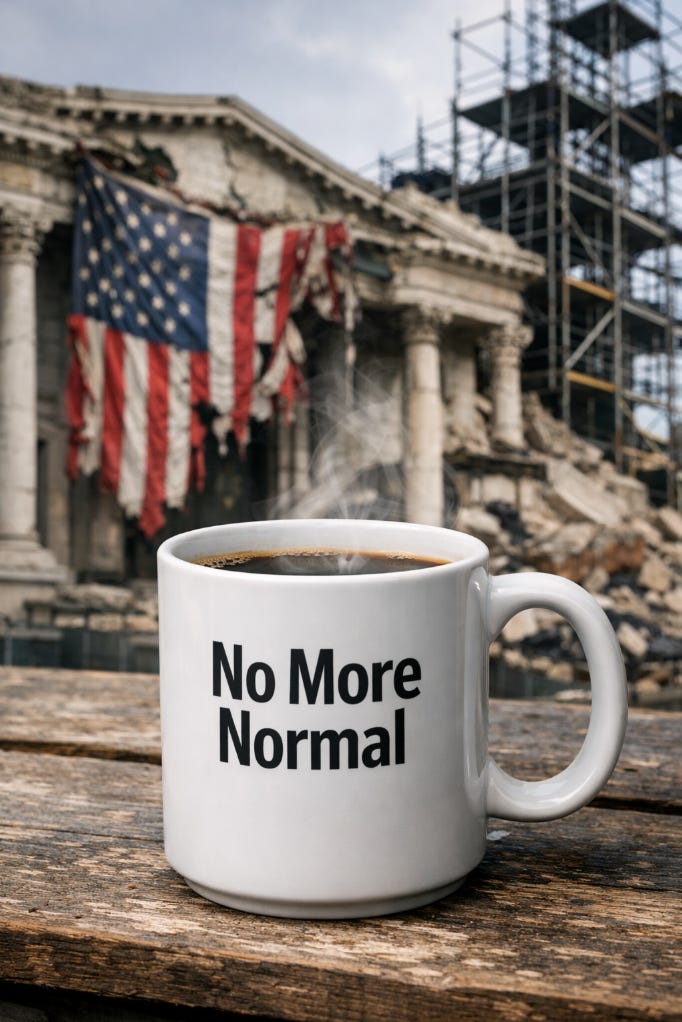
That is why “back to normal” is not a serious political vision anymore. The old normal built the runway for this. The old normal normalized obscene inequality, institutional decay, elite impunity, minority rule, militarized policing, and a political culture in which vast numbers of Americans came to regard other Americans as illegitimate or immoral. Marche’s challenge is the right one: can Americans imagine a new country? Not a restoration of the old script, not nostalgia, but design. That is why exercises like our revived draft Bill of Rights matter. Because they force us to do the thing this moment demands: stop fantasizing about rewinding history and start articulating, concretely, what a more just, democratic, human future would actually require.
That, to me, is the real thread connecting all of this morning’s horror show. A downed American jet. Oil shock spreading through the global economy. Purges, cover-ups, war prayers, ballroom lunacy, and institutions being hollowed out right in front of us. This is not the portrait of a country that simply hired the wrong manager. It is the portrait of a system in visible decay, accelerating under leaders so drunk on grievance and spectacle that they confuse wreckage with power. Trump is emceeing the clown-car stage of imperial decline while the wheels bounce off in every direction.
So yes, we should oppose him, expose the lies, the cruelty, the corruption, the obscenity. But that cannot be where the imagination stops. Trump exploited a flawed system, fed on its weaknesses, and then smashed it further in the process. Now that he has broken the very machinery that enabled him in the first place, we have to seize this moment for something larger than resistance. Refuse the comforting fantasy of “normal,” because normal is what got us here. We have to rebuild. Enact a new Bill of Rights, install a stronger system that prevents this from ever happening again. It means taking advantage of this rupture to demand something better: a country less brittle, less oligarchic, less militarized, less myth-drunk, less casually cruel, and more honestly democratic than the one that delivered us to Trump. He is the symptom that finally made denial impossible. The task now is not restoration. It is refoundation. This is our work now.
A breathtaking call to action, thank you.
Profound and moving essay-- and beautiful writing as well... Thankyou...