


Trump and Pete Hegseth appear to believe they are producing the next great American war movie. Trump gets to play the messianic strongman, forever wrapped in flags and AI glow, while Hegseth stomps onstage as the barked-command defense secretary, part action figure, part youth pastor, part cable-news brawler. The script has everything they love: swagger, enemies, religious imagery, fake moral certainty, and a soundtrack composed entirely of testosterone and grievance. The only problem is that while they are busy filming the trailer, the rest of the world is stuck living through the consequences.
Hegseth’s recent performance at the Pentagon was basically a genre exercise. He threatened Iran in language clearly meant to sound cinematic and overwhelming, warning that the United States was “locked and loaded” on its “critical dual use infrastructure,” then dropping the euphemism altogether and naming “remaining power generation” and “your energy industry.” He called the blockade the “polite way” this could go, then made clear that the impolite version would be “bombs dropping on infrastructure, power, and energy.” Civilian infrastructure is not a movie prop. Under the laws of war, civilian objects are protected, and intentionally attacking them can be a war crime. So when Hegseth bragged that the United States was ready to hit Iran’s “power generation” and “energy industry,” he was publicly threatening the systems that keep civilian life functioning, then dressing it up in the deodorized language of “dual use infrastructure.”
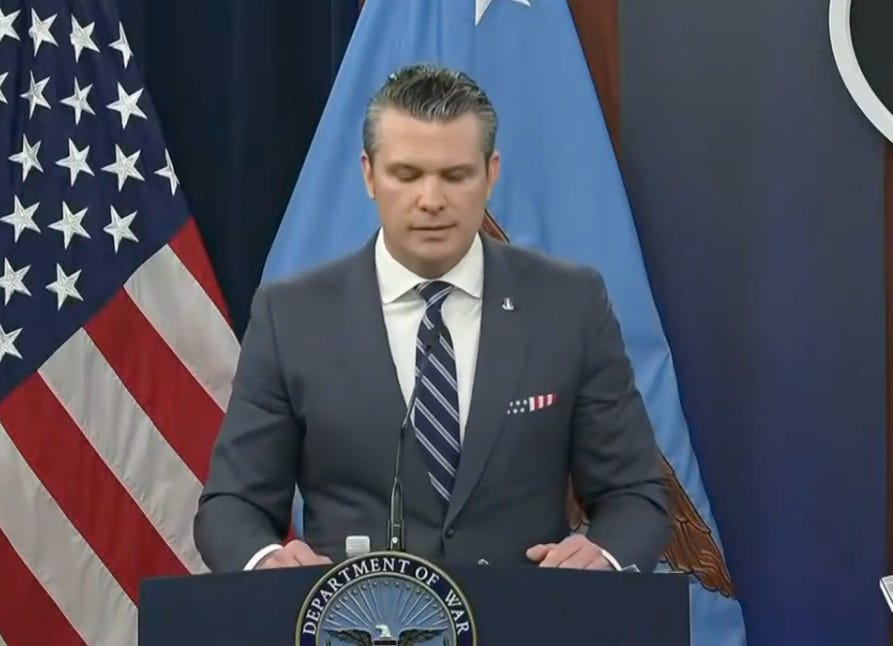
And because the performance apparently must always include a sermon, Hegseth also took time to lash out at the press, comparing reporters to Pharisees. He complained about “garbage,” “negative coverage,” and “fake news,” then reached for scripture to cast himself and Trump’s war effort as persecuted righteousness beset by hardened-hearted elites. It was one of those moments where the whole aesthetic of the administration came into focus at once: the fusion of state violence, Christian grievance, media paranoia, and self-pity. Even their militarism now has the tone of a comment section that found God five minutes ago and immediately decided it should run the Pentagon.
As if that were not enough theater for one week, Hegseth reportedly went from comparing reporters to biblical villains to recycling a fake Bible verse from Pulp Fiction at a Pentagon prayer service. He delivered a militarized version of the famous fake Ezekiel monologue made famous by Samuel L. Jackson. The defense secretary’s office later admitted the prayer was “obviously inspired” by the movie dialogue, which is a wonderful little Trump-era flourish: yes, he did the absurd thing, but you are ridiculous for noticing. It is hard to imagine a more perfect snapshot of this administration’s spiritual life than a Pentagon worship service built out of Tarantino dialogue and vengeance fantasies while bombs are being readied in the background.
That really is the theme here: not faith, but costume. Not moral seriousness, but production design. Trump posts his messianic slop online, bathing himself in sacred imagery like a man trying to workshop poster art for The Passion of the Donald. Hegseth growls about vengeance, accuses critics of impiety, and seems to mistake blockbuster dialogue for holy writ. They are not simply pursuing war, they are aestheticizing it, turning it into content, a stage on which they can perform masculine certainty and divine purpose. It’s not just about power, they want camera angles.
The contrast with Pope Leo could not be more devastating. While Trump and Hegseth have been wrapping force in spectacle and sanctimony, Leo has been doing something far more dangerous to them: naming the disease. He warned that the world is being ravaged by “a handful of tyrants” and condemned leaders who “manipulate religion and the very name of God for their own military, economic and political gain.” It was a blunt indictment of this exact moral fraud: the conversion of religion into set dressing for domination, the laundering of violence through holy language, the attempt to make cruelty feel righteous by baptizing it in public piety.
Leo’s words strip away the atmosphere these men work so hard to create. They want war to feel like purpose, but he reminds us it is devastation. They want the language of destiny and strength. He points to billions spent on killing while healing, education, and restoration go unfunded. They wrap force in God-talk and demand reverence for the result. Leo calls that what it is: corruption of the sacred. In a week full of macho posturing, fake verses, and threats against civilian infrastructure, the Pope sounded like the only adult in the room.
Beneath all the pageantry sits the part that matters most: reality does not care about their script. The Gulf is not a movie set, and Hormuz is not a backdrop. Energy systems are not props. When Hegseth threatens infrastructure, power, and energy, and when the United States chokes one of the world’s most important energy corridors, the effects do not stay confined to maps and podiums. They move outward through shipping lanes, fertilizer supply, jet fuel markets, and food systems. The real world receives these performances not as strength, but as shortages, price spikes, instability, and fear.
While Trump and Hegseth cosplay their holy-war blockbuster, the rest of us are dealing with the consequences. Europe is already hearing warnings that it has “just six weeks of supply of jet fuel left,” alongside talk of “flight cancellations” and what one commentator called “the largest energy crisis we have ever faced.” Fertilizer disruption threatens crop production. CO2 shortages can hit food preservation, affecting chicken, pork, beer, and “the shelf life of everything from salads to bread.” Energy shocks ripple straight into transport and logistics. Food-importing countries feel the strain first and hardest. This is what actual war in an energy chokepoint looks like: not a heroic montage, but a supply-chain nightmare. No glory, just thinner shelves.
In Britain, commentators stripped away every layer of macho delusion and got down to basics. As one guest put it in plain English, food production depends on “four big inputs”: “energy,” including “diesel for tractors, transport, trucks, aircraft fuel”; then “big maize and grains”; then “fertilizer,” because “50% of global food relies on fertilizer and 30% of that comes through Hormuz”; and then transport itself, just getting food “from A to B onto the shelves.” Another guest spelled out the fragility even more starkly: without fertilizer, you lose ammonia production; without ammonia, you lose CO2; and without CO2, meat and other fresh products “cannot be kept fresh for long enough.” You do not need much to go wrong before daily life starts to feel brittle. A threatened shipping lane becomes higher costs. A disrupted fertilizer flow becomes food insecurity. A swaggering blockade speech at the Pentagon becomes anxiety in kitchens and grocery aisles an ocean away.
That is the obscenity of all this. Trump and Hegseth get to perform war as image, myth, and masculine fantasy. They get the podiums, the symbols, the music-video nationalism, the prayer service theater, the self-flattering roles they have written for themselves. Everyone else gets the bill. Civilians are threatened by infrastructure. Families see any tax benefits eaten up by inflation, and whole countries get stressed supply chains. Religion gets dragged through filth and turned into a prop for vengeance monologues. The sacred is degraded, while the practical is destabilized.
Somewhere in the middle of all that, a defense secretary is quoting Pulp Fiction at a prayer service and calling it leadership. Another empire hallucinating that spectacle can substitute for morality, and power-drunk movie buffs mistaking the trailer for the truth.
strong and true. Now, how to get this published on Fox and OAN and Newsmax?
In Catholic theology, there are seven deadly (“cardinal”) sins:
Pride
Greed
Lust
Anger
Gluttony
Envy
Sloth
It’s not a stretch to observe this could be checklist of Trump’s consistent personality traits. Further, Trump exhibits none of the traits Catholic theology says counter these sins: humility, generosity, kindness, patience, honesty, temperance, diligence. Hegseth is one of many in the inner circle about the same can be said.
Let us pray pride (and greed, lust anger…) do indeed go before the fall.