


Good morning! Trump came to NATO demanding backup for Iran, Greenland, Erdoğan, and his Spain tantrum. Mark Carney gently reminded everyone what a defensive alliance is actually for.
At the NATO summit in Ankara, the Donald Trump sat beside NATO Secretary-General Mark Rutte and delivered what may be the purest distillation yet of his foreign policy worldview: friends are people who flatter him, allies are customers who owe him, enemies are monsters, treaties are punch cards, and Greenland is just another foreclosure opportunity.
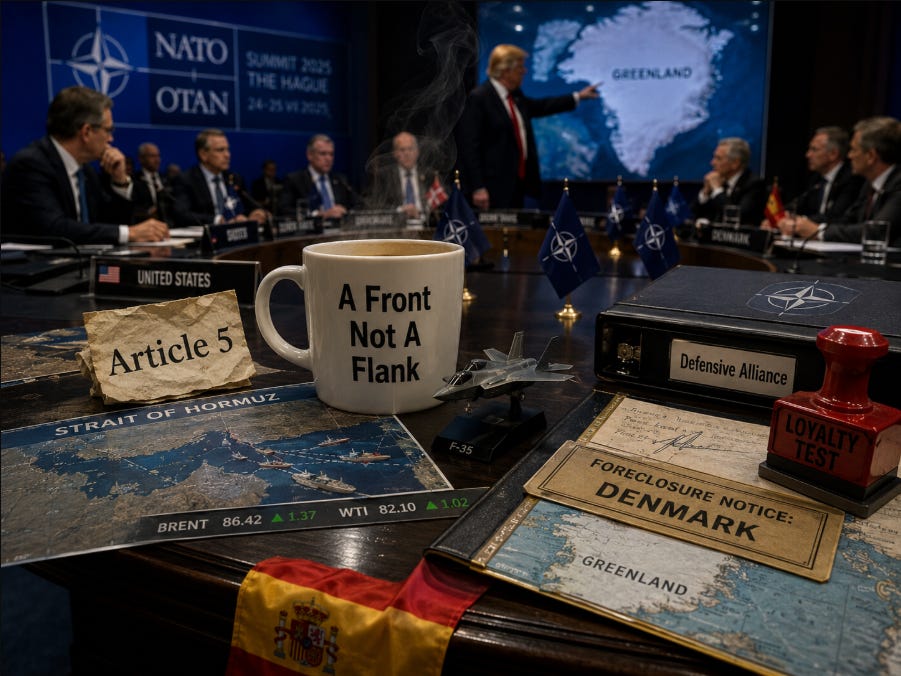
NATO leaders were gathered in Turkey to talk about new capabilities, shifting burdens, airlift, refueling, surveillance, Arctic security, Russia, Ukraine, and the future of collective defense. Hypersonic missiles exist, autonomous warfare is here, and Russia is still Russia. The Arctic is opening, shipping lanes are under threat, Iran is dangerous, Ukraine is bleeding. These are big, serious issues.
Trump arrived and treated the whole thing like a loyalty hearing.
He opened by rating his dinner with President Erdoğan “a 10 maybe a 12,” because the Richter scale now applies to state dinners. He praised the summit, said everything was fantastic, promised a press conference, and then lurched immediately into Iran, declaring that the United States had attacked “very powerfully” the night before after Iran allegedly fired on ships in the Strait of Hormuz.
“They’re scum,” he said of Iranian leaders. “They’re sick people. They’re led by sick people.” They were “vicious,” “violent,” “evil,” “cuckoo,” “liars,” “cheats,” and “cancer” that had to be cut out early. He said the mission was the “de-nuclearization of Iran” and then, because even Armageddon apparently needs branding, announced, “We’re going to d’nuke it.”
It felt like a hostage video for the Atlantic alliance, with Rutte smiling through the kind of diplomatic weather event that makes translators reconsider their life choices.
The immediate issue was the MoU with Iran, the preliminary ceasefire arrangement Trump signed in mid-June and has now publicly stuffed into the wood chipper. After the latest attacks on ships in the Strait of Hormuz, Trump said the deal was over “to me.” He stopped short of formally declaring that the United States was restarting the war, but he made clear he personally did not see much point in continuing diplomacy.
“I don’t want to deal with them anymore,” he said. “It’s just a waste of time dealing with them.”
Then, in the next breath, he said his “wonderful negotiators” could keep talking if they wanted. Those negotiators include Steve Witkoff and Jared Kushner, because when the Strait of Hormuz is on fire, naturally you send in the man who solved Middle East peace by marrying into the family.
The ceasefire now occupies the classic Trump position: not officially dead, just publicly humiliated, contradicted by its author, and left in Jared’s custody.
The Wall Street Journal put the diplomatic damage plainly: Trump’s remarks were the starkest sign yet that diplomacy with Tehran has stalled under the preliminary peace agreement. Oil markets understood the assignment. Brent crude jumped more than 5 percent after Trump’s comments, because when the President of the United States declares a Hormuz ceasefire dead from a NATO summit, traders do not wait around to see whether the son-in-law has a follow-up meeting.
Al Jazeera’s live updates filled in the grim picture behind the rhetoric. The United States says it launched powerful strikes after attacks on three ships in the Strait of Hormuz, including Qatari and Saudi tankers. Iran says it targeted 85 U.S. military installations after attacks on Hormozgan Province and Mahshahr, with air raid sirens sounding in Bahrain and Kuwait. Kuwait reported power lines damaged by shrapnel. Oman, Kuwait, Bahrain, and the Gulf Cooperation Council condemned Iranian attacks. The International Maritime Organization warned that about 6,000 seafarers remain stranded on hundreds of ships in the Gulf. Iran is reportedly insisting ships use a route it designates through the Strait, while Iranian officials talk about a “new Iranian regime in the Strait of Hormuz.”
Underneath Trump’s insult monsoon, there is a real crisis. There is a serious dispute over shipping, sovereignty, the MoU, oil sanctions, the Strait of Hormuz, and Iran’s apparent attempt to impose a new maritime status quo. Exactly the kind of moment when a prudent president might want to be precise.
Instead, Trump explained the crisis like a man yelling at a contractor who installed the water taps backward.
Foreign observers noticed. On LBC, a former ambassador tried to translate the actual dispute into adult language. He explained that the United States and Iran appear to have very different understandings of what the MoU says about the Strait of Hormuz. Iran’s position, as he had heard it from an Iranian spokesperson, was that the agreement gave Iran authority to manage the Strait and direct ships into particular routes, with punishment for ships that refused. That, he said, is obviously not acceptable to the United States, and it helps explain a more robust U.S. response to attacks on international shipping.
This is where maritime security, deterrence, and treaty interpretation should live.
Then he was asked about Trump’s claim that Turkey had considered joining the war on Iran’s side until Trump personally talked Erdoğan out of it.
“I don’t know what President Trump is talking about,” he said. “That doesn’t make any sense to me at all.”
That is the diplomatic version of: the president appears to be freestyling nonsense on live television.
Trump’s Turkey story was not a throwaway line. He used it to justify his praise of Erdoğan, his possible openness to selling Turkey F-35s, and his larger claim that personal loyalty to him had prevented a NATO ally from joining Iran against the United States and Israel.
In Trump’s telling, Erdoğan “doesn’t like Israel much” and “doesn’t like me very much,” but he stayed out of the war because of Trump. Turkey, he said, is a military power with “millions of soldiers” and “a lot of our best equipment.” Turkey wants F-35s. Turkey rolled out the red carpet. Turkey has been more loyal than some traditional allies.
This is how Trump measures alliances: not by treaties, democratic values, or strategic alignment, but by whether the leader praises him, buys American weapons, and refrains from joining the opposing side during his latest undeclared military adventure. That may even earn you the F-35 conversation.
Spain failed the vibe check. Trump called Spain a “wasted cause,” “a terrible partner in NATO,” and “hopeless.” He ordered trade with Spain cut off immediately, including visits. He predicted Spain would come “running back” begging to trade with the United States. He said Spain does not participate, does not pay, and should not be carried by the alliance.
Foreign economic policy as mafia improv: nice little export market you have there, shame if someone had feelings about burden-sharing.
Rutte tried, bless him, to massage reality back into the room. He praised Trump lavishly for forcing NATO countries to spend more. He said European and Canadian NATO nations are spending hundreds of billions more, supporting nearly 200,000 jobs in the U.S. defense industrial base. He told Trump this was his “huge win.” He said, in essence, that Trump had done what Eisenhower and every president since had failed to do.
This is how one manages Trump inside an alliance: wrap the institution in gold foil, label it “Property of Donald J. Trump,” and hope he stops trying to burn it down.
Rutte also gently noted that European countries had supported U.S. operations in “Epic Fury,” with thousands of planes taking off from European airports and Europe serving as a major platform for U.S. power projection. Trump interrupted to complain that the United Kingdom had not let the U.S. use an island, that Italy had been bad about bases, and that Spain was still terrible.
The man cannot process help unless it arrives as personal submission.
Then came Greenland, again.
Trump complained he was unhappy with NATO because of Greenland. He said Greenland is very important to the United States and not important to Denmark. He said Denmark had been overrun by the Nazis in less than one day, that Denmark asked the United States to take care of Greenland during World War II, that America “owned” it, and that we “stupidly” gave it back. He compared it to the Panama Canal, which he also says America should not have given back.
There is, to be fair, a real strategic case for why Greenland matters, and it has only grown stronger as the Arctic becomes less a frozen backwater than a contested frontier. Greenland sits above the Arctic Circle, guarding the Arctic and North Atlantic approaches to North America at the same time climate change, mineral competition, new shipping routes, and Russian and Chinese ambitions are turning the region into one of the central security theaters of the century.
The problem is that Trump expresses it like a man trying to foreclose on Denmark.
Greenland is a self-governing territory of Denmark, home to about 56,000 mostly Inuit people, whose government has made clear that Greenlanders will decide their own future. The island does not exist as a distressed asset in Trump’s mental real-estate portfolio, a hotel property with a complicated deed history, or some postwar possession the United States misplaced because a weak loser forgot to initial the closing documents.
There is a serious Arctic-security case to be made. Trump keeps making it sound like he found Denmark’s mortgage in a drawer.
This is where Canadian Prime Minister Mark Carney enters the story, carrying a glass of water and a binder labeled “What Words Mean.”
Carney was asked directly whether there was a mismatch between alliance leaders wanting to talk about what NATO can do and Trump fixating on what NATO would not do for him in Iran. His answer was careful, but the meaning was clear: NATO is a defensive alliance. It is not an offensive alliance. Trump wanted more offensive support for the Iran conflict. That was between him and specific NATO allies. Canada was not directly asked, did not have the relevant capabilities, and was not relevant as a base in that theater.
In plain English: Trump wanted a posse. NATO is not supposed to be one.
Carney did not excuse Iran. He called Iranian attacks during the mourning period for Khamenei irresponsible. He said Iran targeted infrastructure assets in Qatar and Saudi Arabia and threatened shipping. He said the United States responded as appropriate to stop that behavior and create conditions to reestablish the ceasefire.
That is what adult foreign policy sounds like: Iran’s actions were unacceptable, and NATO still does not automatically become Donald Trump’s auxiliary expeditionary force.
Astonishingly, adults can hold both thoughts at the same time.
Carney also made the sober version of the Greenland argument Trump keeps mangling. He said North American security, particularly Arctic security, can no longer be treated as a side issue. Canada has 15 percent of the world’s coastline. Russia is a direct adversary. The Arctic is not a flank, Carney said. It is a front.
There it is. That is the sentence.
“The Arctic is not a flank, it is a front.”
That is the argument Trump could be making if he were capable of discussing strategy without sounding like he was trying to repossess Nuuk.
Carney also acknowledged the burden-sharing shift that Trump endlessly complains about. Canada, he said, came into this period spending about 1.4 percent of GDP on direct defense and has now reached 2 percent for the first time since the fall of the Berlin Wall. It plans to scale to 2.5 percent over the next four years, with an additional 1.5 percent on resilience, reaching 4 percent by NATO’s definition before the end of the decade. The formal 5 percent target is for 2035 and will be reviewed in 2030.
Trump has won the argument, as Carney put it. The burden is shifting; countries are spending more, and capacities are being built. Canada is investing in maritime capability, submarines, munitions, light vehicles, surveillance aircraft, and defense-industrial partnerships. Rutte said much the same thing in his own Trump-management language: NATO spending is rising, European and Canadian purchases are supporting U.S. jobs, and the alliance is adjusting.
That is the pathology. Trump won the argument and still wants a loyalty oath. Success does not satisfy him unless it comes with humiliation. More defense spending is not enough. He wants tribute, Spain punished, Greenland handed over, and Erdoğan praised. He wants NATO allies to join his Iran operation not because the treaty requires it, but because he is testing them.
The difference between an alliance and a protection racket.
An alliance says: we share threats, responsibilities, capabilities, and obligations.
A protection racket says: nice continent you’ve got there. Shame if someone remembered Spain.
Meanwhile, underneath the summit theater, Gaza’s medical catastrophe continued. A United Nations commission demanded the immediate and unconditional release of Dr. Hussam Abu Safiya, director of Kamal Adwan Hospital, warning that his deteriorating health is the direct result of severe abuse during 19 months of Israeli detention. The commission said attacks on medical personnel were part of a broader policy to destroy Gaza’s healthcare system and repeated its finding that targeting the medical sector constitutes war crimes, crimes against humanity, and genocide. Israel denies systematically targeting medical workers and facilities.
It was a stark reminder that while presidents posture, alliances posture, oil markets panic, and shipping lanes become bargaining chips, the human machinery of war keeps grinding.
And that is where we leave the alliance today: Iran calling the Strait its own toll road, Trump treating NATO like a loyalty program with airstrikes, Greenland being discussed as though Denmark missed a mortgage payment, and Mark Carney gently reminding everyone that a defensive alliance is not supposed to be the president’s personal posse.
Marz and I, meanwhile, are both going in for our annual checkups today, literally. Given the state of the world, I am choosing to regard this as aspirational civic behavior: get your vitals checked, listen to the professionals, and try not to bite anyone unless medically necessary.
There is no one, NO ONE, in the current regime capable of handling an international meeting such as NATO in Ankara.
The United States has no leader at that level who can understand the complex issues and join in meaningful discussions.
Moreover, no American official has the integrity and diplomatic tact to participate as an equal in that group.
The saying is, don't worry about what you can't change.
But I do worry that my country will never be able to recover from Trump's destruction, not at home or on the world stage.
Don’t bite unless medically necessary. But the issue now is that major surgery is required to cut out the entire executive branch.