


Good morning! A pattern is emerging from today’s stories: official assurances keep running into inconvenient evidence, while institutions designed to exercise enormous power are being asked increasingly basic questions about transparency, restraint and competence.
Jonathan Reiner, the cardiologist who treated Dick Cheney for 27 years, has published an unusually pointed list of questions about Donald Trump’s health. He says explicitly that he is not Trump’s physician and has reviewed only information made public. His argument is that what the public can see does not always fit comfortably with the reassuring summaries coming from the White House.
Why did Trump’s recent physical involve 22 consultants? What explains the bruising on both hands and the reported aspirin dose? Why was leg swelling described as chronic when an earlier examination reportedly documented none? What is behind the episodes of apparent daytime sleepiness? Why was advanced heart and abdominal imaging performed? Have medications been omitted from the public record? And why has Trump repeatedly taken the Montreal Cognitive Assessment, a basic screening test rather than a sophisticated neurological examination?
Reiner’s larger point is one that will outlast Trump: the United States has no formal system requiring a president to demonstrate physical or cognitive fitness for office. The annual presidential physical is a custom, and history offers abundant evidence that presidential customs are only as useful as the people observing them.
The White House could answer most of Reiner’s questions fairly easily. So far, it hasn’t.
Karoline Leavitt will leave the White House press secretary’s job at the end of August, saying she wants more time with her young children after the birth of her second child. Trump says she will remain one of his top outside advisers and an influential Republican voice during the midterm campaign.
Her timing is also mildly inconvenient for me. I’ve been working on a video about Trump’s remarkable talent for attracting people of questionable character into his orbit, and Leavitt had already earned a place among the honorees. She has defended the indefensible with much gusto.
Reaction to her departure was predictably tribal. Interior Secretary Doug Burgum praised Leavitt as “a fearless voice for the President’s agenda and a true professional,” while Commerce Secretary Howard Lutnick declared her “the most successful Press Secretary in history.”
Democrats were rather less bereaved. Adam Schiff wrote that Leavitt was leaving the White House to spend a little more time “with the truth.” Satirist Andy Borowitz dispensed with the euphemism altogether, headlining his reaction: “Karoline Leavitt Leaving White House to Spend More Time Lying to Her Family.”
Subtlety did not feature prominently in the farewell tributes.
Simon Marks focused first on the contradiction inside Trump’s own announcement: Leavitt is supposedly leaving to spend more time with her family, yet Trump simultaneously says she will be one of his “top outside advisors” and an “influential voice” in the Republican midterm campaign. Marks suggested that GOP prospects may be looking “so dicey” that Trump has decided he needs her talents more urgently on the campaign trail than behind the White House podium.
Marks nevertheless gave Leavitt credit for being “an unbelievably effective communicator” for Trump. His assessment of how she used those skills was considerably less complimentary. He accused her of having “lied relentlessly” from the podium and argued that her most important legacy was transforming the White House press operation, pushing established journalists aside while, in his words, replacing many of them with “propagandists.” The result, Marks said, is that Leavitt “changed the nature of the press operation at the White House in ways that previously were completely unthinkable.”
James O’Brien supplied the shorter résumé. After listening to Marks describe the gap between Trump’s public claims and events on the ground, O’Brien wondered whether the woman charged with trying to “sanitize the madness and present it to the press as something that is sane” had simply “had enough.”
We’ll see. Trump says she isn’t going very far.
The broader Iran-war pressures we’ve covered this week, disrupted shipping, oil-market strain and Washington’s increasingly visible concern about energy prices, remain very much in place. So does the human strain of sustaining the war. Yesterday we looked at the extraordinary conditions aboard the USS Abraham Lincoln.
Simon Marks returned to the story this morning, and nothing has become more reassuring overnight.
The carrier has now spent more than 250 consecutive days at sea. Families have described dwindling food, severe strain and rapidly deteriorating mental health among sailors, including reports that crew members have had to be restrained from going overboard.
The Pentagon plans to send the Theodore Roosevelt as relief, but Marks noted that the replacement carrier was still in San Diego and therefore weeks away. His larger point is the uncomfortable one: while Trump and Pete Hegseth publicly project limitless American military capacity, the people physically sustaining that projection are showing signs of exhaustion.
A serving British naval officer listening to the program said the thought of 250-plus days at sea “sends shivers down my spine” and called it an abrogation of leadership responsibility.
His closing observation was simpler: loyalty is a two-way street.
ICE has produced enough disturbing stories this week that they are beginning to look less like isolated episodes and more like a question about the institution itself.
In Falls Church, Virginia, U.S. citizen Carolina Molina recorded a masked ICE agent pointing a gun through her open car window after agents boxed in her vehicle. DHS says Molina attempted to harm officers by “weaponizing her vehicle.” The cellphone and dashcam footage described by the Washington Post does not show her trying to strike them.
Molina said afterward that the encounter felt like “a Renée Good situation,” invoking the Minneapolis mother killed by an ICE officer in January after federal officials similarly accused her of using her vehicle as a weapon.
The phrase is becoming sufficiently familiar that it deserves scrutiny whenever the government deploys it.
The wider picture is worse. TIME reports that more than 30 people have died in ICE custody since October and that the mortality rate reached a 22-year high. A JAMA analysis found the rate climbing from 13 deaths per 100,000 person-years in fiscal 2023 to 47.5 last year and then 88.9 during the opening months of the current fiscal year. DHS insists there has been “NO spike in deaths,” emphasizing instead the percentage of the total detained population that dies in custody.
That detained population has itself expanded from roughly 40,000 people before Trump returned to office to more than 68,000 by February. Medical and legal experts interviewed by TIME link the rising mortality rate to rapid expansion, overcrowding, weakened oversight, and potentially delayed medical treatment.
Parady La’s death offers a grim illustration. ICE’s own report says he was found distressed, stuporous, vomiting and with abnormal vital signs. Later that day he was found unresponsive and pulseless. Months later, his family still does not know what happened between those two events or what treatment he received.
ICE has reduced the information it releases about detainee deaths and stopped publicly reporting deaths occurring shortly after release from custody.
More power, more detainees, more deaths, and less information.
As if this needed a more dystopian ending, DHS is considering spending as much as $20 million on electrically charged gloves for ICE officers.
The Generated Low Output Voltage Emitter, inevitably, GLOVE, can deliver rapid electrical pulses through an officer’s hand to exposed skin. The manufacturer says the devices do not cause injury and that each activation is electronically recorded. A jail official already using them describes the purpose more plainly: “pain deterrence,” producing what he calls an “instant complier.”
The manufacturer’s own guidance recommends avoiding their use on pregnant women, young children, elderly people, and people with severe disabilities.
The ACLU’s concern is particularly important. Unlike firing a Taser, an officer administering an electrical shock through an apparently ordinary gloved hand could be extremely difficult for witnesses or cameras to detect.
Simon Marks called the proposal “Dr. Evil stuff.”
A serious question underneath the joke is increasingly unavoidable: ICE’s personnel, detention capacity, money, and coercive tools are expanding very quickly. Are restraints expanding with them?
After presidential health questions, an exhausted aircraft carrier, ICE detention deaths and electric gloves, we arrive at perhaps the most unexpected threat to American national security:
British brass bands.
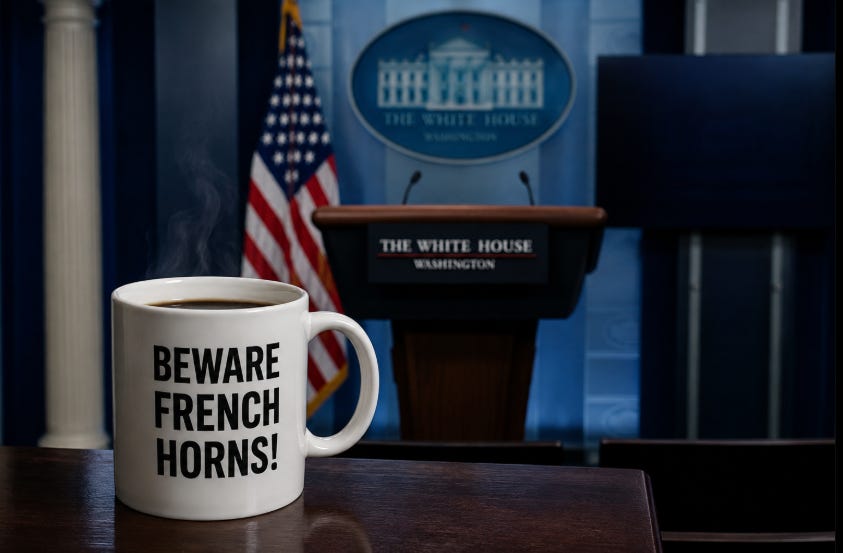
The Commerce Department is preparing a 25 percent tariff on products made primarily from copper and zinc on national-security grounds. That potentially includes British trumpets, trombones, tubas and French horns.
Paxman Musical Instruments has been making French horns in Britain for more than a century and relies heavily on the American market. Its sales manager, Steve Flower, confessed himself slightly puzzled by the security threat posed by his products.
He wasn’t entirely dismissive. A French horn might conceivably be dangerous in the hands of a six-year-old. Beyond that, he struggled.
One imagines the Pentagon is already developing countermeasures.
And that is Thursday morning.
Another wonderful post,Mary.On a lighter note,I wish that warning mug had been available when my daughter practiced for her role as French horn player in the school band !Luckily she chose the violin as her instrument and is now a professional musician.No further injuries have been recorded.
As a former band director, literally the availability of musical instruments is a crisis right now due to this. Very few instruments are made in the US anymore, especially beginner level instruments. It's a tough situation. So you bringing up the horn thing just confirmed what I've been reading from acquaintances still in the band room.