


Today’s roundup is sponsored by:

Good morning! The week begins with Washington and Tehran trying to negotiate a ceasefire by bombing around it. Over the weekend, U.S. Central Command struck radar and drone-command sites at Goruk and on Qeshm Island, saying it was answering Iranian moves against shipping and an American drone downed over international waters. Early Monday, Iran fired two ballistic missiles at U.S. forces in Kuwait; CENTCOM said both were intercepted and no Americans were harmed. Kuwait, which hosts those forces and did not ask to be anyone’s launch point, condemned the attack and activated its air defenses. Oil climbed more than three percent, Brent near $94, West Texas Intermediate around $91, as the markets priced in the obvious: the diplomacy is real, and so are the missiles, and the two are happening in the same airspace.
Into this, the President offered his contribution. Iran “really wants to make a deal,” he wrote, and the rest of us should “just sit back and relax, it will all work out well in the end, It always does!”
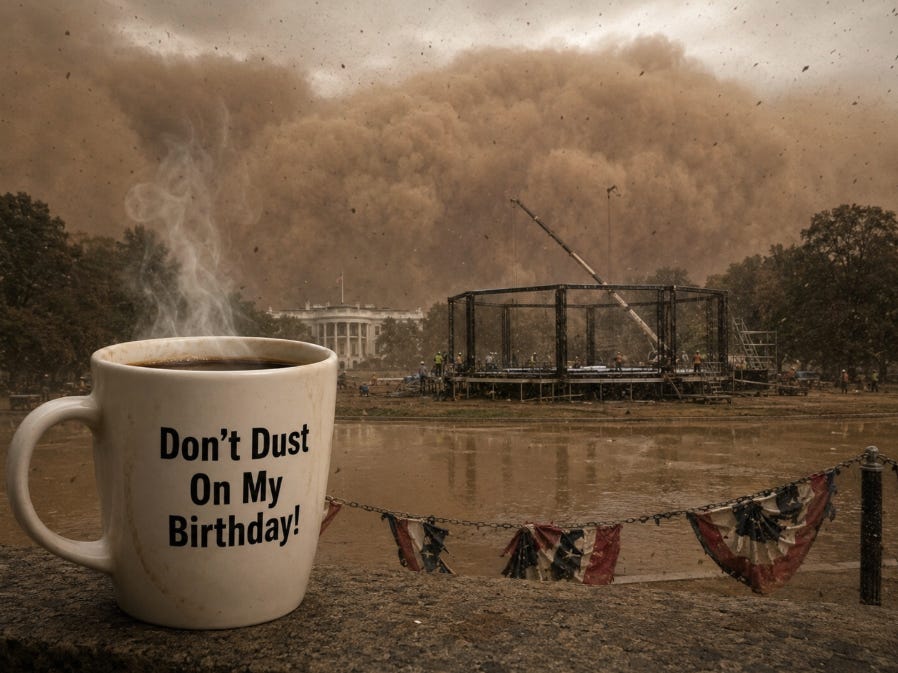
It is worth holding that sentence next to the gas pump, where the national average sits at $4.32 a gallon, up roughly 45 percent since the war began, and diesel at $5.45, up the same. Sit back and relax is advice from a man who does not buy his own fuel.
If you want to understand a conflict, read how three different newsrooms decide what belongs at the top.
That is why Ground News is useful here, not as a replacement for reading, but as a map of what you are reading. On a story like this, where the same exchange can be framed as a Pentagon success, a regional escalation, a Netanyahu maneuver, a market shock, or a ceasefire failure, the first question is not only what happened? It is who is centering what, and who is leaving what out?
Ground News lets you see that at a glance. It pulls coverage of the same story from across the political spectrum, compares headlines, shows source bias and factuality ratings, and surfaces blind spots: stories getting heavy attention on one side of the media ecosystem and little or none on the other. Their Vantage plan is the version built for people who really want to do this work. Vantage includes unlimited access to the Blindspot Feed, political bias, factuality, and ownership ratings, plus My News Bias, a dashboard that shows what your own reading habits are reinforcing. It also includes Ground News’ Alternative Media feature, which tracks how stories are being discussed outside traditional articles, with labels for bias, factuality, and ownership where available.

In other words: it helps you see the frame around the facts before the frame becomes the story. And right now, readers can get 40% off Ground News Vantage by using my link:
The New York Times leads with the American military account: Iran fired, the missiles were intercepted, no U.S. personnel were harmed, and the strikes have strained negotiations that last week produced a draft framework, sent to both capitals, then returned by Trump with tougher terms. It is a clean, sourced, Pentagon-shaped story, and it carries an admission worth keeping: while the President claims Iran’s military has been obliterated, U.S. intelligence assessments say Tehran still holds significant missile stockpiles. The official triumph and the classified caveat, printed in the same paragraph.
Al Jazeera moves Netanyahu closer to the center. Its correspondent reports plainly that the Israeli leader knows escalation in Lebanon could derail the U.S.-Iran talks, and that sabotaging a deal may serve his interests. Where the Times frames Lebanon as a complication, the regional desk frames it as a choice.
The Guardian widens the lens until you can see the whole table: Kuwait condemning Iran, the EU urging Israel to halt its Lebanon offensive, France’s Macron on the phone with Trump pledging a Franco-British naval mission “ready to be deployed as soon as an agreement is concluded,” and an emergency UN Security Council session called for the same day. Underneath the strike-exchange noise, in other words, an entire post-ceasefire security architecture is being pre-positioned, waiting on a signature that hasn’t come.
The same facts, three centers of gravity. U.S. reporting says Lebanon is complicating the deal. Regional reporting suggests Lebanon may be where the deal is being deliberately sabotaged.
Here is the pattern the three readouts share once you stack them, and it is more damning than any claim about who wants peace.
Both sides have decided the theaters cannot be separated, and both have said so out loud. Iran’s foreign minister, Abbas Araghchi: the ceasefire applies “on all fronts, including in Lebanon,” and a violation on one front is a violation on all. Israel’s defense minister, Israel Katz, from the opposite chair: “The Dahiyeh in Beirut is no different from the communities in northern Israel, if there is no calm in the north, there will be no calm in Beirut.” One welds Lebanon to the nuclear track from Tehran’s side; the other welds it from Jerusalem’s. The result is a single bargaining object that nobody can set down without setting down all of it.
A clean ceasefire keeps slipping away, and you do not have to read anyone’s mind to see it. You only have to take the principals at their word. The deal is hard not because the nuclear terms are unsolvable but because two governments have a shared interest in keeping the fronts linked, Iran to extract a Lebanon ceasefire it wants, Israel to keep a deal it doesn’t want from closing. The wreckage in between is the cost of that arrangement, and the people paying it did not negotiate the terms.
Which brings us to the small country that woke up Monday to sirens. Kuwait hosts American forces, so Kuwait gets the missiles meant for American forces. It activated its air defenses, condemned the attack in the strongest terms, invoked the relevant Security Council resolution, and otherwise had no say in the exchange that put its civilians under threat. Iran says it struck a base used to launch attacks against it; Kuwait says it was a direct assault on its sovereignty; both are describing the same morning. Saudi Arabia condemned it. The combatants negotiate over Kuwait’s head about a war Kuwait did not start.
When empires and regional powers communicate through missiles, the smaller countries become the punctuation marks.
Some of the most interesting movement this week is domestic, and it has an Oregon hook. Representative Maxine Dexter, in a long and openly adversarial interview with Mehdi Hasan’s Zeteo, laid out a position that would have been unusual for a House Democrat two years ago. She called the AIPAC money that flowed into her 2024 primary toxic and a mistake, pledged to take no more of it, called Netanyahu a war criminal, called Gaza a genocide, and said she will not support military aid, offensive or defensive, to Israel under its current government. She introduced a War Powers Resolution to end the Iran war and signed a thirty-Democrat letter pressing Secretary of State Rubio to apply U.S. nonproliferation standards equally and disclose what Washington knows about Israel’s own undeclared nuclear program.
Take it for what it is: Her answers were not always fully developed, especially on what concrete policy should follow from the nuclear letter, but the direction of travel matters. One of the clearest divides in Democratic politics right now runs between leaders managing the old pro-Israel consensus and newer members looking at Gaza, Lebanon, Iran, and Hormuz and saying, in Dexter’s words, absolutely not.
Her War Powers Resolution will likely fail, as seven before it have. She frames the votes as a way to put members on the record, which is the honest description of what these resolutions do when they cannot pass: they are not stopping the war, they are recording who would.
While Washington manages a Middle East crisis it helped create, the crisis at home is not politely waiting for the floor. In Scottsbluff, Nebraska, a farmer named James Maser has seen about one inch of measurable rain since last June. He is planting half his corn and pinto-bean acres this year because there is no water for the rest. The federal drought monitor rates nearly half his county in exceptional drought, the most severe category it has, and the other half in extreme. He is, by his own count, sixteen to twenty inches behind, a year and a half of missing rain. The snowpack that feeds the North Platte system, which irrigates these fields, sits at 37 percent of normal. In May, his crop-insurance agent saw something he had never seen: a well pulling air, two months before that should be possible, on a crop not yet in the ground.
Maser’s survival plan is prevent-plant insurance, the provision in a federal crop-insurance policy that pays out when a farmer is kept from getting the crop in the ground by the final planting date. The catch is in the design: it does not replace the harvest you lose. It refunds a fraction of it, roughly 55 percent of the guarantee for corn, 60 percent for most other crops, a figure set to cover the money already spent preparing to plant, not the income from the crop that never grew. It was built to soften a bad year, not to carry a farm through a year and a half of missing rain. His own insurance agent says it will not be enough for most farmers around him. That is the safety net, described by the man who sells it: present by design, inadequate by design, and now meeting a drought it was never sized for.
The war reaches him too, from a different direction. The same oil shock lifting Brent toward $94 raises his diesel and his input costs, on top of a drought that oil prices did not cause and cannot fix. Two pressures, converging on the same half-planted field. The household downstream, yours, mine, gets it as the grocery bill, because food does not care which crisis raised its price.
The war reaches him too, from a different direction. The same oil shock lifting Brent toward $94 raises his diesel and his input costs, on top of a drought that oil prices did not cause and cannot fix. Two pressures, converging on the same half-planted field. The household downstream, yours, mine, gets it as the grocery bill, because food does not care which crisis raised its price.
Here is the fact that turns this from a sad coincidence into an indictment. The last time the American plains turned to dust, the government built an institution to answer it. Hugh Hammond Bennett, the soil scientist who had spent years warning that the country was farming its topsoil into the wind, took his case to Congress in 1935, and the dust itself arrived in Washington to corroborate him, the sky over the capital going dim as he testified. Out of that moment came the Soil Conservation Service: a permanent federal commitment to keeping the ground where it belonged.
That agency still exists. It is now called the Natural Resources Conservation Service, and it is being cut. NRCS staffing has fallen from 11,542 in fiscal 2025 to 9,241 in fiscal 2026, with the next budget holding it there, roughly a fifth of the agency, gone, as the conditions that justified its creation reassemble on the plains. The Farm Service Agency, which actually administers disaster aid and crop programs, is on a steeper slope: 8,135 employees in FY2025, 7,320 in FY2026, a requested 6,009 for FY2027, better than a quarter of its staff over two years. USDA as a whole has shed more than 24,000 workers since January 2025, nearly 27 percent of its workforce, most of them through the deferred-resignation program that emptied the department of its experienced hands.
The drought is not a policy failure; no administration made it stop raining in Scottsbluff. The failure is what a government chooses to do with the predictable shock. In 1935, the dust reaching Washington built an immune system. In 2026, the same conditions meet that immune system mid-dismantlement, the cells of it taking buyouts, the descendant of Bennett’s agency cut by a fifth, the disaster aid that is flowing still settling losses from 2023 and 2024 while the 2026 crop sits unplanted. The body still knows how to respond, but is being instructed not to.
Here is the thing: the competence has not vanished. It has been reassigned. On June 14, the President’s eightieth birthday, and Flag Day, the UFC will stage Freedom 250 on the South Lawn of the White House. The cage is going up now, because apparently even the White House lawn needed a side hustle as a pay-per-view opportunity. It is a real, expensive, prime-time production: a genuine main event, Topuria against Gaethje for the lightweight title, simulcast on CBS and Paramount+, weigh-ins at the Lincoln Memorial. This is not a flailing, half-empty pageant you can wave away. The government can clearly execute spectacle at a very high level. The octagon has a project manager. The topsoil is understaffed.
The audience is being cast like the spectacle it is. Of roughly 4,000 tickets, about 1,200 are reserved for active-duty service members, free tickets, with conditions. To receive one, a soldier must meet a waist-to-height ratio under 0.55 and pass all service fitness requirements. The memos instruct commanders to choose “genuine UFC fans,” to favor junior enlisted and junior officers, and to recruit from outside Washington, the troops who will pay the most to travel to their own free reward, because the tickets are free but the trip is not. One defense official described the selection criteria to CNN in three words: “No fattys.” Another said leadership wanted attendees who would “look good” on camera. It is the Ft. Bragg method, soldiers handpicked for the backdrop by appearance and disposition, refined into a body-composition screen.
So consider the two citizens this week produced. One is a farmer the safety net was built to catch and is not catching, watching dust blow off a field he has already watered. The other is a soldier the state will photograph for its birthday party, screened by waistline and billed for the bus. The body that cannot staff the agency that keeps the plains from blowing away can, on short notice, run a casting call by waist-to-height ratio. Bread and circuses was apparently too elegant. We have gas prices and weigh-ins.
The last Dust Bowl eventually darkened the skies over Washington. It took a continent’s worth of ruined topsoil, lofted by wind, to make the capital look up.
This time the dust does not need to travel that far. It is already here, in the grocery bill and the diesel bill, in the insurance paperwork that won’t cover the loss, in the seed corn returned unplanted and the irrigation canals that open too late in a season already lost, in a well pulling air in May on a crop that isn’t in the ground. It is in a farmer in Scottsbluff doing the arithmetic of whether to plant at all, and a household three states away paying for his drought at the register without knowing the name of his county.
You cannot parade your way out of that, even if you build a cage on the lawn and screen the crowd for camera-readiness and tell the country to sit back and relax, the dust will still be in the bread. The government that met the last one by building something is meeting this one by staging a fight and offering tickets to thin people. Bennett brought the dust into the committee room to make them act. Ninety years on, the dust is already in the room. We are simply being asked not to notice it over the noise of the crowd.
How do you do it - “see” complex realities and convey them with evidence, context and astute analysis - every day?
One takeaway today is the importance of holding two streams of thought at the same time: Trump and MAGA loyalists are absurd, incompetent, corrupt, and often lethal, and they also have extraordinary power and wealth to achieve their goals.
So opposing them requires more than recounting how awful they are. We need to take on their vast propaganda machine and government by spectacle with a reality-based vision of America that inspires voters outside the MAGA cult.
Effective messaging has never been our strong suit. Focus on gas prices fails to capture the much more consequential, long term devastation of Trump’s reign. Pritzker, Ossoff and Newsome have compelling moments. The DNC and Congressional leaders: less so. It’s not beyond our capabilities.
If “no fattys” are allowed, how will Trump be able to see it?