


At six o’clock Thursday evening, President Donald Trump went on television to explain that Americans should no longer trust American elections. Around the same time, I was cleaning the house, tending to a baby with an upset stomach, getting three children ready for bed, and hanging a canopy over my daughter’s bed because she wanted something beautiful above the place where she sleeps. One of us was confronting the actual state of the union, it was not the president.
I know what I was doing when the news happened because the ordinary American day leaves its own meticulous record. It’s written in dirty dishes, unfinished work, half-eaten lunches, damp pajamas, children calling from another room, and the cold cup of coffee you have reheated twice but still have not managed to drink.
At eight o’clock Wednesday morning, federal judges in Washington state swore Roger Rogoff in as the new U.S. attorney for the western part of the state. Rogoff was a longtime prosecutor, a former judge, and the unanimous choice of the court after the Trump administration left the position without a permanent, Senate-confirmed leader. I was making breakfast for the kids and trying to earn a living, just like millions of other Americans. Fifty-four minutes later, Trump fired Rogoff.
His tenure as one of the country’s most powerful federal prosecutors lasted less time than it takes my children to agree on what they want for breakfast. The White House objected because the judges had appointed Rogoff without consulting the administration, although federal law allows courts to fill the position when an interim appointment expires.
The administration had neglected to fill the vacancy, the courts performed their lawful duty, and Trump responded by removing the person they selected before most people had finished their coffee. This is apparently what efficiency looks like once governing has been replaced by territorial aggression.
At six o’clock Thursday morning, House Republicans began considering a $95 billion package containing $60 billion for the Iran war, $13 billion for intelligence operations, $12 billion for farmers, and $10 billion for Trump’s election agenda. I was putting my daughter back into her bed for the fourth time.
The package is a remarkably concise summary of current Republican governance. First, spend billions prosecuting a war that drives up fuel, fertilizer, and transportation costs. Then provide assistance to farmers suffering from those costs. Finally, attach voting restrictions so the people paying for the entire arrangement have a more difficult time objecting to it. It’s the federal government’s version of breaking a window, offering to help sweep the glass, and billing the homeowner for a new security system.
Ten minutes later, Secretary of State Marco Rubio opened an international conference on the alleged resurgence of left-wing political terrorism. Representatives from more than sixty countries gathered in Washington to hear American officials describe the political left as an urgent global threat. I was watering the garden.
Rubio called far-left extremism a “distinctive and unique evil” driven by “a hatred for civilization itself.” Stephen Miller described it as a “fatal cancer to civilization.” The conference focused exclusively on violence from the left, despite research showing that far-right violence has historically been more frequent and deadly.
No one in attendance appeared troubled by the possibility that an administration using the machinery of international counterterrorism to classify its domestic political opponents as enemies of civilization might itself be displaying a symptom worth examining.
My garden, meanwhile, was engaged in a less theatrical struggle for survival. The plants needed water, they didn’t require an ideological designation, a visa restriction, or a multinational working group. They simply required someone to notice that they were thirsty and do something useful.
By eight fifteen Thursday morning, thick wildfire smoke had settled across much of the Midwest and East Coast. Millions of people were breathing air officially classified as unhealthy or hazardous. Detroit and Chicago were among the most polluted major cities in the world, while officials advised residents to remain indoors or wear protective masks.
I was trying to work while juggling a baby and two children who were disagreeing with each other so persistently that my ADHD brain had begun abandoning all attempts to maintain a continuous thought. The administration had spent the morning identifying threats to civilization. Civilization itself was sitting beneath a yellow sky, inhaling particles small enough to enter the bloodstream.
At eleven o’clock, another wave of American strikes against Iran was underway. The campaign had expanded beyond military installations to bridges, transportation routes, energy systems, an airport, and port infrastructure. Each strike was described as another step toward forcing Iran back to the negotiating table, although destroying the routes by which people travel, trade, and receive essential goods has rarely been mistaken for an invitation to calm conversation. I was making lunch for the kids while researching my next piece.
This is one of the stranger features of modern American life. Somewhere, military planners were selecting bridges in another country to destroy, while I was deciding what three small people might eat without initiating a constitutional crisis over sandwich composition.
The distance between those realities is enormous, but the bill will eventually arrive at the same kitchen table. War becomes higher diesel prices, more expensive groceries, larger farm subsidies, strained household budgets, and another congressional request for billions of dollars that the country somehow never possesses when a child needs medical care or a family needs housing.
At two forty Thursday afternoon, the Associated Press published an investigation into ICE’s rapid expansion. The agency has added roughly 12,000 agents and officers while relaxing some entry requirements, accelerating training, and offering large signing bonuses. Former officials have raised concerns about recruits beginning work before every layer of vetting was complete. I was back at work, caring for three children and attempting to negotiate with a migraine that had established sovereignty over the right side of my skull.
A few hours later, the Associated Press reported that the officer involved in the fatal shooting of a Colombian man in Maine had an alleged history of threatening and violent behavior. Court records and family accounts raised serious questions about whether he should ever have been entrusted with a badge and a gun.
At that point, I was planning dinner and building a temporary home for our potted plants while we installed irrigation. ICE had been given billions of dollars to recruit an enormous new enforcement force as quickly as possible. Speed was treated as proof of strength, while caution became an administrative inconvenience. The result is an agency expanding faster than its ability to determine who should be armed in the name of the United States government. My potted plants received more careful placement.
By six o’clock, Trump was standing before the country claiming there were shocking vulnerabilities in America’s election system. He revived unsupported allegations about the 2020 election, accused China of interference, demanded passage of the SAVE America Act, and offered no evidence that voting machines had been compromised or that votes had been altered.
The speech was nominally about an election that occurred six years ago, but its audience was being prepared for the election approaching in November. Trump was not proving that the last result was fraudulent. He was teaching his supporters to regard the next result as legitimate only if it pleased him. While the president worked to make the country suspicious of its own ballots, I worked to make my daughter’s room feel safe.
At six forty, U.S. Central Command announced that it had completed the latest major wave of strikes against Iran. I was cleaning, moving children toward bed, and fastening a canopy above the place where my daughter would soon refuse to remain.
Washington had spent the day firing a prosecutor, financing a war, classifying political opponents as threats, expanding an immigration force, bombing bridges, and undermining public faith in elections.
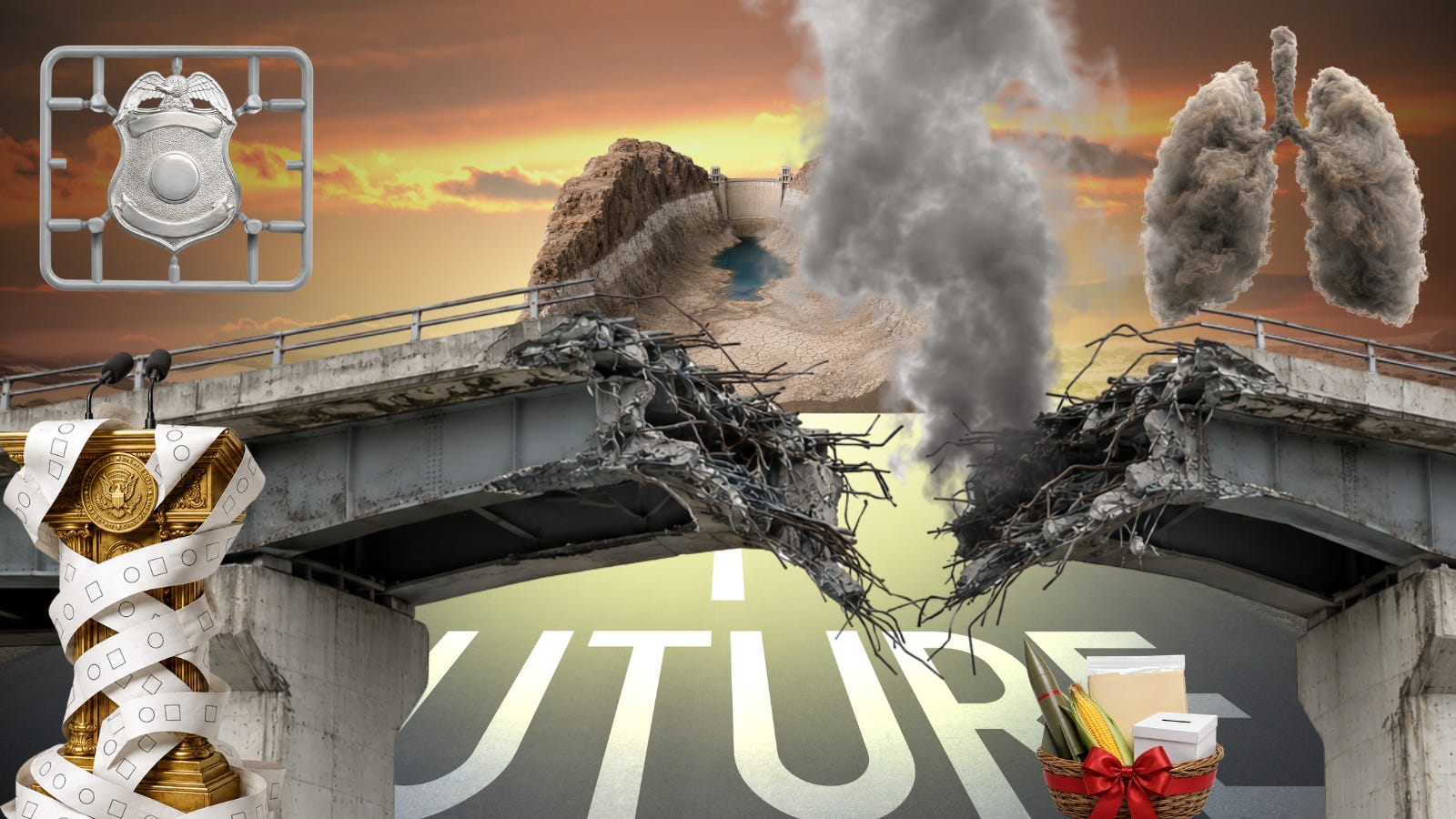
I had spent it feeding children, earning money, watering plants, working through a migraine, planning dinner, cleaning the house, tending to a sick baby, and returning my daughter to bed. Only one of those days produced anything resembling security.
At five o’clock Friday morning, a report announced that Lake Mead and Lake Powell had reached their lowest combined storage level in nearly seventy years. The two reservoirs provide water to major cities, tribal nations, farms, and millions of people across the West. They are now less than one-quarter full. I was waking from another thirty-minute stretch of half-sleep, carrying my daughter back to her bed, and deciding whether to attempt rest again or surrender and begin working.
This is where the country actually lives. It doesn’t live beneath the television lights where powerful men invent enemies, declare emergencies, and call the resulting panic leadership. It lives in kitchens, gardens, bedrooms, workshops, and unfinished backyards, where ordinary people continue performing the small acts of maintenance upon which everything else depends.
The country is not held together by the men who frighten us for power. It’s held together at five in the morning by people who have slept for thirty minutes, return a child to bed, and get up anyway.
Dear Shanley, You are the patriot who deserves the opportunity to solicit approval from a prime time TV audience. Each word you carefully craft into alignment is more important than the entire
venomous effluent dumped last night by our grimacing president. My 90th year is more than half
gone. I am no longer capable of great things. I am able to discern greatness in others. My mother created a quality life for me and my sister. She did it by observing and acting much as you do every day. I was A.D.H.D.. Of course I still am. I think she may have been also. I love feeling as if I know how well your life will play out I have never been "popular". I did attain and maintain respectability
and utility for those I sought to help. When in the presence of a MAGA Republican I attempt silent
observation.
You are wonderful.
Thank you for returning us to reality.