


Ezra turned one this week, and yesterday we brought his first birthday party to Pa’s house. Pa is my husband’s grandfather. He has ALS, and whenever possible, we bring our celebrations to him so there can be another happy memory in his home. Each one becomes more valuable as time carries on, and we want to cherish as many as we can.
He’s a Vietnam veteran and one of the kindest people you could meet. He helped shape the moral character I love so much in my husband, the same character my husband is trying to pass along to our children. I think about that when I watch our family together, something a person gives the world can keep moving through other people, quietly influencing how they love, how they show up, and what the children watching them learn to expect. Yesterday, that kindness had another birthday to attend.
Ezra was adorable and exhausted, having missed the nap that ordinarily makes being a person a manageable undertaking. He promptly fell asleep in the car on the way home, he had attended his party, accepted our affection, and fulfilled his obligations. Any further processing of this enormous milestone would have to be handled by management. I’m still processing.
Speaking of things I haven’t emotionally authorized, he is becoming a walking baby. Crawling remains faster at his current experience level, so he has wisely retained it as his primary means of transportation, but more and more often, he takes a few steps. Recently, he walked almost three feet. I was incredibly proud and also furious that the universe could allow this to happen to my sweet baby pie.
I will forever cherish the sound of his little hands and knees storming across the floor, then looking up to find that bright smile coming toward me. There are moments when it feels as though my eyes have become a Polaroid camera and I’m trying to take enough pictures to keep every version of my children somewhere safe. I love the little boy he’s becoming. I would also like to keep the baby, please. I don’t see why this requires a negotiation. He’d already been given an opportunity to smash a cake before the party, although he seemed more interested in watching us than in the cake itself. Perhaps he was assessing the people who had handed him an entire dessert and then gathered around to observe. Fair enough, we are a lot.
The kids are about to return to school, and all this growing has arrived alongside the familiar end-of-summer interrogation I conduct inside my own head. Did I do enough? Did I show them, in ways they could actually feel, how much I love them? How much of our time went to getting through the day, and how much did I manage to notice while we were living it?
There are things I wish I had done differently. I can acknowledge that. I can also spend the next several weeks punishing myself for them, although I suspect my children would prefer an available mother to one occupied full time with the prosecution of her previous shortcomings. Luckily, I have people who encourage me to be better and give me somewhere to stand while I figure out how.
My daughter recently went four nights without trying to crawl into bed with me. My back and neck would like to issue a statement of appreciation. The rest of me is having a harder time. There’s something about waking up beside a tiny person who has sought you out for safety. Finding that little body settled against you, content in the absolute conviction that this is where she belongs, can make a person remarkably forgiving of whatever has happened to her spine. I miss her.
Which is complicated, because my daughter and I have also been struggling lately. She has a strong will, a warm heart, and seemingly no chill whatsoever, particularly during moments when I have specifically requested chill. She’s my baby girl, my firstborn, my perfect, improbable little person, and she can wear me all the way out.
She has also entered a phase I would describe as thoughtful helplessness. This previously fiercely independent child, who once considered my assistance a personal insult, has decided she cannot possibly remove her clothes for a bath, retrieve a drink from the counter, or put on her own socks and shoes. I suspect she’s noticed that attention tends to flow toward whoever currently needs it and has made the perfectly reasonable strategic decision that she currently needs it. All of it, preferably. Her understanding of socks appears intact. What she may need is reassurance that being capable still leaves plenty of room to be somebody’s baby.
When she was Ezra’s age, I worked away from home full time. Sometimes, by the time I saw her, I could hardly bear to spend any of our remaining hours making her unhappy. Saying no felt especially difficult when I’d spent the whole day wanting to say hello. I understand that tired mother who missed her baby, I also recognize the places where guilt began making decisions that needed a little more thought.
Now my daughter is discovering her confidence and developing opinions she is prepared to defend before any available court. I want her to keep that spirit, I also need us to survive an ordinary day in which other people occasionally have needs. We get frustrated, we bicker, and I remind myself that I’m the adult and try to hold a boundary while remaining available for comfort. Sometimes I have an apology to make, too. Her father helps both of us find our footing, we’re getting there, with some considerable noise along the way.
My oldest makes me prouder every day. He has his struggles, as do I, but I see him taking real steps toward improving. That’s no small thing at ten years old. Growing up asks an awful lot of people who have barely had time to get used to being here. I want to notice his effort as carefully as I notice the things that still need work.
Then there is my husband, because of course there is. He keeps finding ways to surprise me, to work on himself, and to make our situation better. As summer ends, we’re learning how to find peace in time together while navigating financial challenges, medical questions, and the ordinary work of raising a family. Sometimes we’re changing so many things that it becomes overwhelming. Sometimes progress slows, and we have to remember that standing beside each other counts for something, too. Through the hard and the easy, we stay.
Now we get to design a home together, with little pieces of both of us and the family we’ve built. I couldn’t be more grateful. I could, however, be considerably less frustrated by what everything costs. If you couldn’t afford hardwood, you used to buy vinyl, we all understood the arrangement. Now even vinyl flooring seems to cost more than my husband’s truck, and truthfully, I would take the truck. It’s lasted forever. At these prices, I would appreciate similar ambition from the floor.
The fairy garden is on hold while we wait for more dirt and, realistically, more money to spend on plants. Apparently my imagination has once again submitted a proposal that exceeds the available budget. My husband still tends the forest. He removes ivy from the trees and selectively thins crowded places to give new growth room. Recently, he said to me, “The trees appreciate me, I can feel it.” I don’t think I have ever been more in love with him.
My woodland hero. The man who somehow finds time to care for the trees, help build the things I dream up, and remain beside me when I abruptly decide the kitchen must be reorganized immediately for reasons that have become extremely clear to me and perhaps less clear to everyone else. I see something of Pa’s example in the way he moves through our life: the willingness to notice what needs attention, to do what he can, and to keep trying. Our children get to grow up around that. Maybe that’s why the news from New Zealand stayed with me this week.
On September 1, the Department of Conservation announced that the official kākāpō population had reached 325 birds, a high for the modern recovery program. Ninety young birds from this year’s breeding season joined the count after the youngest surviving chick reached 150 days old, the milestone used for sufficient independence. Producing that many chicks took sixteen years during the program’s early days. This year, they achieved it in one season.
And these are birds worth getting acquainted with. Kākāpō are large, green, flightless parrots with owl-like faces, active at night. The people who care for them describe distinct personalities: friendly birds, grumpy birds, explorers, playful birds, and individuals deeply committed to food. Somewhere in New Zealand, a rare parrot is apparently being difficult while another is looking for a snack. I’m already emotionally invested.
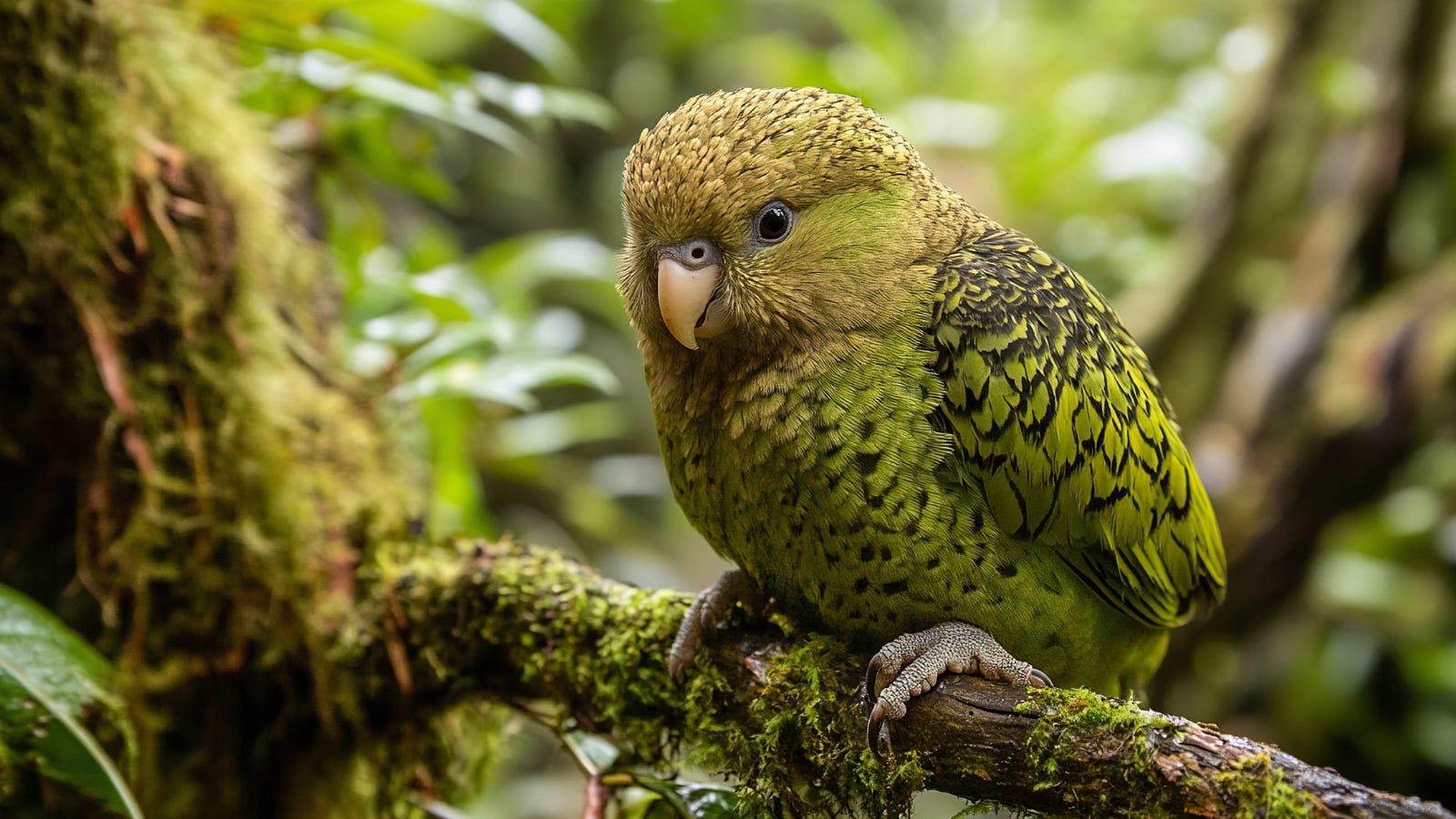
Human hunting, habitat loss, and introduced predators devastated a species once widespread across the country. When the modern recovery program began in 1995, just 51 remained. The Department of Conservation and Ngāi Tahu have spent decades rebuilding a future from that frighteningly small beginning.
The practical work is extraordinary. Staff and volunteers carry backpacks weighing up to twenty kilograms (44 lbs) across steep island terrain to replenish feeding stations. They track birds, safeguard habitat against predators, and care for vulnerable eggs and chicks. Artificial incubation can require attention around the clock. Some females that were themselves hand-reared have since raised healthy chicks of their own. The effort to save one small life can reach forward into lives that didn’t yet exist when someone first stepped in.
This year, a nest camera followed Rakiura, a twenty-four-year-old female raising foster chicks beneath the roots of a rātā tree. She’s used that nest site since 2008. Rangers have worked over time to help keep it safe, dry, and warm. In May, the youngsters began exploring outside. I keep thinking about that small home beneath the roots, the years of attention around it, and another generation finding its way out into the forest.
The species remains critically endangered. More protected habitat is needed, and this year’s achievement carries the weight of earlier losses and years of patient work. The team is also testing where it can safely reduce intervention, using remote monitoring for fewer nest checks and adjusting supplementary feeding. Care continues to change as the birds’ prospects improve.
For a moment, I want to stay with what’s happened: ninety young birds have reached this milestone. There are more lives here to protect, more personalities to discover, and more possibilities for the species’ future. People kept working long enough for that to become true. That feels like something worth carrying into Sunday.
I think about the continuity in it. Someone cared for a chick that grew up to raise chicks. Someone learned something useful and passed that knowledge along. People kept tending a place so another generation could live there.
Pa has given our family something that travels in a different way, through the example he set for my husband and the example our children are watching now. They notice who comes when they need help, who apologizes, who keeps trying, and whether being tired or frustrated becomes an excuse to be cruel.
I want to be worthy of that attention. I want to meet my children as they are now, even while I miss the smaller versions of them. My daughter can need reassurance and encouragement toward independence in the same afternoon. My oldest can struggle and still make progress worth celebrating. Ezra can take another step while his mother experiences several entirely unnecessary feelings about it. We’re all allowed to keep learning.
Yesterday, we brought another happy memory into Pa’s home. My husband is tending the forest. People far away have spent decades helping a vulnerable species reach another breeding season, another generation, another chance. I’m a lucky woman. Even with the unanswered questions, the bills, the unfinished projects, and the moments when everyone appears to have reached the end of their patience simultaneously, I get to be here. I get another chance to listen, to be more patient, and to try again after an apology.
My husband believes the trees appreciate him and I can’t tell you how much I love that he is paying enough attention to feel it. I want our children to carry that kind of attention into the world: to notice the lives around them, to understand that what they do matters, and to offer care wherever they can. Pa has already shown us how far a little of that can travel.
Read and enjoyed, all the way from over here in New Zealand
What a lovely essay and wonderful description of your husband’s feeling that the trees appreciate him and his attention to them. You certainly don’t need anyone to point out that you are a fortunate woman, your gratitude is in every word you write about your beloveds. Thank you.