

Good morning! Donald Trump took Sunday off from the campaign trail. Early that morning, he announced on Truth Social that an energy ceasefire between Russia and Ukraine was in effect immediately. “Both parties have agreed,” he wrote. A Ukrainian official told CNN that Kyiv learned about the agreement when everyone else did, by reading the president’s feed. The Kremlin had confirmed no such agreement. When reporters asked the White House for details, it referred them back to the post.
Within hours, Russian forces struck a power plant in Kharkiv. Speaking at the Warsaw Security Forum on Monday, Volodymyr Zelenskyy offered a dry assessment: “It was clear that Putin does not read Truth Social.”
Also on Sunday evening, a Russian missile struck a residential area near grocery stores in Pisochyn, outside Kharkiv, killing three people, including a 16-year-old boy, and injuring at least 25.
To understand what was behind this abruptly proclaimed ceasefire, follow the diesel.
The Iran war, now in its eighth month, has choked global energy supplies. Diesel hit a record $6.53 a gallon on Sept. 22, according to AAA, and was still at $6.28 on Friday. Trump’s approval rating is in the low 30s. Pew puts him at 30 percent, almost exactly where he finished his first term in January 2021. The midterms are three weeks away.
So on Friday, a call with Vladimir Putin that was expected to address a possible case of plague in Russia produced something quite different: a diesel deal. Trump announced that Russia would supply 300,000 tons immediately, another 500,000 in November, a million more after that, and three million more “within a short period of time.” Treasury promptly issued a six-month license easing sanctions on Russian diesel. Putin’s envoy Kirill Dmitriev celebrated on X. According to AP, the announcement came while Steve Witkoff and Jared Kushner were meeting with Ukrainian officials in Miami to discuss a peace proposal.
The announcement left out some context. Trump signed a sweeping Russia sanctions law just last month, aimed squarely at the energy revenues funding Putin’s war. Congress banned Russian energy imports in 2022, with Marco Rubio among the Republican supporters. And the United States has been a net exporter of diesel for years.
Then there is the arithmetic. The entire Russian package, spread over several months and intended for both American and global markets, amounts to roughly nine days of U.S. distillate consumption. The first shipment wouldn’t cover even one day if every gallon came here.
So a country that already exports diesel is easing sanctions on an aggressor in exchange for a promise of relatively modest additional fuel supplies, three weeks before an election.
Trumponomics: a press release with a tanker attached.
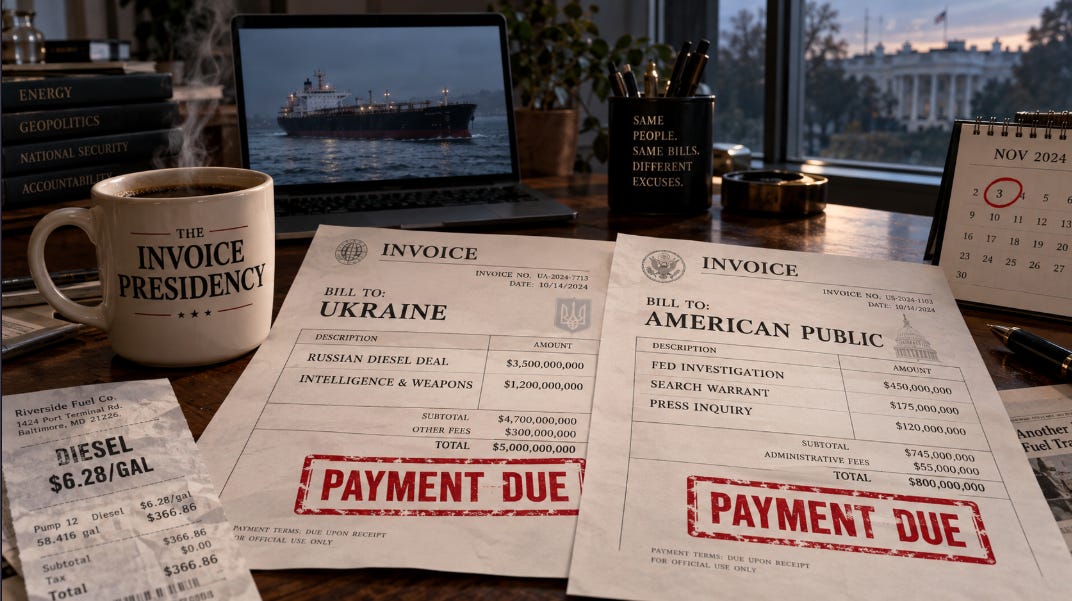
Ukraine’s strikes on Russian refineries are among its most effective economic weapons against Moscow, and continued attacks could disrupt the diesel supplies Trump was counting on. So Kyiv got the invoice.
Trump described his instructions to Zelenskyy: “Don’t hit refineries. There’s plenty of targets.” Then he gave his reason. Ukraine’s strikes, he said, would hurt American farmers and ranchers, so “he better damn well stop.”
According to the Kyiv Independent, American officials called senior Ukrainian military and government officials over the weekend with threats to cut off intelligence sharing and PURL, the program through which European allies buy American weapons for Ukraine. Deputy head of the Ukrainian President’s Office Pavlo Palisa confirmed the threats to the Financial Times, and two European officials independently confirmed them to CNN. PURL attracted $6.7 billion in contributions in its first year, primarily from NATO allies. Washington is threatening to withhold weapons its allies are paying for, including equipment Ukraine needs to defend its cities.
The proposed ceasefire is hardly balanced either. Ukraine has one oil refinery, and Russia damaged it long ago. Protecting refineries while leaving power plants and electrical grids exposed would primarily benefit Moscow. Ukrainian MP Oleksiy Goncharenko acknowledged on CNN that the Middle East, not Ukraine, is the principal driver of soaring fuel prices. Then he suggested something more useful than Trump’s announcement: let Russian diesel reach the market in exchange for an end to Russian attacks on Ukraine’s power grid and Black Sea ports, with Ukraine refraining from refinery strikes. That would be an actual trade, with something for each side. Trump’s proposal would offer Moscow diesel revenue and protection for its refineries, while Kyiv faces threats to its military assistance without comparable guarantees.
There’s an irony here too. When Trump and Putin discussed an earlier energy ceasefire in March 2025, the Kremlin demanded that foreign military aid and intelligence sharing for Ukraine “completely cease” as a condition for broader progress toward peace. Washington didn’t agree to that condition then. Now American officials are reportedly threatening to withhold both forms of assistance to force Kyiv to stop attacking Russian refineries.
So the bill for the Iran war’s fuel shock is being presented to Ukraine, a country that neither started that war nor controls the Strait of Hormuz.
Over the weekend and into Monday, British broadcasters tried to make sense of it all.
Former Prime Minister Boris Johnson called the diesel deal “sickening,” accusing Trump of making American drivers bankroll Putin’s war to lower pump prices. Coming from the man who elevated the son of a former KGB officer to the House of Lords despite earlier security concerns, that is quite a review.
The British government was more careful, although its position was clear. Asked directly by LBC whether the UK supported the diesel deal, Defence Secretary Wes Streeting replied: “We support President Zelensky.” On the BBC, he dropped the diplomatic cushioning: “We don’t support that decision.” Britain, he added, was strengthening sanctions against Russia.
On Times Radio, John Lough, a former NATO representative in Moscow, suggested the Kremlin views Trump as “living on borrowed time,” useful for now but unlikely to deliver everything Russia wants. The presenters wondered aloud whether Downing Street was simply hoping to get through the midterms and whatever comes afterward. One suggested that perhaps it was time to stop being surprised.
On the Continent, the language was blunter. At the same Warsaw forum where Zelenskyy delivered his Truth Social line, Polish Prime Minister Donald Tusk warned that anyone suggesting Ukraine shares responsibility for the war is handing Putin a gift. Poland remembers when Nazi propaganda blamed it for Germany’s invasion, he said. Now the same arguments are coming from Moscow and “more and more often in some of our capitals.”
As for politicians working to weaken Ukraine, Tusk offered three possible motives: “treason, stupidity, money.” He named no individuals, but made his position unmistakable: “Ukraine is fighting for survival. Russia is fighting for domination.”
He was diplomatic about Trump himself, calling the energy truce a proposal that gave hope and blaming Putin for answering it with missiles. His travel plans said the rest. Tusk is heading to Brussels this week to press European partners for tougher sanctions on Russia. The same weekend Washington eased sanctions on Russian diesel, Warsaw went looking for harder ones.
This is what losing the predictability premium looks like. London carefully manages its disagreements with Washington. Europe invests in military capabilities it can control. Moscow, in Lough’s assessment, takes advantage of the opportunities available while Trump remains willing to provide them.
The United States still possesses enormous power. But power and credibility are not the same thing. American commitments increasingly look as though they come with expiration dates, subject to the next announcement, the next phone call, or the next election.
Other invoices went out this week at home.
The Fed. Trump has appointed three administration officials to investigate mortgage-fraud allegations against Federal Reserve Governor Lisa Cook, whom he has already tried to fire. She’s been ordered to appear at a closed-door White House hearing on Nov. 5, two days after the election. Her lawyers question whether the proceeding will be genuine or “simply a box checking exercise.” One of the committee members is the chair of the Equal Employment Opportunity Commission. Apparently, mortgage fraud is now an equal employment opportunity.
The congresswoman. On Monday morning, Homeland Security Investigations agents searched Rep. Ilhan Omar’s Washington-area home, just 22 days before she’s up for reelection. Homeland Security Secretary Markwayne Mullin has repeatedly accused Omar of marrying her brother to facilitate his immigration, an allegation she denies and that no publicly disclosed evidence has substantiated. The New York Times reports that investigators have also explored her finances, campaign funds, and contacts with a foreign citizen. The Justice Department confirmed a judge authorized the search but hasn’t disclosed the suspected offense. Omar has not been charged.
Responding on X, Omar called the search an attempt to target political enemies and weaponize federal law enforcement. “I will not be silenced,” she declared.
The timing matters. Justice Department practice has long discouraged unnecessary, overt investigative actions against political candidates within 60 days of an election. It isn’t an absolute prohibition. The Washington Post reports, citing a government official, that investigators consulted the Justice Department’s Public Integrity Section and Attorney General Todd Blanche approved the search. That addresses an important procedural safeguard, but the department still hasn’t publicly explained why the search was necessary before Election Day.
In 2024, Trump and his lawyers accused Jack Smith of violating that same election-period restraint. Now the shoe is on the other foot, and federal agents are at a candidate’s front door.
The witness. The Justice Department’s Civil Rights Division is presenting evidence to a grand jury examining whether Cassidy Hutchinson lied to Congress about January 6. Her most famous account, of Trump lunging toward the steering wheel of his presidential vehicle, was explicitly secondhand. She testified that Tony Ornato told her what happened. Proving the incident never occurred would not, by itself, prove she lied about what Ornato told her. Prosecutors are reportedly examining other testimony as well. No indictment has been announced. Why the Civil Rights Division is handling a congressional false-statements investigation remains unexplained.
The press. The Justice Department has opened an antitrust investigation into five television networks, including Fox News, after they temporarily suspended pooled White House coverage in solidarity with CNN, which the administration had excluded. The broadcasters challenged restrictions on press access. Now they’re answering government demands for records about that challenge.
Four proceedings, four different legal standards, and four subjects with histories of conflict with Trump. Their timing doesn’t establish a coordinated political strategy, but the administration’s investigative choices deserve scrutiny.
Not every Republican wants Trump on the campaign trail. One senior Republican involved in a competitive House race told Politico that Trump’s team had called four times offering a visit. “I’ve said no.”
The promised checks, Russian diesel, and investigations may take months to sort out. But the announcements are arriving now, while voters are making their decisions.
Make the mess, assign the bill, and hope voters forget who sent it.
Trump’s “alliances,” just like his friends, can be thrown under the bus at any moment. Alliances, regardless of history, can be immediately terminated if there’s a seemingly more attractive option, one involving personal enrichment for Trump or his family. The enrichment may be in cash or in reflected glory. Trump really identifies with Putin: powerful & merciless.
Excellent synthesis of a treasonous, cruel and incompetent regime in pursuit of unaccountable power and self-enrichment. Impeachments or arrests of the key MAGA operatives are long overdue.