

Good morning! There’s a version of “Making America Great Again” that involves manufacturing jobs, strong unions, and a shrinking trade deficit. And then there’s the version we’re actually getting: gutted air standards, one-sided regulatory accounting, and an administration that would very much prefer you not look too closely at either the smokestacks or the ballot box. Turns out you can’t have robber barons without also handling the annoying democracy part; history’s original Gilded Age solved that problem with poll taxes for the ballot box and Pinkertons for the picket line. This week’s models are a bit more bureaucratic, but the instinct’s the same: control what gets counted, and you control the outcome, whether the ledger in question is a cost-benefit analysis or an election. We’ve written before about which decade Trump considers America’s actual golden age (spoiler: it ends before federal child-labor protections actually stuck). Today’s stories are what that nostalgia looks like once it’s out of the speeches and into federal policy.
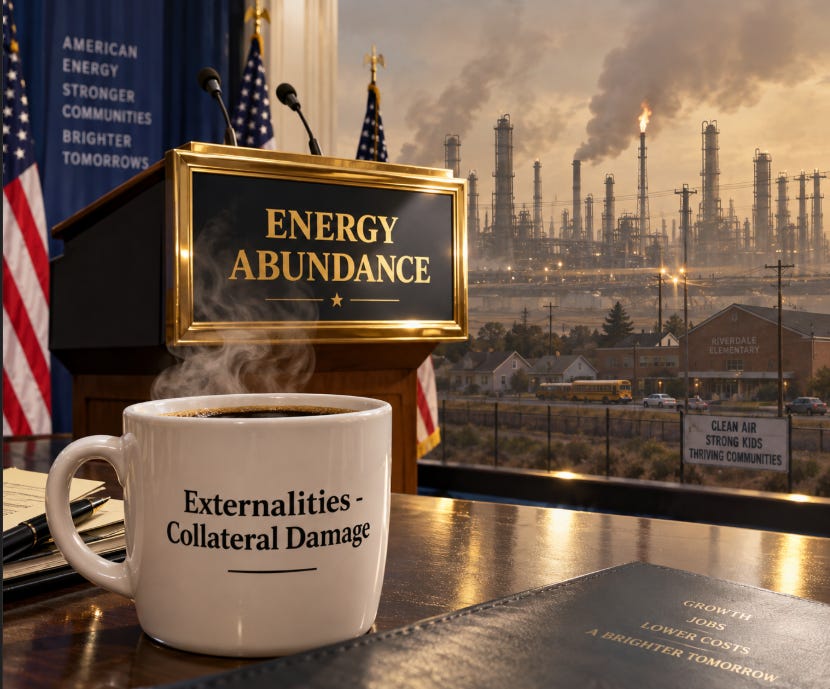
We’ll start in Houston, where Environmental Protection Agency Administrator Lee Zeldin joined Interior Secretary Doug Burgum and Energy Secretary Chris Wright yesterday at something called the G20 Energy Abundance Ministerial.
“Energy Abundance” is one of those phrases designed to arrive with its own applause track. Who could possibly object to abundance? Abundant electricity sounds lovely. Abundant groceries would be nice. Abundant money in my checking account remains an underdeveloped federal initiative.
At the gathering, Zeldin announced that EPA had finalized repeal of most of the Biden administration’s 2024 greenhouse-gas requirements for fossil-fuel power plants while proposing to eliminate the remaining federal greenhouse-gas standards as well. EPA calls it the largest power-sector deregulatory action in American history and estimates that the finalized portion will save Americans and the power sector as much as $310 billion.
An impressively large number, and sitting on the other side of the table another impressively large number.
When EPA finalized the rule in 2024, its regulatory analysis estimated approximately $370 billion in net climate and public-health benefits through 2047: about $270 billion in climate benefits and $120 billion in health benefits, against roughly $19 billion in compliance costs. Expressed annually, EPA estimated about $20 billion in net benefits.
Obviously, these are not dueling price tags calculated under identical assumptions. Different administrations are using different regulatory judgments and methodologies, but the disagreement itself is instructive.
The Biden EPA’s ledger counted what pollution controls would cost the industry and what reduced pollution might save everybody else. The Trump EPA emphasizes what businesses, utilities and consumers could save by avoiding those regulatory costs. The New York Times reported in its coverage of the event that EPA under Trump has stopped estimating the public-health benefits of reducing pollution in the cost-benefit analyses used for clean-air rules and instead estimates the costs businesses incur complying with them.
EPA’s 2024 analysis projected that in 2035 alone the power-plant standards could avert as many as 1,200 premature deaths, 870 hospital and emergency-room visits, 1,900 new cases of asthma, 360,000 episodes of asthma symptoms, 48,000 missed school days and 57,000 lost workdays.
Simply eliminating a number from a regulatory ledger does not eliminate the thing being measured.
This brings me back to an essay I wrote a year and a half ago.
On April 2, 2025, Trump’s “Liberation Day” the president offered an unusually specific clue about the economic past he admired. “From 1789 to 1913, we were a tariff-backed nation,” he said, describing the United States during that period as “proportionately the wealthiest it has ever been.” He said the government collected so much tariff revenue that officials struggled to figure out what to do with it.
I wrote then that Trump’s nostalgia sounded less like a return to the 1950s than a trip considerably farther back: toward the political economy that culminated in the Gilded Age, with its factories and railroads, steel and oil, spectacular industrial expansion and spectacular private fortunes.
The essay was about tariffs.
Eighteen months later, the question becomes what exactly does “great” look like?
Trump repeatedly describes prosperity in physical, industrial terms: factories, steel, coal, oil, mines, drilling, ships and domestic manufacturing. His administration routinely treats environmental restrictions on those activities as economic constraints to be reduced or removed. EPA’s own fact sheet yesterday described the previous requirements as regulatory barriers and said repealing them would allow fuller use of coal and natural gas.
Which is why the phrase “Make America Grimy Again” keeps wandering into my head. Grimy is doing double duty. There is the literal grime and also the figurative grime: somewhere in the semantic neighborhood of sordid, grubby, and squalid. The grubby business of deciding which costs count, which ones disappear from the ledger, and who gets left holding the bill.
We keep revisiting an older argument about industrial prosperity and asking how much of its collateral cost ought to be placed on the books of the industries creating it, and how much can simply be handed to somebody else.
Space supplied us with an illustration yesterday.
A UCLA analysis using satellite observations identified an Energy Transfer gas-processing site near Shreveport, Louisiana, as the largest individual methane “super-emitter” in the three major American oil-and-gas basins the researchers examined. From January 2025 through June 2026, the facility emitted methane at an average measured rate of 1.56 tonnes an hour, about fifteen times the threshold used by EPA’s Biden-era super-emitter program.
Energy Transfer was connected to four of the fifteen highlighted sites and to 75 methane plumes during the study period, three times the number attributed to the next operator.
Its chief executive, Kelcy Warren, has also donated millions of dollars to Trump’s political efforts. That relationship is relevant context, but it is not evidence that Warren’s donations caused the regulatory changes. At the same time federal methane reporting and enforcement requirements are being rolled back, independent satellites are becoming good enough to identify enormous releases that previously could remain largely invisible. UCLA researchers found 1,097 methane plumes across the Permian, Appalachian and Haynesville-Bossier regions during their study period, although publicly available information allowed them to identify a potentially responsible operator for only about one-third of them.
This is where our Lords and Serfs series has another rabbit hole waiting for us, because “cheap energy” becomes a much more complicated concept once you ask cheap for whom?
The regulatory compliance cost appears on the utility or producer’s books. The asthma attack does not. Neither does the parent’s lost shift, the local road repairs, the diminished property value, the public-health expenditure or every future cost associated with the carbon and methane released into the atmosphere.
Economists have a perfectly respectable word for that: externalities.
Communities living beside heavy industry sometimes have another: home.
EPA’s own 2024 environmental-justice analysis acknowledged that climate and pollution burdens fall disproportionately on some communities and specifically examined the effects of its power-plant standards on communities with environmental-justice concerns.
We are going to come back to that in much greater depth; sacrifice zones, rural communities desperate for jobs, urban neighborhoods hemmed in by industry, abandoned wells, public-health costs and the peculiar magic by which an expense can vanish from one balance sheet merely by appearing on someone else’s.
This morning another ledger is demanding attention.
The Supreme Court on Monday rejected the Trump administration’s attempt to impose new restrictions on mail ballots ahead of November’s midterm elections, allowing states to proceed under their existing systems.
Great news, but that proposal was only one part of a much broader federal effort.
The Justice Department has sued 30 states seeking unredacted voter lists containing information including driver’s-license numbers and partial Social Security numbers. At the time of the Times report, the administration had lost 23 of those cases.
Federal agencies are also reviewing voter rolls for possible noncitizens and raising questions about voting-machine security. And FEMA has demanded changes in state election practices while threatening the possible loss of tens of millions of dollars in terrorism-prevention funding.
Nothing says “federalism” quite like discussing election administration while somebody from Washington is holding the homeland-security grant application.
Presently, only 34 percent of American adults say they trust government certifications of election results “a great deal” or “quite a bit,” down from 40 percent in 2024.
So Monday’s Supreme Court ruling closed one door, but did not end the larger effort to reshape how elections are administered before November.
The EPA story is about who gets to define a cost. The election story is about who gets to write the rules. Underneath both is the question we keep returning to in Lords and Serfs: who receives the benefit, who absorbs the cost, and who gets enough power to decide the difference?
We’ll come back to both before November.
As Mary’s essay underscores, the new rulers of the universe have vast wealth to buy political power. They also have ownership of major media to deceive with messaging and distract with circuses; corrupt foreign tyrants on their team; and an ideology of supremacy that fortifies their indifference to laws and those not like them.
We the people (serfs…) have the power of numbers and personal agency to say no, your agendas are unacceptable. Start with the midterms. Check your voter registration today. Vote as early and safely as possible. Tell your friends your plan to vote and urge them to set their plans. Volunteer to be a poll worker or with an election protection team.
It’s a long game to restore capable, ethical national leadership dedicated to the aspirations our founders expressed in the Declaration of Independence and Constitution. With intent and effort, we - the American majority - can do this.
Of course, the profound irony of trump’s desire to “restore” the ‘gilded age’ is the bleak reality of that period of teetering wealth during that period built on the backs of the poor. Not even “trickle down” aided those who didn’t benefit from the giant funds that rained on the already very wealthy… not the child laborers (some as young as 5) toiling in dangerous factories IF they could find a job “better” than begging on a street corner. Or the women crammed into rooms full of sewing machines and closed windows & locked exit doors (ie triangle shirt factory). Men working brutal hours in unsafe factories… but with trump’s current vision I imagine he & his billionaire buds would be very happy with the restoration of these inequities so long as they are assured that their trillionaire status is clearly on the horizon.