

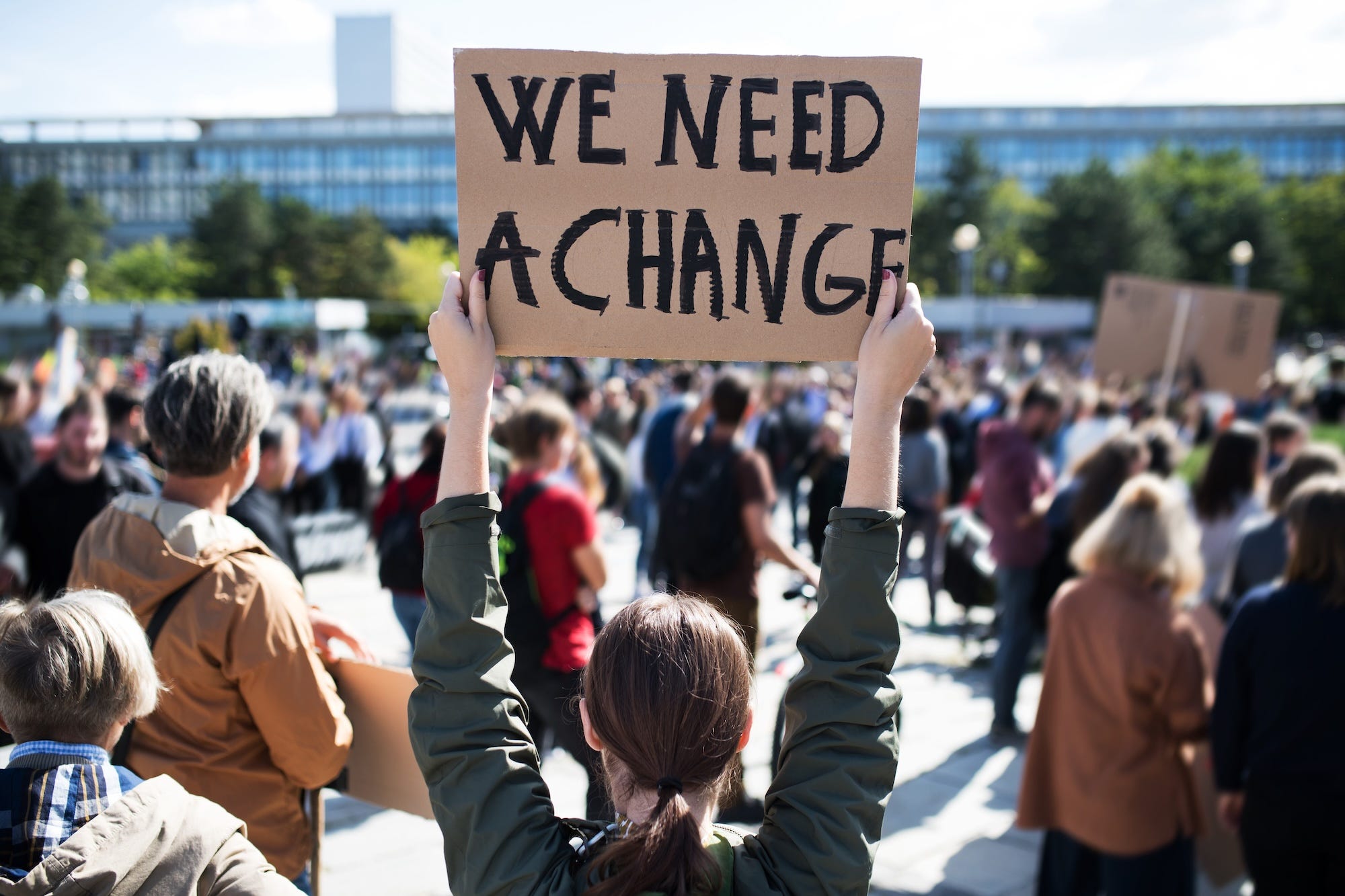
On a warm evening in Santa Fe, New Mexico, hundreds of people marched to the state capitol building. They carried signs. They chanted. They were utility customers and community organizers and indigenous rights advocates and young people who had grown up in some of the poorest communities in one of the poorest states in the country. They were marching because a private equity firm headquartered in a Manhattan skyscraper had filed an application to acquire their electrical grid, and they had decided that the people who had never set foot in New Mexico should not be the ones to decide New Mexico’s energy future.
They were not marching because someone told them to. They were marching because they had looked at what was being proposed, the confidential documents, the data center connections, the ratepayer costs, the 40 percent of current customers already living below the poverty line, and named it for what it was. Jonathan Juarez, a young organizer with Youth United for Climate Crisis Action, put it plainly: this is not a partisan issue. It is billionaires versus the people.
That framing is worth pausing on. Not Democrats versus Republicans. Not government versus market. Billionaires versus the people. It is the feudal arithmetic stated without apology, by a young man born into five generations of resistance to what he called nuclear colonialism in New Mexico, marching to a state capitol building to tell a Wall Street firm that it was not welcome.
This is what resistance looks like at the beginning. Not a movement. Not a policy victory. Not a changed law. A group of people in a specific place, naming a specific thing, refusing a specific set of terms. The Swiss cantons did not begin as a confederation. They began as neighbors who decided to stop paying tribute and told each other so.
At the international scale, the same dynamic plays out with higher stakes and more visible consequences.
Canada was supposed to be the vassal state. Trump said so openly, repeatedly, and eventually codified it in a National Security Strategy that lumped Canada into the Western Hemisphere alongside Latin America, subject to the same coercive economic nationalism, the same pressure to align with American interests or face consequences. Kerry Buck, Canada’s former NATO ambassador, used the term without hesitation: vassal state, offering military protection only if Canada serves American interests. The threat was real. The tariffs were real. The pressure on steel and aluminum and automotive sectors was real and ongoing.
Canada refused the terms. Not dramatically, not in a single confrontation, but through the sustained, deliberate construction of alternatives. Mark Carney’s government diversified trade relationships, built new alliances, accelerated defense commitments that should have come earlier, and told a room full of business leaders that every country in the world, with one exception, was desperate to do more business with Canada. That is not a boast. It is a strategy. The vassal refused the title and began building the Swiss Confederation’s answer to the Habsburg empire, lateral relationships of mutual obligation that made the extractive relationship progressively less relevant.
Mexico chose differently, or more precisely, had fewer choices available. Claudia Sheinbaum’s government has performed public denial of CIA operations that Pete Hegseth confirmed on the record before Congress, because the alternative, acknowledging the full scope of American unilateral action on Mexican soil, would be domestically devastating while pushing back too hard risks provoking something worse. Mexico is the compliant vassal, not by preference but by calculation. The compliance has a cost that is measured in sovereignty, in the gap between what a nation’s president says publicly and what a foreign power’s Defense Secretary says openly before Congress.
Cuba neither complied nor had the resources to pivot. The US blockade cut off fuel imports. Venezuela and Mexico, once top suppliers, stopped sending oil after Trump threatened tariffs on any country that did, the vassal used as instrument against a third party, which is the fullest expression of what vassalage actually means in practice. Cuba’s energy minister stood before state media and said: we have absolutely no fuel, and absolutely no diesel. We have no reserves. Twenty-two hours of blackouts a day in Havana. Schools closed. Hospitals in chaos. The UN declared the blockade unlawful, yet it continued anyway.
Cuba’s government has its own accountability failures that are real and documented, and this is not an argument for that government. It is an argument about ten million ordinary people living without power for twenty-two hours a day because a geopolitical dispute is being resolved through the collective punishment of a civilian population. The lord’s quarrel with the vassal’s government is paid for by the vassal’s people. It always is.
These three cases, Canada, Mexico, Cuba, represent a spectrum of available options, determined largely by resources, geography, and the degree to which a nation has built the lateral relationships that make independence possible. Canada had them. Mexico has fewer. Cuba has almost none. The lesson is that the time to build the relationships that make resistance possible is before you need them. The Swiss cantons did not begin organizing at Morgarten. They organized before the Habsburgs sent the army.
At the community scale, resistance is less dramatic and more durable.
In New Mexico, the Blackstone application is still working its way through the regulatory process. It would be naive to treat that process as a neutral arbiter. Regulators are not in the business of denial. They are funded by the industries they oversee, staffed by people who move between the regulator and the regulated through a revolving door that the industry built and maintains, and structured by design to approve with conditions rather than refuse outright. A permit approved with environmental conditions is still a permit. A utility acquisition approved with rate protection provisions is still an acquisition. The conditions are the concession the lord makes to maintain the fiction of accountability. The extraction continues under new terms.
This is the mechanism of learned helplessness, and it operates at every scale the extraction economy touches. It does not require gulags or assassinations to function. It requires only that the rules be complex enough, the process long enough, the designated spaces remote enough, and the outcomes predetermined enough that the people who follow the rules faithfully arrive at the end of the process having done everything right and changed nothing. Environmental activists file comments on schedule and attend public hearings and meet every deadline and cite every relevant regulation and speak carefully within the three minutes allotted to each member of the public, and the permit gets approved with conditions, and the pipeline gets built, and the comment period closes, and the next application arrives. The process was followed. The extraction continues. The rules worked exactly as they were designed to work.
The free speech zone is the physical embodiment of this design. The government designates an area where protest is permitted, at sufficient distance from the decision-makers, at sufficient remove from the cameras, at sufficient separation from anyone whose response to the protest might affect the outcome. The protest happens in the designated zone. The hearing happens in the designated building. The permit gets approved in the designated process. Everyone followed the rules. The rules produced the outcome they were written to produce.
This is not an argument against participating in regulatory processes. Filing comments matters. Attending hearings matters. Meeting deadlines matters. The record being built in those processes is part of the larger record this series has been describing, documentation that outlasts the immediate decision and shapes what comes after. But participation in the process is not the same as believing the process is neutral, and the people most effective at changing outcomes have generally been the ones who understood the process well enough to work within it while simultaneously building outside it, creating the lateral organization, the economic pressure, the public record, and the political cost that the process itself cannot impose.
Gandhi understood this. He knew the laws of the British Empire thoroughly; he was a trained lawyer. He used that knowledge not to comply with the Empire’s terms but to expose their injustice precisely and publicly. The salt march was not a violation of a rule chosen at random. It was a violation of the specific rule, the salt tax, that most clearly illustrated the Empire’s extraction of tribute from a basic resource the people needed to survive. He chose the rule carefully. He broke it publicly. He made the Empire’s response, beating unarmed marchers at Dharasana, the story that discredited the Empire more than any legal challenge could have.
The lesson is not to break rules for the sake of breaking them. It is to understand which rules exist to protect people and which rules exist to protect the extraction, and to be clear-eyed about the difference.
What the New Mexico organizing has produced that outlasts any regulatory decision is something the permit process cannot grant or revoke, a coalition of people who have named what is happening, built relationships across lines that the extraction economy prefers to keep divided, and created the kind of lateral organization that makes the next fight easier than the first one. The Blackstone deal may be approved. The organization that formed to oppose it will remain. And when the next acquisition comes, when NextEra absorbs Dominion and extends its reach into new states, when the next private equity firm files the next confidential application for the next public utility, the people who organized in New Mexico will know how to do it again, faster, with more people, against a target they have already learned to name.
That is how the Swiss cantons worked. Not a single dramatic confrontation. A sustained accumulation of organized refusal that made the empire’s terms progressively more expensive to enforce.
In San Francisco, a tenants union organized specifically to fight against a private equity landlord named John Atwater organized every building the firm owned. Not some buildings. Every building. The strategy was lateral, building to building, tenant to tenant, creating a network of mutual obligation that the landlord could not pick off one property at a time. They won significant victories. The organizing continues.
At Bohemian Grove itself, valets filed a class action lawsuit alleging wage theft, misclassification, and other labor violations. They won. The most powerful private social club in America, whose members have shaped American policy for generations, was held accountable for stealing wages from the people who parked their cars. It is a small victory in the scale of what this series has documented. It is not a small thing to the workers who won it.
In Cameron Parish, Tad Theriot refused Venture Global’s settlement offer. He had hundreds of thousands of dollars worth of oysters. He wanted hundreds of thousands of dollars. He is still fighting. He is still fishing. The tankers are still leaving. But the refusal matters, not because it will necessarily produce the outcome he deserves, but because the record of the refusal exists. The company offered $20,000 and a permanent silence. He said no. That no is in the record now.
These are not the victories that change the headline numbers, the wealth distribution statistics, the consolidation ratios, the SNAP enrollment figures. They are the victories that build the organizational capacity, the legal precedent, the community relationships, and the individual confidence that larger change requires. Every movement that eventually changed the headline numbers began with exactly this kind of granular, specific, unglamorous resistance. The labor movement began with individual workers refusing individual injustices in individual workplaces. The Civil Rights Movement began with Rosa Parks refusing to give up a seat on a bus in Montgomery, Alabama, a refusal that was not spontaneous but was the product of years of organizing, legal strategy, and community relationship-building that had been happening quietly, laterally, before anyone outside Montgomery knew the movement existed.
The organizing happening now in New Mexico and San Francisco and Cameron Parish is not small. It is early.
I have been called a socialist for what I am about to say. I want to be precise about what that means and what it does not mean, because the label is designed to end thinking and I intend to start it.
I do not believe the state should own all means of production. I do not believe market economies should be abolished. I have no interest in relitigating the Cold War or defending systems that failed the people they claimed to serve.
I believe that certain things, the infrastructure every person depends on for survival and participation in society, should be democratically accountable rather than privately extractive. Energy. Water. Healthcare. Public transit. The things you cannot opt out of, that operate as natural monopolies, that cannot be subjected to genuine market competition because there is no competition to be had. You cannot choose a different electrical grid the way you can choose a different brand of cereal. When the only provider is a private equity firm in Manhattan whose primary obligation is to its investors, the people who depend on that infrastructure have no market recourse and increasingly no democratic recourse either, since the regulatory bodies designed to protect them have been converted from elected to appointed or simply stopped enforcing the rules.
For those things, and specifically for those things, I am an avowed socialist. And I am in good company.
Franklin Roosevelt was called a socialist when he proposed rural electrification in the 1930s, bringing electricity to millions of Americans that private utilities had decided were not profitable enough to serve. The private utilities lobbied against it vigorously and lost. The Rural Electrification Administration built the grid anyway, through cooperatives and public investment, and transformed rural American life in ways the private market had explicitly refused to do because the returns were insufficient. The people who called Roosevelt a socialist were the people who had decided that rural Americans didn’t deserve electricity. That is the tradition the accusation defends, whether the people making it know it or not.
There are today more than 2,000 publicly owned electric utilities operating in the United States right now, in a capitalist economy, delivering cheaper rates, more reliable service, and more renewable energy than their corporate counterparts. They are not Soviet collectives. They are municipal and cooperative institutions built on the straightforward principle that the infrastructure a community depends on should be accountable to that community. They exist in Florida and Nebraska and Texas and every state between. They are not radical experiments. They are the American baseline from which the Blackstone acquisition of New Mexico’s grid and the proposed $400 billion NextEra-Dominion merger are the radical departures.
It is not about socialism versus capitalism. The question is whether a private equity firm in Manhattan or a $400 billion corporate utility giant should own the infrastructure that millions of people cannot live without, extract maximum profit from it, pass the costs to ratepayers who have no alternative, and answer to shareholders in New York rather than to the communities whose lights it controls.
If believing the answer to that question is no makes me a socialist, then I am a socialist. So was Franklin Roosevelt. So, it turns out, is almost everyone when the question is put that way, before the label is attached and the thinking stops.
The label is meant to stop you from thinking. Don’t let it.
Clarity about what we are building toward requires equal clarity about what we are building against. The NextEra-Dominion merger now under discussion would create a $400 billion utility giant serving tens of millions of customers across Florida, the Carolinas, and Virginia, including Northern Virginia, home to what the Financial Times calls data centre alley, the heartland of American digital infrastructure for the AI economy. NextEra is already partnered with BlackRock, Microsoft, Nvidia, and Elon Musk’s xAI on AI infrastructure expansion. It has committed to building 15 gigawatts of new power generation for data centers over the next nine years. It reopened a shuttered nuclear plant in Iowa specifically to power Google’s operations.
The people on Air Force One flying to Beijing, Jensen Huang of Nvidia, the Microsoft and Google executives, are the same people whose energy demands are driving this consolidation. The court is not merely extracting from the grid. It is acquiring the grid to power its next extraction. And the regulatory mechanisms designed to prevent this kind of consolidation are being dismantled at precisely the moment the consolidation is accelerating, by an administration whose trading disclosures show hundreds of millions of dollars in positions in the companies driving the merger wave.
This is the scale of what the New Mexico protesters are marching against. It would be dishonest to pretend that a community organizing meeting in Albuquerque, however well organized, is sufficient to stop a $400 billion merger backed by the largest technology companies in the world and approved by a captured regulatory environment. It is not sufficient alone. Nothing is sufficient alone. That is precisely why the demand has to be specific, the organization has to be lateral, and the resistance has to be built at the scale of the problem rather than the scale of the immediate grievance.
The Swiss cantons were small. The Habsburg empire was vast. The cantons did not match the empire’s force. They made the empire’s terms irrelevant by building something the empire could not easily reach. That took time. It required patience and lateral organization and the willingness to keep building even when the outcome was not guaranteed. It required people who understood that the alternative to building was not the status quo but the progressive tightening of terms that the empire would impose as long as the cantons remained dependent.
We are in that moment. The terms are tightening. The consolidation is accelerating. The question is not whether to build the alternative. The question is whether we build it before the grid belongs entirely to the court.
History does not always move at the speed we need it to. Sometimes it moves at the speed of decades. The United Fruit Company operated in Guatemala for more than half a century. It owned the land and the railroads and the ports and, when necessary, the government. When Jacobo Árbenz tried to give unused United Fruit land to landless peasants in 1954, the company had him removed. The CIA, whose director’s brother had previously been United Fruit’s lawyer, orchestrated the coup. The land reform was reversed. The peasants got nothing. Guatemala entered a civil war that lasted thirty-six years and killed an estimated 200,000 people, the majority of them indigenous Mayan civilians.
United Fruit eventually became Chiquita Brands. It paid a $25 million fine in 2004 for making payments to a designated terrorist organization in Colombia. The fine was a cost of doing business. The 200,000 dead in Guatemala were not a line item.
But the record exists. In 1999, a Guatemalan truth commission documented the atrocities. The CIA’s role was confirmed by declassified documents. The names of the people who made the decisions, the executives, the lobbyists, the CIA directors, the secretaries of state, are in the public record. The fiction that what happened in Guatemala was a natural market outcome or a Cold War necessity has been replaced, for anyone willing to read the record, by the documented reality of a corporation using state power to protect its profits at the cost of 200,000 lives and decades of civil war.
The naming took decades. It was incomplete. It produced no criminal accountability for the people most responsible. But it happened. The record exists. And the record matters in ways that are not always immediately visible, it shapes how subsequent generations understand what corporations are capable of, what governments will do on their behalf, and what the cost of silence is for the communities that absorb the consequences.
Alexei Navalny spent years documenting Vladimir Putin’s corruption: the palaces, the treasury skimming, the cronies enriched at public expense. Putin had him killed. The documentation survived. The palace videos still circulate. They still infuriate people who see them. Viktor Orbán built his own version of the same system in Hungary, and when his government fell to a popular movement earlier this year, the videos of his cronies’ palaces infuriated ordinary Hungarians in exactly the way Navalny’s documentation had infuriated ordinary Russians. The naming outlasted the named. The record outlasted the regime.
This is not a comfortable argument. It does not promise that justice will come quickly or completely or at all within any particular lifetime. It promises only that the record matters, that naming is not nothing, that the documentation of what is being done, industry by industry, community by community, quarter by quarter, earnings call by earnings call, is itself a form of resistance that the extraction economy has every reason to suppress and every reason to fear.
Ida Tarbell spent years documenting Standard Oil. The documentation produced Theodore Roosevelt. The documentation produced the Sherman Antitrust Act’s first serious enforcement. The documentation produced an outcome that the people living under Standard Oil’s dominance could not have predicted and would not have seen in time to be personally relieved by. But it came. It came because the record existed and because enough people read it and because the gap between the story Standard Oil told about itself and the reality Tarbell documented became too wide to sustain.
We are building that record now. This series is part of it. The New Mexico protesters are part of it. The Lexington workers who talked to the cameras are part of it. Tad Theriot refusing the settlement offer is part of it. The Financial Times interview in which a presidential envoy explained that access to the president is available for the price of a Boeing stock purchase is part of it.
The record is being built. The question for Part Five of this series is what we do with it.
In the final part of this series, we will name the demands. Not in the language of general sentiment, not we want fairness, not we want justice, not things should be better, but in the specific, accountable, clause-by-clause language that creates a standard against which conduct can be measured and against which failure to meet that standard can be documented and named.
A resistance without specific demands is too easy to absorb, too easy to divide, and too easy to exhaust. The lord has absorbed vague grievance for centuries. He is very good at it. What he is less good at is a specific indictment, documented in enough detail that it cannot be dismissed, held to a standard precise enough that when it goes unmet, the person responsible for not meeting it can be named.
Thomas Jefferson did not write that King George was unkind. He wrote a 27-count indictment.
We have our indictment. In Part Five, we will write it down.
The arithmetic has not changed. The lord counts his money. The court plans in the redwoods. The tankers leave the harbor. The grid is being purchased.
We are allowed to name what we see. We are allowed to count. We are allowed to build.
We are allowed to demand, specifically, precisely, accountably, something different.
FDR brought us Social Security. Child labor laws. The WPA. The CCC. The National Labor Relations Board. The TVA. The FDIC. The SEC. And many other programs that lifted people out of poverty and kept them there. He was called a socialist. Pretty sure then, I am too.