


Good morning! Today we begin with a peeling blue swimming-pool coating and somehow end with the mental fitness of the man ordering airstrikes against Iran.
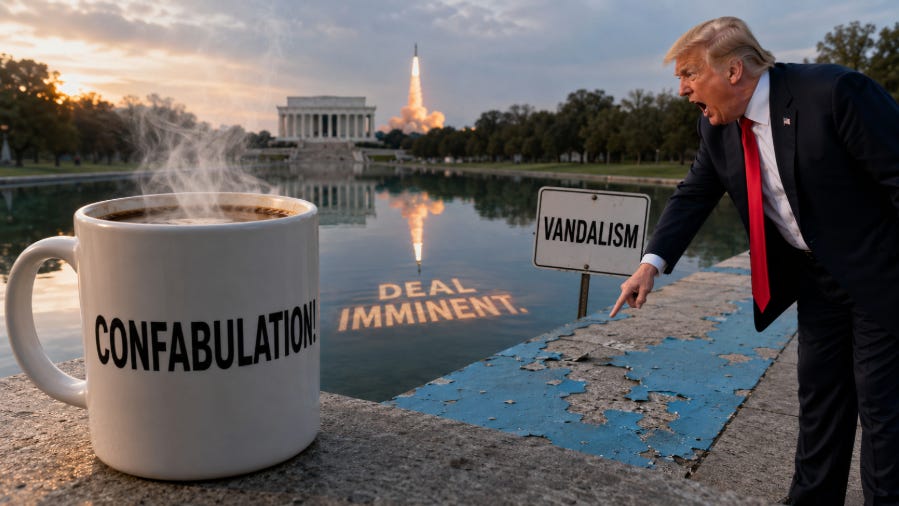
The Reflecting Pool becomes a controlled experiment. We know what happened. Government records showed that the coating was failing before David Hearn ever touched it. Jeanine Pirro’s office conceded that the installation had been botched and abandoned the felony prosecution. The physical evidence, construction records, and Trump’s own Justice Department all arrived at the same conclusion.
Trump rejected it.
“I disagree 100% with Jeanine Pirro,” he announced, continuing to insist that vandals armed with knives or box cutters had destroyed the pool.
Trump’s own prosecutors has confirmed the damage wasn’t vandalism. The useful information is what Trump did after the answer became undeniable. He held his position and demanded that reality move back.
One commentator described the behavior as confabulation, a clinical phenomenon in which a person produces a false account and believes it to be true. We cannot responsibly diagnose frontotemporal dementia from social-media posts, and confabulation is not simply a medical synonym for lying. We do not know whether Trump sincerely believes the vandalism story, has forgotten the contradictory evidence, never understood it, or merely considers admitting error more intolerable than falsely accusing an innocent man.
We do know what the machinery beneath him did. Trump declared that vandals had attacked his pool. Interior officials supplied a vandalism narrative. Prosecutors found a defendant and threatened him with ten years in prison. Jeanine Pirro went before the cameras promising to prove the president’s story beyond a reasonable doubt. Only after prosecutors obtained the government’s own records did the official version collapse.
Hearn’s lawyers called the government’s approach “ready, fire, aim.”
Scott Jennings, a man who has devoted much of his professional life to finding the hidden statesmanship in Donald Trump’s every bowel movement, told CNN that the administration looked like “a monkey having intimate relations with a football.”
Even then, Trump did not.
What happened at the Reflecting Pool offers something unusually valuable: a small, testable demonstration of how Donald Trump responds when evidence conflicts with his preferred reality. Facts were readily available, and the contradiction came from inside his own administration. Although the consequences for the man prosecuted were appalling, the episode remained contained enough for the entire process to be reconstructed in public.
Apply that governing pattern to Iran. The man who cannot absorb a factual correction about a peeling pool liner is also issuing, canceling, and reissuing orders for military strikes in a five-month war.
At the pool, Trump refused a correction delivered by his own government. With Iran, he announced that Tehran had asked him to cancel an attack, and Tehran immediately said the conversation never happened.
On Friday, Trump was promising to hit Iran “very hard” until the country could not take it anymore. The United States was reportedly preparing another major round of strikes. Trump announced that America was “locked and loaded and ready to go” with levels of military power “not seen since World War II.”
By Saturday evening, Trump had become the man who saved the world from Friday’s Donald Trump.
He announced he had canceled the attack because Iran and other Middle Eastern countries had asked him to hold off while a deal was completed. He said the “perimeters of a deal” had been agreed upon, presumably after the parameters were unable to clear security.
The imaginary agreement would immediately and completely reopen the Strait of Hormuz and end Iran’s nuclear threat. Israel was joining him in the commitment. Everyone needed to “get to work” and get it done.
There were only a few details missing.
No terms were released, no mediator was identified, and the Strait of Hormuz remained closed. Iran then denied asking Trump to cancel the attack, calling his claim “nothing but a new lie.”
That denial is not as conclusive as the government records in the Reflecting Pool case; governments sometimes conceal diplomatic contacts. Yet the same weekend, Trump also rejected his own intelligence agencies’ preliminary assessment that Iran was behind cyberattacks on Minnesota’s water systems, blaming the state and its governor without evidence.
The contrast remains useful. At the pool, Trump rejected a factual correction from his own administration. With Iran, he announced a diplomatic breakthrough that the supposed counterparty denied, while the White House offered no documentation and regional mediators spoke only of possibly restarting negotiations.
Available reporting points toward a less flattering explanation for the pause. Saudi Crown Prince Mohammed bin Salman reportedly called Trump and warned against escalating the war. Gulf governments feared that American attacks on Iranian energy infrastructure would prompt Tehran to strike oilfields and gas facilities in Saudi Arabia, the United Arab Emirates and Qatar. According to AP, the Saudi intervention came as Trump was weighing new strikes and as concern grew that another escalation could ignite a much wider attack on the region’s energy system.
The United States also has a munitions problem.
Al Jazeera reports that the estimated American inventory of Patriot interceptors has fallen from approximately 2,300 before the war to fewer than 827. General Dan Caine, chairman of the Joint Chiefs of Staff, has reportedly raised concerns about the depletion of interceptors needed to defend American troops. Trump dismissed those concerns.
So it is at least possible that Trump did not pause an attack because Iran begged him for mercy after the contours of a magnificent agreement appeared.
It may be that Gulf allies were begging Trump not to set their energy infrastructure on fire while the United States was burning through the weapons needed to protect its own forces.
In what seems like a weekly ritual, operational constraint became diplomatic triumph. Regional panic became a plea to the Great Peacemaker. A pause the military and America’s allies may desperately need became another story in which frightened nations approach Donald Trump and ask him alone to spare the world.
Since Trump launched the war on February 28, the country has repeatedly been told that Iran is on the verge of surrendering, that an agreement is imminent, that the war has been settled, that attacks have been canceled at the last moment and that peace has arrived through Donald Trump’s singular strength.
Then the deal evaporates, the ceasefire collapses, Hormuz remains closed, the missiles begin flying and Trump returns to announce that the United States is once again locked and loaded.
In May, strikes were paused to allow another agreement to be finalized. In June, hours after threatening to seize Kharg Island and hit Iran’s oil infrastructure “very hard,” Trump canceled another planned attack and announced that final points had been approved by virtually every government in the region. Documents would be signed in the coming days.
A June memorandum of understanding later unraveled over ambiguities surrounding navigation through the Strait of Hormuz. Renewed fighting followed. Now Trump has announced another undefined breakthrough, and an analyst quoted by Al Jazeera says that without a clear agreement on the strait and the American blockade, this latest declaration will amount to “only another pause.”
Trump has turned brinkmanship into serialized entertainment.
Every week brings a new episode of Locked and Loaded, followed by Historic Breakthrough, followed by Iran Betrayed Me, followed by Locked and Loaded: This Time We Mean It.
The president creates the brink, backs away from it and demands credit for rescuing everyone from the danger he created. The presidency has become a recurring hostage negotiation in which Trump plays the gunman, the negotiator and the grateful hostage.
This is not television. American troops have been killed and wounded. Ships have been attacked. Energy markets have been jolted. Governments across the region are preparing for the possibility that one impulsive decision could bring missiles down on their cities and energy facilities.
The pool does not prove that Trump has dementia. Iran’s denial does not prove that he invented every diplomatic contact. Neither story allows a remote diagnosis of frontotemporal dementia, confabulation or any other neurological condition.
Together, however, they create a legitimate and urgent question about whether the commander-in-chief remains compos mentis, of sufficiently sound mind to exercise the powers of his office.
Can he accurately receive information?
Can he distinguish what advisers have told him from what he wants to be true?
Can he revise a conclusion when evidence disproves it?
Can he tolerate bad news without punishing the person who delivers it?
Can he understand the difference between negotiations that might begin and a deal whose “perimeters” have supposedly been settled?
The public should not bear the burden of diagnosing Donald Trump from afar. The administration bears the burden of demonstrating that the man issuing and canceling military orders remains capable of doing so.
The White House points to Trump’s May physical and his perfect score of 30 out of 30 on the Montreal Cognitive Assessment. His physician said Trump remained in excellent health and fully fit to serve.
That is evidence, but it is not sufficient evidence for the questions his behavior raises.
The MoCA is not a comprehensive examination of executive judgment under stress, impulse control, fixed beliefs, emotional regulation or the ability to evaluate contradictory intelligence while deciding whether to launch missiles. Even the physician who created the test has explained that a perfect score indicates normal cognitive performance on the screening; it does not demonstrate the “extreme intelligence” Trump claims.
The country needs an independent neuropsychological evaluation conducted by qualified clinicians who do not owe their positions to the president, with a meaningful public summary of the methods and findings. Congress also needs to examine how military decisions in the Iran war are being made: what information Trump receives, who explains it, whether orders have been issued and withdrawn impulsively, whether senior military officials have objected and what safeguards exist when the president’s version of events conflicts with the evidence available to everyone else. Also known as oversight.
Speaking of oversight, the Trump Organization and Eric Trump sued Capital One after the bank closed more than 300 Trump-affiliated accounts in 2021. They claimed the closures were politically motivated, that the bank had embraced “woke” beliefs and wanted to punish the Trump family after the January 6 attack on the Capitol.
Capital One has now answered.
According to a court filing, the accounts were closed after months of examination by the bank’s anti-money-laundering specialists. Capital One said the transaction patterns its experts identified were among the types of activity federal banking guidance instructs financial institutions to scrutinize.
Capital One has not accused the Trump Organization of money laundering. An anti-money-laundering review can identify patterns, compliance risks, or relationships a bank no longer wishes to maintain without establishing that a crime occurred.
Capital One’s answer is still remarkable. The Trump family sued because it wanted the public to believe that the bank rejected it for being conservative. Capital One says the decision followed months of examination by the people responsible for keeping suspicious financial activity from becoming the bank’s legal problem.
No, it was not the politics. They were looking at the transactions. Sometimes the most dangerous thing a plaintiff can demand is a public explanation. Nothing makes Trump happier than discovery until discovery begins discovering things.
Each story begins with a Trump claim and ends with reality refusing to cooperate.
He can bully appointees, threaten prosecutors and order the government to behave as though his latest declaration is established fact. Documentary evidence remains less accommodating.
The pool shows what Trump does when the facts catch up with him. Iran forces us to ask how many missiles may be launched before they do. Capital One reminds us that reality, however delayed, occasionally hires counsel and files a response.
Love your essays. You analyze the issues brilliantly and with wonderful language. You don’t just tell us the truth of what’s happening, your essays are delightfully rendered. Shanley is another great wit. I thank you both for your wonderful contributions to the political essay. I read everything you publish.
If Ms. Pirro possessed the slightest degree of personal conscience or professional ethics, she'd…
… Never mind.