


Good morning! Today’s news cycle is doing that thing where it oscillates wildly between menace, absurdity, and the occasional flicker of actual human decency.
We’ll start, as always, with Donald Trump, who continues his one-man campaign to prove that hypocrisy is not a flaw but a governing philosophy. This time, he’s discovered a sudden and profound concern for peaceful protesters, specifically Iranian ones. Trump announced that if Iran “shoots and violently kills” demonstrators, the United States will “come to their rescue,” because America is apparently “locked and loaded” in defense of civil liberties abroad. This will come as thrilling news to U.S. protesters who have recently enjoyed tear gas, batons, militarized police, unmarked vans, felony charges, and lectures about obedience. Apparently, the right to protest is sacred provided it’s happening somewhere else.
Iran, for its part, responded with warnings that U.S. interference would destabilize the region and endanger American troops, which is diplomatic-speak for please stop threatening us on social media. Iranian officials are doing their own familiar dance: acknowledging that people are starving and angry while promising to crush “illegal gatherings” with maximum firmness. Trump’s contribution to this volatile mix is not diplomacy, pressure, or restraint, just vibes, threats, and the subtle suggestion of war, all without the inconvenience of consistency.
Ukraine’s intelligence service dropped something genuinely new, and unsettling, into the information war. In a rare public warning, Kyiv’s foreign intelligence agency said it believes Russia may soon carry out a mass-casualty attack against civilians, possibly at a religious site, and then blame Ukraine using a manufactured media narrative. This wasn’t a claim of an attack already committed, but a preemptive strike against propaganda itself, an attempt to inoculate journalists, governments, and the public before the lie arrives fully formed with “eyewitnesses,” debris photos, and talking heads.
It’s an extraordinary move risky by design. Ukraine is effectively saying: we know the playbook, and we’re telling you before it’s deployed. Given Russia’s history, including the still-unanswered questions around the 1999 apartment bombings that helped propel Putin to power, the warning lands with uncomfortable plausibility. It also comes days after U.S. intelligence reportedly debunked a Kremlin claim Ukrainian drones attacked Putin’s private residence, a story Trump initially reacted to as if it were true. In a world where false narratives can move markets, policies, and presidents before verification catches up, Ukraine is trying to get ahead of the lie, not by shouting louder, but by arriving earlier.
In a Wall Street Journal interview that appears intended to project vigor and defiance, Trump instead delivered a remarkably candid inventory of age, denial, and medical noncompliance. The president, now 79, volunteered that he takes four times the standard preventive dose of aspirin every day, against his doctors’ advice, because he’s “a little superstitious” and prefers what he described as “nice, thin blood pouring through my heart.” This has, by his own admission, caused him to bruise and bleed easily, a problem he manages not by adjusting medication, but by applying makeup to his hands after being “whacked again by someone.”
Trump also acknowledged that he briefly wore compression socks to treat swelling in his legs, the result of chronic venous insufficiency, before abandoning them because he didn’t like how they felt. Exercise beyond golf, he explained, is “boring.” Sleep is optional. And advanced imaging, which he underwent last fall, was a mistake not because it revealed anything alarming, but because it created “ammunition” for people asking whether something might be wrong. The real offense, in other words, was documentation.
The interview unintentionally confirmed what cameras and aides have been quietly compensating for: Trump struggles to stay awake during public events, has difficulty hearing in crowded rooms, and requires staff to adjust presentations so he doesn’t drift. His response to footage showing him dozing was that closing his eyes is “very relaxing,” and any photographs suggesting otherwise are merely unfortunate moments of blinking. As for hearing loss, he denied it by mocking the question, always a reassuring diagnostic tool.
White House officials insist he is in “exceptional health,” citing an AI-assisted estimate that pegs his “cardiac age” at 65, a data point presented without context, methodology, or explanation. Supportive allies like Mehmet Oz dutifully vouched for Trump’s mental acuity, assuring the Journal that he has never heard Trump say anything that suggested a lack of understanding, a claim that does heroic work in a single sentence.
What’s most striking isn’t that Trump is unavoidably aging. It’s that his approach to health mirrors his approach to governance: dismiss expertise, override professionals, manage optics instead of risk, and treat transparency as the problem rather than the condition itself. After years of attacking Joe Biden for concealing decline, Trump is now offering a live demonstration of what denial looks like when paired with power.
Trump’s favorite tool, tariffs, nearly took out an innocent bystander: pasta. Yes, pasta. The administration had threatened levies as high as 92% on Italian pasta, accusing centuries-old producers like Barilla and Garofalo of the unforgivable crime of making affordable food efficiently. This would have nearly doubled prices for American shoppers, turning spaghetti night into a luxury experience. Fortunately, after the Department of Commerce reviewed the case and discovered that Italian pasta makers had, inconveniently, answered their questions, the proposed tariffs were slashed to a far more modest 2% to 14%. What a relief! Udon noodles are great but can only carry one so far in my household.
This is now the standard Trump trade maneuver: light the house on fire, then take credit for turning down the flame. The pasta reprieve comes just days after the White House quietly delayed tariff hikes on kitchen cabinets, vanities, and furniture, all items Americans actually buy, while insisting it’s engaged in “productive negotiations.” Translation: chaos first, calibration later, applause regardless. Enjoy your linguine while you can.
Trump’s “deal-making” credentials were also put to the test south of the Caribbean, where Venezuela’s Nicolás Maduro reiterated what can only be described as an inconveniently reasonable position. In a recent interview, Maduro said Venezuela remains open to talks with the U.S. on combating drug trafficking and even signaled continued willingness to expand oil investment opportunities, essentially keeping a transactional win on the table for a president who claims to live for them.
Instead, the administration has escalated a shadow war: naval deployments, drone strikes, seizures, and what U.S. media report may have been the first CIA-led strike on Venezuelan soil. By the administration’s own count, at least 115 people have been killed in these operations. Maduro’s response, calm, wary, and notably not bombastic, made Trump’s posture look less like strength and more like reflex. The self-proclaimed master negotiator once again opted for force over follow-through, because diplomacy doesn’t generate the right kind of headlines.
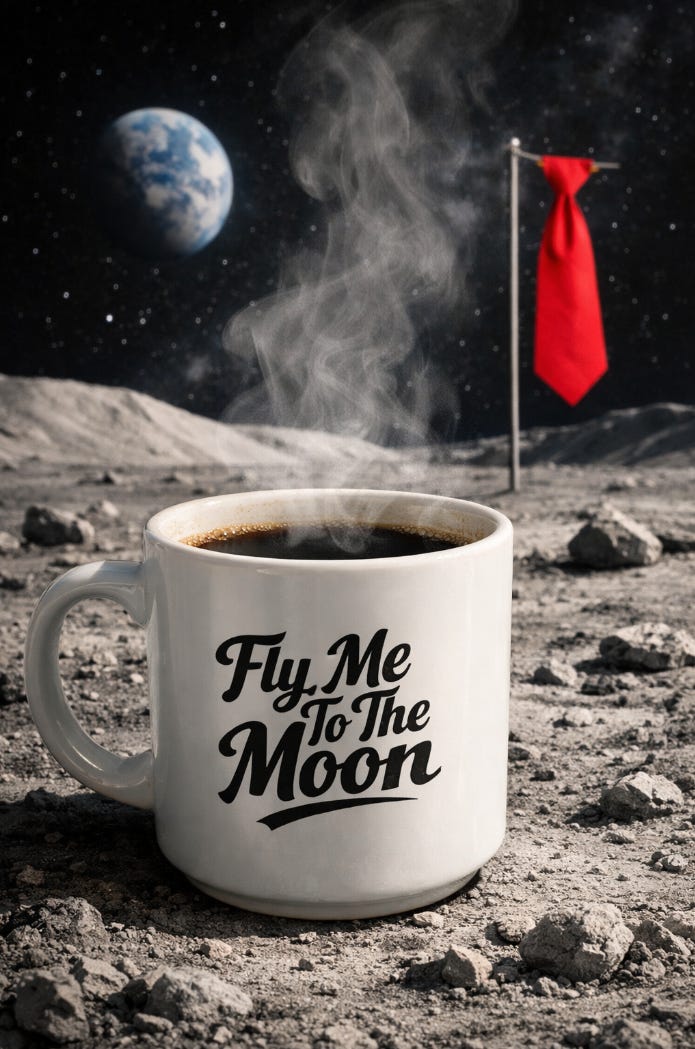
Then there’s space, because if Trump loves anything more than tariffs and threats, it’s declaring historic “firsts.” He now wants Americans back on the moon before his term ends, framing it as a race against China and ordering “American space superiority” with the confidence of someone who believes physics is negotiable. Artemis 2 is set to fly astronauts around the moon this spring, which is real progress. The actual lunar landing mission, Artemis 3, is scheduled for mid-2027, tight, but theoretically possible.
The problem is that Trump spent the past year destabilizing NASA: slashing jobs, proposing science budgets so severe they were described as “extinction-level,” and leaving the agency in leadership limbo. Now, with billionaire private astronaut Jared Isaacman installed as NASA administrator and Musk-adjacent private contractors carrying much of the load, the U.S. risks becoming an observer to its own moonshot. Launching is easy. Landing safely on another celestial body repeatedly, sustainably, and on a political deadline, is not. Space, inconveniently, does not care about branding.
Which brings us, mercifully, to something genuinely hopeful. At the end of a day filled with threats, posturing, and performative power, there’s a quieter story unfolding, one that doesn’t involve missiles, tariffs, or flags planted for cameras. A growing number of Gen Z graduates are becoming teachers. Not because they’re naïve. Not because they don’t know the pay is bad, the burnout is real, and the political hostility is constant. But because they want their work to matter in ways they can see.
These are young people shaped by lockdowns, gun drills, economic precarity, and institutional failure, choosing classrooms anyway. They’re teaching media literacy in an age of disinformation, social-emotional skills in a country allergic to vulnerability, and history that actually encourages students to think. They talk about building good humans, not just test scores, and know the risks, but are showing up regardless.
It’s a quiet rebuke of everything else in today’s news. While powerful men posture about dominance, superiority, and force, a generation raised amid collapse is choosing care, presence, and responsibility. That choice is fragile; it won’t survive on praise alone, but it’s there, real, human, and stubbornly hopeful. Tonight I will add these brave souls to my moonbeam vigil because a healthy democracy requires an educated electorate.
As a former teacher in New York City for 25 years, I can say looking at the landscape now, I don't know why anyone would teach. AI is posed to change education, to make our kids even dumber than social media would have it and turn teachers into monitors without any real voice in learning. AI is being put into classrooms without any thought as to how it will change learning in ways that are not beyond our comprehension. In fact, it's pretty simple to predict outcomes based on children losing their ability to read, figure and think. I use basic words here because it is the basics that create the foundation. A weak foundation means that a student is preparing for a life of frustration and likely poverty. I am not saying give up or don't go into teaching, I am saying STOP THE AI MADNESS. There is nothing to be achieved by allowing students to let machines do the thinking for them.
I honestly don’t know how I’d cope in the deadly, insane Trump-MAGA farce without the clarity and focus Mary brings to daily reporting and analysis. Simply staying tethered to reality feels like a successful start to the day.
While many seem to be tuning out with hope it all goes away, I continue to believe in staying informed and engaged, ready to do what’s possible to resist the madness and help forge a better outcome than the Trump coup masters intend. Every drop of truth and resistance adds to the stream.