


Good morning! Five months after Donald Trump promised a brief excursion into Iran, the United States is waiting for Iran and Oman to negotiate the reopening of a waterway that was open before Trump attacked.
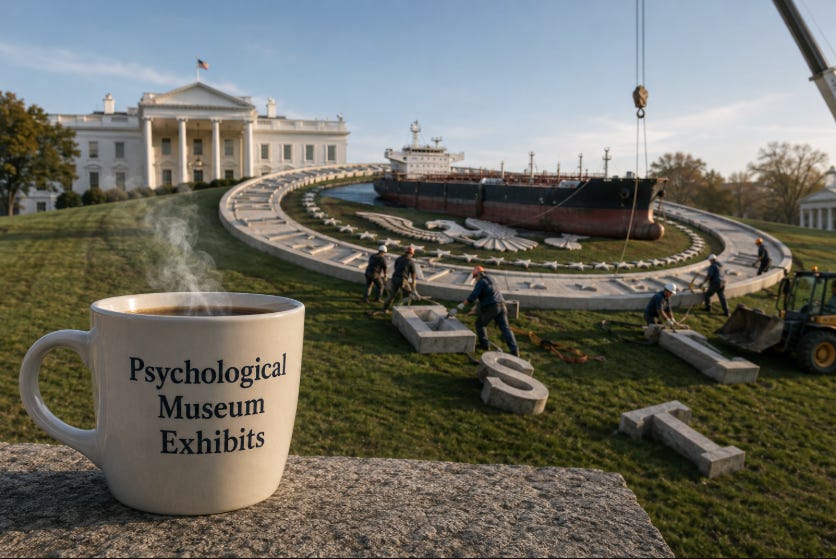
There is a certain brutal clarity to that progression, and a longer history behind it. During his first term, Trump withdrew the United States from the JCPOA before securing the “better deal” he promised would replace it. Washington began the present war by demanding an end to Iran’s nuclear ambitions, its ballistic-missile program and its support for regional militias. Trump demanded “UNCONDITIONAL SURRENDER,” because carefully calibrated statecraft always includes typing the desired conclusion in capital letters. Those expansive objectives have since contracted to a single urgent plea: Please reopen the Strait of Hormuz.
According to the Financial Times, the emerging arrangement could give Iran responsibility for vessels entering through Iranian waters, with ships departing principally through Oman’s side of the strait. Washington may lift its blockade of Iranian ports and ease restrictions on Iranian oil exports in return. Iran continues to insist that it will eventually collect “service fees” from passing vessels, although Oman has proposed the more decorous fiction of voluntary contributions for navigation and environmental protection.
Replacing “toll” with “service fee” and strategic humiliation with “breakthrough” is quite a face-saving achievement.
The essential fact is that Trump’s war converted Iran’s latent leverage into active control. Successive administrations treated Iran’s ability to disrupt the strait as a central constraint on any conflict with Tehran; Trump attacked anyway, and Iran picked up the weapon his predecessors had worked to keep holstered. Washington is now hoping that an agreement between two other countries will recover something less favorable than the conditions Trump inherited.
The White House says the waterway is “completely controlled” by the United States. For this to be true requires an unusually liberal definition of complete control, given that the administration is waiting for Tehran and Muscat to decide when ships can use it, where they can travel, and under what eventual financial arrangements. One shudders to imagine what partial control looks like.
Sadly, the maritime war is spreading. The Houthis claim to have attacked a Saudi tanker in the Red Sea and say they are preventing Saudi ships from proceeding through both the Red Sea and Arabian Sea, in an effort to force Saudi Arabia to lift its blockade of Houthi-controlled Yemen. The strategic effect is to place pressure on Bab el-Mandeb while Iran constricts Hormuz, threatening two of the world’s most important maritime chokepoints at once.
Brent crude moved above $80 after the reported tanker attack, while American petrol prices remain substantially above their prewar level. US missile-interceptor stocks are dwindling, regional allies are exhausted, inflation is again under pressure, and the midterm elections are less than three months away. Escalation risks intensifying every one of those problems.
Diplomacy, however, presents Trump with a different danger: it could make him look weak.
Trump does not approach national policy as a balance of interests. He approaches it as a continuing referendum on Donald Trump. A settlement that reduces the danger to American forces, reopens an essential trade route, and lowers energy prices could still be intolerable if Iran appears to have extracted concessions. The issue is whether Trump can call it the greatest agreement in history without Fox News, Laura Loomer and the remaining Republican hawks laughing loudly enough for him to hear.
The Financial Times describes the resulting trap. Trump cannot win militarily at the present level of force, but he cannot reach a diplomatic settlement without paying a domestic political price. The predictable cycle is already visible. He announces an imminent breakthrough. The details reveal a compromise far short of his original promises. His supporters complain that he capitulated. The criticism gets under his skin. He returns to coercion. Coercion fails to produce surrender but succeeds in raising oil prices and depleting American defenses. Another improvised truce follows, and Trump announces another historic breakthrough.
Times Radio’s discussion of the administration’s White House construction projects offered a surprisingly precise explanation of why this cycle is so dangerous. At first glance, an algae-infested reflecting pool and a crisis in the Strait of Hormuz might appear unrelated. In practice, they are different-sized exhibits in the same psychological museum.
Trump’s reflecting-pool renovation ran over budget and produced conspicuously dirty water — a story we’ve covered in detail. Rather than accept poor design or defective installation, Trump blamed sabotage and wanted the people responsible prosecuted. When the US attorney for Washington, Jeanine Pirro, concluded the evidence didn’t support that case, Trump publicly accused one of his most devoted allies of choking and folding “like an umbrella.”
Pirro is right, and that is precisely the offense. A favored project fails; failure threatens the president’s self-image; incompetence becomes conspiracy; and a loyal official’s refusal to manufacture a case against an innocent man becomes betrayal. The Justice Department, in this conception, is not an independent institution with rules and evidentiary standards. It is the litigation department of Trump, Inc.
The newly constructed White House helipad provides an even better metaphor. Workers had spent weeks building a 100-foot circle on the South Lawn and decorating it with a giant presidential seal. By Tuesday, the granite lettering had disappeared. Trump reportedly ordered contractors to redo the work because he was unhappy that the helipad, like the lawn on which it sits, had a noticeable slope.
Trump can order the presidential seal dismantled, but he cannot command the ground beneath it to become level.
The project reportedly costs between $5 million and $6 million and is being donated by Lockheed Martin, which owns the manufacturer of the new presidential helicopters whose hot exhaust created the stated need for the pad. Construction also bypassed Congress and the architectural bodies that ordinarily review changes to Washington’s monumental core. The White House classified it as an operational upgrade and, when asked why completed work was being removed, declined to explain.
Looming over all this is Trump’s immense new White House ballroom. Maggie Haberman has reportedly said that the president devotes an astonishing share of his attention to the ballroom and related construction matters. Thus, while the United States confronts a war capable of disrupting global energy supplies and remaking the Middle East, its president is preoccupied with whether he can throw a sufficiently proper party and whether the lawn beneath his enormous seal has committed a topographical offense.
These stories are funny because the symbolism is almost indecently generous. They are frightening because the same habits govern matters of war and peace. Trump mistakes declarations for plans, loyalty for competence, and personal vindication for national interest. When reality intrudes, he searches for someone to prosecute, threaten, or humiliate. When a project cannot deliver what he promised, he does not reconsider the project. He changes the explanation and demands that everyone admire the result.
Which brings us, happily, to Liberation Day.
The administration has now reportedly refunded approximately $100 billion of the $165 billion collected under Trump’s “Liberation Day” tariffs after the Supreme Court ruled that the levies were illegal. The tariffs were supposed to revive American manufacturing, force concessions from foreign governments, replace other sources of federal revenue and help close the budget deficit. Instead, American importers paid the taxes, businesses absorbed months of uncertainty, the government acquired an enormous refund obligation and the federal deficit reached $1.37 trillion during the first nine months of the fiscal year, slightly higher than during the comparable period in 2025.
Liberation Day has become Refund Day.
A normal administration might respond to such an expensive judicial defeat by reconsidering the policy. If it remained convinced that tariffs were necessary, it could ask Congress to impose them. The Constitution gives Congress authority over duties and foreign commerce. Legislation could specify the countries, products and rates involved, establish exemptions, define the intended economic outcome and give businesses some assurance that the government would not eventually have to return another mountain of money.
Going to Congress would also force lawmakers to hold hearings, examine the costs and vote publicly for taxes on American importers and consumers. In other words, it would involve constitutional government, which appears to be precisely the defect.
Rather than seek explicit congressional authorization, the administration imposed another set of tariffs under a provision of the Trade Act intended to address practices including forced labor. The replacement levies reportedly reach countries responsible for 99.4 percent of American imports. Apparently almost the entire trading world became one vast forced-labor emergency at exactly the moment Trump needed a new statutory pretext for his invalidated import taxes.
Twenty-five states are now suing. They argue that the new rationale is an unlawful attempt to reproduce the tariffs already struck down by the Supreme Court. If they prevail, the administration may face another set of refunds, having repeated the same experiment while carefully preserving the conditions that made the first attempt so risky.
It is constitutional risk taken to avoid constitutional government. The administration has chosen the path that maximizes presidential discretion and, potentially, the size of the next refund.
Reality keeps declining to cooperate. A sloping lawn cannot be ordered flat. Iran cannot be talked into unconditional surrender merely because Trump placed the words in capital letters.
With tariffs, the result is wasted money, disrupted businesses and an administrative spectacle in which the government returns the revenue it had boasted of collecting. With the helipad, workers pry the presidential seal out of the ground and start again. But in the Strait of Hormuz, the same refusal to admit error can prolong a war, exhaust American defenses and destabilize the global economy.
The ground beneath Trump will not stay flat. The danger is how much he is prepared to destroy before admitting that it never was.
Here at home, Marz and I are training to build our aerobic capacity for a big hike later this month. The oppressive heat has complicated the project slightly, but we are persisting, adjusting our pace, choosing our moments and putting in the miles. Some ground, after all, is meant to slope.
We are still holding our moonbeam vigils and holding all of you in our thoughts.
Mary,
You are the calm voice of sanity and humour in the midst of all this chaos and destruction.
Thank you for all you do, and I hope that you and Marz continue to enjoy the training - if 'enjoy' is the right word!
Trump is desperately looking for a way to stick his beak into the money flow that Iran will gain from controlling the traffic through the Straights.