

Good morning! By Friday night, the name was coming off behind a tarp. There are more consequential images from the last twenty-four hours: smoke rising over southern Lebanon as diplomats whisper about a peace deal; strike footage posted to Truth Social like a campaign ad for executive assassination; Venezuelan miners fleeing resource country while private capital books its tickets. But the tarp is useful because it is almost embarrassingly literal. Trump’s name went up on the Kennedy Center as a vanity project, and when the courts ordered it down, the public was not supposed to get the satisfaction of seeing the letters peeled off the wall.
Rename a public institution without Congress. Call a war-ending memorandum “close” while the war expands. Call a targeted killing counterterrorism while the ground beneath it is being reopened for investors. The day’s theme is what is being moved, monetized, bombed, blessed, renamed, or erased while the screen is up.
Trump lost the Kennedy Center fight twice in one day. First, a federal judge refused to pause an order requiring his name to be removed from the façade of the John F. Kennedy Center for the Performing Arts. Then his lawyers ran to the D.C. appeals court for an emergency stay, because apparently the Republic itself could not survive another evening in which the Kennedy Center was allowed to be the Kennedy Center. The appeals court said no. Even better, one of the judges who denied the stay was Gregory Katsas, a Trump appointee and former Trump White House lawyer. Somewhere in the marble afterlife, irony put on a tuxedo.
The emergency filing reportedly read like a Truth Social post made to wear a tie. It warned of “life threatening structural damage,” rusted beams, falling parking garage ceilings, and “total collapse,” because nothing says “serious appellate litigation” like a motion that appears to have wandered in from a 3 a.m. all-caps dispatch about windmills. The real confession was buried in the argument about money. Trump’s board had created a bylaw conditioning donations on keeping his name attached to the building, meaning the renaming was not just an act of narcissism but an attempted legal ratchet. Put the name up, tie the money to the name, then claim removing the name would create a financial emergency. The arsonist’s defense, but with donor plaques.
By evening, workers were back on the scaffolding. News Central video showed them behind a tarp, pulling letters off the wall. Rep. Joyce Beatty, the ex officio board member whose lawsuit challenged the renaming after she was not allowed to vote, supplied the constitutional point and the visual diagnosis. Only Congress can change the name, she said. This never came before Congress. The tarp, she added, was “a Trump thing,” meant to cover it up and prevent people from seeing the vanity project come down. But the letters came down anyway. For once, the building won.
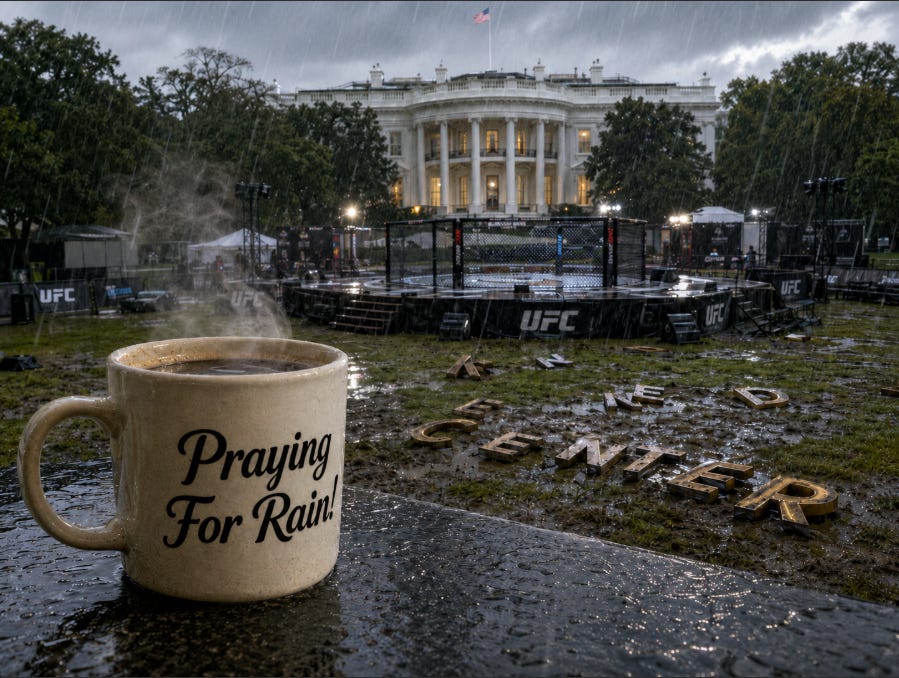
On the South Lawn, the White House UFC birthday spectacle continued its transformation from authoritarian kitsch into a municipal hazard. The event was already a corruption syllabus: public property turned into a private combat-sports venue, a 250th-anniversary celebration repurposed as a branded birthday spectacle, sponsorship packages, broadcast rights, donor access, and the aesthetic principle that the White House should look like a sportsbook designed by a monarch with heatstroke.
Reality began filing objections. The Lincoln Memorial Reflecting Pool, drained and repainted “American flag blue” at Trump’s direction as part of a $14.2 million renovation he had bragged about for weeks, reportedly greened over with algae within a day of being refilled. The Interior Department called it normal startup residue. Trump had called it perfect.
Then the weather started filing objections of its own. Sunday, fight night, the full main card, is forecast at around 91 degrees with a 75 percent chance of rain, the wettest and near-hottest day of the week landing precisely on the marquee event. Joe Rogan, the UFC’s longtime commentator and a man friendly with both White and Trump, said on his podcast what no promoter is supposed to say before a show: you should not stage a world-championship fight in an uncontrolled environment, it belongs in an air-conditioned arena, and at minimum someone should build a roof. He worried about the heat, about dehydration in fighters who have already cut weight, about the bugs. You wouldn’t ask them, he said, to play a championship basketball game outside in the sun. Then, having said all that, he is still scheduled to call the card. The objection is coming from inside the tent.
Dana White, who is staging the thing, did not even bother to deny the conditions. He conceded it had rained for eight straight days while his crew built the venue, and ran through the variables he could not control, rain, lightning, bugs, temperature, before insisting, as strongmen’s stage managers must, that the show goes on regardless. So the promoter and the broadcaster both agree the South Lawn in mid-June is a bad place to hold a fight. They are going to hold it there anyway, because the date was never chosen for the fighters. It was chosen for the birthday.
Then came the pilot-lighting allegation. Powerful lighting tests for the UFC setup reportedly shone into the cockpit of a commercial plane approaching Reagan National Airport, prompting FAA and NASA safety reports. That detail should still be handled carefully as reported, but it is almost too on-brand to have been invented. The White House turned into an octagon, the octagon turned into a glare hazard, and the glare hazard may have reached one of the most sensitive airport approaches in the country.
The federal-resourcing irony is rich enough to require a cardiologist. Agencies supposedly too bloated, too woke, too captured, too wasteful, or too hostile to Trump’s will are suddenly available to help route the president’s cage-match birthday party around aviation, security, logistics, and weather. The FAA is inside the tent, possibly while pilots are complaining about the lights outside it. The state is bad until it is needed as stage crew.
This is the point where the comedy starts to curdle. The spectacle was meant to project dominance: Trump as promoter-president, as ringmaster, as the man who turns the White House into his own pay-per-view palace. Instead, it keeps manufacturing the opposite. A green pool. Bad weather. Legal challenges. Safety complaints. A vulgar production so physically indifferent to its surroundings that it may have bothered actual aircraft. The strongman’s stagecraft keeps producing evidence of weakness, because the people in charge of reality television are not necessarily qualified to manage reality.
Then the machinery gets quieter, cleaner, and much more expensive.
The Justice Department cleared Paramount’s $111 billion merger with Warner Bros. Discovery, saying it would not challenge a deal that would put Paramount, Warner Bros., Paramount+, HBO Max, CNN, and CBS News under David Ellison’s roof. The antitrust concerns are obvious. The combined company would control two major movie studios, two major streaming platforms, and two major television news networks, and could reduce competition for scripts, actors, crews, creative labor, and news influence. The Justice Department blocked a major publishing merger in 2022 on similar labor-market logic. But this time, Trump’s DOJ did not merely decline to sue. It issued an unusually detailed public statement blessing the deal and arguing that the film and television industry is too dynamic for the transaction to harm competition or consumers. Bill Baer, who led DOJ’s antitrust division under Obama, called it the most detailed explanation he had seen for a decision not to challenge a transaction.
That statement gives Paramount a federal stamp to wave at state attorneys general, private plaintiffs, and foreign regulators. California is still investigating. The UK is looking. But DOJ did not just step aside; it handed the merging parties a shield.
The politics are not hidden very deep. Larry Ellison is friendly with Trump and reportedly advocated for the deal. Paramount hosted a dinner “honoring the Trump White House” while the merger was under review, with Trump and David Ellison seated at the same table. Before Ellison acquired Paramount, the company settled Trump’s lawsuit over a “60 Minutes” interview for $16 million. Now CBS News and CNN may end up in the same Trump-friendly Ellison media empire, while the Justice Department provides unusually helpful legal scaffolding.
This is the smaller, bloodless version of the day’s larger pattern: public instruments bent toward private and favored ends. A board renames a public cultural institution for Trump. Federal resources gather around a private fight spectacle on the White House lawn. DOJ blesses a politically connected media consolidation with language that may help defeat future challengers. Once you see the machine operating in marble, lights, and merger statements, it is easier to recognize when it moves through war.
Which brings us to the “peace deal” that is not yet peace. This morning’s live updates from Al Jazeera have the Trump administration and mediators talking as if a U.S.-Iran agreement could be finalized within twenty-four hours. Pakistan’s Prime Minister Shehbaz Sharif says the deal may be ready for electronic signing, with technical talks to follow. Iran’s foreign minister, Abbas Araghchi, says a memorandum of understanding “has never been closer,” and Trump is amplifying the optimism. Switzerland may host the signing. The administration wants the image: the deal, the signature, the headline, the triumphal post.
But in Lebanon, the war is not pausing for the branding rollout. Israel has continued and expanded attacks across southern Lebanon, killing at least five people, including the mayor of Ar-Rihan municipality, and issuing forced-displacement orders for more than twenty towns and villages. Some of those orders reportedly reach into areas north of the so-called Yellow Line, the zone Israel has sought to control and occupy. Al Jazeera’s Beirut correspondent described this not as a moment of peace but a “moment of danger.”
Lebanon is the hinge. Iran wants it included in any U.S.-Iran settlement. Trump and his administration have reportedly insisted that Israel versus Lebanon is separate from the broader U.S.-Iran issue. Tehran disagrees. Israel, meanwhile, appears deeply worried about an imminent memorandum precisely because a deal that leaves Iran’s governing system intact is not the strategic victory Netanyahu promised. So while diplomats talk, Israel may be banking facts on the ground: more strikes, more displacement, more leverage before anyone signs anything.
There is a precedent, and it is ugly. Al Jazeera notes that on April 8, another open question about whether Lebanon would be included in a deal was followed by the deadliest day of the war, with more than 350 people killed. That is the shadow over the “within twenty-four hours” headlines. A peace process that excludes the active front is not peace. Just paperwork with explosions around the margins.
Both sides are already rehearsing victory speeches over a document that may not settle the central dispute. Iran says it does not trust the Americans but suggests the MoU has never been closer. Trump wants the win. Vance and other administration figures want to say they got what they wanted. Israel wants to make sure the deal does not cost it freedom of action in Lebanon. Hezbollah-aligned voices warn that no one will disarm the group. Lebanese officials warn the country is at a fateful juncture between state sovereignty and militia logic. Everyone is claiming the future while people in southern Lebanon are being told to leave their homes.
The rest of the regional ledger keeps moving. Gaza’s Health Ministry says at least two Palestinians were killed and eleven injured in Israeli attacks over the past forty-eight hours, and that 983 people have been killed since the October “ceasefire” announcement. A tanker was reportedly struck by an unknown projectile east of Oman, with the crew safe and no environmental impact reported. That is the real map beneath the diplomatic one: Lebanon burning, Gaza bleeding, Oman flickering, Iran negotiating, Israel striking, Trump posting.
Then there is Venezuela, where the whole system becomes visible.
Start not with the investors, but with the missing miner. In Bolívar state, where violent gangs and Colombian guerrillas operate around illegal gold mines, residents told the Financial Times that Venezuelan military operations have been intense enough to send people fleeing. One person said a young miner in their family had not returned home in days, and feared he may have died. That is the human image to hold while the rest of the story fills in around it: a family waiting for someone who went into resource country and did not come back.
Trump announced Friday night that U.S. Southern Command had killed Héctor “El Niño” Guerrero, whom the administration identified as the leader of Tren de Aragua, in what he called a “swift and lethal” operation inside Venezuela. Defense Secretary Pete Hegseth said a kinetic strike hit a compound housing Guerrero earlier this week. Trump framed the killing in revenge language, invoking American victims, border panic, “retribution,” and the promise to send “murderers and drug lords” to “the depths of hell.” Not exactly the voice of a government soberly explaining the legal basis for military action. It was the voice of a president turning targeted killing into domestic political content.
The legal questions are enormous. Where exactly did the strike occur? What authority was invoked? Was Congress notified? What standard applies when the target is a gang leader designated under a terrorism framework? Does Venezuelan cooperation supply consent, and from whom? Is the administration now asserting a standing power to use U.S. military force against cartel and gang figures anywhere it claims they are hiding? These are the questions that separate law from a global execution doctrine with better camera angles.
The FT’s reporting makes clear the strike is not only a counter-gang story. It lands inside a much larger Venezuela opening.
After U.S. special forces arrested Nicolás Maduro in a January raid, as the FT and others have reported, the Trump administration backed Delcy Rodríguez as Venezuela opened vast oil and mineral reserves to foreign investment in exchange for sanctions unwinding. Venezuelan authorities passed a new hydrocarbons law that weakens PDVSA’s mandatory control and allows private companies to operate wells directly. Mining reforms are opening resource regions. Majors including Repsol, Eni, and Shell are making agreements. Investment funds are scouting assets. Oil executives are flying around the country on private jets. One Maracaibo oil executive told the FT his phone had not stopped ringing. A Caracas fund manager supplied the line that may explain the whole geopolitical mood: “The Middle East is on fire and Venezuela is stable.”
There it is. War in one region, opportunity in another. Instability generating capital flows. One front burns; another is marketed as the safe distressed-asset play.
Lionheart Capital, a Miami-based fund founded by Ophir Sternberg, is trying to merge its public affiliate Lionheart Holdings with Keo Energy, which has Maracaibo Basin oil assets. The proposed transaction could create what a source described as the first Nasdaq-listed company giving U.S. and institutional investors direct access to Venezuelan oil. Lionheart is aiming at roughly a $1 billion valuation through a blank-check vehicle that raised $230 million in 2024, though the deal is preliminary and could fall apart. Keo’s exposure runs through PetroUrdaneta, whose fields once produced hundreds of thousands of barrels per day but have fallen below 2,000 barrels of oil equivalent per day after decades of underinvestment. With new investment, an investor presentation says production could rise to 54,000 barrels per day by 2029. This is the pitch deck version of regime change.
Other names are circling. Bryan Sheffield of Formentera attended a White House summit in January aimed at drumming up Venezuela investment, then visited in April with other potential investors to meet interim president Delcy Rodríguez. Ali Moshiri, Chevron’s former head of Latin American operations, is seeking to raise $2 billion through Amos Global Energy Management for Venezuelan oil assets. Grupo Cisneros says it has secured two-thirds of a $1 billion fund for non-oil and non-mining investments, including agribusiness, communications, and real estate, with money from American and Latin American family offices, institutional investors, and sovereign wealth funds.
Then there is the SPAC-shaped shadow. The Yorkville Advisors vehicle is not merely a vague “Trump-adjacent” curiosity. It is a $200 million blank-check company aimed at Latin American acquisitions with particular focus on Venezuelan territory, on the stated rationale that companies there need substantial capital after years of underinvestment. The key name is Kevin McGurn, the SPAC’s CEO, who was recently named interim CEO of Trump Media & Technology Group, the parent of Truth Social. McGurn also heads New America Acquisition I Corp, the $300 million blank-check firm backed by Eric Trump and Donald Trump Jr., who sit on its advisory board and received a combined five million founder shares. That vehicle is tied to Dominari Securities, whose CEO sits on the board, and the Trump brothers are among the largest shareholders in Dominari’s parent.
This does not prove the Guerrero strike was ordered to benefit Yorkville, McGurn, the Trump sons, or any investor. It should not be written that way. The documented story is not causation. It is convergence.
The sequence is enough: Maduro removed by U.S. raid. Rodríguez backed by Washington. Sanctions unwound. Resource laws rewritten to admit private and foreign capital. U.S. and foreign investors race toward oil, gas, mining, agribusiness, communications, and real estate. A named Trump-linked SPAC positions itself for Venezuelan opportunities. Venezuelan forces move through gold-mining regions controlled by armed groups. The U.S. kills a gang leader inside Venezuela and frames it as a joint anti-narco-terror operation. Civilians flee. A miner is missing. The arrangement is the argument. Force, policy, and capital are all pointed at the same ground.
The Kennedy Center shows the vanity. The UFC spectacle shows public property converted into private performance. The Paramount merger shows institutions blessing favored consolidation. Iran and Lebanon show diplomacy announced over active violence. Venezuela shows the system entire: military force, regime change, sanctions policy, resource law, private capital, Trump-family adjacency, and human displacement braided into one frontier.
So yes, by all means, let it rain.
Let it rain on the South Lawn octagon and the sponsor signage and the camera platforms and the very expensive lighting rig that apparently wanted to participate in air traffic control. Let it rain on the birthday spectacle and the pay-per-view patriotism and the federal agencies conscripted into making one man’s vanity pageant look like a national celebration. Let it rain until the flag-blue pool turns swamp-green again, until the red carpet squelches, until every branded backdrop curls at the edges, until someone in a poncho has to explain on live television that the White House lawn was never meant to be a cage-fighting theme park.
Marz and I spent a healthy portion of last night’s moonbeam vigil imagining exactly this: not catastrophe, not harm, just weather with a conscience. A little democratic precipitation. A soft-power protest from the clouds. The kind of rain that does not need a permit, cannot be moved behind a tarp, and does not care how much the sponsor package cost.
Because that is the prayer, really, at the end of a day like this: that something public still refuses to be privatized. The sky, maybe. The mud. The people outside the barricades. The workers taking the letters down. The families waiting for the missing to come home. The stubborn fact that no matter how much gold leaf they staple to the grift, reality keeps leaking through.
May it pour.
Yes, let it rain. Let it pour. Let it be miserable for the viewing crowd assembled for their complicit power, wealth and - at least for members of the military - Hegseth-approved physical appearance.
Our nation’s capital is in full-on Hunger Games territory now. All it needs is Stanley Tucci reprising his movie role as event MC.
PS: Mary’s analysis of lawless corruption and greed within our and across borders - and how they benefit the Trump family and its billionaire-trillionaire allies - is the story that matters; and it will not see the light of day in Ellison’s vast media empire or other major media outlets. Spread the truth!
The weather refuses to bend a knee, to be privatized. Mother Nature heard my prayer - the plagues of Egypt will have nothing on the rain, humidity, lightning, mosquitoes and gnats. The algae is blooming! The letters came down as the people cheered and kept vigil until 4 a.m.! May the rage that is surely consuming him today finally cause that weak capillary to burst. Before the arch is finished, before the ballroom is built. The rats will run. And Peace will be slowly restored to the realm.
Thank you Mary, for giving wings to my fantasies.