


Donald Trump started a war to eliminate Iran’s nuclear program. Three months later, he is negotiating to discuss eliminating Iran’s nuclear program at some point in the next 30 to 60 days, conditions permitting, details to follow, terms still being worked out. Don’t listen to the losers.
This is what winning looks like...
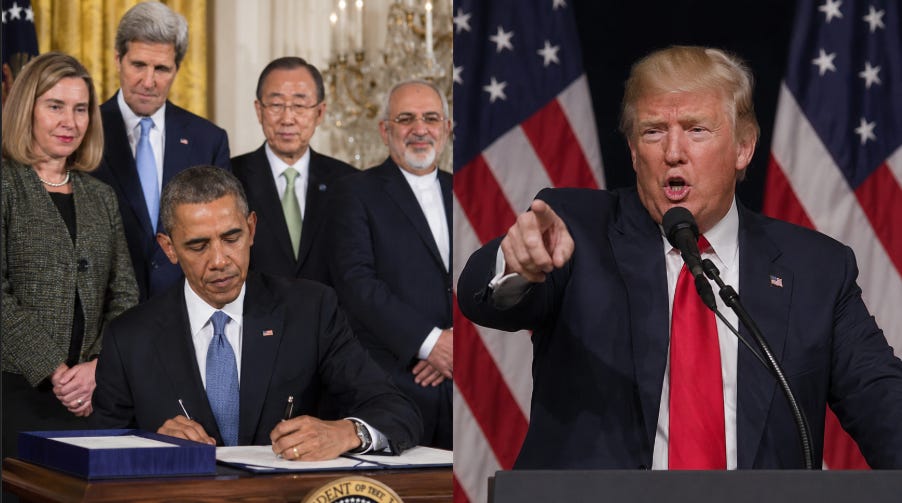
On Saturday, Trump announced on Truth Social that the United States and Iran had “largely negotiated” a memorandum of understanding “pertaining to PEACE.” By Sunday morning, the same man was instructing his negotiators “not to rush into a deal.” The deal that was largely done is not even fully negotiated yet, he clarified, in a subsequent post, apparently without irony. Both of these things were said by the same president, about the same deal, within roughly eighteen hours of each other. The national security of our country demands it. There can be no mistakes.
What is actually on the table, to the extent anyone can determine, is this: a 60-day ceasefire extension during which the Strait of Hormuz would gradually reopen, Iran would commit to “disposing” of its highly enriched uranium by some as-yet-undetermined method, frozen Iranian assets worth somewhere between $14 billion and $110 billion, the range itself is a kind of poetry, would be released in phases, and the actual question of Iran’s nuclear program would be kicked down the road for future negotiations. The missiles Iran possesses are not addressed. The enrichment moratorium the United States was previously demanding, twenty years, is not in the framework. What is in the framework is a promise to talk about these things later, which is the diplomatic equivalent of a contractor telling you the kitchen will be done by Friday.
For context: Donald Trump spent the better part of two terms publicly humiliating Barack Obama for releasing $400 million, not billion, million, in a cash transfer to Iran in 2016. He called it rank amateurism. He called it surrender and made it a centerpiece of his argument that Democrats could not be trusted with American foreign policy. The current deal under consideration involves unfreezing assets that dwarf that figure by orders of magnitude, and the nuclear question that supposedly justified the war remains, as of this writing, unresolved.
Even his own party noticed. Senator Lindsey Graham, who supported the war with the enthusiasm of a man who had been waiting for it his whole career, wrote on Saturday that striking a deal now would fuel the perception that the United States was recognizing Iran as a dominant force requiring a diplomatic solution. “It makes one wonder,” he added, with the wounded dignity of a man being asked to eat something he personally ordered, “why the war started to begin with.” Senator Roger Wicker, chairman of the Senate Armed Services Committee, called the emerging framework “a disaster.” Senator Ted Cruz said he was “deeply concerned.” Senator Thom Tillis said it “doesn’t make too much sense to me,” which, coming from the Senate, is practically a declaration of war.
Trump called them losers who know nothing about a deal that, again, isn’t fully negotiated yet.
By Sunday afternoon, however, Graham had located his offramp. Trump, it emerged, was dangling Abraham Accords expansion as a sweetener for hawks reluctant to swallow the Iran framework. The Abraham Accords, brokered during Trump’s first term, were normalization agreements between Israel and several Arab states, the United Arab Emirates, Bahrain, Sudan, Morocco, that had previously refused to recognize Israel’s existence. Expanding them to include Saudi Arabia has been the white whale of Trump’s foreign policy ambitions, a deal that would redraw the Middle East’s diplomatic map and, not incidentally, deliver Trump a legacy moment of genuine historic weight. The prospect of it, dangled at the right moment, has a way of making other problems look smaller. Within hours of the Accords being floated, Graham was describing this potential outcome as “historic” and “one of the most consequential agreements in history.” The Iran deal he’d called a nightmare had not changed, Graham had.
Iran, meanwhile, was doing its own messaging. A military adviser to the Supreme Leader declared that Iran has a “legal right to manage” the Strait of Hormuz, on the same day a deal to reopen it was supposedly agreed in principle. The IRGC announced it was already authorizing vessels through the strait “under coordination and security protection” of the Iranian navy, which is a creative way of saying Iran intends to function as the waterway’s management company regardless of what any memorandum says. The IEA noted that even in a best-case scenario, clearing the mines Iran planted would take a minimum of two to three months. The national average gas price had already climbed to $4.56 per gallon, the highest in four years.
Benjamin Netanyahu, for his part, broke his silence on Sunday with a statement so carefully worded it constituted a polite torpedo. He and Trump, he said, remained united in their stance that Iran would never have nuclear weapons, and that any final agreement must include dismantling Iran’s enrichment sites and removing all enriched material from Iranian territory. This is not what the emerging deal does. Netanyahu was not endorsing the framework. He was defining it out of existence from a distance, with a smile.
We are watching, in real time, the architecture of a capitulation being constructed floor by floor while everyone involved insists they are building something else entirely. The war was brought to end Iran’s nuclear program. The ceasefire didn’t end it, and the memorandum of understanding, if signed, will not end it. What it will do is create a 60-day window during which the United States agrees to stop squeezing Iran economically while both sides pretend the hard part is still ahead rather than already lost.
Trump will call it a great deal. His allies will call it historic. The hawks will grumble and then discover, as Graham already has, that there is always another Abraham Accord to admire.
Somewhere in the background, the Strait of Hormuz, which Iran has now established it can close, which it has mined, which it has declared its sovereign right to manage, will reopen. Gradually, though, and on Iran’s terms. The exact opposite of the JCPOA.
In 2 weeks...many people are saying. It'll be peace like no one has ever seen before. Grown men have come up to me in the street, with tears in their eyes, thanking me for having the outline of a plan to solve the war I started.
So is Iran going to charge tolls now?
Meanwhile, it's clear Ted Cruz has been talking to Susan Collins. Myself, I'm not concerned. I mean about Cruz and Collins. I don't think either could produce a brain cell, let alone a cogent statement.
As for Lindsey Graham, pffft. And where's ol' Mitch McConnell these days? Just because he's retiring doesn't mean he can't tell us about how proud he is everything's working out just as he wanted. 🤣🤣🤣