


Good morning! Just so you know, I am not a remotely superstitious person. I don’t knock on wood, I have nothing against black cats, and I consider 13 a perfectly respectable prime number. What follows is offered strictly for the record.
Friday the 13th arrived yesterday, and the Federal Aviation Administration forgot to knock on wood.
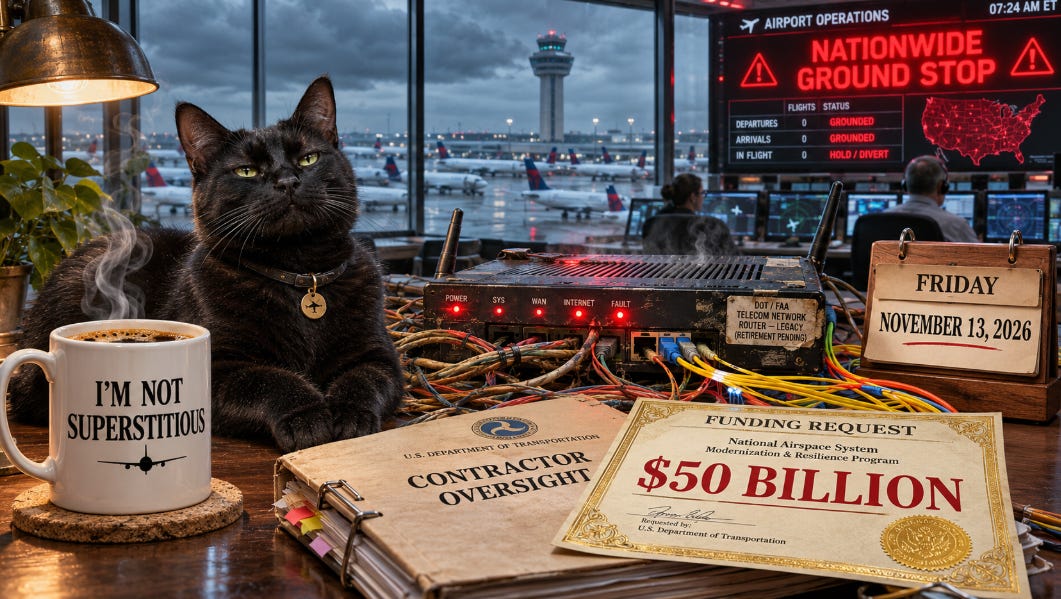
Midafternoon, radar and communications systems across the country began behaving unpredictably. Air traffic controllers were suddenly dealing with intermittent radio contact and unreliable radar information. The FAA responded by grounding departures nationwide, while controllers and pilots worked to bring more than 3,500 aircraft safely down.
By Saturday morning, more than 8,200 Friday flights had been canceled, with another 3,000-plus already canceled for Saturday. Passengers slept in terminals, airlines scrambled to locate their aircraft and crews, and the nation’s aviation system struggled to recover.
It wasn’t the FAA’s first bad Friday the 13th this year. On March 13, a circuit board overheated at the agency’s Potomac radar facility in Virginia. The smell drove the controllers out of the building, and flights at Reagan National, Dulles, BWI and Richmond sat for about two hours while firefighters tracked down the source.
A calendrical coincidence, surely. The outages are a habit. Newark’s radar screens went blank in the spring of 2025, and Denver’s radios went quiet for 90 seconds a few weeks later. Dallas lost its primary and backup data lines in a single afternoon that September. Philadelphia pulled the same trick this September and took New York’s airports down with it. After Newark, Sean Duffy assured senators that the system had “multiple redundancies” to keep people safe.
On Friday, we found out that “multiple” means enough to land the planes, but not enough to keep the country flying.
By Duffy’s account, radar and radio data at the high-altitude centers and the approach facilities around the country turned unreliable. Contact with aircraft came and went, and so did the picture of where those aircraft were. The FAA held every departure in the country “due to extraordinary circumstances and for reasons of safety” and worked to get the thousands of aircraft already airborne safely to an airport.
Nick Daniels, who heads the controllers’ union, described the scene on CNN. Controllers were asking the person at the next scope, and then the next facility, whose frequency still worked, and moving aircraft onto whichever one did. The text-based communications system that people online kept asking about does exist, but Daniels estimated that only 25 to 30 percent of U.S. aircraft were equipped for it. And it couldn’t replace the ordinary back-and-forth between pilots and controllers.
Everyone landed. Credit for that goes to the controllers and pilots who worked through an afternoon for which, as Daniels put it, there was no playbook.
The airspace reopened at 8:15 p.m. In this century, only the September 11 ground stop ran longer. Cirium, the aviation data firm, estimated on Friday evening that about 1.5 million passengers were left in limbo. Austin was reportedly approaching the point where it had nowhere left to park airplanes. The FAA’s own status page crashed under the traffic. The Transportation Secretary was himself on a flight from Dallas when it all started, and he briefed the nation that night in jeans.
By the time Duffy appeared before reporters on Friday night, the aircraft were safely on the ground, the airspace had reopened, and the administration was ready to explain what had happened.
Or, more precisely, to offer two explanations that didn’t quite agree.
The official explanation changed clothes all afternoon. What began as an “equipment outage” at Chicago’s airports became a communications problem at en-route centers nationwide, then a “temporary telecommunications outage.” By the 8:30 p.m. White House briefing, the two Cabinet secretaries had different stories about what went wrong.
Duffy blamed aging analog switches and routers overwhelmed with data, emphasizing that upgraded equipment had performed just fine. The moral: Congress should send money.
Mullin, asked about foreign interference, suggested that FAA patches and new technology “was overwhelming the older system.” When a reporter asked whether the agency’s own patching had caused the outage, Duffy replied, “I want to clarify that,” and marched everyone back to the copper wire.
In one version an antique fell over by itself. In the other, somebody bumped it. But the age of a router doesn’t explain what suddenly flooded it with data on a Friday afternoon.
Overnight reporting gave Mullin’s account considerably more substance. CBS, citing multiple sources, reported that a network update triggered a reboot and crash. Bloomberg reported that the FBI was examining a software update. A Washington Examiner reporter told CNN she’d spoken with 60 controllers and “none of them are buying what he said.” The definitive cause remained unconfirmed, but it is a rare day when the Secretary of Homeland Security is the leak.
They couldn’t agree on the danger, either. Mullin repeatedly insisted that no flight had been at risk. Duffy acknowledged intermittent radar and communications failures, describing them as “a risk that we’re unwilling to tolerate.”
Regular readers know the word this newsletter keeps coming back to. Kakistocracy is government by the least able, and Friday night was a 34-minute demonstration.
Mullin opened by announcing, “This is what the leadership of President Trump looks like,” while travel plans for an estimated million and a half people hung in the balance. Duffy thanked Stephen Miller, one week into the chief of staff job, for assembling “all of the intelligence assets of the White House” against what he himself described as a router problem. Asked how Americans could feel confident flying, he found room for “the greatest country, by the way, with the greatest president.” Asked why that president hadn’t spoken publicly, Duffy said he doesn’t run the president’s comms.
What neither secretary could explain was why a vulnerable network, already undergoing billions of dollars in upgrades, had been allowed to fail nationwide during that work.
Of course the system needs modernizing. But replacing a fragile system while keeping the country flying requires more than money. It requires planning, testing, and oversight.
All things Congress is supposed to insist upon.
Most of Friday’s briefing was a fundraising appeal. Congress gave the FAA $12.5 billion for modernization last year. By Duffy’s own telling, the president had asked for $30 billion more. By the time Duffy reached the podium on Friday night, he wanted $50 billion. The outage added $20 billion to the Transportation Secretary’s wish list. He wants it as emergency money before the end of the year, which the Times notes is before Democrats take over Congress.
An NBC reporter pointed out that Republicans have held the White House and both chambers for almost two years. Duffy observed that no Democrats had voted for the bill carrying the first $12.5 billion. That bill passed through reconciliation, which allowed Republicans to enact it without a single Democratic vote. And they did.
The system is old. Nobody disputes the copper, the analog circuits, or the radar parts no one manufactures anymore. After the Dallas outage in September 2025, the contractor that runs the FAA’s telecom network said it had warned for years that the circuits needed replacing and “funding was never available.” Replacing all of it is the right goal.
Old explains why the system was fragile. It doesn’t explain why it broke Friday. If Mullin was right, the modernization work itself had triggered the failure, and the people asking for another $50 billion were responsible for overseeing that work. That calls for a few questions before the check is written.
It also calls for a short trip to 2023. After the last nationwide ground stop, under a Democratic president, Ted Cruz had no patience for the idea that Congress was the problem. The failure, he said, came from the agency’s “inability to modernize, despite Congress providing the requested resources.” Cruz now chairs the committee that oversees the FAA. Three years ago, an equipment failure was evidence that the agency couldn’t manage the money Congress had already provided. On Friday night, Duffy argued that Congress was to blame for not providing enough. Apparently, accountability depends on who’s holding the checkbook.
Then there was the most candid sentence of the night. Asked why the FAA hadn’t prepared for a catastrophic failure in a network everyone knew was deteriorating, Duffy replied, “I didn’t anticipate that we would have an outage like this.” Newark, Denver, Dallas and Philadelphia were each just clearing their throats.
In 34 minutes at the podium on Friday night, neither secretary mentioned L3Harris, the defense contractor that operates the FAA’s telecommunications network and the company the FAA blamed after the September 2025 Dallas outage for failing to ensure that the network’s redundancies worked.
By Saturday morning, L3Harris finally had a name at the podium.
Duffy acknowledged that the company had been performing routine work at a remote FAA facility, replacing old copper telecommunications lines with fiber. He called the work straightforward and “not complicated.” A router involved in the conversion began flooding other routers across the network with more than 1,000 connection attempts every four or five seconds. Communications and radar feeds became unreliable, and the FAA grounded the country.
Suddenly, Mullin’s explanation from Friday night looked considerably closer to the mark.
Duffy and FAA Administrator Bryan Bedford said investigators were still determining whether L3Harris had made an installation error, configured something incorrectly, or installed defective equipment. Duffy even volunteered the word “incompetence.” History has been here before. In November 2009, a Harris technician incorrectly configured a router while moving the FAA’s communications network onto fiber. The error disrupted 129 air traffic facilities and delayed hundreds of flights nationwide. A subsequent Transportation Department inspector-general investigation found that the contractor’s configuration and procedural mistakes caused the outage, and that FAA oversight of Harris had been inadequate. The inspector general also warned that critical outages could recur as additional services were migrated onto the fiber-optic network.
Seventeen years later, we’re back to a router, a fiber conversion, and a nationwide disruption. Questions about contractor oversight begin to sound awfully familiar.
Duffy also mentioned that L3Harris owns the network, and that he is “stuck” with the company until he can build a replacement. The company did not immediately respond to CBS’s request for comment.
So the aging equipment didn’t simply collapse under the weight of its years. According to Duffy’s new account, something went wrong during the work intended to replace it.
A reporter asked why that work was being done at three o’clock on a Friday afternoon. Duffy’s answer, as Yahoo News reported it, was that jobs at small, remote sites are done during the day because they aren’t expected to affect the wider system. “It shouldn’t have that kind of impact,” he said.
That brings us back to the question he still hasn’t answered: how did routine maintenance at one remote location bring down a nationwide aviation network? Where were the safeguards, the isolation procedures, and the redundancy? Those seem worth answering before anybody signs the next check.
Replacing copper wire with fiber, it seems, isn’t quite as straightforward as the Transportation Secretary would like us to believe.
Duffy made one prediction on Friday that I fully believe: “You will have more of these.”
He meant it as a sales pitch, of course, but I would read it as a forecast and act accordingly.
If your flight was canceled or significantly delayed and you chose not to travel or accept a replacement flight, you’re entitled to a refund, regardless of whose fault it was. You don’t have to settle for a voucher.
The larger lever is the money. An emergency request for tens of billions of dollars is about to land on a lame-duck Congress, and every member of it can be asked for three things: a public root-cause report and independent oversight before billions more are committed, the contractor’s testimony under oath, and an inspector general following the money. None of that is hostile to modernization. It is how you make sure the next modernization effort doesn’t repeat whatever went wrong on Friday. Hakeem Jeffries has already called for timely answers. Republicans who demanded accountability from the FAA in 2023 are invited to demand it again.
The next Friday the 13th falls on August 13, 2027. I’m still not superstitious. I would, knock on wood, just like to see the report before then.
I’d love to see an interview w Pete B. I don’t trust any of the admin talking.
This was bound to happen. It’s not just aging equipment. Multiple sources indicate that between 300 and 400 FAA employees were terminated, primarily probationary support‑staff roles, during Donald Trump’s administration.
The only surprising thing is Trump hasn’t (yet) blamed Biden. Or Obama.
And, most importantly—- "We call it S.I." bitches!