


Good morning! I held off publishing today’s essay to hear what Donald Trump had to say at his much-advertised White House press conference. After all the promises of historic achievements, I thought there might be something worth waiting for. Apart from one revealing claim, it was hardly worth the bother.
Trump came home from China with a souvenir more precious than any trade deal: Vladimir Putin’s personal assurance that, had Trump won the 2020 election, Russia never would have invaded Ukraine. Or so Trump told reporters. There has been no public corroboration of that assurance, which is convenient, because it doesn’t hold up well in daylight.
Take it at face value, and Putin has just conceded that the invasion was a decision, made after checking who sat in the Oval Office. He could still argue that a friendlier American president would have handed over what he wanted without a war. But if he meant what he told Trump, he can hardly maintain that the invasion was inevitable.
The other possibility is that he didn’t mean it, and was simply telling Trump what Trump most likes to hear. Anyone inclined to believe him is welcome to make an offer on Putin’s bridge in Kerch. Lightly used. Damaged twice this week.
And that brings us to the real story of the week. Fresh off a midterm drubbing, with Democrats about to take over Congress, Trump needs a historic diplomatic success. The other people on his stage understand exactly what that’s worth, and how cheaply they can supply the appearance of one.
Trump opened Friday’s news conference by calling the trip the most consequential presidential visit in history. He had photographs to prove it. In 1972, Richard Nixon went to China and rearranged the Cold War. In 2026, Trump went to China and heard “YMCA” performed in his honor, for the second time in one trip.
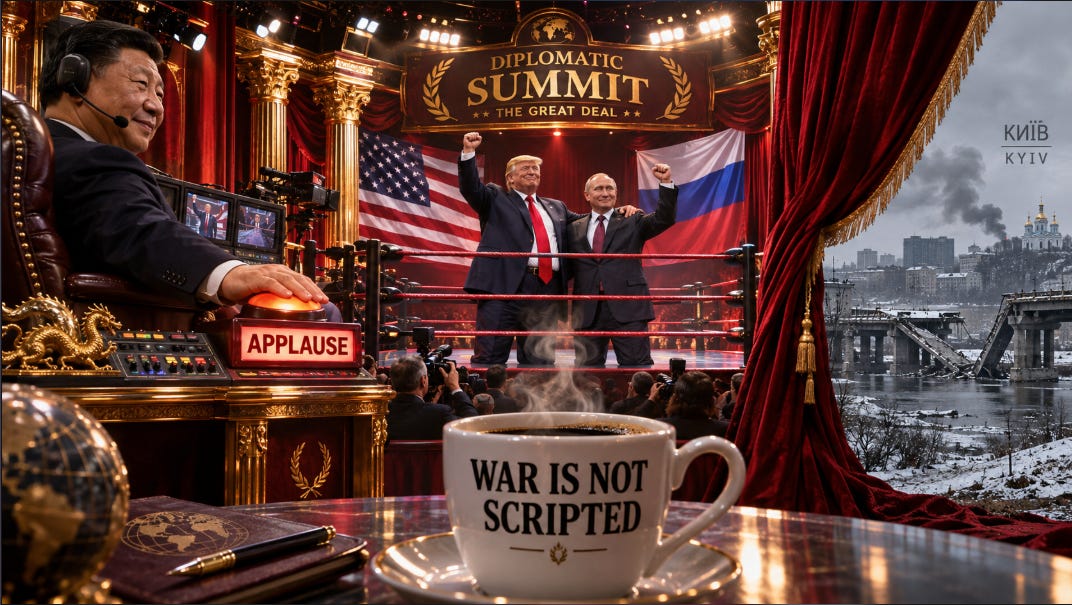
Professional wrestling has a word for this: kayfabe, the convention of presenting a staged performance as genuine competition. Trump knows the form; he’s in the WWE Hall of Fame. What he may not appreciate is the business model. The wrestlers get the spotlight. The promoter owns the building, books the card and keeps the gate. In Shenzhen, the promoter was Xi Jinping.
Xi made the unusual gesture of greeting Trump personally on the tarmac, with a military flyover and flag-waving dancers in pink, blue and white. When Putin landed the day before, Beijing sent Cai Qi, Xi’s chief of staff. That’s a senior welcome, but a calibrated one. At the group photograph, video showed Trump and Xi shaking Putin’s hand before gesturing for him to stand apart. At the banquet, Putin found himself seated at a different table from Trump, prompting a complaint from his own aide that the two presidents couldn’t talk.
For the summit itself, Xi managed the geometric feat of sitting at the head of a round table. The Times’ China correspondent, Richard Spencer, described Trump and Putin on either side of him as “almost in a supplicant position.” Xi then used his remarks to call nuclear weapons a “sword of Damocles hanging over humanity” that should be eliminated. Mikhail Kasyanov, Putin’s first prime minister and now an opposition figure, noted on Times Radio that nuclear weapons are the only thing that gets Putin’s Russia into that room. Calling for their abolition in front of him, Kasyanov said, amounted to treating Putin as a junior partner.
The promoter also controlled the cameras. When Bloomberg’s Annmarie Hordern shouted a question about whether Nvidia’s former chief executive had been disloyal to the United States, Chinese officials barred her from the trilateral meeting. The White House reportedly intervened on her behalf. Beijing refused. Trump’s own complaint about the trip was that journalists hadn’t been allowed to see enough of it: “It’s too bad the media couldn’t see some of it.”
The star of the production never seemed to notice who was running the camera.
The three leaders did produce a document. China, Russia and the United States issued a joint declaration on peace, which, as the Guardian noted, never mentions the wars in Ukraine or Iran. Two of its three signatories are fighting those wars.
What it does contain: a pledge to reform the United Nations, a plan to increase supplies of refined petroleum products, and an agreement to keep talking about nuclear risk. It also affirms that “a nuclear war cannot be won and must never be fought,” a sentence Reagan and Gorbachev agreed to in 1985, now repackaged as a breakthrough. To be fair, getting Beijing into a three-way conversation about nuclear weapons at all is something. It just isn’t a framework, a timeline or a treaty.
Then there’s the International Criminal Court. The declaration recognizes respect for the immunities of state officials as being of “paramount importance” and warns the court against abusing its jurisdiction. One of the state officials sitting at the table is wanted by that court for alleged war crimes involving the deportation of Ukrainian children. Trump, for his part, called the ICC a “rogue” organization and, according to Putin, renewed his invitation to next month’s G20 summit in Florida.
On Friday, White House aides handed reporters a summary of what they called the “Declaration toward Peace,” highlighting the consensus on the UN, the ICC, energy and nuclear risk. The warning to the court seeking Putin’s arrest made the highlights reel.
After the summit, the BBC’s Steve Rosenberg asked Putin the obvious question. How does a declaration on shared responsibility for world peace square with Russia’s continuing attacks on Ukraine? Rosenberg has done this before. At the 2024 BRICS summit in Kazan, he held a declaration on security and justice up against the war. Declarations come and go. Rosenberg keeps showing up with the receipts.
Putin insisted the summit was “not just an image” but conceded it was not yet a new format, with no agreement to meet regularly. He then complained about Ukraine’s strikes on the Crimean bridge, which he called a purely civilian facility. It is also a key supply route for Russian forces in occupied Ukraine. Putin ruled out further discussions of a limited ceasefire covering energy infrastructure and shipping and threatened retaliation considerably more painful than the damage to the bridge.
As for peace, Putin explained, that’s up to Ukraine. Kyiv need only accept what Putin described as American compromise proposals floated before the Alaska summit, which Moscow claims to have accepted. Chief among them is handing over the remaining Ukrainian-held territory in Donetsk, which Putin described as roughly 10 percent of the region. Independent battlefield monitors put the figure at more than 20 percent. Even the territory Russia hasn’t conquered is subject to creative accounting.
Asked what Russia would sacrifice, Putin said it had no intention of sacrificing anything. Everyone else, he said, must recognize the realities on the ground. He referred to Ukraine’s elected government as “the regime in Kiev.”
So when Trump says Putin wants peace, he’s telling the truth in the way a mugger wants your wallet without a struggle. Putin would like the war to end, preferably right after Ukraine surrenders.
In Berlin, Europe’s leaders were offering a rather different definition of peace.
Europe had a rather different definition of peace. In Berlin, German Chancellor Friedrich Merz hosted nearly 40 delegations of the Coalition of the Willing at the Chancellery, co-chaired with Emmanuel Macron and British Prime Minister Andy Burnham. Trump’s envoys, Steve Witkoff and Jared Kushner, attended. Zelenskyy stood alongside them.
Merz was less dazzled than Trump. The Shenzhen meeting, he told reporters, was apparently above all a photo op. “A Yalta format will not bring peace,” he said. Every guest went home with a piece of the Berlin Wall, a reminder of what happens when great powers divide Europe into spheres of influence.
The difference between the two cities comes down to a preposition. Shenzhen offered a peace negotiated over Ukraine; Berlin insisted on one negotiated with it. The European Commission has proposed an additional 45 billion euros for Ukraine in 2027, a plan that drew broad support at the summit but still needs approval. Britain reaffirmed a £10 billion assistance package agreed in its recent budget and announced another £260 million in military support, including more than 1,000 long-range drones. The money, Merz said, isn’t meant to prolong the war but to let Ukraine negotiate from a position of strength.
Europe also put terms on the table. Any territorial settlement would start from the current front line, not from Moscow’s map. Ukraine keeps its path toward the European Union and help with reconstruction. Sanctions on Russia could be eased step by step, with conditions. And the sequence matters: peace in Ukraine first, then talks about the wider European security order. Macron added that, so far, Russia hasn’t put a single concrete element of a peace on the table. Burnham was blunter: it isn’t up to the aggressor to make unrealistic security demands.
Then Trump called in. According to Politico, citing European officials briefed on the discussion, he dialed into the summit from Air Force One, hours after leaving Putin. He told the room that Putin was genuinely committed to peace, and three officials said he voiced strong doubts about Europe committing billions more to Ukraine. Another participant described his remarks as more general, focused on the death toll. The White House didn’t comment.
Europe’s leaders were rejecting Putin’s terms. Trump phoned in to vouch for the man who had laid them out. Kushner, ever the developer turned diplomat, assured reporters afterward that Trump wanted Europe at his side. Whether he wanted Europe to have a say was rather less clear.
Overnight, Russia answered the declaration on peace in the language it actually speaks. A massive missile and drone barrage across Ukraine killed at least eight people and knocked out power, water and heat, including in Kyiv. A day after Putin threatened retaliation for the Crimean bridge, Russian missiles damaged three bridges across Kyiv’s Dnipro River. Employees of the city’s water utility were among the dead.
Two Russian cruise missiles and a suspected jet-powered drone came down in southeastern Poland, not far from where the Coalition of the Willing’s first joint military exercise was under way. No one was reported hurt in Poland. NATO scrambled jets, and Poland’s prime minister, Donald Tusk, said everything pointed to an intentional provocation.
A few hours later, Trump strolled into a packed White House briefing room nearly half an hour late. Two easels stood ready, one promising “Securing Historic Deals in the Indo-Pacific.” Vance and Rubio flanked him at the podium.
He opened with the airplane, his new Air Force One, a gift from Qatar. China was impressed. Russia was impressed. Trump was impressed. He was especially taken with its ability to fly nonstop, and it did fly home from Shenzhen without stopping. On the way out, it stopped in Fairbanks to refuel. Unlike the older presidential jets, it reportedly lacks aerial-refueling capability and some of their advanced defenses. New equipment, the president assured the room, is always better than old equipment.
On trade, Trump spoke of deals bringing in tens of trillions of dollars. His own staff’s handout advertised $17 billion in Indo-Pacific deals and investments. He announced that the Philippines would buy all its agricultural products and energy from the United States, a claim the New York Times’ trade reporter called highly unrealistic. Thailand’s broader trade agreement still awaited finalization and signature.
The trouble waiting at home got similar treatment. Asked during the trip about a week of outages that grounded flights and froze bank transactions, Trump offered his philosophy: “It’s life. When you’re big and powerful and you have all the money, things like that happen. It’s fine.”
As for Ukraine, Trump said he had clearly expressed to Putin his desire to see the war end by diplomatic means. In nearly half an hour of opening remarks, he mentioned neither the overnight strikes nor the missiles in Poland.
In kayfabe, the performers get the glory and the promoter controls the production. Shenzhen followed the script. Trump collected his pageantry, Putin his rehabilitation, and Xi the role of host to the great powers.
Wrestling, at least, scripts its endings. Shenzhen scripted everything else: the entrance music, the staging, the carefully choreographed photographs. Nobody scripted an end to Russia’s war. The casualties were in Kyiv, and the missiles landed in a Polish field.
3 big Hats…still no cattle….
The new Axis Powers?