

Good morning! The world is on fire, and the people allegedly in charge of the United States government are once again demonstrating that kakistocracy is not just a diagnosis but a management style. Let’s start in the Strait of Hormuz, where Trump’s war of improvisation has now ripened into a full-scale supply-chain and affordability crisis. Oil flows through the strait have plunged, traffic has been effectively choked off, commercial ships have been hit, and allied governments are reaching for emergency reserves because one of the world’s most critical energy arteries is barely functioning. Gas prices in the United States rose for an eleventh straight day to a national average of $3.578 a gallon, while Brent crude stayed elevated around $90 a barrel after earlier panic spikes. The man who sold himself as the champion of cheap gas and strong leadership has once again found a way to make everyday life more expensive while setting fire to the global plumbing.
How did we arrive at this elegant tableau of self-inflicted disorder? Through the kind of clear, disciplined statecraft normally associated with a bachelor party after a head injury. First came the wild social media messaging suggesting escorts and control, followed shortly thereafter by the walk-backs. Then came Trump’s all-caps Truth Social war poetry, promising “Death, Fire, and Fury” like a man auditioning to be the understudy for his own delusions. Then came the actual burning ships, the spike in prices, and the emergency oil planning. So the sequence, in case anyone lost track, was fantasy, contradiction, market whiplash, and then real-world economic pain.
What makes this even more grotesque is that countries which were not consulted before this attack are now being forced to coordinate petroleum reserve releases just to stop Trump’s chaos from metastasizing into a full global economic seizure. That is the part that deserves to be underlined in red. The United States helped ignite a conflict that choked one of the world’s most important energy arteries, and now allies and partners, many of whom were blindsided by the escalation rather than brought into any serious planning, are left scrambling to stabilize oil markets, protect their own economies, and prevent a wider affordability shock for everyone else. Think of it as geopolitical vandalism followed by an international cleanup operation.
What makes the Hormuz debacle even more damning is that the criticism has moved beyond “their messaging is confused” to something much worse: they appear to have stumbled into this crisis without a serious, ready public plan to keep the strait open or reopen it quickly once it seized up. That charge no longer sounds like partisan sniping. Gen. Dan Caine publicly said the military would consider “a range of options” to escort ships if tasked, while reporting indicated there were no current orders for such escorts. Instead of competence, we get swagger. They had a slogan for the war before they had a plan for the choke point.
There is also the small matter of American casualties, which deserve a hell of a lot more honesty than this administration has offered. The Pentagon’s latest figure is 7 U.S. service members killed and about 140 wounded, with 8 severely injured. Those are not abstractions. Those are human beings paying the price for a war whose public justification has lurched from one talking point to another. The administration has given the country maximal confidence theater and minimal clarity about the endgame.
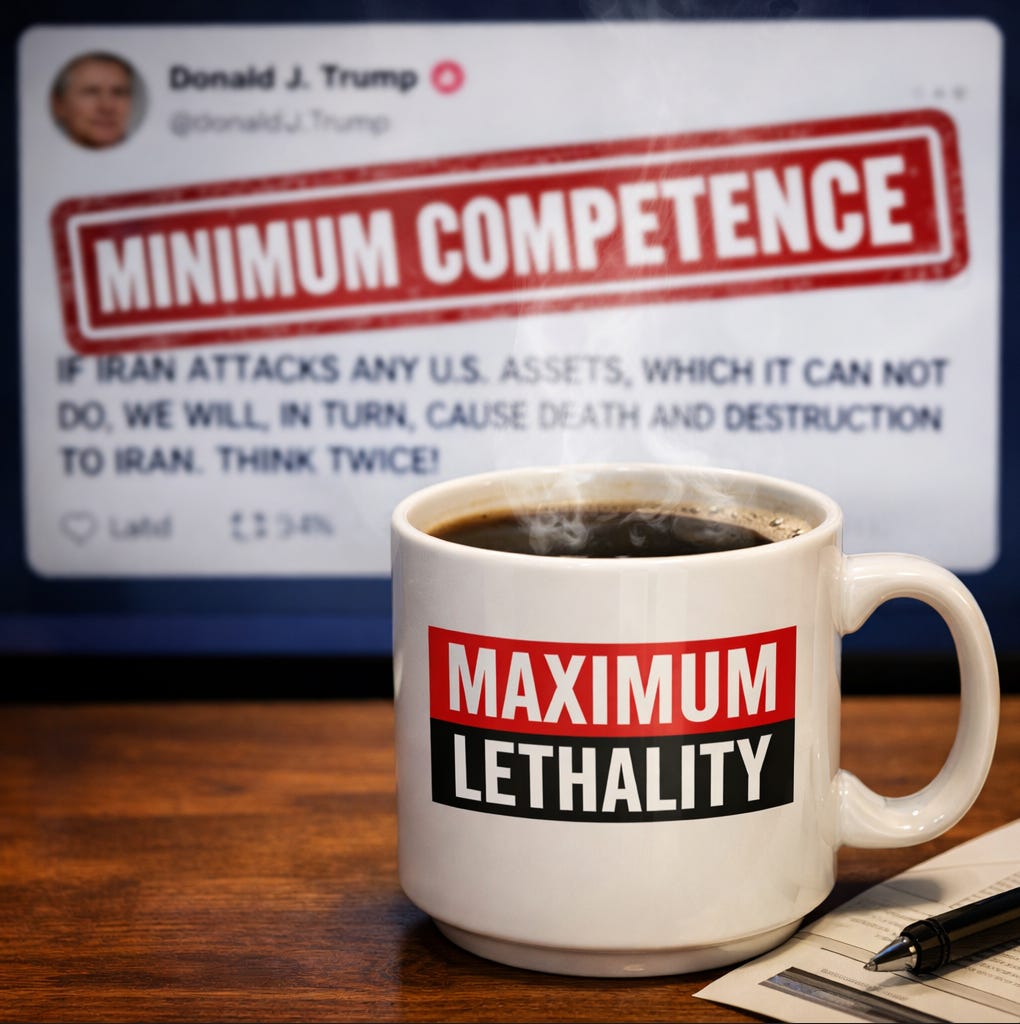
Because no Trump-era disaster is complete without civilian carnage being rebranded as toughness, let’s talk about the ProPublica investigation into the strike on the Iranian girls’ school in Minab. The reporting lays out how the Pentagon had been building a framework to reduce civilian harm in war, more careful targeting, stronger no-strike protections, better analysis of civilian presence, real investigations after things went wrong, only to have much of that effort gutted under Pete Hegseth’s fetish for “lethality.” That word is not new, but the way it is being used now is different. It has been promoted from military jargon into ideological branding, a macho solvent meant to dissolve oversight, law, and moral hesitation. Then came the missile strike, the dead children, and the overhead image of rows of graves being dug for the victims. The graves are the policy made visible. They did not just loosen the rules of war, they bulldozed the guardrails, then left children to be buried in rows.
Back on the home front, the administration is serving up an equally pure domestic specimen of kakistocracy. After spending a year chainsawing the federal workforce in the name of efficiency, Trump’s people are now quietly ramping up hiring because it turns out the government actually needs people who know how to do things. A remarkable discovery. Fire hundreds of thousands of workers, break agency capacity, produce no meaningful evidence of savings, then sheepishly admit that maybe, just maybe, some of those skills were useful after all. Because this administration never learns the right lesson, the rebuild is coming with more ideological screening, more White House control, and easier ways to purge people later. They mistook vandalism for reform, and now they’re calling the repair crew a hiring strategy.
That is the throughline this morning. Abroad, they improvise a war, jam a global choke point, spike energy anxiety, send troops into danger, and then appear startled that markets and allies would like to know whether anyone is actually steering. At home, they gut the civil service, discover too late that governance is not a podcast vibe, and then try to rebuild the wreckage in the leader’s image. Fewer adults, less competence, more propaganda, and a larger bill for everyone else. This is kakistocracy in its natural habitat: loud, cruel, sloppy, expensive, and always convinced that the next act of vandalism will finally make everything work.
On a personal note, I may finally, finally be on the downhill side of this miserable bug, which is excellent news because both my patience and my productivity have been taking turns flatlining. None too soon, either, because Marz remains fully committed to his romp addiction and has shown absolutely no interest in adjusting his lifestyle to accommodate my attempts at convalescence. In his defense, he is right that the world always looks a little more survivable after fresh air, movement, and a determined dog insisting that lying around feeling sorry for yourself is not, in fact, a long-term plan. So I’m hoping this means a little more energy, a little more momentum, and maybe a return to something resembling normal human function, or at least enough to keep up with a dog who believes recovery should be measured in sprints.
Let me start with the positive, I’m glad you are shaking your “bug.” And, now to the profound. Your report captures our nation’s moral demise. The nice little not-war, war is a first class debacle. There was never much doubt about our military’s lethality. The deeper question, unanswered, is the legal sophistry allowing Congress to avoid declaration and a President to commit war acts by declaration; whether, whim or circumstance the same. The war may not be “unlawful;” it is most certainly illegitimate and unnecessary.
We are burning money like a drunken sailor (former Navy myself). The war’s purpose is still a bumper sticker—actually several—and the notion of an end state vague. Today, we learn from Mr. Trump there’s really not much left worth bombing. In Pogo’s parlance, “let’s just declare victory and leave.” Works for me. Israel wanted this war, let them “enjoy” its fruits. Who didn’t want this war, the Gulf States (GCC). Good chance they will rethink their US interests.
Most depressing, Congressional members whose calculus is craven in the full sense. It’s a war. We are expending blood and treasure. We are torching American prestige. We went to war in the midst of diplomatic talks with Iran to prevent war—that is damning beyond words. There is a price to pay, and those receipts will come due.
I hope you feel better soon. I appreciate this posting and rely on your take on all the horribleness. Plus you are a most felicitous writer and one of only two substacks that I subscribe to! Courage to us all!