


There are two ways to look at Greenland from far away. One way is as a shape on a map, an enormous white mass at the top of the world, parked on strategic air and sea routes, sitting on minerals, rare earths, fish, and the collective attention span of every great power that thinks the Arctic will define the next century. In that view, Greenland becomes a “prize,” a thing to be acquired, secured, or controlled. Like it’s a limited-edition expansion pack for the Northern Hemisphere. The other way is as a home, towns and settlements stitched to the coastline, families who have lived with the ice and ocean for generations, a language and culture that endured long before Copenhagen, or Washington, had big plans for the far north. In that view, Greenland is not a “thing.” Greenland is a people.
And if you’re an American who cares about the story we tell ourselves, liberty, consent of the governed, the idea that people shouldn’t be ruled from far away without a voice, then Greenland’s history isn’t a curiosity. It’s a mirror. Right now, that mirror matters. Because in recent weeks, senior U.S. political rhetoric and reporting has again raised the idea of the United States acquiring Greenland, sometimes framed not as negotiation, but as something the U.S. would get “one way or the other.” Which is… a bold tone for a country that claims to dislike imperialism, as long as you ignore the times we forget that. Greenland’s response has been clear, it cannot accept a U.S. takeover “under any circumstances,” and it insists its security belongs in NATO frameworks, not unilateral American ownership. Translation: Thanks, but absolutely not, and also, please stop talking about us like we’re a piece of real estate you saw on Zillow.
Here’s what we argue, for a country founded on self-determination, treating Greenland as purchasable, or pressure-able, is not realism. It’s a betrayal. It’s the language of empire dressed up as “strategy,” with a red tie on it so we can pretend it’s respectable. Because Greenland’s story is not a story of empty land waiting to be claimed. It is a story of a people living on the edge of ice and ocean, building lives, language, and community in a place outsiders have long imagined as distant, useful, and quietly available. Like the nations of earth are Greenland’s exes keeping the island in their back pocket, mostly because the thought of another nation getting into bed with Greenland fills the powers with jealous rage.
Greenland’s modern political story gets reduced to a few dates, Home Rule in 1979, Self-Government in 2009, but the real arc is more human, a long effort to move power from “over there” to “right here.” Denmark-Norway’s colonial administration is commonly dated to 1721, and by 1814 the Treaty of Kiel had locked Greenland into Denmark’s orbit for generations. In the twentieth century, Greenland’s geography made it strategically priceless. The Cold War turned the island into an Arctic shield, and formalized defense arrangements followed, including the 1951 U.S.–Denmark agreement on Greenland’s defense under NATO responsibilities.
Denmark ended Greenland’s colonial status formally in 1953 by folding it into Denmark’s constitutional framework, but changing the legal label didn’t erase the feeling of being managed, or the pressure toward Danish language and priorities. Greenland’s answer was democratic and determined. A 1979 referendum brought Home Rule into effect on May 1, giving Greenland control over major domestic matters. Soon after, Greenland proved what self-rule means by choosing its own relationships, after a 1982 referendum, it left the European Communities effective February 1, 1985.
And in 2009, Self-Government recognized Greenlanders as a people with a right to self-determination. It put into law what Greenland’s long political journey had been demanding all along, not “a better deal,” but the right to decide.
Americans love a clean origin story, brave break with tyranny, declaration, war, flag, a nation rising like a majestic sunrise. But our own history teaches a harder truth, freedom isn’t only won by winning a fight. It’s secured by building institutions that protect the dignity of people who are weaker than you, farther from you, or inconvenient to you. If “consent of the governed” is the foundation of legitimacy, we can’t quietly add a footnote that says, “except when the resources are tempting.” That’s not a principle. That’s a coupon code.
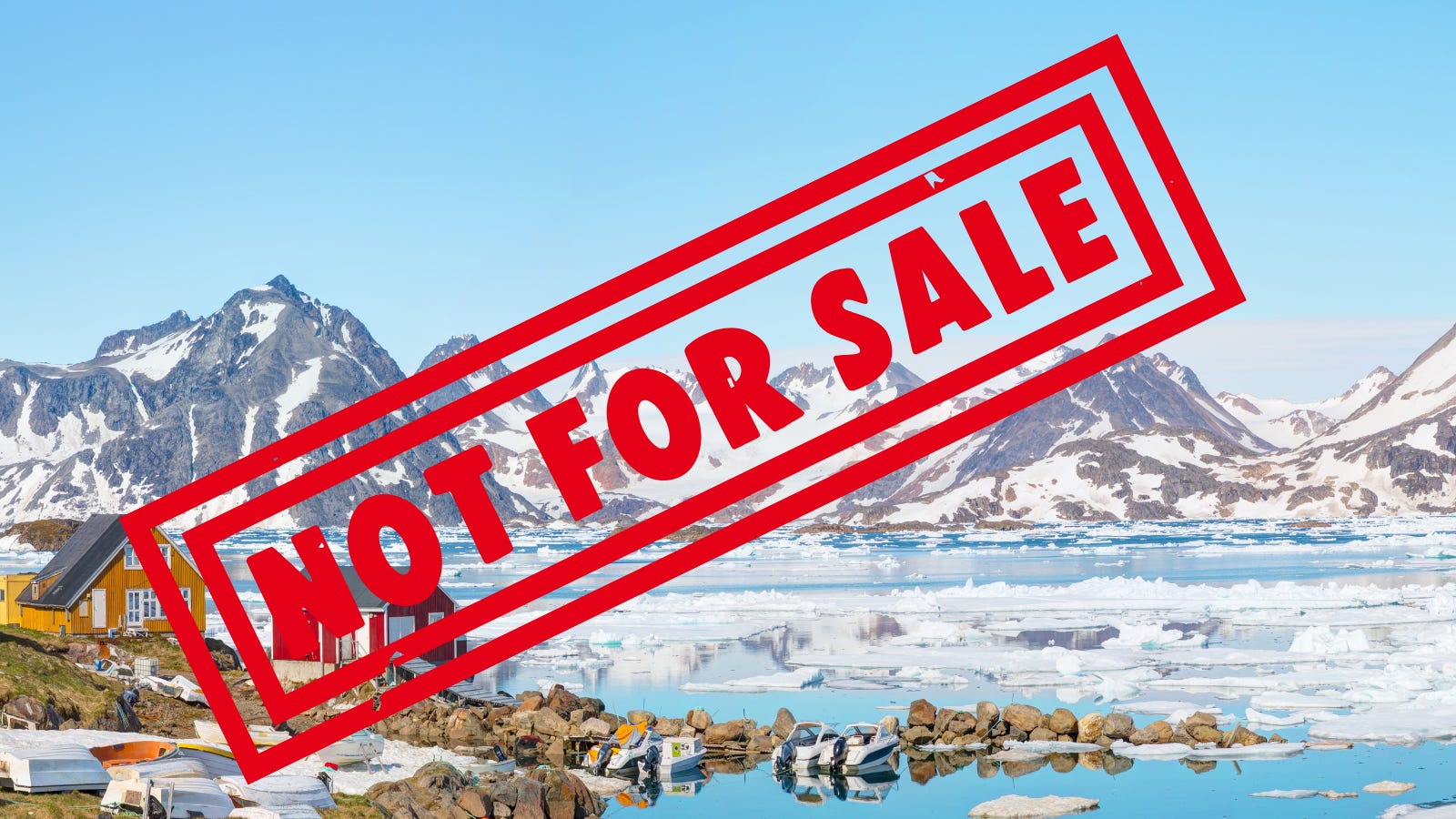
This is where Greenland’s story collides with the American conscience. Because in today’s America, our president is stating that the United States “must own” Greenland for strategic reasons, despite warnings from European and U.S. figures that a military takeover would be catastrophic for NATO and transatlantic relations. Greenland’s leaders haven’t been ambiguous. The message is not “make us a better offer.” The message is “no.” And honestly, “no” should be the end of the conversation. It’s a complete sentence. It’s not a negotiation starter. It’s not a dare.
When Americans hear talk of “buying” or “taking” Greenland, it’s tempting to file it under big-power bravado, a headline, a provocation, a tactic. But for Greenlanders, this isn’t a joke. It’s the oldest threat small places face when they sit beneath the shadow of large states, the fear that the world will talk about them, trade around them, and decide for them. There’s a kind of language that always appears when powerful states want territory. It sounds practical. It sounds adult. It says: “strategic necessity, security, resources.” But listen closely and you’ll hear what it refuses to say, “Who asked them?”
Greenland is not empty. Greenland is not ownerless. Greenland is not an unclaimed platform for someone else’s ambition. It is part of the Kingdom of Denmark with broad self-government, governed by Greenland’s own elected institutions. That autonomy sits alongside fiscal reality, Greenland still relies heavily on Denmark’s annual block grant, along with additional Danish spending on functions Denmark retains, like defense and parts of the justice system. But here’s the moral distinction Americans keep trying to blur, this is a relationship built on law, negotiated autonomy, and long-earned trust, plus a recognized pathway for Greenlanders themselves to decide their future, including independence.
And the rules the world agreed to after the last century’s catastrophes are not ambiguous about coercion. The UN Charter commits member states to refrain from “the threat or use of force against the territorial integrity or political independence of any state.” That principle is one of the thin lines separating “international order” from “everyone with an army gets to be a realtor.”
So, if the United States continues down a path toward coercive acquisition, if we treat Greenland as a target to be pressured, frightened, or bought over the heads of its people, we are not extending freedom. We are reenacting the logic Americans once claimed to reject. Even if someone insists, “No, no, only a purchase,” the moral problem doesn’t disappear. A land purchase is a transaction between states. But Greenland’s story is precisely about rejecting the idea that its fate should be traded between capitals like baseball cards for diplomats.
After World War II, U.S. officials raised Greenland’s importance to American security, and diplomatic records show discussions with Denmark about long-term rights and defense arrangements. In 2019, President Trump publicly expressed interest in purchasing Greenland; Greenlandic and Danish officials responded with clear honesty, Greenland was “open for business, not for sale.” And here we are again. When the same desire keeps returning, it stops being a quirky idea and becomes a habit of thought, Greenland as an object for American needs. That habit is the opposite of solidarity.
None of this requires Americans to pretend Greenland isn’t strategically important. It is. Its location matters for Arctic security, NATO planning, air routes, and monitoring emerging threats. But the United States doesn’t need to acquire Greenland to benefit from those realities, this is not a doorbuster sale where if you don’t buy the whole island you’re not allowed to stand near it. There’s a version of U.S.–Greenland relations that’s strong, mutually beneficial, and morally defensible. Treat Greenland’s elected government as a partner, not a bargaining chip. Work through alliances and law, especially NATO frameworks, instead of unilateral claims. Invest in infrastructure, education, climate adaptation, and economic resilience in ways Greenland actually asks for.
Respect Greenland’s legal and constitutional pathway toward whatever future it chooses, including eventual independence.
And yes, if America wants more Arctic access and coordination, we could also try something truly radical and deeply un-American, using the agreements we already have, like a country that plans to stay invited to meetings. We have treaties. We have alliances. We have NATO. We have trade frameworks. This is literally what they’re for. The adult option is cooperation, not conquest. The “buy it or else” option is what you say when you’ve stopped making a case and started issuing a threat with extra syllables.
You want influence in the Arctic? Great, show up, invest, coordinate, build trust. That’s the boring part of leadership. But leadership is not “I must own this.” That’s not strategy; that’s a toddler at the airport gift shop, gripping a snow globe and shouting, “MINE,” while everyone pretends not to notice because it’s awkward and we’d like to make our connecting flight.
Here is what Americans need to say out loud, even if it’s uncomfortable, when we talk about “owning” Greenland, we are talking about owning decisions over someone else’s home. When we talk about Greenland as minerals and routes and outposts, we are training ourselves to see Greenlanders as scenery. That’s how dehumanization begins, not with hatred, but with abstraction. If we allow ourselves to do that, then our freedom story becomes a weapon we use only when it benefits us, not a principle we live by when it costs us something.
Greenland’s modern political history is a slow insistence on the same idea Americans claim to cherish, expressed through referendums, laws, institutions, and the steady transfer of authority. So, if Americans want to honor our myth at its best, not as propaganda, but as a moral commitment, we should be able to look at Greenland and say, “We recognize you as a people, not a purchase. We see your homeland as a home, not a commodity. We will not dress up taking as “security.””
Superpowers are not only measured by what they can seize. They are measured by what they refuse to seize. In the short run, it may feel clever, even tough, to talk about acquiring Greenland “one way or another.” But the world has seen this movie before, powerful countries insisting their needs override other people’s rights, until the moral vocabulary that protects small nations collapses. Greenland’s answer, “not for sale,” “not under any circumstances,” is not an obstacle to American greatness. It is an invitation to live up to our own values.
Excellent framing. “Might makes right” sits very uneasily on the American conscience—or should.
Mary posed the issue well. My comments mirror what I believe the essence
The tell is Trump’s rape of E.Jean Caroll. It is the notorious Access Hollywood “grab’em” remark. It is his harassment, his bullying. To possess by force, then discard his vanity assuaged momentarily. Simply, he has no respect for things. For people. For our Constitution. For him it is the strong over the weak. In Greenland, we again see the chief flaw. In ICE enforcement, no respect has become domestic policy. Unchecked, NO RESPECT will become our national character. If one is MAGA, they need to look through the eyes of their children and see they are the bully. And ask, is this who I really am, what I’ve become? Trump is a lost soul, only remaining shall our great country follow him to hell?