


On Wednesday afternoon the House of Representatives voted, 215 to 208, to order the President to stop fighting a war he insists is already a ceasefire, a ceasefire he was, that same afternoon, describing to reporters as “shooting in a more moderate manner.”
Both things are true at once. That is the first thing to understand about this vote. It is a real rebuke and a legal nullity, and it is both for the same reason, by design, and the design is older than the war.
The resolution invokes the War Powers Resolution of 1973, the post-Vietnam statute that says a president must remove armed forces from hostilities after a set period unless Congress authorizes the fighting. The war crossed the relevant threshold weeks ago. The administration’s answer is that a ceasefire in place since April 8 stopped the clock, a tidy argument undone by the fact that the United States, Israel, and Iran have all broken that ceasefire several times since. You cannot toll a deadline with a truce you are actively shelling through. The clock is stopped and running at the same time, which is to say it is whatever the man holding it needs it to be on a given afternoon.
Even if the clock were clean, the measure that passed Wednesday carries no enforcement behind it. It is a concurrent resolution, and it does not go to the President’s desk. In 1983, in INS v. Chadha, the Supreme Court held that for Congress to bind anyone, its actions have to clear the full legislative process, both chambers, then presentment to the president for signature or override. A concurrent resolution does none of that. The Court took the teeth out of the 1973 law four decades ago, quietly, in a case most people have never heard of, and what the House exercised on Wednesday was the gums.
So the structure is this: Congress reached for a 1973 statute that the Court neutered in 1983, to constrain a 2026 war that the President says is a ceasefire he happens to be violating. Every layer is a form without a force. The vote is genuine and it changes nothing, and anyone telling you it is purely symbolic or genuinely binding is picking one truth and hiding the other.
Four Republicans crossed the aisle: Thomas Massie of Kentucky, Warren Davidson of Ohio, Brian Fitzpatrick of Pennsylvania, and Tom Barrett of Michigan. A fifth break came from the Democratic side, where Jared Golden of Maine, who had voted against three previous versions of this resolution, switched to yes and handed his party unanimity. It was the fourth attempt. House leadership had pulled an earlier vote before the Memorial Day recess rather than lose it on the floor, and could not stall again once the war powers law forced the timetable.
Within the same few hours, the Senate moved to strip a billion dollars in security funding for the President’s ballroom project. A bloc of Senate Republicans threatened to sink his own immigration bill unless it permanently killed the $1.8 billion fund to compensate his political allies, a fund his acting attorney general had pronounced dead under oath the day before, and which the President resurrected from the Oval Office that afternoon with the words “I love it.” And the House voted, 218 to 204, to take up sweeping new sanctions on Russia over a White House veto threat, six Republicans joining the Democrats.
Four breaks in an afternoon. The temptation, the one every cable chyron reached for by evening, is to call this the Republican Party rediscovering its spine.
Look at the vertebrae before you accept the diagnosis.
Massie lost his primary last month to a challenger Trump recruited and endorsed; the grievance, by most accounts, was Massie’s push to force the release of the Epstein files. He is a dead man voting. Over in the Senate, the loudest voices for killing the payout fund belong to Thom Tillis, who is not seeking re-election; Bill Cassidy, who already lost his primary to a Trump-backed challenger; and John Cornyn, who lost his the same way. Davidson is a libertarian who was never inside the tent. Fitzpatrick and Barrett are swing-district members doing the arithmetic of November in front of constituents who can see the price of gas.
This is the pattern, and it is not the pattern of conscience. The defections cluster almost perfectly among the politically deceased and the politically endangered members Trump has already destroyed, members who have announced their exit, and members who fear the voters more than they fear the President. Tillis said the quiet part into a microphone: there are people advising the President, he observed, as if there were no election in November. The spine appears precisely, and only, where the whip has lost its grip. Retribution was supposed to enforce discipline. Instead it manufactured a small population of men with nothing left to lose, and it is that population, not the conference, that crossed the aisle.
There is a grim symmetry to it. The machinery of punishment that kept three hundred Republicans in line is the same machinery that freed the four. You cannot threaten a man you have already ruined.
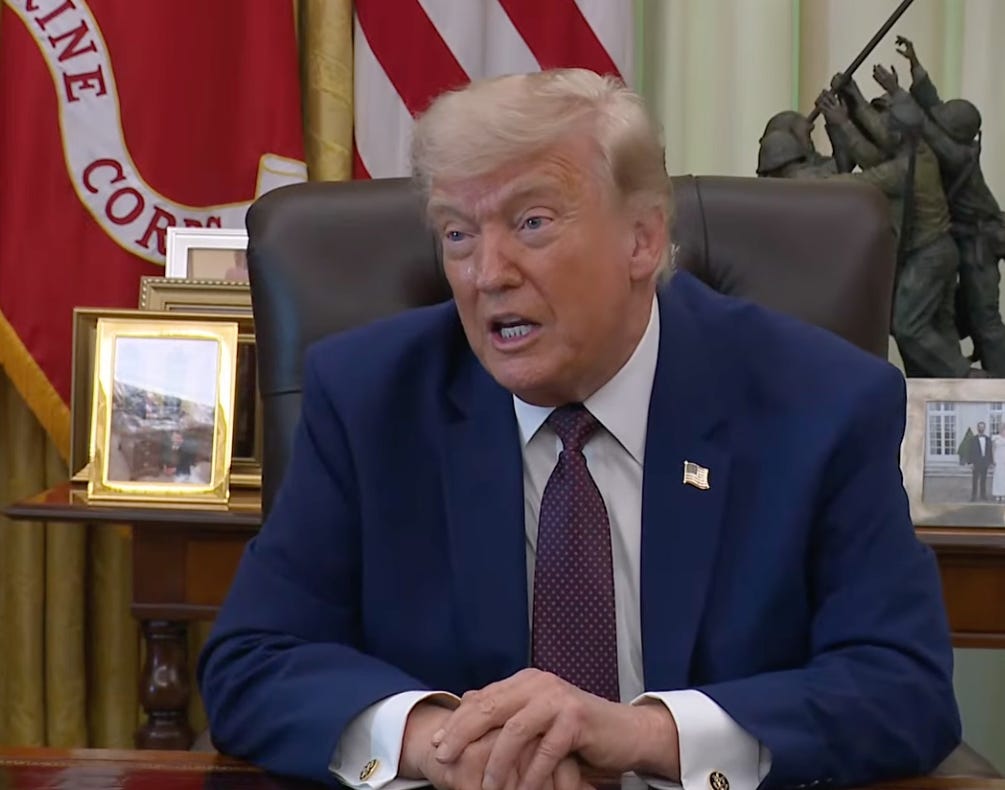
While the House voted, the President sat for an Oval Office availability and spent the bulk of it on a reflecting pool. The fountains of Washington, the new grass, grass, he explained, has a life, like people, the color he chose for the water, “American flag blue.” Iran entered the room only when a reporter dragged it in, and when it did, he called the entire war a “detour.” A detour, taken between groundskeeping projects, that he was proud of, and that had coincided, he noted, with a record stock market, a war as a line item in a good quarter.
Pressed on whether the ceasefire still held after an Iranian strike on Kuwait, he redefined the word rather than defend the fact: a ceasefire over there, he said, is when the shooting gets more moderate. He confirmed the United States had hit Iran the previous two nights over something “unrelated,” and that Kuwait was Iran “reciprocating.” The ceasefire, in other words, is a state of ongoing fire that he is choosing to call peace, and the choosing is the whole of it.
The public, for what it is worth, is not confused about whether it likes this. A 56 percent majority opposes the military action, in NPR/PBS/Marist’s polling; the Economist and YouGov put opposition at 53 percent, Reuters/Ipsos higher still. What the public cannot do is explain it: 58 percent told YouGov they understand the President’s objectives in Iran poorly or not at all. And the opposition tracks the pump with almost embarrassing precision, among Americans who say gas prices near them are rising sharply, opposition runs to 65 percent, against 30 percent among those who see no increase. A war the country does not want, cannot parse, and is paying for at the gas station. The self-inflicted wound has a price tag, and the voters can read it.
Setting the cable framing aside, Wednesday was not the system working. It was the system’s forms being exercised, a war powers resolution, a funding revolt, a discharge petition on sanctions, by the handful of members the President can no longer hurt, against a man who treats the lot of it as weather. The resolution goes to the Senate, which must take it up within roughly two and a half weeks under the same 1973 law, and even unanimous passage in both chambers would run aground on Chadha and the veto and the President’s flat insistence that none of it binds him anyway.
The four vertebrae are real. I have written, more than once and for months, that ending this would not take a revolt, it would take a handful, a few Republicans willing to cross the aisle and say no. Here, finally, is the handful, or half a handful. I would be lying if I pretended the arithmetic coming true felt like vindication. It does not, because of who supplied the votes. They are, every one of them, attached to a member who has already been burned or is already walking out the door, and that is the measurement that matters. The math was right and the men are the wrong men, not the persuaded, but the unpunishable. A spine is not four bones that move once the nerve is severed. It is the thing that holds the body upright under load, every day, against gravity. What the House showed on Wednesday was something else: the reflex of a body that can still twitch after the part that was supposed to govern it stopped listening.
We still need a few more. That was true when I first wrote it and it is true tonight, with the count closer than it has ever been and the hardest crossings still ahead, the ones who would have to vote no while they still have something to lose.
Read the lesson of Wednesday correctly: the four did not cross because they were persuaded. They crossed because, for them, the cost of obedience had finally come to outweigh the cost of defiance. Not morals, math made the difference, and the math is the only language this conference has shown it can hear. The members still in line are not unmovable, just uncalculated. They have not yet been shown that voting for an unpopular, unwinnable, unexplained war will cost them their seats, because not enough of their constituents have made it cost anything.
So make it cost something. Call the offices, not the national ones, the district ones, where the staffer who answers actually files the tally that lands on the member’s desk. Name the war and name the price of gas in the same breath, because the polling says that breath is what moves them. Show up at the town halls the swing-district members cannot afford to skip. Put it in writing, on the record, where it can be counted, because counting is the only thing that changed four votes and counting is the only thing that will change the next four. The resolution heads to the Senate now, which must take it up within two and a half weeks. That is a deadline. Use it.
A spine is built under load. If the Republicans who are still standing upright are ever going to bear weight, it will be because the people who can end their careers decided to be the gravity. Let’s do this!
What they really wanted was to keep their cushy lifestyles, with all sorts of perks and bennies. They wanted two (or more) residences, free flights, conferences in exotic locations. They wanted free medical care for life and the best retirement plan in the US.
That's why they bent to Trump's will. Self-protection, or self-greed, is what kept them there.
Have Massie, Cormyn, or Cassidy explained why they went along with Trump until he turned on them? Not that I've heard.
No morals, no integrity, no ethics, not even a sense of doing it for the country, just a weak-tea revenge for Trump taking away the luxurious lifestyle that required little work.
Shame on them.
You're right, Mary, that we need "the persuaded." Maybe the examples of these four will persuade those who are keeping quiet.
I kinda feel like we should send Iran a thank you note.