


At home, hope has taken the form of a fairy garden, and not a timid little fairy garden either, but a full-scale, dirt-moving, tractor-backed declaration of wonder.
My husband has been outside shaping the land, and oh, does he look happy doing it. There’s something about seeing someone you love fully in their element that makes the whole world feel briefly less impossible. He takes the kids for rides on the tractor, which they obviously consider a major civilizational advancement, and my daughter has become his little sidekick, following him around all day like she was born with a clipboard and a strong opinion about grading the land. Ezra watches all of this with the solemn patience of a baby who knows his turn is coming, and when that day arrives, I suspect none of us will be prepared for the power he intends to wield.
The cucamelons are growing right along, the strawberries are blooming, and summer keeps bringing us beauty day after day, almost as if the world is trying to make a case for itself. We planted a weeping willow in the marsh, then discovered native willows down there while we were exploring, which made the whole thing feel less like landscaping and more like being welcomed into a story that had already been waiting for us. It is truly an adventure, and I couldn’t be more grateful to be on it.
Ezra, meanwhile, has decided that he is a dog person through and through. He follows our Goldendoodle, Odin, around all day with the devotion of a tiny apprentice, and Odin, to his credit, seems to understand that he has acquired a very small, very serious fan club. We are also in the season where Odin needs a bath approximately every fifteen minutes, so he and I are spending a great deal of quality time bathing, blow drying, brushing, and repeating, which is either a pet care routine or the soft launch of a rural spa I never consented to opening.
The kids couldn’t be happier, my husband couldn’t look more in his element, and I couldn’t be more in love with every messy, blooming, muddy, tractor-riding moment of it.
Maybe that’s why this week’s story struck me so deeply, because once you start watching land come back to life, learning which plants belong where, which roots hold the soil, which small choices invite more beauty in, it becomes harder not to see the same lesson everywhere. Hope is not always abstract. Sometimes it’s planted, protected, and shaped, one muddy afternoon at a time.
And sometimes, on an island off the western coast of Africa, hope looks like a man who once hunted sea turtles becoming one of the people standing between them and extinction.
His name is Manuel da Graça Sacramento Gomes, though most people know him as Lindo, and he is from Príncipe Island in São Tomé and Príncipe, a small island nation in the Gulf of Guinea. He grew up in a fishing family, started fishing as a child, and later worked as a spear fisherman. For years, he also poached sea turtles and sold their meat to help support his family.
That is the part of the story where it would be easiest, and laziest, to flatten him into a villain. We do enjoy a villain, after all. They simplify the paperwork of moral outrage, let us point at one person, declare the case closed, and get back to pretending our own systems are not constantly rewarding destruction with quarterly bonuses and a commemorative tote bag.
But Lindo’s story is not useful because it gives us a tidy villain. It is useful because it gives us something much more honest, which is a human being inside an economy, inside a community, inside a fragile ecosystem that had been asked to feed too many needs for too long. He wasn’t born hating turtles; he was trying to survive. The turtles were valuable dead, and that is the sort of sentence that explains a great deal about the world if you let it sit long enough.
Then, in 2007, a turtle researcher arrived on Príncipe and began working to study and protect the animals. At first, Lindo and other spear fishers saw the project as a threat to their livelihoods, which is not hard to understand. When conservation arrives wearing a clean shirt and carrying a clipboard, the people whose dinner depends on the sea are often asked to carry the moral burden while everyone else poses for the photo.
Early efforts created conflict because some people who sold turtle-shell crafts were compensated, while spear fishers were not. That detail matters, it’s the kind of bureaucratic little oversight that looks small from a distance and enormous when you are the person being told to stop feeding your family without being given another way to do it. It’s also where many well-meaning efforts go to die, in the gap between the noble goal and the rent due Friday.
But the researcher did something important. He didn’t only lecture; he hired. Lindo and another fisherman began helping with the research. Their job was to capture turtles, bring them to the scientist, tag them, collect samples, and release them. They were paid for the work, and then something remarkable happened. Over time, they began recapturing the same turtles. A turtle that had once been worth money only once, as meat, was suddenly worth money again and again because it was alive.
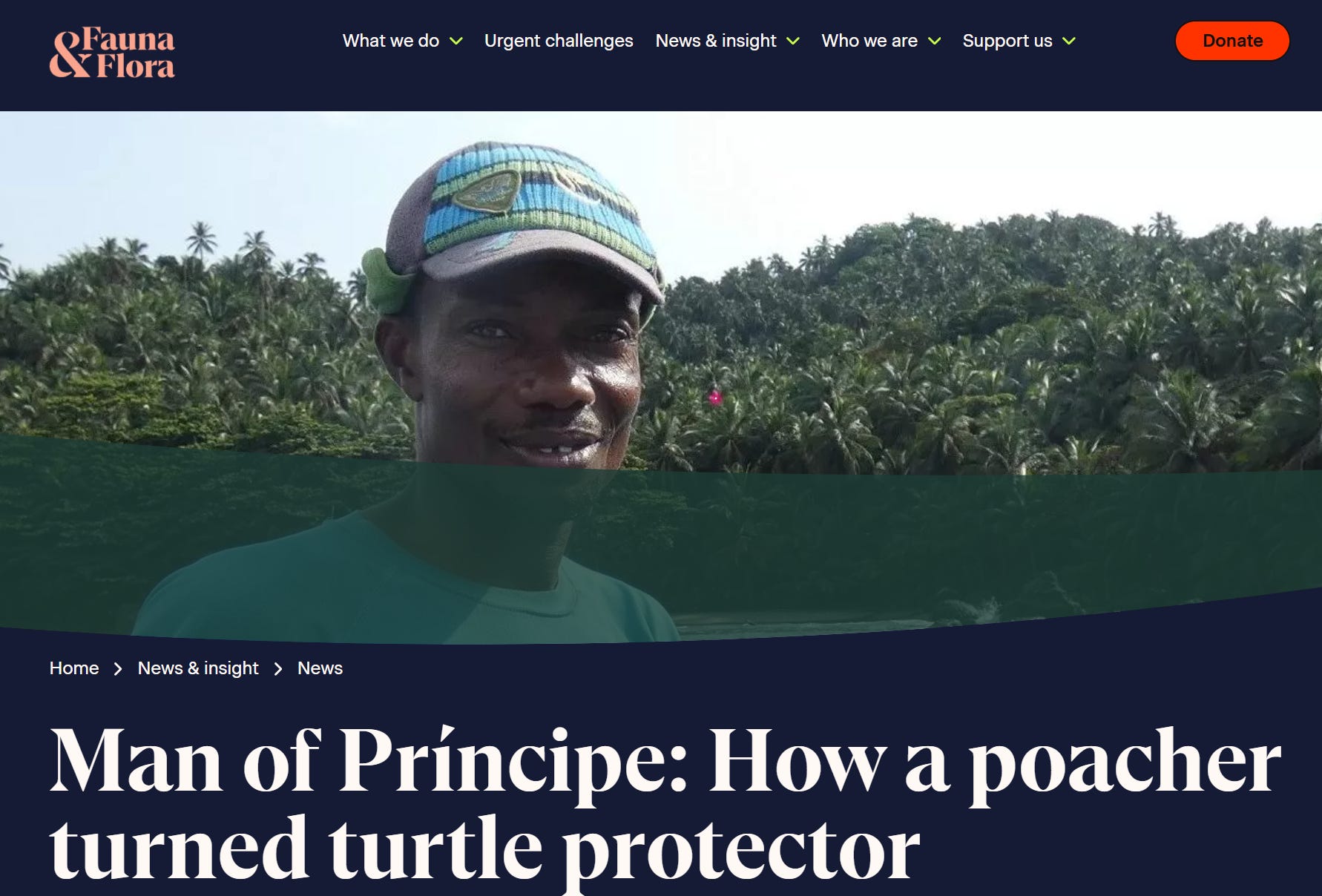
Lindo later explained that they did the math and realized they could earn more by keeping the turtles alive than by killing them. “After this, of course, we didn’t want to kill the turtles anymore and the love for the turtles grew within us.”
“The love grew within us.” Not because someone shouted at him from a foundation gala. Not because a committee produced a 94-page document titled Preliminary Framework for Multi-Stakeholder Compassion Outcomes, although I am sure one of those was lurking somewhere nearby in a folder. The love grew because the work changed. The incentive changed. The relationship changed. A living turtle became valuable, and then it became beloved.
This is one of the most practical forms of hope we have.
We talk so often about changing hearts and minds, but sometimes the heart follows the paycheck. Sometimes the mind follows the work. Sometimes the moral awakening begins with a person being given a dignified alternative to harm, and then, once they are close enough to the living thing, they begin to love what they were once paid to destroy.
After the research project ended, Lindo kept going. He became a turtle guard, walking long distances to protect nesting beaches. Later he began marine patrols, helped rescue fishers in trouble at sea, monitored dolphins, whales, whale sharks, and other marine life, and eventually became a supervisor for Príncipe’s turtle conservation work. He learned computer skills in his fifties, including email, Excel, Word, mapping, data collection, and the use of tablets for surveys, which is both deeply impressive and personally threatening to anyone who has ever fought with a printer and lost.
He also became strict, because love, real love, is not always soft. Lindo has said that if he sees or hears that someone is poaching turtles, even if that person is family or a friend, he will take them to the authorities. This is not sentimental conservation. This is not a man gazing at the horizon while a viola plays softly in the background. This is a man who knows exactly what destruction looks like because he once participated in it, and who knows that protection without enforcement is just a very polite suggestion handed to a chainsaw.
His work has helped transform turtle conservation on Príncipe, and this year, São Tomé and Príncipe moved forward with a national network of marine protected areas. The protections are designed to safeguard important marine and coastal habitats, create zones where fishing and resource collection are highly restricted, support sustainable traditional fishing, and give damaged ecosystems a chance to recover. The first protected areas at Santana and Ilhéu das Rolas include habitats used by sea turtles, manta rays, sharks, fish, mollusks, and shellfish, while additional sites in Príncipe’s coastal waters are expected to follow.
Lindo helped build support among local fishers, gather biodiversity data, and support the development of proposals for the government. He described the protected areas as valuable not only for nature, but for the people who depend on the sea, saying they help guarantee that “we won’t run out of fish in our waters one day.”
That is where the story becomes bigger than turtles. Because this is not only a conservation story. It is an incentive story, a policy story, and a story about what happens when we stop expecting individual virtue to overcome every bad system we have built.
People often do what the world around them rewards them for doing. If destruction pays, some people will destroy, if extraction is profitable, industries will extract, if outrage gets clicks, platforms will serve outrage by the trough, and if politicians are rewarded for cruelty, they will perform cruelty with the dead-eyed enthusiasm of a man trying to earn airline miles on democracy’s credit card.
Then, after building all of that, society has the nerve to stand around looking surprised. Imagine that; we filled the vending machine with poison, hit the glowing poison button all day long, and now the break room has become unwell. The problem isn’t that humanity lacks goodness. The problem is that goodness is often expected to survive on fumes while greed gets a benefits package.
We reward politicians for humiliating vulnerable people, then clutch our pearls when cruelty becomes campaign strategy. We reward industries for polluting cheaply, then hold solemn hearings beside rivers that have developed the complexion of a haunted smoothie. We reward speed over care, profit over repair, spectacle over truth, and then wonder why everything feels disposable, including people.
Lindo’s story offers a different possibility. It says people can change, but it also says we should stop designing systems that require sainthood as the entry fee. It says conservation works better when local people aren’t treated as obstacles to the mission, but as the mission’s strongest possible guardians. It says the person who knows the old harm most intimately may become the person best equipped to prevent it, if we create a path where repair is possible, respected, and real.
That matters in conservation, but it also matters everywhere. Imagine if we rewarded care the way we reward extraction, if keeping people housed was more profitable than evicting them, if preventing illness paid better than denying care, if farms were rewarded for rebuilding soil, companies for reducing waste, platforms for lowering the temperature, and politicians for solving actual problems instead of setting little rhetorical fires and calling themselves strong because they own a match.
What we reward grows. I see that every day now in the garden. The cucamelons stretch toward their little future because they have been given sun, soil, water, and a place to climb. The strawberries bloom because conditions invite them to bloom, and the willow goes into the marsh because that’s where the willow belongs, and then, as if to underline the lesson, we find native willows already there, quietly doing what they were made to do before we arrived with our shovel and our opinions.
The land isn’t becoming beautiful by accident, it’s responding to care. People do that too. Of course, this doesn’t mean harm should be excused, that every destructive choice is innocent, or that people should be allowed to strip the world bare and then receive a congratulatory fruit basket for eventually discovering remorse. Accountability, enforcement, and boundaries matter. Ask Lindo, who is apparently quite prepared to turn in a cousin if the cousin decides to step too far with a turtle.
But accountability works best when it’s paired with a door out. A person who has done harm needs a way to become useful, a community under pressure needs alternatives that aren’t imaginary, a damaged ecosystem needs protection that lasts, and a society that wants better behavior needs to make better behavior livable.
That’s the part we so often forget. We want people to choose the good, but we build obstacle courses around goodness and express moral disappointment when everyone gets tired.
So maybe hope isn’t waiting around for better people to descend from the clouds, wearing linen and carrying reusable water bottles. Maybe hope is building a world where better choices are easier to make, harder to punish, and actually worth something. Maybe hope is a former turtle poacher becoming a guardian of the sea, a baby following a dog through the house as if devotion itself has four paws, a father on a tractor, grinning in the dirt, with his daughter beside him and the whole afternoon spread out like a promise, a willow in the marsh, a strawberry blossom, a muddy dog in need of yet another bath, and a family discovering that land, like people, can respond to care in ways that feel almost miraculous.
The world isn’t saved because one man protected turtles, or because one family planted a willow, or because one child watched the tractor with the fierce patience of a baby waiting for his turn. But the world is not only saved by grand gestures, and thank goodness for that, because grand gestures are often busy being turned into commemorative plaques by people with suspicious procurement habits.
The world is also saved by incentives changed, habits repaired, beaches guarded, children delighted, animals loved, soil tended, and ordinary people given a reason to become better stewards of the place they call home.
Hope isn’t a decorative throw pillow with cursive lettering and a questionable relationship to reality; hope is a living thing, and living things need conditions that help them grow.
My God! Another absolutely beautiful well phrased essay full of insight! People will do what they are rewarded for doing. Sometimes “follow the money” is more than an encouragement for investigation, it can be a way to incentivize behavior.
I witnessed this in my own family. My politically conservative, staunchly ‘right to work’ father became a union member solely because he saw it as a way to keep from being laid off during a hard economic period. But as time went on, as he realized so many more benefits, something changed inside him. He began to diversify his friendships and volunteer for assignments to represent others. His political beliefs became more liberal. As Lindo said, “the love grew inside his heart.”
Giving people this chance, to make solid (& profitable!) the reasons for doing things differently can’t always be done so easily, but when it can, lasting, sustainable change can be achieved.
Your writing is magical!
Dinner's on the grill and I saw that your newsletter arrived. I always know that there's going to be that part that slays me and then tries to dry my tears with a hopekerchief. The lost dog who goes back to the crash site. Not today. What a great story. A subsistence fisherman who turns into a computer literate conservation leader and advocate for all marine life. A person who was given a dignified alternative to harm, and then, he began to love and protect what he was once paid to destroy. Thank you. Hope is a living thing.