


I must be truthful. This week, my own ability to hope has been growing dim. I have pulled every stop I can think of, but none of them stopped the realtor from coming to take pictures so our home of ten years can be listed for sale, by our landlady who has reached her 90’s and just can’t handle the stress of rentals anymore. As I hurriedly cleaned in preparation, while my husband landscaped the yard to perfection, I found myself thinking about all the other times I have cleaned this house as if my life depended on it.
I folded newborn clothes while I was in labor so they would be ready for my youngest son, just down the hall from where I am writing this. I scrambled to clean up sewage when the septic on our street backed up and flooded the house the night before we took my daughter on her first road trip to see the snow. My husband nursed me back to health after I gave myself tendonitis so we could finish painting my oldest son’s room before he got home from school. We have built years of memories here and raised our children here. We have grown ourselves here, in all the ways a family grows, which is to say messily, stubbornly, with more laundry than anyone could have warned us about and more love than the walls could possibly hold. So, hope feels a little naïve to me today.
It feels thin, it feels like something I am supposed to offer other people because that is what I do on Sundays, even when I am not entirely sure I can find it for myself. And maybe that is why this story got to me, because there is something so moving about the fact that even now, even with everything else going on in the world, there are still people walking Florida beaches at night so they can move sea turtle eggs out of the path of bulldozers.
Not metaphorical bulldozers, either, though God knows we have enough of those. Actual bulldozers, dump trucks, and heavy equipment brought in for beach restoration work along Florida’s Treasure Coast, where crews are trying to fight erosion and rebuild damaged shoreline. It is necessary work, in its own way, because the coast is changing and the water keeps reminding us that denial is not a climate policy. But the trouble is that sea turtles do not read municipal work schedules. They come ashore when their bodies tell them to come ashore, dragging themselves out of the dark water and up the sand to do what sea turtles have been doing for longer than we have been inventing terrible ideas in conference rooms.
They dig, they lay, they cover the eggs, and then they turn back toward the ocean, leaving behind a small, buried future and absolutely no backup plan. So, people have become the backup plan.
This spring, trained beach monitors and volunteers on the Treasure Coast relocated more than 4,100 sea turtle eggs from 45 nests before the machines arrived. Most of them were leatherback eggs, nearly 4,000 of them, from 44 separate nests. There were loggerhead eggs too, 122 of them from one nest, each one small and vulnerable and wildly overmatched by the world above it.
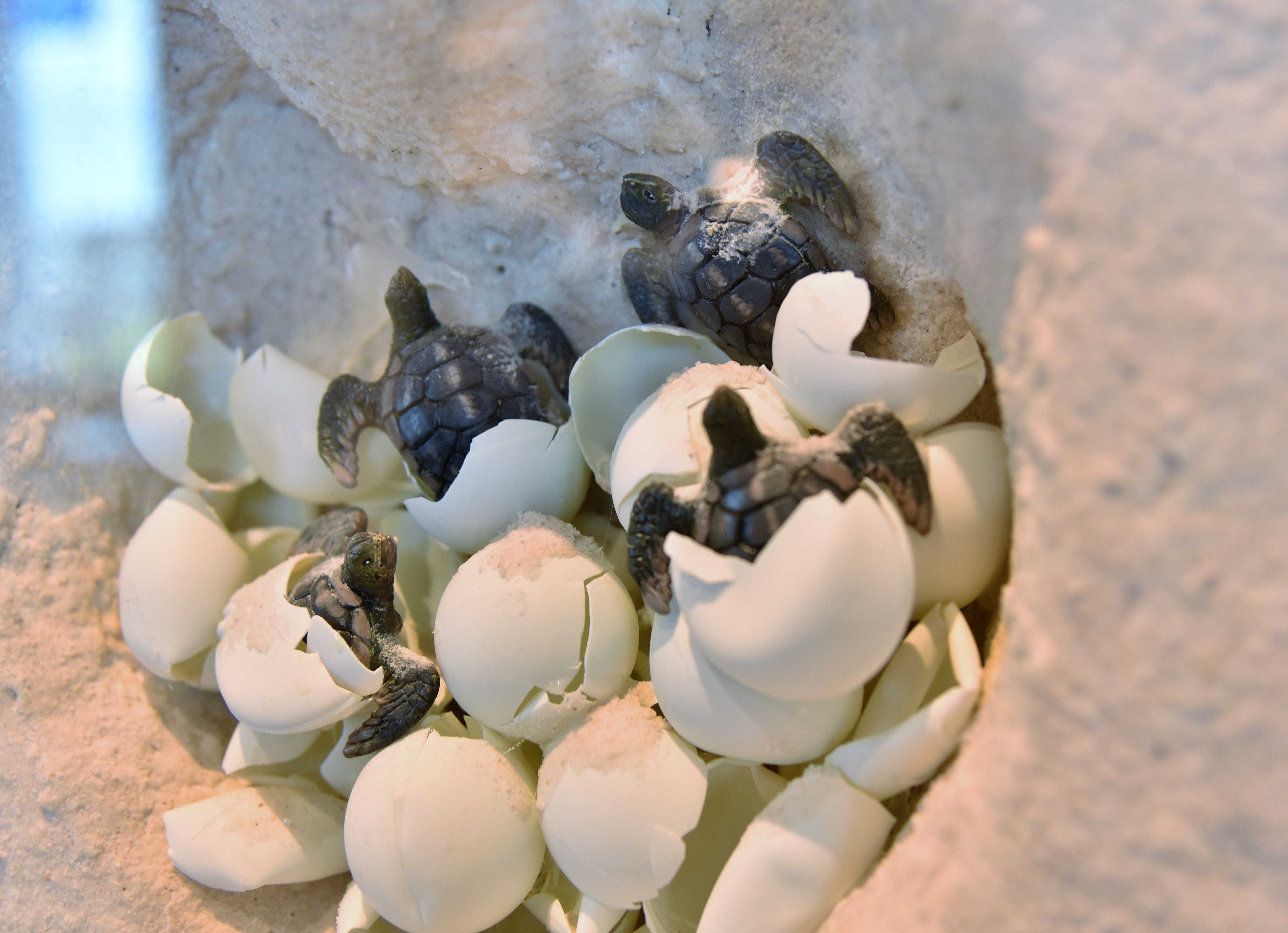
And I know there are many ways to measure civilization, many of them involving markets and armies and whoever is yelling the loudest on television, but I would like to submit another one. Somewhere, while much of humanity was busy being exhausting, other human beings were out on the beach at night, carefully lifting sea turtle eggs into sand-lined containers. That should count for something.
The work is delicate in a way that makes you want to lower your voice just thinking about it. The teams patrol after dark, when the turtles are most likely to come ashore. When they find a nest that needs to be moved, they do not simply scoop it up and hope for the best. They mark the location, they record the shape and depth of the original nest, and they place the eggs by hand into containers lined with sand, careful not to rotate them, because once a sea turtle embryo has settled inside the egg, turning it the wrong way can harm it. Then they rebuild the nest somewhere safer, as close to the original conditions as they can manage and keep the new location secret so poachers can’t find it.
Imagine the tenderness of that, imagine being careful with an egg because the life inside it has already chosen a direction. There is no grand speech in this part of the story, no dramatic soundtrack, and no single heroic person standing on a dune with the wind whipping through their hair, although honestly, if someone wants to make that movie, I would watch it immediately and probably cry in the first twelve minutes. Mostly, it is people doing slow, fussy, unglamorous work in the dark. It is clipboards and flashlights, it’s sand in your shoes, it’s knowing the difference between a nest that can stay and a nest that can’t, and it is understanding that good intentions are not enough if you do not also know how to hold the egg. This is the part I keep coming back to, because the story is not only that the eggs were saved from machines, the story is also that people learned how to save them properly.
That matters, there is a version of human help that is mostly performance, all noise and ribbon cuttings and photographs of important people pointing at things. Then there is the other kind, the kind that requires training and patience and humility. The kind that understands nature is not a prop for our redemption arc; the turtles don’t need us to feel better about ourselves. They need us to stop making their world more dangerous, and when we fail at that, they need us to at least show up with some competence. And somehow, blessedly, people did.
They showed up for leatherbacks, those enormous, ancient, improbable creatures who can grow longer than a person is tall and cross whole oceans with the kind of navigational genius we still don’t fully understand. They showed up for loggerheads, with their broad heads and stubborn little faces, who return to nest on the same beaches where they hatched if the beaches are still there, if the lights are not too bright, if the sand has not been swallowed or paved or made impossible by us.
That “if” is doing a lot of work, as usual. Sea turtles are up against so much, and almost all of it has our fingerprints on it. Coastal development, plastic, fishing gear, climate change, artificial light that confuses hatchlings, pulling them away from the moonlit water and toward parking lots, roads, and buildings. It would be easy to make this story only about what we have ruined, and maybe part of it has to be about that, because hope without honesty is just marketing. But it is also true that, in the same species capable of doing the damage, there are people who will spend their nights trying to make one beach a little less deadly.
There are people who will move 4,100 eggs because 4,100 lives might matter. Not all of them will make it, of course. That is the hard truth of sea turtles, even under natural conditions, the odds are brutal. The hatchlings have to claw their way out of the sand, cross the beach, reach the surf, survive the birds, the crabs, the fish, the currents, the plastic, the warming water, and the long, strange lottery of being alive. Nothing about this is guaranteed. But then again, nothing about tenderness is guaranteed either.
Nobody is required, in the grand bureaucratic machinery of the world, to care about a buried nest of turtle eggs as if it contains something sacred. Nobody is required to walk the beach after 9 p.m., to kneel in the sand, to measure the old nest so the new one can be made just right. Nobody is required to treat a small white egg like it is carrying the future. And yet people keep doing it.
That is the part I want to hold onto this week. Not because it fixes everything, and not because sea turtle eggs can bear the full symbolic weight of our despair, though they are trying their best and honestly doing more than most elected officials. I want to hold onto it because it is specific, it is real, and it’s not a vague hope that humanity will somehow become better in the abstract. It’s a flashlight on a beach, a hand in the sand, and one fragile thing moved carefully out of harm’s way.
Maybe hope is not always a big, shining thing. Maybe sometimes it is quieter, maybe sometimes hope is a person standing between an egg and a bulldozer, saying, “not this one.” And maybe, this week, that is the most I can believe in.
Maybe I can’t save this house, no matter how many times I have cleaned it like my life depended on it, no matter how much love we have pressed into the walls, no matter how badly I wanted all my careful work to add up to staying. Maybe my career change means I can’t finance the rescue I imagined and maybe this one is not ours to keep.
But those turtles didn’t get to keep their first nests either. Something larger and louder came for them, and still, somewhere in the dark, careful hands made another place ready. The future was lifted, gently, and carried somewhere safer. So maybe we can be moved and still not be lost, maybe we can grieve the sand we chose and still trust that another shore is waiting, and maybe we can build another nest.
This is just what I needed to read in this moment. Thank you so much. I just finished reading Robert McFarlane‘s book Is A River Alive?, And in it he describes the turtle rescuing happening in Chennai, India. Yes there is a world of goodness if we can only discover it for ourselves.
What a lovely moving essay. Thank you. When we are overwhelmed by all the noise in the news, we discover that people are doing hard precise work on Florida beaches for sea turtles. It is these seemingly small things that get us through the destruction we see happening before us. I love a sense of the ancient here and the sacred. I note the sentence on poaching because there are always opportunists whose greed defines their lives. Kudos to the people on the beach and everyone who makes an effort to help the world and the creatures who share it with us.