


This week, the tomatoes decided to make an announcement, and I am pleased to report that it was considerably more encouraging than most of the announcements I spend my days reading. There are blossoms and little green tomatoes everywhere, while the cucamelons are climbing their trellis of woodland sticks with the confidence of plants that have never once questioned whether they belong somewhere. Some of our other plants are beginning to settle into dormancy, and although I’ll miss their bright blooms, they’ve given us a great deal of happiness. I’m trying to appreciate what they’ve given us without immediately asking them for more. This is a useful exercise for someone who looks at a garden and sees approximately thirty-seven additional projects, all of which apparently needed to begin last Thursday.
Which probably helps explain why I’m posting a little late today. I spent the day plant shopping at the nursery with my husband and enjoying my daughter’s officially last day of summer before she starts pre-K tomorrow. I am super prepared, and also absolutely not prepared, depending on whether we’re discussing school supplies or my feelings. Mostly, I’m grateful we got to spend this day together.
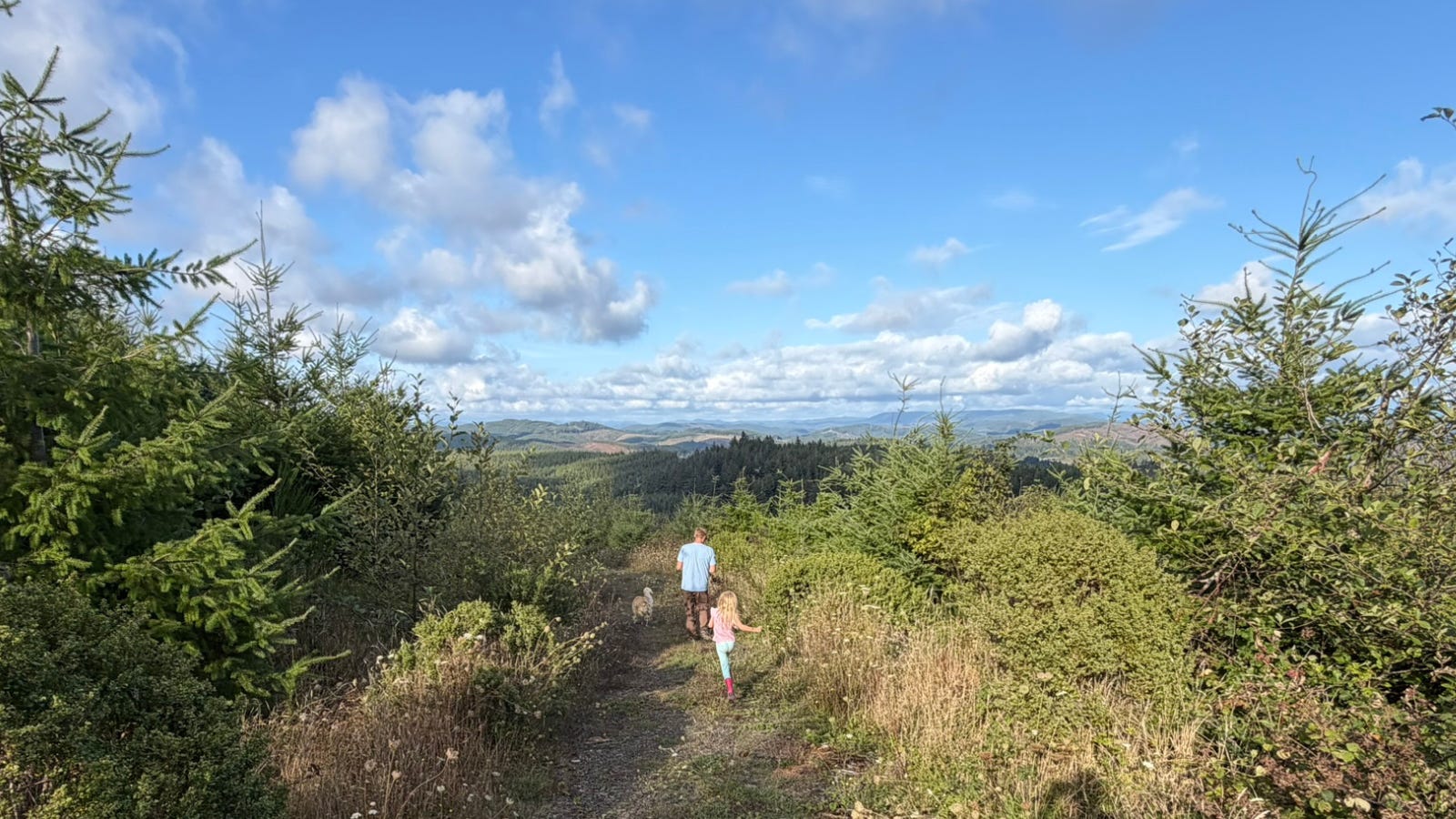
We came home with a strawberry tree, a coastal redwood, an adorable button fern for the house, and an assortment of other plants, because apparently I felt those thirty-seven projects needed company. They’re all amazing, but the best part of the day was watching my husband and daughter run down a mountain road together, with a beautiful Oregon view stretching out around them. There is nothing quite like a good Oregon walk, especially with people you love, to remind you why you love this world.
I think hope needs moments like that, too, when we get to feel some of what we’re working so hard to protect. Tomorrow my daughter will walk into a new classroom, and I’ll be excited for her while having some private objections to the passage of time. Today I got to watch her running with her dad, and to feel grateful for the life she’s growing into. I want there to be so many more days like this ahead of her, and being there for this one reminded me how much I want to help make that possible.
Some of you might remember that, a few months ago, I was writing about planting tomatoes while we still weren’t certain we could keep this house. I was trying to imagine what would happen to our family, our home, and all the little pieces of our lives we had tucked into this place. Now I’m standing here looking at green tomatoes, in the garden we got to keep, and remembering how difficult it was to believe we would reach this ordinary afternoon.
I think about that when I sit down to write these Sunday pieces. There were weeks when hope felt almost embarrassing to admit to, because I was afraid of how much it would hurt to be disappointed. But people reached toward us, we kept looking for a way forward, and eventually something became possible that I had struggled to picture. I want to remember how it felt before we knew, because so many people are still standing in that uncertain place, trying to decide how much of themselves they can afford to invest in tomorrow.
I’ve also been listening to parenting experts, trying to become more thoughtful about the way I handle the ordinary difficulties of raising children. I want my kids to feel confident, capable, and safe enough to become themselves, which occasionally requires their mother to learn a skill she would very much prefer to have already mastered. It can be uncomfortable to recognize that something you’ve been doing needs to change, especially when you were doing it with love and the very best intentions available to your tired brain.
Still, the willingness to learn contains its own kind of hope. It means I believe my children and I can have an easier time together, that an apology can lead to a different choice the next time, and that the things I haven’t yet learned don’t have to remain things I never learn. I want my kids to know that growth continues well beyond the age when people begin expecting you to have everything figured out, an age I apparently passed without receiving the relevant documents.
Perhaps that’s why I was so taken with the people bringing glowworms back to a nature reserve in England, where their light had been missing for more than a century. According to reporting from The Guardian, ecologist Pete Cooper raised larvae in a Bristol garden shed for release at North Yorkshire’s Nosterfield reserve in 2024. This summer, volunteers counted up to twelve glowing females, an encouraging first result after the long wait for them to mature. Establishing a self-sustaining population will require more time and monitoring, but there is light in the grass again.
The hopeful part began before there was anything glowing to show for it, when people decided that something missing might still have a future there. They learned, prepared, and kept working through the long stretch when the outcome remained a question. I find that moving because an absence can become so familiar that we begin treating it as permanent, and then somebody comes along with enough knowledge and patience to ask whether it has to stay that way.
I spend so much of my working life reading about destruction that I sometimes need to be reminded how much human effort is also going toward repair. There are people doing that work right now, beyond the headlines I’ve opened and the disasters I know about. Their existence matters to how honestly I understand the world. Somewhere, while humanity was producing its usual assortment of horrors, somebody was in a garden shed trying to bring back the glowworms, and I would like that entered into the official record.
Here at home, a small person has been producing a considerable amount of light himself, along with enough forward momentum to make every room more interesting. Ezra is officially a walking boy, and I couldn’t be prouder of him, although I would appreciate a brief consultation before he proceeds with any further growing. He’s all bright eyes and love, moving into this new version of himself while I attempt to understand how the baby I was just holding became a person who can walk over to me.
He also had a deeply unfavorable encounter with vaccines this week, followed by a venous blood draw that required me and three other people to accomplish. My mister boy was brave, furious, and apparently strong enough to warrant his own tiny weightlifting division. From his perspective, the people with the needles had made some profoundly poor choices, and Mommy’s chest remained the most reasonable place to file his objections. I was glad to be that place for him, even while wishing I could make the whole experience easier.
And then there is the news I have been so grateful to be able to say: his MRI is scheduled. After the waiting and the complications involved in getting it arranged, we finally have that next step in front of us. I’m still a mother with questions and worries, but having something scheduled gives all that waiting a place to go. Sometimes hope becomes possible to hold when you can see the next thing to do, when the future stops being one enormous question and becomes an appointment you can attend, with your baby in your arms.
I thought about the relief of having a little help with the next moment when I read about Monique Harris, a Republic Airways flight attendant who noticed an exhausted mother on a September 2 flight from Newark to Grand Rapids. As ABC reported this week, the woman was returning to the United States after giving birth abroad, and her family hadn’t yet met her baby. When Harris saw her drifting off with the child in her lap, she stepped in and held the baby to keep him safe. The mother woke shortly afterward, worried that she had dropped him, and Harris reassured her and offered her a chance to rest. She also wrote an encouraging note, something she’s done for passengers for years. Another traveler photographed the moment, and that quiet act of care reached people far beyond the airplane.
I can understand why it did, because exhaustion has a way of making everything ahead of you look harder. When someone notices and helps, the demands of the next few minutes become a little more manageable. That person has given you something real to work with, and sometimes that’s enough to help you believe you can manage the minutes after those, too.
We ask people to stay hopeful through an awful lot, and I think we should spend more time asking how we can make hope easier for them to hold. A tired mother needs help with her baby, a family needs somewhere to live, a person waiting for care needs a way to reach it. There’s so much we can do for one another that changes the circumstances in which hope has to survive.
My husband has been doing his own version of that work by renovating a trailer for grandma, putting his time and skills toward something she needs. Around here, love frequently has a project attached to it, and sometimes the person doing the loving comes home with sawdust on his clothes. My contributions this week have included a warm chest for a baby, labels on school supplies, and a hand extended to teachers I was meeting for the first time. My daughter is learning to read, sounding out words and playing her reading games, and she has already begun correcting my grammar, which seems rather ambitious for someone whose mother writes for a living. I’m delighted by her confidence and mildly concerned about the editorial oversight awaiting me in kindergarten.
My oldest, my bonus son and fellow ADHD traveler, is beginning a new chapter of his own. His mom has moved to the town where his dad and I live, so he is going to school close by this year, with new teachers, new routines, and the possibility of a fresh start after some difficult experiences with bullies at his previous school. His dad couldn’t make it to back-to-school night, so his mom and I went together, following our very excited big kid through the classrooms and introductions. A few handshakes in, I realized that our repeated introductions as Mom and Stepmom might be leaving some ambiguity about the family arrangement, so his dad began making occasional verbal appearances as we went. Mostly, though, I was paying attention to our boy, who seemed so happy to be showing us around.
He has class periods now, and a locker with a combination, which he remembered and demonstrated for me four times in a row. I watched all four demonstrations with the attention appropriate to someone being shown a significant technological achievement, because that is exactly what it was to him. He had learned how to open this little piece of his new world, and he wanted us to see. Then his Social Studies teacher predicted, with great enthusiasm, that this was going to be the kid who memorized all fifty state capitals.
My bonus son, who had clearly been occupied by an entirely different thought, looked at him with impeccable timing and said, “I’m trying to remember your name.”
I burst out laughing, because apparently we would be getting to the fifty state capitals just as soon as we established who was teaching them. It made my night to see him excited, and underneath the laughter I felt something tender about his willingness to begin again. After being hurt by other children, he was still able to walk into a new school and imagine that good things might happen there.
I want the adults around him to help make that trust worthwhile. I want him to have people who enjoy his humor, recognize his curiosity, and understand that a wandering thought can belong to a very interested mind. Hoping he has a better year gives us something to do: listen to him, get to know his teachers, notice when he needs help, and take his happiness seriously enough to protect it. His hope deserves people willing to support it.
That responsibility reaches further than any one school year, which brings me to Mozambique, where communities that have cared for a forest across generations are now being recognized in its formal protection. Mongabay reported this week that an August decree established the Mount Mabu Community Conservation Area, covering roughly 23,000 acres, with stewardship granted to local communities. The detailed management plan still needs to be completed, but the designation is an important step for a place its people have long kept standing.
Mount Mabu is home to more than two hundred recorded butterfly taxa, along with other wildlife found in very few places on Earth. In October and November, butterflies gather near its summit to find mates, a behavior known as hilltopping. Their future depends on the continued life of that landscape, and the people whose care helped preserve it now have formal recognition of their role in its protection.
There’s something hopeful in a society giving lasting support to the people doing the caring. Good intentions need ways to endure, through changes in leadership, through financial pressure, and beyond the lives of any one group of people. Protecting a forest means accepting responsibility for creatures that haven’t hatched yet and people who will someday depend on what’s growing there now. That’s one of the things hope asks of us that I find most beautiful: to believe the future deserves our effort even when we won’t be there to see everything that effort becomes.
My husband and I are trying to enjoy the life happening around us while we help it along, which currently includes carving sticks with historically accurate axes and learning to play guitar together. We are an unusual household, but we are finding things to make, things to learn, and reasons to spend time beside each other. Our children are watching us, and I hope some of what they see will stay with them when they’re grown and trying to understand how to meet a difficult world.
I want them to remember that people can learn to be gentler, that asking for help can lead to someone reaching back, and that things worth protecting deserve more than our sadness when they’re threatened. I want them to have memories they can turn to when hope feels unreasonable, little pieces of evidence that someone tried and something changed.
I need those reminders myself, which is why I keep returning to this on Sundays. The cruelty we write about all week is real, and its consequences deserve our attention. So do the people whose actions make a different outcome possible. We belong to the same humanity as the people raising glowworms, comforting a stranger, and keeping a forest alive, and their choices remind us that we still have choices of our own.
If your hope feels thin this week, I understand. You may be waiting for news, trying to repair something, or looking at a future that feels too uncertain to trust. I hope someone helps you carry it, and I hope these stories give you a little evidence to hold onto while you wait.
A few months ago, I couldn’t picture the ordinary afternoon I’m living now, with tomatoes coming, a walking baby, and a boy who wants to show me his locker one more time. What a life we get to lead, and how much of it has been made possible by people willing to keep trying before they knew how things would turn out.
Somewhere in Mozambique, a forest is still standing, and another generation of butterflies will need it. Somewhere closer to home, there’s a person whose next step could become easier because one of us noticed. I think that is a hopeful thing to remember as we begin another week: we are still here, with some ability to make tomorrow kinder than it would’ve been without us.