

Good morning! We begin in Beijing, because apparently the world’s most powerful geopolitical rivalry is now being staged somewhere between a state banquet, a billionaire networking event, and a hostage video for coherent diplomacy.
Donald Trump arrived in China this week for his first presidential visit there in nine years, and Beijing delivered exactly the kind of pageantry his brain treats as a love language: red carpets, military formations, cheering children, ornate halls, gold detailing, and enough theatrical symbolism to keep the whole thing feeling historic rather than desperate. But there was a tell in the staging. Trump was not greeted on arrival by Xi Jinping or even by senior ministers. He was greeted by children waving American and Chinese flags, which Trump praised as “happy,” “beautiful,” and “amazing.” It was spectacle calibrated for his ego, not status calibrated for American power. Beijing gave him the visuals. It did not give him deference.
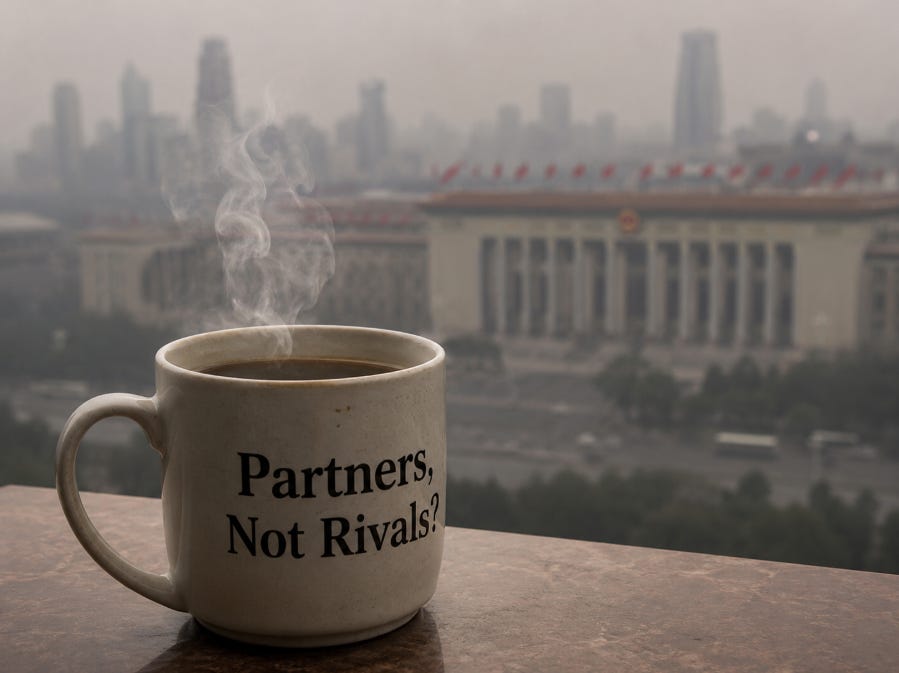
And in an otherwise dirty Beijing sky, that felt like a signal. The Guardian noted that this visit did not come with the “blue sky” treatment Beijing rolled out in 2017, when factories were reportedly ordered to halt production and polluting cars were restricted ahead of Trump’s first state visit. This time no such effort appeared to have been made. The air quality index was over 150, shrouding the city in gray smog. So Trump came looking for a triumph and got a welcome ceremony under a warning label.
Speaking at the Great Hall of the People, Xi opened with a reference to the Thucydides Trap, the idea that conflict becomes more likely when an established power feels threatened by a rising one, and framed the summit as a civilizational inflection point. “The world has come to a new crossroads,” he said. “Can China and the United States overcome the Thucydides Trap and create a new paradigm of major country relations?” He cast the two countries as co-equal great powers facing questions “vital to history, to the world, and to the people.” He congratulated the United States on the 250th anniversary of its independence and said the two nations have “more common interests than differences.” His key message was disciplined and strategic: China and the United States should be “partners, not rivals.”
That sounds warm, but it is not just warm. It is Beijing’s preferred operating system. “Partners, not rivals” is not merely an olive branch; it is a demand that Washington stop treating China’s ambitions as something to resist and start treating them as something to accommodate. In Xi’s version, stability means accepting a “new paradigm” for relations between major powers. Translation: China wants to be treated not as a challenger to the U.S.-led order, but as a power entitled to rewrite the rules of that order.
Then Trump spoke, and the register dropped from great-power theory to Yelp review of the parade. He praised the children, “they were happy, they were beautiful, they were amazing.” He praised the military display. He praised Xi personally. He praised China. He praised his own relationship with Xi. He praised the business executives he had brought with him. He called Xi a “great leader,” then noted that some people do not like when he says that, but he says it anyway because “it’s true.” As always, any time Trump says he only tells the truth, somewhere a fact-checker’s printer catches fire.
Trump appeared eager throughout, not just friendly, but visibly seeking approval. He did not sound like a president arriving to negotiate from strength. He sounded like a man trying very hard not to disappoint the host. Xi sat inside the language of state power: history, destiny, stability, the future of humanity. Trump offered adjectives: fantastic relationship, amazing children, greatest businessmen in the world. And then, in one sentence, he turned an American delegation into tribute. “They are here today,” Trump told Xi, “to pay respect to you, to China.”
What a delegation it was. The cast of players standing behind Trump at the Great Hall of the People was basically the summit agenda wearing name tags. At the front were the officials: Marco Rubio, Scott Bessent, Pete Hegseth, and Stephen Miller — men who have spent years denouncing Beijing across every available frequency. Rubio was sanctioned by China in 2020 over his criticism of human rights abuses in Xinjiang. Bessent has called Beijing an unreliable trade partner. Hegseth has criticized China’s actions in the South China Sea. Miller has accused China of distorting the global trading system through theft. There they all were, taking their places in the receiving line, shaking Xi’s hand beneath the gold ceilings. The anti-China chorus had arrived for its protocol rehearsal.
Behind them came the money. The full apparatus of American financial services: Citi, Goldman Sachs, Blackstone, Mastercard, each with obvious interests in market access and financial openings. Boeing’s Kelly Ortberg, hoping for aircraft orders. Cargill’s Brian Sikes, seeking restored Chinese purchases of U.S. beef, sorghum, and soybeans. And then the semiconductor bloc: Nvidia’s Jensen Huang, Micron’s Sanjay Mehrotra, Qualcomm’s Cristiano Amon, and Apple’s Tim Cook. If you want to understand the real U.S.-China rivalry, follow the chips. Washington wants to block Beijing from advanced technologies. American companies want to keep selling into the Chinese market. The summit becomes a geopolitical group therapy session, and the conclusion was predictable: Washington wants leverage, Wall Street wants access, Silicon Valley wants sales, and Trump wants everyone to clap when he says “deal.”
Because subtlety was detained at customs, Eric Trump and Lara Trump were also there. The Trump Organization says Eric attended in a personal capacity to support his father, and that he has no business ventures in China and no plans to pursue any. Fine. Wonderful. Completely reassuring. But when the president’s son, who runs the family business while his father is in office, stands in the Great Hall of the People and shakes hands during a summit packed with corporate executives seeking Chinese market access, the optics are not subtle. They are not even optics anymore. They are a Times Square billboard blinking: conflicts of interest, now with state banquet. It is worth pausing to imagine the Republican response had Joe Biden brought Hunter to Beijing under equivalent circumstances. The hearings alone would have required their own C-SPAN channel.
The Chinese side, by contrast, looked like the state. Xi’s lineup included loyalists and technocrats: Cai Qi, his right-hand man; He Lifeng, the vice premier overseeing economic policy; Wang Yi, China’s top diplomat; Wang Wentao, the minister of commerce; finance, foreign affairs, defense, and planning officials. Beijing sent the machinery of the party-state. Trump brought the machinery of American capitalism, the machinery of American government, his campaign operation, and the family brand. It was not a delegation. It was a lobbying bundle with Secret Service protection.
Xi used the summit to tell Trump that Taiwan is not a side issue. It is, in his words, “the most important issue in China-U.S. relations.” If mishandled, Xi said, the two countries could face “confrontation or even conflict,” pushing the entire relationship into “a highly dangerous situation.” The warning was stark, deliberate, and public, delivered not in a private message but in the official Xinhua readout, meaning it was intended for every audience simultaneously: Trump, Taiwan, Tokyo, Manila, and the world.
Xi wrapped the summit in the language of partnership, but Taiwan was the demand inside the packaging. China claims sovereignty over the self-governing island and has threatened to take it by force if Taipei resists indefinitely. Taiwan’s foreign ministry responded by saying Beijing is “the sole risk to regional peace and stability” and that Taiwan would continue cooperating with the United States and other countries that uphold freedom and democracy.
The danger is not simply that Xi is applying pressure. The danger is that Trump may see Taiwan less as a democratic partner than as a bargaining chip. Officials and analysts fear Xi could try to extract concessions from Trump on Taiwan in exchange for cooperation elsewhere, perhaps help pressuring Iran to reopen the Strait of Hormuz, progress on trade, or shiny business deals Trump can wave around as proof that he alone can make the world obey. There is concern that Trump might reduce arms sales to Taipei, or shift U.S. diplomatic language from the current stance of not supporting Taiwanese independence to Beijing’s preferred wording that Washington actively “opposes” it. That may sound like diplomatic hairsplitting, but in this context words are weapons, and Beijing knows exactly how to use them.
The timing matters. The Trump administration approved a record $11.1 billion arms package for Taiwan late last year, air defense systems, missiles, the infrastructure of deterrence, and is reportedly preparing another package worth at least $14 billion. Xi’s warning was not philosophical. It was directional. It was aimed at the next move.
When reporters asked Trump about Taiwan afterward, he was quiet. That silence is its own headline. He can gush about Xi, the children, the military precision, the welcome, the CEOs, the dinner, and the “magnificent” hospitality. But when asked about the democratic island Beijing is threatening, suddenly the man who cannot stop talking discovers restraint.
The trade talks are being dressed up in the language of “strategic stability,” which is what great powers call transactional horse-trading when the tablecloth is expensive. Treasury Secretary Scott Bessent said the two sides were discussing a possible “Board of Trade” and “Board of Investment.” The trade board would reportedly identify about $30 billion in non-sensitive or low-value Chinese goods that the U.S. does not want to produce and could earmark for lower tariffs. Fireworks were cited as an example. China, in turn, might buy more U.S. fuel to diversify its energy sources, while both sides explore non-sensitive areas for investment.
China also granted permission for hundreds of American slaughterhouses to resume beef shipments before the talks began. It is exactly the kind of concrete deliverable Trump can sell as a win: beef, Boeing orders, soybeans, market access. The trade truce the two sides are hoping to extend came after a tariff war in which both sides hit each other with duties of more than 100 percent, which is the economic equivalent of two people setting fire to their own houses to warm their hands.
Xi said there are “no winners” in a trade war, which is true, although Trump has spent years trying to prove there can be many losers if one man is sufficiently committed.
Then there is the technology fight. Nvidia’s Jensen Huang was reportedly expected to try to revive talks over Chinese orders for advanced H200 chips, a conversation that matters because whoever controls the infrastructure layer of artificial intelligence effectively controls the commanding heights of the next economy. The presence of Nvidia, Micron, and Qualcomm underscores the central contradiction of the entire summit. The United States wants to limit China’s access to advanced semiconductors and AI capabilities. U.S. companies want to sell. China wants access, leverage, and relief from the export controls that have been throttling its technology sector. Trump wants to declare victory before anyone reads the fine print.
The contradictions extend beyond chips. Meta’s Dina Powell McCormick was also in the delegation at a moment when Beijing has forced the company to unwind its $2 billion acquisition of Chinese AI startup Manus, intervening after the deal was done, leaving Meta weighing whether to sell to a new buyer, return the business to existing investors, or find new backers. It is a reminder that market access in China is not a negotiation you win once. It is a toll road with variable pricing and a gatekeeper who changes the rules mid-journey.
The Iran war hangs over everything. Trump told reporters he wanted “a long talk” with Xi about Iran, while also insisting he did not need any help. A diplomatic equivalent of texting “I’m fine” from inside a burning building. China is the largest buyer of Iranian oil, and the Strait of Hormuz has been effectively blocked since the U.S.-Israeli war on Iran began in late February, sending energy markets into crisis and driving U.S. inflation to a three-year high in April. Rubio said on the way to Beijing that the United States hoped to convince China to play a more active role in getting Iran to back down in the Persian Gulf, which is a polite way of saying Washington flew to Beijing to ask for help with a war it started.
The White House said both sides agreed that the strait must remain open and that Iran can never have a nuclear weapon. Chinese state media’s summary was more restrained, saying only that the Middle East was discussed. The gap between those two readouts is itself a measure of how much was actually resolved. Xi expressed “interest” in increasing China’s purchases of U.S. oil, which is the geopolitical equivalent of offering to think about it.
Trump arrived in Beijing needing Xi’s help while performing as if needing help were dominance.
What’s missing from the agenda is as revealing as what is on it. Human rights are not expected to feature meaningfully, if at all. Maya Wang of Human Rights Watch noted that Trump has been hostile to the concept itself, making it difficult to imagine the issue surviving contact with a Trump-Xi meeting. Jimmy Lai, the imprisoned Hong Kong media mogul, was mentioned as a possible agenda item, Trump said he would raise the case, but the broader architecture of repression, Xinjiang, the dismantling of Hong Kong’s freedoms, the surveillance state, is not on the table.
Climate cooperation is also absent, despite the United States and China together accounting for nearly half of global emissions. In 2017, Beijing cleared its skies for Trump’s arrival, factories idled, polluting vehicles banned, the air scrubbed clean for the occasion. This time, no such effort was made. The air quality index sat above 150, the city wrapped in gray smog. So the world’s two largest powers met under polluted skies to discuss markets, military risk, technology, oil, and trade, while the climate crisis waited outside without a badge.
The New York Times added another useful layer by talking to ordinary people in China. For everyday Chinese residents, Trump is not an abstraction, but a market volatility with hair. A steel trader in Fuzhou said tense U.S.-China relations were hurting his business. A taxi driver in northern China complained that rising global gas prices amid the Iran war were costing him more at the pump. An investor in Beijing said Trump’s words can “stir up things globally” because he says one thing today and another tomorrow. She was watching her portfolio, because apparently one man’s impulse control problem is now an asset class.
Others were blunter. One woman said some of Trump’s words and actions seem like “stand-up comedy” to people in China. A nail salon worker said he was “not friendly to China” and questioned why the United States could not simply change presidents. An 18-year-old hairdresser called him “quite brutal.” A taxi driver in Jinan argued that Trump’s decision to come to China proved the United States was struggling too, that China, in effect, had won the staring contest.
Not all of it was grounded in reality. Some negative views had clearly been shaped by misinformation circulating on Chinese social media, including a claim that beggars in the United States eat human flesh, and another that the U.S. dumped bodies in the sea during the pandemic. But the more grounded voices were consistent: Trump is erratic, transactional, and dangerous. Almost everyone hoped the summit might reduce tensions. One retiree put it plainly: “Everyone wants a good life. Which ordinary person wants to fight?”
Chinese state media, meanwhile, was selling a different story, not to the world, but to itself. Trump’s visit was framed as a diplomatic victory for Beijing, a sign of China’s rising parity with the United States, and an opportunity for Washington to accept the “right way” for the two countries to coexist. State media avoided attacking Trump by name, preserving the fragile trade truce. But the message underneath was clear enough: China arrived at this summit feeling like the stronger hand. Whether that is true will depend entirely on what Trump agrees to once he is back on Air Force One and the pageantry has worn off.
The most revealing moment came not during the bilateral talks but at the state dinner, when Xi raised his glass and told Trump that the “great rejuvenation of the Chinese nation” and “making America great again” could go hand in hand. Not casual flattery; that was message discipline. Xi folded Trump’s own slogan into the Chinese Communist Party’s civilizational project, telling Trump, in effect, that his personal brand and Beijing’s national destiny are compatible, as long as Washington stops treating China as an adversary and starts accepting Beijing’s preferred terms. Trump thanked Xi for a “magnificent welcome like none other” and invited him to the White House in September.
Trump thinks he is being honored. Beijing thinks he is being handled. Xi came to define the century. Trump came to be liked. Somewhere in the gap between those two ambitions, Taiwan is waiting to find out what was actually said in that room.
More to follow.
“Trump thinks he is being honored. Beijing thinks he is being handled. Xi came to define the century. Trump came to be liked.”
Another deeply informative essay with analysis and context - and exceptional writing. Thank you - again!
Taiwan and the world must now wait to see how China and its allies benefit from Xi’s encounter with a mad toddler and his entourage of mediocre officials, ring-kissing oligarchs, and heirs. No matter how Trumpworld spins this, China will almost certainly win the next chapter if not the foreseeable future.
Thanks Mary, such great info! Hope that cute baby’s doing great! 🥰