


According to recent reporting, Trump’s company has filed trademark applications tied to the 250th anniversary of the United States, including a mark built around “Trump 250,” which means that even the nation’s birthday is apparently being gently ushered toward the gift shop. America is preparing to mark a quarter-millennium of revolution, contradiction, aspiration, bloodshed, reinvention, and democratic experimentation, and Donald Trump, with the unerring instincts of a man who sees every historical milestone as a licensing opportunity, has reportedly responded by asking the republic whether it has considered becoming a line of commemorative merchandise.
It is, in its own vulgar way, an almost perfect story. The United States turns 250 and instead of receiving the sort of grand, serious, slightly conflicted civic reflection one associates with an old and unstable democracy taking stock of itself, the country gets the spiritual equivalent of a gold-plated monogram stitched onto the national bathrobe. The American experiment, having survived monarchy, civil war, depression, fascism, Watergate, disco, and the food pyramid, now faces the distinctly modern indignity of being treated like a premium lifestyle brand by a president whose first instinct upon encountering a large symbolic object has always been to ask how it would look with his name on it.
There is something almost too perfect about the image of Trump gazing upon the 250th birthday of the United States and arriving at the conclusion that what this occasion really needs, what it has been missing all along, is more Trump. Not more history. Not more citizenship. Not more context or reckoning or national self-examination. More branding. More merchandise. More of that uniquely American alchemy by which public life is reduced to product placement and the product placement is then sold back to the public as patriotism.
It would be unfair to say Trump has never met a sacred institution he did not want to convert into a sales surface, because unfairness implies exaggeration and in this case we are dealing with a man whose central political gift has always been his ability to make the outrageous sound merely consistent. Of course he would want in on America’s 250th birthday. Of course he would want it not just as president, not just as the man speaking at the podium under the fireworks, but as a branded presence, a stamped logo, a proprietary flourish, a human watermark pressed directly into the frosting of the national cake. He has spent his entire adult life behaving as though reality itself were an underperforming property that could be improved with better signage and some more gold in the lobby. Why should history be any different.
What has always separated Trump from ordinary vanity is the sheer acquisitive sprawl of it. Most vain men want attention. Trump wants annexation. He does not merely wish to be admired in the vicinity of power or history or national symbolism. He wants those things to become decorative extensions of himself, the way a casino owner wants a chandelier not simply to shine but to flatter. When other politicians enter office, they try to inhabit the presidency. Trump behaves as though he has purchased it furnished and is considering a renovation. The idea that America’s 250th birthday could proceed as a tribute to the country rather than as a side hustle orbiting his own image was never likely to satisfy a man whose ego has always had the zoning ambition of a luxury development.
And so here we are, with the world’s oldest continuously operating constitutional republic arriving at one of its great ceremonial milestones only to discover that somewhere in the planning atmosphere hangs the unmistakable scent of a merch table. This is not merely funny, though it is obviously very funny. It is funny in the specific American way that things become funny once they have crossed the invisible line from disgrace into farce, and from farce into a kind of operatic tackiness so complete that one can only stand back and admire the commitment. Trump does not just cheapen things. He cheapens them with vision. He cheapens them at scale. He cheapens them with the confidence of a man who has never once mistaken restraint for a virtue.
You can picture the whole thing with painful ease. Somewhere there are historians trying to discuss the Revolution, the Constitution, slavery, expansion, labor, immigration, war, civil rights, suffrage, the long unfinished argument over who counts as fully American, and somewhere else another person is asking whether the logo could be more commanding. Somewhere there is a solemn conversation about democratic inheritance, and somewhere else a grown adult is wondering whether the semiquincentennial can support a stronger retail footprint. Somewhere the Founders are invoked as flawed architects of a radical political experiment, and somewhere else they are being spiritually repositioned as the opening act for a deluxe presidential brand extension.
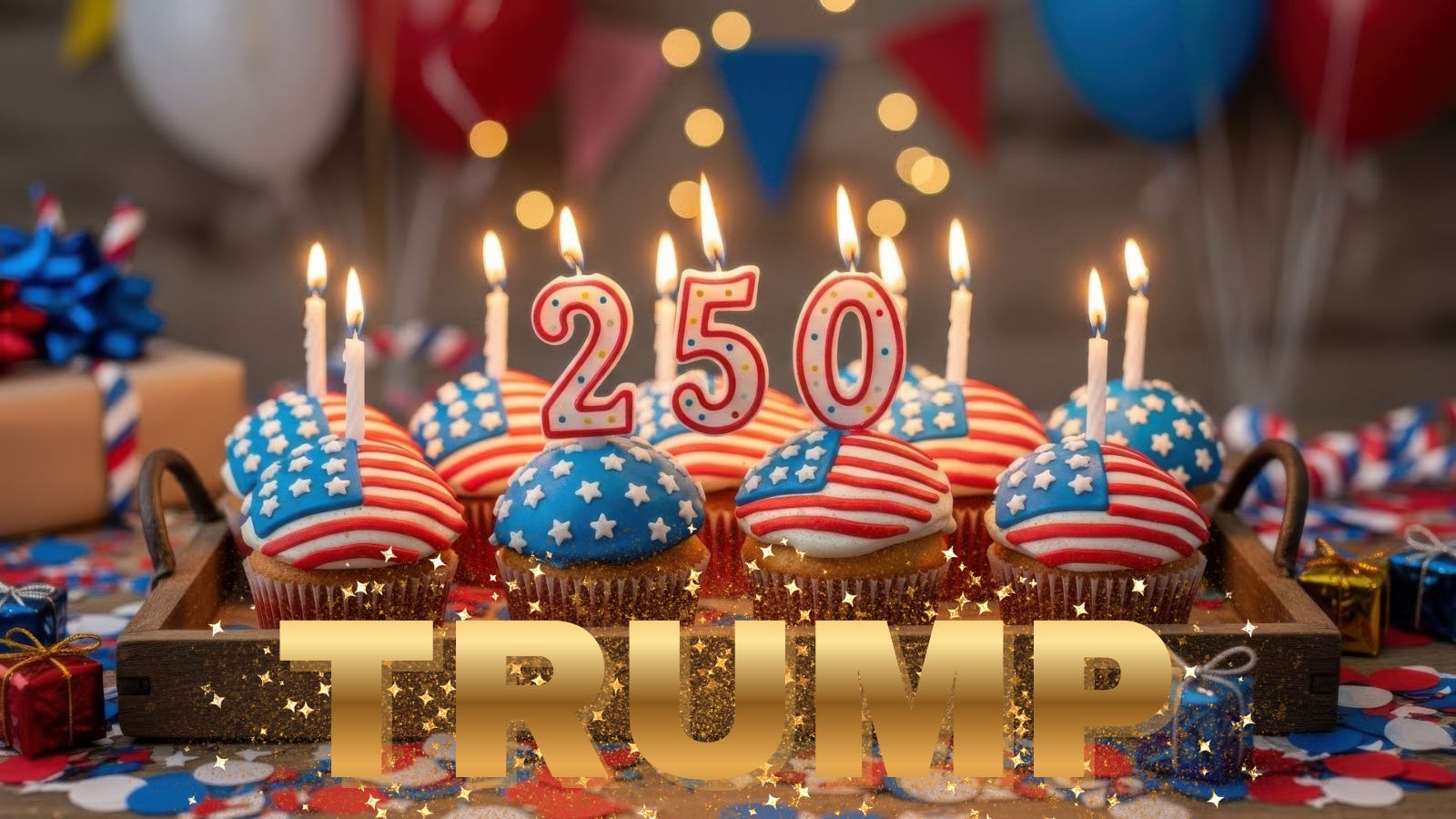
The whole thing reveals something important about Trump, but it also reveals something bleakly familiar about the country. Trump did not create America’s weakness for spectacle, branding, gigantism, or the belief that enough gold leaf can substitute for meaning. He simply wandered into those weaknesses like a man discovering that the front door had been left open for him. We are a country that has always been dangerously susceptible to bigness masquerading as greatness. We like the oversized promise, the giant flag, the dramatic backdrop, the salesman’s certainty, the theatrical gesture that flatters the audience into believing it has witnessed destiny rather than a performance designed by a committee of lighting technicians and id-based instincts. Trump’s genius, to the extent that one wants to use that unfortunate word without being struck by a falling chandelier, has been his ability to locate every cheesy impulse in the American bloodstream and market it back to the country as grandeur.
Still, even by those standards, there is something almost touchingly needy in the idea of wanting a trademark orbiting the nation’s 250th birthday. The presidency, one would think, might already provide a sufficient quantity of attention for a single mammal. There are the rallies, the cameras, the aircraft, the salutes, the endless commentary, the legal and historical weight of the office itself. Yet none of it is ever enough. Trump moves through adoration the way a sinkhole moves through a strip mall, which is to say with appetite, momentum, and no visible sign that the swallowing will ever stop. There is always one more symbol to stamp, one more backdrop to colonize, one more institution to coax into serving as emotional support decor.
That may be why the story lands with such peculiar comic force. It is not just that Trump reportedly wants to attach himself to America’s birthday in a branded and legally recognizable way. It is that the desire feels so perfectly native to his psychology that the mind almost skips past outrage and arrives directly at laughter. Of course he does. Of course the national birthday would appear to him not as a shared civic inheritance but as a potentially underleveraged event vertical. Of course the republic, with all its grandeur and failure and unresolved promise, would enter his imagination as something that might benefit from the addition of his surname in block letters.
At a certain point satire begins to lose its job because the original material has already done the hard work. What is left for the writer except embellishment. Let the Washington Monument be wrapped like a luxury fragrance reveal. Let the Liberty Bell become the Liberty Bell presented by Trump. Let schoolchildren receive glossy educational packets in which George Washington is gently downgraded to founding-era brand ambassador. Let the fireworks burst over the National Mall in tasteful gold script spelling TRUMP 250, so that future generations may look back and say yes, this was exactly how a mature civilization chose to honor two and a half centuries of constitutional struggle.
America at 250 deserves many things, including honesty, seriousness, perspective, and perhaps a stiff drink. What it does not deserve is to find itself transformed into a commemorative tote bag for one man’s bottomless narcissism. Then again, maybe there is no more fittingly American climax than this, a country founded on resistance to kings arriving at a great national birthday only to discover that one of its most powerful men has looked at the entire occasion and thought, with full sincerity, full appetite, and not one molecule of shame, “this would look fantastic with my name on it.”
As I read this, I was reminded of an essay I wrote for school waaay back in 1976, as our nation was getting ready to celebrate its Bicentennial. However, I rebranded it as the Buy-centennial in my essay. Even as a 17 year old, I was put off by all the hype and the merchandising that was being pushed upon us. You couldn't go anywhere without seeing ads and banners for all the merch. Yes, it was a pretty big deal, but I wasn't buying into the hype. I don't remember the grade I received, I don't really remember the content of the paper, but my instructor called me a real patriot, haha!
Great piece but you left out the most important celebration for the Nation’s 250th birthday -- a fistfight on the South Lawn with 25,000 rabid fans packed between the Ex-Rose Garden and the smoking ruins of East Wing. Trump is honoring America’s founding ideals is with blood sport, fireworks and, of course, a merch tent.
Jefferson wrote about life, liberty, and the pursuit of happiness — yeah, forget about that.
https://jaywilson1.substack.com/p/gladiators-on-the-south-lawn?utm_campaign=post-expanded-share&utm_medium=web