

Good morning! Friday offered the nation what scientists might call a longitudinal study and the rest of us might call an alarmingly long day with Donald Trump.
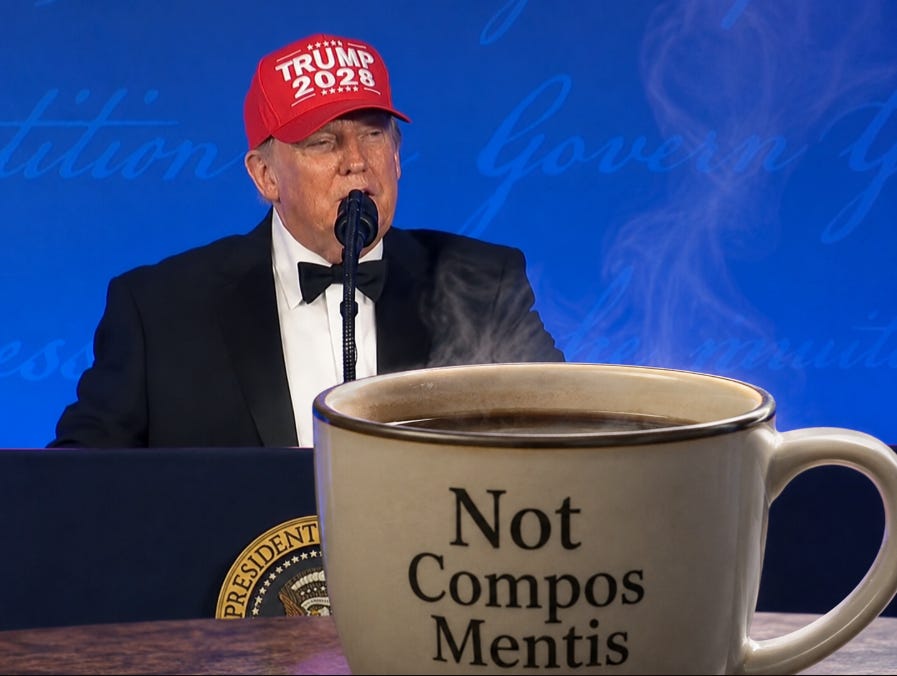
By nightfall, the president was standing before the White House press corps in a tuxedo and a bright red TRUMP 2028 cap, squinting into the lights and trying to goad a roomful of journalists into laughing at the possibility that he might simply remain president forever. Behind him, in elegant script, the backdrop quoted the First Amendment’s protection of the right to “petition the government for a redress of grievances.” The image captured the evening nicely: formal attire, constitutional menace and a president staging his own grievance recital beneath the constitutional guarantee that the public is allowed to complain about him.
Before Trump spoke, he sat through more than an hour of journalism awards, many of them honoring work he had attacked or attempted to punish. The Aldo Beckman Award for Overall Excellence in White House Coverage went to the Wall Street Journal’s Josh Dawsey. The judges praised reporting that showed “how power works inside the presidency, how decisions are made, who influences them and how authority is exercised,” and cited Dawsey’s “integrity, persistence, and steadfast commitment to holding power to account.” Trump responded from the stage with the occasional shrug and open-palmed oh well gesture of a man attending his own evidentiary hearing.
The Associated Press’s Aamer Madhani and Zeke Miller received the WHCA Award for Excellence in Print Reporting Under Deadline Pressure for exposing the administration’s loyalty purge inside the National Security Council. Their reporting revealed that staff members had been questioned about political donations, voting histories and social-media posts to determine whether they were sufficiently aligned with Trump. More than 150 NSC aides were ultimately removed, taking a considerable amount of foreign-policy expertise with them.
CNN’s Kaitlan Collins received the corresponding Award for Excellence in Broadcast Reporting Under Deadline Pressure for her coverage of Trump’s Oval Office confrontation with Ukrainian President Volodymyr Zelenskyy. The judges praised the “depth of knowledge, access, and context” she brought to a meeting that “unraveled before the world’s eyes.” Collins accepted the award beaming incandescently, an image worth remembering when Trump later complained that she “never smiles.” She smiles, just not about him.
The evening’s sharpest rebuke came with the Katherine Graham Award for Courage and Accountability, presented to the Wall Street Journal team that reported on Trump’s past relationship with Jeffrey Epstein and published the provocative birthday letter bearing Trump’s signature. The citation recounted what followed: Trump filed a $20 billion lawsuit; reporter Khadeeja Safdar’s home address was disclosed, forcing her family to relocate; and the Journal was removed from Air Force One. The reporters continued publishing. Trump therefore had to sit onstage while an award named for one of American journalism’s most celebrated defenders honored reporters for displaying courage in the face of retaliation from Donald Trump.
The ceremony was not merely celebrating journalism in his presence. It was reading aloud the record of what journalism had uncovered about his government, and what his government had done to those who uncovered it.The footage from the stage was striking. Trump repeatedly closed his eyes for extended periods, his head dipping as speakers described journalism’s obligation to scrutinize power. It is impossible to determine from video whether someone is asleep, exhausted, bored or merely conserving presidential electricity. It is possible to observe that he appeared to be struggling to remain alert during a public event at which he was seated in full view of the cameras.
He did, however, wake up for the insults.
“This has not been an easy evening,” Trump announced when he finally reached the microphone. “All these awards. Do I have a say in those awards?”
No, which may have been the first constitutional principle successfully demonstrated all night.
The awards had already placed him in an intolerable position. He was required to stand beside journalists while their profession praised them for investigating him, exposing his administration and refusing to be intimidated by his retaliation. Trump responded with shrugs, grimaces and open-palmed what can you do? gestures, the physical vocabulary of a man complying with the ceremony while rejecting its legitimacy.
Then he took possession of the microphone and attempted to reverse the power arrangement. What followed lasted slightly more than an hour. The Associated Press called it “rambling” and “insult-filled.” The Washington Post reported that it produced mostly stunned silence. According to the AP, the room began with some friendly laughter but steadily quieted into scattered titters as the personal attacks accumulated.
Trump mocked Chris Christie and Jerry Nadler for their weight. He called Don Lemon stupid, said Bruce Springsteen looked terrible, repeated racist insinuations about Ilhan Omar, commented on female journalists’ appearances and instructed CNN’s Kaitlan Collins to smile. He called Adam Schiff’s head fat and ugly, described Rosie O’Donnell as sick and used an imaginary heckler to call Illinois Gov. JB Pritzker a “fat pig” while pretending to defend him.
A roast works because everyone agrees to become ridiculous for a few minutes, including the most powerful person in the room. Trump cannot do that. He does not possess dignity so much as demand deference, and he experiences every room as a referendum on his supremacy. He can deliver insults, but he cannot accept vulnerability, laugh at himself or permit anyone else to control the joke. Instead of comedy, we get grievance with a rimshot.
The most revealing moments came when Trump realized the audience was not cooperating. After proposing that the dinner be renamed for him, he paused and asked, “How’s that one going?” Then he supplied the review himself: “Not too good.” When a joke about Christie and Nadler fighting over cheesecake failed, he demanded, “Who the hell wrote that line?” After telling a joke about an elderly senator being unable to climb the stairs and make love to his wife, Trump asked whether anyone understood it, explained the punchline, acknowledged that it had received “not exactly great laughter,” and explained it again. He was performing CPR on his own jokes.
Foreign broadcasters appeared almost grateful for the material. An LBC host greeted one clip with “Dear Lord,” then recalled that the Secret Service had warned that bad people might attend the dinner and observed that Donald Trump had indeed shown up. Times Radio’s Washington correspondent, Katy Balls, who was in the room, said the general feeling afterward was that it had been a very long night and that she was not sure every joke landed as Trump intended. She described the mood turning colder when he began commenting on individual women, including his insistence that CNN’s Kaitlan Collins “never smiles.” Collins had just received the WHCA’s award for excellence in broadcast reporting under deadline pressure.
The British reports had the advantage of distance. American political journalism often wraps Trump in protective language: provocative, combative, unconventional, freewheeling, because plain description can sound alarmist. The foreign commentators mostly watched the same spectacle and concluded that the president did not seem to understand the event, the jokes, the audience, or why the audience might not enjoy being personally degraded by a man whose government has sued, subpoenaed and excluded their colleagues.
Trump eventually pulled out the red cap and announced what he called a scoop: he intended to seek a fourth term. He insisted that he had already won three elections and would win again. The Constitution limits a president to two elected terms, but Trump has discovered that threats become jokes whenever people object to them. Display the merchandise, repeat the idea, normalize the possibility, and accuse anyone who takes it seriously of lacking a sense of humor. Constitutional laundering via comedy.
Earlier in the day, Trump appeared at a nuclear-energy event with Energy Secretary Chris Wright, Interior Secretary Doug Burgum and four reactor-company executives. Beneath the compulsory praise, there was real news: four privately financed advanced reactors had reached criticality under a Department of Energy pilot program, exceeding Trump’s goal of three by July 4. These were experimental milestones rather than commercial power plants supplying the grid, but they represented meaningful progress in the development of next-generation nuclear energy.
Burgum supplied the event’s most ideologically efficient sentence: “If you want to invest in green energy, invest in nuclear.” In one stroke, he absorbed green energy into the administration’s vocabulary, emptied wind and solar out of the category and re-anchored the climate-adjacent investment conversation around fission. Nuclear has a strong case on its own merits as a source of low-carbon, dependable power. But Burgum was not offering a comparative technical analysis. He was staging a linguistic acquisition. Under the administration’s “energy dominance” framework, green now means whatever can be presented as abundant, centralized, industrially muscular and compatible with national power.
Trump’s own scientific contribution was to credit his instincts to “my uncle,” who he said “was very big into nuclear for 40 years at M.I.T.” John G. Trump was, in fact, an accomplished professor of electrical engineering, not nuclear physics, a distinguished career fed through the family myth-enrichment centrifuge regardless.
Questions afterward did not stay on reactors. A New York Times reporter asked whether bombing civilian power plants and bridges might constitute a war crime. Trump refused to answer, asked which organization employed the reporter, and responded “Figures” upon hearing the Times. Asked for an exit strategy in Iran, he offered continuing the war, intensifying it, or negotiating, a menu presented as strategy rather than an admission that no exit strategy exists. He said twice that the United States remained “locked and loaded” and that Iran could be dismantled at a much higher level if negotiations failed, this, at a ceremony celebrating experimental civilian reactors.
“I only like people that like me,” Trump said at one point, of LeBron James, explaining his preference for Michael Jordan. It may be the most concise statement of his governing philosophy ever recorded, and it could just as easily have been the epigraph for the entire day.
None of this allows us to diagnose the president from afar. A person can ramble, repeat himself, lose his place, close his eyes, stumble, tell dreadful jokes and possess poor judgment without satisfying the criteria for any particular neurological or psychiatric condition. Political disagreement is not a diagnosis, and neither is personal repugnance.
The absence of a diagnosis does not require the absence of concern. Dr. Jonathan Reiner, a professor at George Washington University School of Medicine, CNN medical analyst and longtime cardiologist to former Vice President Dick Cheney, has repeatedly raised public questions about Trump’s health. After one unusually frantic presidential address, Reiner said Trump looked unwell and that he was seriously concerned. He emphasized that his alarm arose not from the political content but from the pressurized cadence and apparent lack of control. Reiner has also questioned Trump’s admitted decision to take 325 milligrams of aspirin daily, four times the commonly prescribed low dose, despite doctors reportedly urging him to reduce it.
In April, Senators Sheldon Whitehouse and Jack Reed entered into the Congressional Record a statement signed by 36 physicians and mental-health specialists, including neurologists, psychiatrists and experts in cognitive disorders. The authors acknowledged they had not personally examined Trump and based their concerns on extensive observation of his public behavior. They described what they saw as a “rapidly worsening, reality-untethered, increasingly dangerous decline” and urged action under the 25th Amendment. The statement appears in the Congressional Record at Volume 172, pages S2162–S2163.
Their conclusion is disputed, and remote assessment remains ethically controversial. But it cannot responsibly be dismissed as a few anonymous partisans diagnosing a television clip. It is an attributable warning from named specialists whose central concern is not whether Trump occasionally confuses a name. It is whether observable changes in speech, alertness, judgment and impulse control create an unacceptable risk in a president who exercises enormous military authority.
Representative Jamie Raskin has pursued the narrower and more immediately answerable issue: disclosure. The White House says Trump is in excellent health, but it has not released complete cognitive-test results or explained why a supposedly routine examination involved 22 physicians, why he underwent two CT scans within six months, or why he has already received two evaluations described as routine or annual within the same year. His April request for a comprehensive cognitive and neurological assessment went unanswered, according to House Judiciary Committee Democrats.
Trump, meanwhile, repeatedly boasts that he has “aced” cognitive tests and treats them as proof of extraordinary intelligence. Cognitive screening tests are designed to detect possible impairment, not to rank presidential genius. Passing one is reassuring within its limited purpose. It is not the neurological equivalent of winning Jeopardy! against Einstein.
The public therefore receives superlatives instead of evidence: perfect health, tremendous vitality, flawless cognition, doctors amazed by the specimen before them. What it does not receive is the underlying data necessary to evaluate those claims.
Trump is not an elderly retiree whose health belongs entirely to him. He is the commander-in-chief of a country engaged in an expanding war. On Friday, he alternated between appearing drowsy at an awards ceremony and telling reporters that the United States was locked and loaded to intensify attacks on Iran. No single closed eye, awkward step, bruised hand, verbal detour or mangled joke establishes incapacity. But presidents do not receive the luxury of having every troubling episode evaluated in splendid isolation, particularly when the government withholds the information that might place those episodes in context.
Why is the White House so determined to prevent the public from making an informed assessment of whether he remains physically and cognitively capable of exercising the powers of the presidency?
Friday ended with one final act of institutional theater. Just before attending a dinner dedicated to the First Amendment, Trump signed an executive order directing the government to install warning signs outside the National Museum of American History, telling visitors that its exhibits contain inaccurate information and directing them toward government-approved accounts of the national past. The White House cannot simply rewrite every exhibit from inside; so it will use National Park Service property outside the museum to post ideological warning labels instead.
Journalism Trump dislikes is fake news. History Trump dislikes is inaccurate information. Medical questions Trump dislikes are derangement. Elections he loses are rigged. Jokes that fail were badly written. Audiences that do not laugh are hostile. Every institution exists to validate him. Any institution that does not must be discredited, threatened or relabeled.
The irony is almost too neat. Trump spent the awards ceremony struggling to keep his eyes open while journalists were praised for keeping theirs open on him. He then woke up, put on a 2028 cap, demanded laughter for an unconstitutional future, and put a bow on the day by ordering warning signs against history.
Perhaps the Smithsonian should preserve the cap.
Artifact: Presidential campaign hat, 2026. Worn at a dinner honoring the First Amendment by a president who had spent the day threatening reporters, contemplating wider war, and explaining that he only likes people who like him.
The museum might want to display it quickly, before the government installs a sign outside explaining that we did not see what we saw.
Your essays are absolutely magnificent. So are your daughter’s. I love your work very much. I would be a paying subscriber in a heartbeat but I am a retired senior on a small social security check. Not from not working, but from working too long in a poorly paid caregiving profession. Alas, I have my health and my wits. I just wanted you to know that I think your work, and that of Shanley’s, are excellent and marvelous. Thank you for sharing your sharp and witty insights.
Excellent! The awards given last night could not have been a better indictment of this presidency. And for Trump to have to sit there while they were given out is so delicious.