


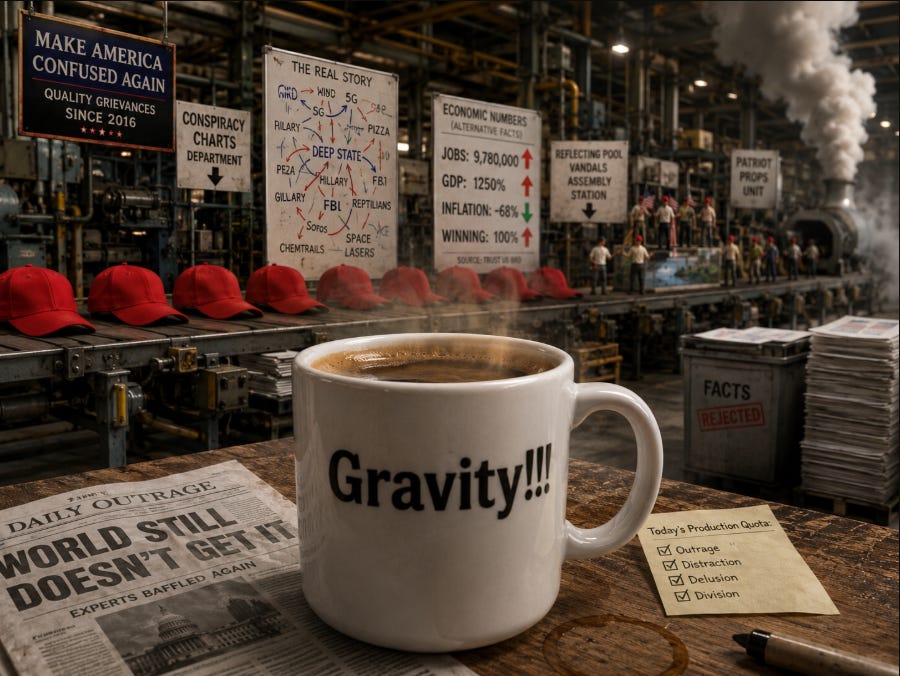
Good morning! Today’s governing theme is gravity: the kind that pulls rockets, trillionaire fantasies, imperial war stories, and over-promoted television men back down to earth.
We begin at the Pentagon, where competence continues to have a very rough season. Defense Secretary Pete Hegseth has forced out Gen. C.D. Donahue, the top U.S. Army officer in Europe and Africa, because apparently the one thing this administration cannot tolerate is a decorated military commander with actual field experience. Donahue is not a faceless Pentagon climber. He is a former special operations commander, a key figure in U.S. support for Ukraine, NATO’s Allied Land Command chief, and the last American soldier to leave Afghanistan. In a government that valued capability, that would be called a résumé. In this one, it seems to be probable cause.
The timing is not subtle. Donahue is being pushed aside just as the Pentagon is reviewing the U.S. military presence in Europe and considering downgrading the command he leads. Europe is facing Russian aggression, Ukraine remains dependent on U.S. coordination, and NATO allies are trying to read Washington’s mood through the smoke signals of Trumpian impulse. Naturally, this is the moment chosen to remove one of the people who understands the theater best. If kakistocracy needed a staff reorganization chart, this would do nicely.
Trump went to Mack Trucks in Pennsylvania for what was nominally a manufacturing speech, because nothing says “blue-collar economic policy” like using factory workers as set dressing for an 80-minute lounge act about yourself. He did begin in the vicinity of the advertised subject, praising the company that builds trucks “right here in Eastern Pennsylvania” and telling workers they put their pride into the words “made in the USA.” But within minutes, the speech had wandered into the usual fog machine: “we had a rigged election,” “these people cheat like hell,” and “maybe we should run again.” From there, the event became less a manufacturing address than a guided tour through the crawlspace of Trump’s mind.
There was Iran, naturally. “Iran cannot have a nuclear weapon,” he declared, before later insisting, “we can fly over Tehran just at will.” There were tariffs, delivered as economic policy by way of barstool threat: “If they wanted to come in, they pay 100%. They pay 200%. I don’t care what it is.” There was the inevitable attack on Democrats, including his proud new schoolyard formulation: “I changed the E for a U. It’s very simple. Dumocrats.” There were election conspiracies, transgender athletes, “communists,” “fake news,” and a long detour into UFC fighters, during which Trump asked whether, after a few months of working out, he could beat Bo Nickal or Anthony Cassar in wrestling. The crowd, to its credit, did not appear willing to suspend disbelief that far.
There was, according to observers, a health emergency unfolding behind him. Trump, ever the empath, continued to drone on. It was almost too perfect as metaphor: crisis in the background, monologue in the foreground, applause cues where governance ought to be. A normal president might pause, check on the situation, or at least pretend to be aware of another human being. Trump treated it the way he treats facts, allies, legal boundaries, and the occasional Constitution: as something happening off-camera.
The transcript is a marvel of undisciplined authoritarian vaudeville. One moment he is promising that “all American roads will be filled with American trucks,” and the next he is riffing about Melania telling him, “please don’t dance,” or warning that if Democrats win, Mack’s possible truck contract will go from “15,000 trucks” to “15 trucks.” He pauses to praise factory workers, then pivots to election lies. He gestures toward jobs, then veers into women’s sports. He invokes war, then UFC. The actual workers at Mack Trucks were present, but the real product being manufactured was grievance.
Blessedly, we turn to the schadenfreude desk, where Elon Musk has had a small accounting problem. His brief reign as the world’s first trillionaire appears to have ended after SpaceX shares fell back from their post-IPO highs and Tesla weakness helped drag down his paper fortune. Do not worry. No soup kitchen will be required. Musk remains almost comically rich, perched atop wealth so vast it requires scientific notation and a moral vacuum to comprehend. But the trillionaire crown has slipped, and there is something satisfying about watching the market briefly inflate one man into a Bond-villain milestone and then remember, several trading days later, that gravity exists.
SpaceX, we are told, “came down to earth with a bump,” which is the sort of phrase the universe occasionally gifts us as a public service. Musk’s fortune is still obscene, but the episode is useful because it reveals the fragility underneath the myth. These men are sold to us as inevitable: geniuses, builders, disruptors, saviors, civilization’s main characters. Then a share price moves, a bond sale spooks investors, and suddenly Olympus has a margin call.
Overseas, Iran has begun writing the first draft of Trump’s war as an American defeat. Tehran’s parliamentary speaker says the deal to end the war was not the result of U.S. pressure or coercion, but a declaration of Washington’s failure. This is propaganda, of course. Governments do not survive wars and then issue press releases saying, “That was close and we are slightly embarrassed.” But self-serving does not mean meaningless.
Trump wanted the theater of domination: the big strike, the hard line, the “only I can fix it” swagger repackaged for the Middle East. What he has now is a negotiated framework, Gulf allies requiring reassurance, disputes over the Strait of Hormuz, continuing Israeli operations in Lebanon, and Tehran claiming that Washington blinked. According to Iran, Trump started and lost a war in under four months. That is not an objective verdict. It is also not a ridiculous one.
So that is the morning: a decorated general pushed out while loyalty politics eats military professionalism; a president performing through crisis at a truck plant; a billionaire’s trillionaire cosplay interrupted by the stock market; and Iran declaring that Trump’s war ended not in triumph, but retreat.
The common denominator is fragility dressed up as dominance. The administration purges expertise and calls it strength. Trump rambles through emergencies and calls it leadership. Musk rides speculative wealth into trillionaire mythology and calls it genius. Washington escalates a war, negotiates its way out, and calls it victory.
That is where we will leave it this morning. The roundup is a little briefer than usual because Marz and I were up early finishing a separate essay about a Texas case that deserved more room than a quick item here could give it.
I really hope you will read that piece. It looks at the danger of designating “antifa” as a terrorist organization, not because the state has suddenly discovered some coherent, centralized terrorist network, but because such a label can become a blank permission slip. Once dissent is collapsed into “terrorism,” the machinery of the state has a freer hand to surveil, intimidate, prosecute, and chill protest. That is the point. The vagueness is not a flaw in the strategy; it is the strategy.
Today’s roundup may be shorter, but the warning is not. Whether it is generals being purged, public events turned into loyalty theater, billionaires confusing markets with destiny, or dissent being recast as terrorism, the pattern is the same: power trying to remove the friction of accountability.
Please read the Texas piece, sit with it, and share it with people who still think this is all just rhetoric. It is not.
More Idiocracy: "There was the inevitable attack on Democrats, including his proud new schoolyard formulation: “I changed the E for a U. It’s very simple. Dumocrats.”
If you have to explain the joke, maybe the dum one isn't who you think it is...
The Texas piece was terrific. Frightening but terrific.