


Good morning! A few days ago, this newsletter argued that climate change doesn’t announce itself as a single event. It accumulates in places no one is watching, and then it fails all at once, the way Hemingway’s bankrupt man described going broke: gradually, then suddenly. We used the Rhine to make that point, and the Danube, and a wildfire outside Reno that went from nothing to uncontained in about a day and a half.
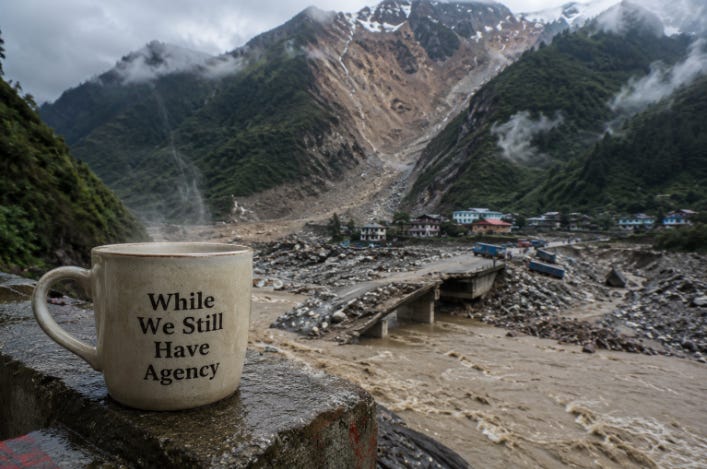
The Himalayas just offered a cleaner version of the same argument, and a far more brutal one. On Wednesday morning, Nepalese authorities initially assumed an earthquake had struck the border with Tibet. Not an unreasonable guess given this is one of the most seismically active regions on the planet. The U.S. Geological Survey’s own seismic reading indicated, instead, a 5.2-magnitude glacial collapse, not a fault rupture. A chunk of ice, thousands of feet up, let go of the mountain it had been part of for longer than anyone had been measuring it. It fell, picked up mud and rock and whatever water was already loose, and arrived in the valley below as a wave eight to ten meters high, moving with a force scientists have compared to liquid concrete.
The death toll, as of Thursday morning, stands at more than 360 dead and more than 1,400 missing.
What failed was the mountain itself, its structural integrity, built up and eroded over a timescale that has nothing to do with news cycles, finally giving way in the time it takes to read this sentence. If “Gradually, Then Suddenly” was about systems reaching their breaking point, a river too shallow to cool a reactor, an insurance market too strained to underwrite a coastline, Rasuwa district is what happens when the system is the mountain, and the villages built beneath it never had a say.
Climate change happens gradually. Structural failure happens all at once. Nepal is the second half of that sentence.
Whatever failed here didn’t erode. It sheared, the way a structural member fails under load rather than the way a hillside slowly slides. Satellite imagery, once scientists went looking, showed something specific: a section of glacier had sheared away in what Dr. Simon Cook, a senior lecturer in environmental sciences at the University of Dundee, described as an almost impossibly clean break, a line so sharp it looked, in his words, as if it had been drawn with a ruler.
How that specific piece of ice detached on that specific morning is still not entirely known, and Cook didn’t pretend he had all the answers. The satellite record shows the surrounding glaciers less snow-covered after the event than before, which suggests warming and meltwater may have worked their way into cracks in the ice, reaching the glacier bed and acting as a lubricant. It’s a plausible mechanism. It is also, in his own assessment, speculative, one hypothesis among several that rival scientific teams will spend weeks arguing over.
What is not in dispute is the scale. Roughly 0.2 square kilometers of ice came down from an elevation near 5,200 meters and fell approximately 1,200 meters vertically to the valley floor. That volume of ice alone, by Cook’s own estimate, doesn’t obviously account for all the water that ended up moving through the Trishuli valley, which means the flood likely picked up something else on its way down: pockets of older, “dead” glacial ice already destabilized by years of warming, along with loose sediment, boulders, and debris accumulated in a landscape that climate change has spent decades quietly loosening. The result, when it reached populated ground, moved with a density scientists have likened to liquid concrete, fast enough and heavy enough that people in its path had minutes, not hours, to get to higher ground.
The mountain didn’t just melt. It broke.
Cook was direct about one thing in particular: this was not an isolated event, and he does not expect it to remain one. “I think this is more is becoming more likely,” he said, “and we’ve seen other similar events in the Himalaya and around the world in recent years.” He didn’t have to reach far for examples.
In 2021, in India’s Uttarakhand region, a rock avalanche fell roughly 1,800 meters into a valley in the Indian Himalaya, destroying two hydropower stations and killing about 200 people. In 2025, the Swiss village of Blatten was completely buried when a glacier above it collapsed. In 2022, in the Italian Dolomites, part of the Marmolada glacier broke away and killed a group of climbers who had no reason to expect the mountain beneath them to move. Different ranges, different continents, the same family of cascading high-mountain failures in warming environments, with what Cook called “fairly regular frequency” and, in his assessment, likely to keep repeating “in the years to come” as the planet continues to warm.
None of these events were freak occurrences in the sense the word usually implies. They were the predictable output of an unpredictable input, mountain environments whose ice, rock, and water had settled into patterns human communities learned to build around, now absorbing change at a rate those communities never planned for. Cook wouldn’t commit to naming climate change as the direct cause of any single one of these collapses; the honest scientific answer, in his words, is that “we can’t make a direct causation” for a specific event, only that “climate change has a destabilizing effect on these sorts of environments.”
Distinguishing between causing an event and destabilizing the conditions that produce it is not evasion. It’s what intellectual honesty sounds like when the truth is genuinely uncertain.
Part of what made Wednesday’s collapse so lethal was not just the glacier; it was how little anyone was watching it. The Himalaya, Karakoram, and Hindu Kush ranges together hold something on the order of 40,000 glaciers, stretching from Bhutan in the east to Pakistan in the west. Of those, only a small fraction, journalist Leela Jasinto put it at “a few dozen” are under any kind of consistent monitoring, a fraction dwarfed by the coverage given to a far smaller mountain range half a world away: the Alps.
Asked why satellite technology hasn’t closed that gap, Cook offered an answer that doubles as an indictment of how the problem is being approached. “It’s a bit like looking for a needle in a haystack,” he said. Thousands of glaciers in the region look broadly similar to a trained glaciologist; steep, fractured, sitting in cold-but-warming terrain, and there is no reliable way, with current monitoring, to know which one is closest to failure. Even with eyewitness footage, satellite data, and incoming seismic and meteorological readings all in hand after the fact, Cook said the root cause of Wednesday’s collapse “won’t be determined... for the days and weeks to come.”
It would be a mistake to file Rasuwa district away as remote. It is mountainous, yes, some of the most vertiginous terrain on the planet, but it is not isolated. The valley the floodwater tore through is a working economic corridor, part of the cross-border trade route that moves goods between Nepal and China. Trucks travel the route daily to keep local villages supplied. The destruction of roads and bridges severed a supply line and a rescue route.
Journalist Leela Jasinto pointed out that it is also a region under real development pressure; hydroelectric projects, infrastructure expansion, population growth pushed into terrain that is, by any geological measure, still geologically active. The same steep, unstable, glacially-fed valleys that make this terrain dangerous are also what make it valuable for trade routes, for hydropower, for the water itself. Nepal’s government now faces the same question in the aftermath that it faced before Wednesday, only louder: how do you develop a landscape that is actively, geologically alive, without eventually building directly in the path of what it’s going to do next.
That’s what the monitoring gap actually costs. It’s the difference between a government that can weigh economic development against geological risk honestly, and one that finds out the terms of that trade-off by accident.
This is Tendon, Not Fat applied to the physical world: the monitoring station that watches a glacier for twenty uneventful years looks like bureaucratic overhead until year twenty-one, when knowing that glacier is moving becomes the difference between a warning and a body count. Monitoring is a bit of an abstraction. It’s satellites, gauges, staffed research stations, the unglamorous infrastructure of simply knowing what a warming planet is doing before it does it to you. This is the boring stuff you fund during “gradually,” when it looks unnecessary, so that “suddenly” doesn’t catch you empty-handed.
In the US, it’s the same infrastructure the current administration has spent the last year trying to shrink. Trump’s 2026 budget proposed slashing NOAA’s funding by roughly a quarter and gutting its climate research division entirely; USGS was targeted for a $564 million cut, with internal reporting warning it would gut the agency’s biological research program along with drought and wildfire monitoring. Congress rejected the bulk of it. The administration proceeded anyway where it could, canceling three of the five instruments on NOAA’s next-generation weather satellite program this year, contracts terminated regardless of what lawmakers had just funded.
It is the same epistemological trick Trump performed during COVID, when he complained that testing was finding too many cases: confuse observing a problem with creating one. The virus kept spreading when you stopped counting it, just as a glacier keeps destabilizing when nobody is measuring it. Forty thousand glaciers. A few dozen being watched, and an administration actively working to watch fewer. The mountain does not require your belief in it to fail. It only requires your inattention.
By Thursday morning, the death toll in Nepal and Tibet had climbed and includes at least 65 Americans. Against that scale, the United States’ response arrived Wednesday evening in a single sentence from the State Department: $500,000 in assistance, routed through its existing partnership with Catholic Relief Services, for emergency shelter and water, sanitation, and hygiene support. Secretary of State Marco Rubio posted his own condolences separately on X, offering “solidarity” and “prayer.”
Not a word from Trump. In December of last year, as severe flooding, landslides, and mudslides displaced 100,000 people in Washington state, Trump approved the disaster declaration his aides asked for and then, according to reporting from Eric Trump’s own Instagram account, sat on a handwritten draft statement about it, on paper, in the Oval Office, without ever posting it. In its place that week: a repost about tariffs, and comments about a mirror recently installed along the White House’s “Presidential Walk of Fame.” The approvals happen. The acknowledgment, when it might cost something rhetorically, does not.
The $500,000 is real money and will do real good. It is also one eighteen-hundredth of the roughly $900 million this administration has assembled for construction on the White House grounds. America can afford more. Measured against gold leaf and granite, it reads like a priority.
Bill Maguire, the volcanologist we quoted at length a few days ago, made his own version of this argument about a different mountain entirely, the Cumbre Vieja volcano on La Palma, whose flank has been creeping, almost imperceptibly, toward the Atlantic for decades. It could go, he said, in a thousand years. It could go next year. Nobody knows, because that’s not really how the mechanism works. “They creep,” he said, “and then there’s that final trigger that sets them off.” Hemingway’s bankrupt man went broke the same way: gradually, then suddenly, with no reliable warning between the two states except the arrival of the second one.
Rasuwa district was the mechanism, not the metaphor. For years, decades, if you take the long view Cook and Maguire both take, the Himalaya has been doing exactly what a warming planet does to ice: thinning it, destabilizing it, loosening whatever holds it to the mountain. None of that looked like catastrophe from month to month. It looked like weather. Then, on a Wednesday morning, it stopped looking like anything except a wall of water and debris moving with the density of liquid concrete, and more than 360 people were dead before lunch.
We keep reaching for Hemingway’s line because it’s the rare piece of borrowed language that doesn’t flatter the person using it, it just describes, accurately, how things actually fail, with an accumulation nobody was watching closely enough to see, and then, all at once, a mountain that moves.
The gradual part was where we still had choices. Monitoring is what you do while you still have agency. By the time suddenly arrives, the mountain is in charge.
Nearly two years ago, here in western North Carolina, the mountains came down when Helene hit. My town, Burnsville, in Yancey County, was one of the hardest hit. We're still working to rebuild infrastructure and homes that were simply wiped off the earth by mudslides and raging rivers.
Hundreds of miles from any coast and a hurricane hit the mountains. I know climate change is real and this is not going to be an isolated incident.
A sad commentary on what governments prioritize.