


Good morning! There is a famous exchange in Ernest Hemingway’s The Sun Also Rises in which one character asks another how he went bankrupt.
“Two ways. Gradually and then suddenly.”
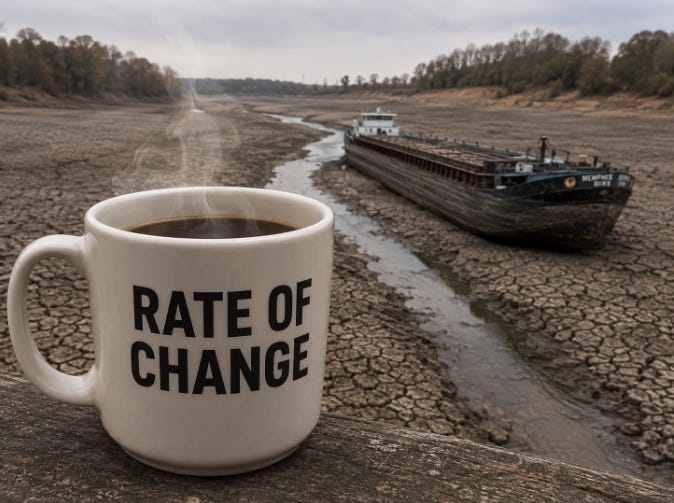
That line came up in one of the climate interviews I was watching this weekend, and it has been rattling around in my head ever since because it turns out to be a pretty good description of how complicated systems fail.
They usually don’t wake up one Tuesday morning, stretch, yawn and announce that they have decided to collapse.
They try to compensate and adapt, borrow from reserves, and continue to look surprisingly normal. Then something that would once have been manageable arrives after enough resilience has already been consumed.
Suddenly.
Saturday, the average surface temperature of the world’s oceans reached 21.1 degrees Celsius, or about 70 degrees Fahrenheit, the highest daily temperature ever measured. The previous record was 21.09 degrees, reached repeatedly during the 2024 El Niño. The measurements cover the oceans between 60 degrees north and 60 degrees south and are compiled from satellites, ships and buoys by the Copernicus Climate Change Service. Daily records go back to 1979; monthly observations extend much further.
One one-hundredth of a degree does not sound like much until you remember we are averaging most of the ocean on Earth.
We are not talking about a statistical fluke, by the way. July had already produced the highest average sea-surface temperature ever recorded for that month, and throughout much of the summer the extra-polar ocean has been setting records for the respective day of the year. Copernicus says the developing El Niño is adding heat on top of an ocean that has already spent the past several years running dramatically warmer than its long-term average.
Which brings us to the phrase “global warming,” a term that has always made what is happening sound vaguely pleasant, like somebody adjusted the thermostat because Grandma was chilly.
The ocean has absorbed more than 90 percent of the excess heat trapped by human-generated greenhouse gases. It is the largest heat sink in the climate system, quietly protecting us from experiencing even more warming in the atmosphere.
Except a heat sink does not make heat disappear, it stores it. The heat sink is getting hot.
The ocean is not a decorative blue border around the continents. Warmer seawater expands. Ice melts into it. Marine ecosystems live in it. Storms draw heat and moisture from it. Atmospheric circulation interacts with it. Rainfall patterns depend upon temperature differences between oceans and continents.
The ocean has been doing an enormous amount of load-bearing work for us while we mostly treated it as background scenery.
Professor Benjamin Horton, dean of the School of Energy and Environment at City University of Hong Kong, made another point this weekend that I think gets closer to the problem than most discussions about “adapting to climate change.”
We frequently talk about adaptation as though the climate were moving from one stable setting to another. Build higher seawalls, install more air conditioning, enlarge the culverts, move the flood maps, plant different crops and then carry on.
Horton’s deliberately provocative formulation is that adapting to the climate of 2026 is “pointless” if we mean adapting once and declaring victory, because the climate of 2027, 2028 and 2029 will continue changing unless we stop adding greenhouse gases.
Adaptation itself is obviously not pointless. Horton spends considerable time explaining how urgently we need it.
The moving baseline is the problem. You cannot build resilience around yesterday’s definition of normal when normal itself is moving.
Nature is not satisfied with simply changing the temperature. It may be moving some of the rain, too.
A recent Nature Communications study examined decades of observations of tropical rainfall and found persistent changes in the position and distribution of major rain belts that models reproduce only imperfectly. Tropical rain and monsoon systems provide freshwater, determine growing seasons, replenish reservoirs and groundwater, and support food production for billions of people.
Just Have a Think vlog discussion of the research makes the point beautifully: if a rain belt shifts, agriculture shifts. Reservoir performance changes. Flood risk changes. Hydropower changes. Groundwater recharge changes. The movement can be almost invisible from one year to the next and profoundly important after several decades.
And this is where rate of change matters.
The climate has never been static. Rivers move. Rain belts migrate. Coastlines advance and retreat. Species shift their ranges. Over geological time, enormous changes are perfectly ordinary.
Civilization, however, did not develop on geological time.
We built farms, cities, dams, ports, power plants and water systems during a comparatively stable climatic interval, and we built them to last for decades or centuries. A reservoir can accommodate wet years and dry years. A bridge can accommodate floods. Farmers can adjust planting dates. What becomes much harder is adapting when the underlying conditions are changing faster than the systems built around them can be redesigned, financed, permitted, constructed or relocated.
This is where climate change becomes much more interesting, and much scarier, than a thermometer.
Civilization is constructed around assumptions of persistence. A river runs here, rain falls there, snow melts during this season; this region grows wheat, that reservoir fills in winter, this aquifer recharges at roughly this rate, and the high-water mark is approximately there. Over generations, those observations about nature became design specifications for civilization. We located cities, farms, dams, roads, power stations, ports and water systems around an expectation that, although conditions would vary from year to year, the underlying patterns would remain reasonably familiar.
Climate change does not necessarily need to blow infrastructure apart to make it fail. It only needs to invalidate the assumptions under which it was designed, and do so faster than we can redesign the infrastructure.
If that still sounds like models and graphs, Reno, Nevada, is what it looks like on Monday morning.
The Hawk Fire began northwest of Reno on Saturday and grew to more than 15,000 acres by this morning, pushed by wind into neighborhoods around the city. Authorities say the fire was human-caused, although exactly how it started remains under investigation. At least six people have been injured, including three first responders; homes have been destroyed, nearly 10,000 customers have lost power, schools have closed and portions of US 395 have been shut down. Roughly 42,000 people were under evacuation orders and another 45,000 in warning zones as shifting winds repeatedly changed the direction of the fire.
Climate change did not strike the match, but it is changing the background conditions that can make fires harder to control. Heat, low humidity, dry vegetation and wind help determine whether an ignition remains manageable or becomes a metropolitan evacuation. That is how climate risk usually enters everyday life: not wearing a little badge that says CLIMATE CHANGE, but as power shutoffs, closed schools and highways, strained fire crews, mass evacuations and insurers reconsidering whether your house is worth covering at all. And Reno is hardly having a private crisis.
As of this morning, the United States is at National Wildland Fire Preparedness Level 5, the highest level. More than 50,000 wildfires have burned about 7.74 million acres this year, 169 percent of the ten-year average acreage for this point in the season. Seventy-nine large fires are currently being managed, with more than 22,000 firefighters and support personnel assigned.
Canada is also at Preparedness Level 5.
CIFFC’s August 23 report listed 637 active fires, with more than 4.3 million hectares burned this year. Level 5 means firefighters and equipment are already heavily committed across jurisdictions and international assistance has been requested.
That simultaneous demand matters because aircraft, firefighters, emergency managers and utility crews are finite, and disaster budgets are not infinite.
A changing climate doesn’t have to make every fire unprecedented. It only has to make expensive emergencies common enough, large enough and simultaneous enough that systems designed to handle exceptional events can no longer treat them as exceptional.
Europe is discovering the same thing.
As of August 20, nearly 620,000 hectares had burned across the European Union this year. That remains below 2025, the EU’s worst fire year on record, but is still more than twice the twenty-year average for this point in the season.
France and Spain have endured enormous fires and mass evacuations this summer. World Weather Attribution found that the extreme fire-weather conditions seen in central Spain in July are now at least 20 times more likely than in a preindustrial climate, while similarly severe conditions in southwestern France have become at least twice as likely. The mechanism is straightforward: a wet winter produces abundant vegetation, then exceptional heat and drought dry it into fuel.
Fire is only one expression of the same underlying stress.
England is having a water problem.
Seventy-one percent of the country’s land area is now officially in drought. Rainfall for August through August 20 was just 17 percent of the long-term average. Seven major reservoirs were at exceptionally low levels. Approximately 29 million people were living under temporary water-use restrictions.
Farmers are reporting agricultural boreholes drying up. Farm reservoirs are critically low or empty. More than 1,500 abstraction restrictions are in force. Crop yields are poor. Grass growth is down, threatening winter feed supplies for livestock. Root crops are becoming difficult to harvest because the ground is so hard.
There is something called a “flash drought,” which sounds like the sort of aggressively marketed drought Silicon Valley would invent after deciding ordinary drought wasn’t selling.
It means exactly what it sounds like: drought conditions intensifying unusually quickly because very low rainfall coincides with high heat and evaporation.
England is only one piece of the European water story.
Half of the European Union and United Kingdom was under some level of drought by late July. Europe’s four major rivers, the Loire, Po, Rhine and Danube, reached record-low levels in August. The European Commission’s Joint Research Centre says water resources, agriculture, energy, river transport, tourism and ecosystems are all being squeezed simultaneously.
“Simultaneously” is doing an enormous amount of work. A river simultaneously supplies drinking water, irrigation, freight, industry, power generation and habitat. We divide those functions into separate sectors because that is how bureaucracies and newspapers work; the river does not recognize the categories. When its flow drops far enough, the supposedly separate systems begin failing together.
Across the Danube basin this summer, low water has constrained navigation, agriculture, hydroelectric production and nuclear generation. This is where the abstraction becomes almost comically physical: as the Danube fell, Romanian authorities dredged the river and even sank rock-filled barges to redirect more water toward the cooling intake at the Cernavodă nuclear plant. The improvisation bought time, but falling water levels ultimately forced reactor shutdowns.
Nothing in the machinery had to break for the system to fail. A nuclear reactor can be fully functional and still stop producing power because its cooling-water source has fallen outside its operating range; a hydroelectric turbine can sit idle for lack of flow, a cargo vessel can lose capacity because the channel is too shallow, and a productive farm can fail for lack of water.
Climate change does not have to destroy infrastructure to make it unusable. It only has to push the physical conditions that infrastructure depends on beyond the assumptions built into its design.
And there, I think, we return to Hemingway. Rainfall declines, soils dry, reservoirs fall, rivers grow shallower and vegetation loses moisture while power plants, barges, taps and crops keep functioning. The “suddenly” is often just the moment when those accumulated stresses finally push a system past its margin.
That is the part of the climate discussion we routinely miss. Collapse is rarely a single event arriving from nowhere; more often it is the end of a long erosion of resilience that remained mostly invisible while the system still appeared to work.
Systems that were once comfortably inside their operating envelopes move closer to the edge. They still work, so we congratulate ourselves. Then a drought, fire, storm, heatwave or equipment failure arrives and discovers that the cushion has already been spent.
A lot of resilience looks like waste right up until the minute you need it.
So after all of that, here is the part where I decline to tell you that civilization is doomed and recommend drinking heavily before breakfast. We actually know quite a lot about how to stop making the underlying problem worse, and something extraordinary has been happening while political arguments over renewable energy continue as though solar panels remain an exotic technology personally invented last Thursday by Greta Thunberg.
The world installed a record 664 gigawatts of solar power in 2025, pushing global capacity past three terawatts and supplying roughly 9 percent of global electricity demand, about three times its share five years ago. A technology that was prohibitively expensive a generation ago is now one of the cheapest forms of new electricity generation available across much of the world.
Which means the problem has changed. For decades the renewable-energy question was whether we could make enough inexpensive clean electricity. Increasingly, the answer is yes. The bottlenecks are transmission, storage, interconnection, planning, grid flexibility and market rules designed for twentieth-century power stations rather than millions of distributed generators.
The Just Have a Think discussion of SolarPower Europe’s latest report gets this exactly right: the next stage of the energy transition is increasingly about integration rather than generation. Electricity systems built around large centralized fossil-fuel plants were not designed for millions of rooftops producing power simultaneously at noon. Solar can succeed so rapidly that the grid itself becomes the constraint, which is such a perfect ending to this particular story that I almost resent it. Once again, the shiny object receives the attention. The connective tissue decides whether the shiny object works. Transmission lines, substations and battery-storage permitting are not sexy, and flexible electricity pricing has never once caused anyone to throw their underwear onto a stage. But civilization is mostly composed of boring things that function.
We know how to generate low-carbon electricity, build transmission and store it in batteries. We also know how to electrify transport and heating, design cities that hold onto more water and absorb less heat, and restore the wetlands, watersheds and forests that used to do some of that work for free. Humanity possesses sufficient cleverness, but can deploy it before physics completes the peer review?
Naturally, this brings us to ticks.
After an entire morning devoted to humanity discovering that natural systems have operating rules whether we approve of them or not, it seems only appropriate that Martha’s Vineyard is experiencing a remarkable increase in Alpha-Gal Syndrome.
Alpha-Gal is a bizarre condition in which a bite from certain ticks can cause an allergy to a sugar molecule found in most mammalian meat and some mammal-derived products. Suddenly beef, pork, lamb, and sometimes dairy products can cause serious allergic reactions.
On Martha’s Vineyard, hospital testing went from nine alpha-gal tests in 2020, two of them positive, to 1,689 tests in 2025, with 742 positive results. Massachusetts made Alpha-Gal Syndrome a reportable condition effective April 1.
Lone star ticks have been expanding and re-establishing populations farther north for a mixture of reasons involving deer, land use and habitat. Warming conditions may make northern environments friendlier to them, although I would not blame climate change alone for their spread.
Still, there is something almost offensively elegant about the ecological joke: we raise enormous numbers of cattle, cattle emit methane, methane contributes significantly to planetary heating, a warming climate may help make more northern territory hospitable to a tick, the tick bites us, and our immune system announces that perhaps we shall not be eating the cow after all.
Nature does not, alas, have a Department of Ironic Retribution. But if she did, Alpha-Gal Syndrome would be difficult to improve upon.
I don’t believe in the evangelicals’ picture of end times. I do believe in the power of Mother Nature. She always wins in the end.
a wonderful - wonderfully sobering - account.
I recall an editorial cartoon about 1972 of a typical cartoon plutocrat responding to an ecological study saying that global warming would cause a crisis in 35 years, 'oh, that's OK! I thought you had said 3 to 5 years!'
Eventually short-term thinking fails... Sounds as if our 35 years (and a couple of decades of grace) are just about up.