


Good morning! It’s one of those Sundays. Let’s start with the Epstein files, because the administration would very much like this to be the end of the story, and it very much is not. Three million documents were dumped on the public Friday and immediately framed as transparency, closure, vindication, pick your preferred euphemism. The president himself declared absolution without bothering to read them, based on what “very important people” told him, which is apparently how innocence works now. But once you look past the spin, what emerges is a rerun of the original crime, with the roles intact.
Attorneys for Epstein’s survivors are furious, and for good reason. They say the Justice Department’s release was riddled with “ham-fisted redactions” that somehow still managed to expose victims, including women who had never gone public, while continuing to shield powerful men. Survivors describe being re-traumatized by the federal government itself. The files, they say, protect perpetrators and expose the people Epstein and Maxwell trafficked. Put succinctly, the document dump didn’t disrupt the power structure of the crime; it replicated it.
That makes Trump’s claim of “exoneration” almost darkly comic, not least because he made it during a rambling press gaggle aboard Air Force One. Asked about the Epstein files, the president admitted, “I didn’t see it myself,” before declaring himself vindicated anyway, based on what “very important people” had told him. He then accused a journalist, Michael Wolff, of conspiring with Jeffrey Epstein to harm him politically and announced, “We’ll probably sue Wolff for that.” Personally, I would love that and to see the ensuing discovery but this was no verdict. It was a warehouse door flung open and then half-slammed shut again, with the fragile things tumbling out first. One intake memo among three million pages doesn’t absolve anyone, especially not when the president openly concedes he hasn’t read them. Declaring vindication from hearsay and threatening lawsuits from 30,000 feet is pure reality TV performance.
What’s striking, and damning, is how differently other countries are responding to the same material. In Britain, Prime Minister Keir Starmer is openly urging Andrew Mountbatten-Windsor, formerly Prince Andrew, to cooperate with Congress. Royal titles have already been stripped, and homes reassigned. Silence is no longer treated as a neutral choice. Starmer put it plainly: you can’t claim to be victim-centered if you refuse to share what you know. In Slovakia, a national security adviser resigned simply for having met with Epstein after his conviction. No criminal charges or drawn-out process. Just a recognition that judgment matters.
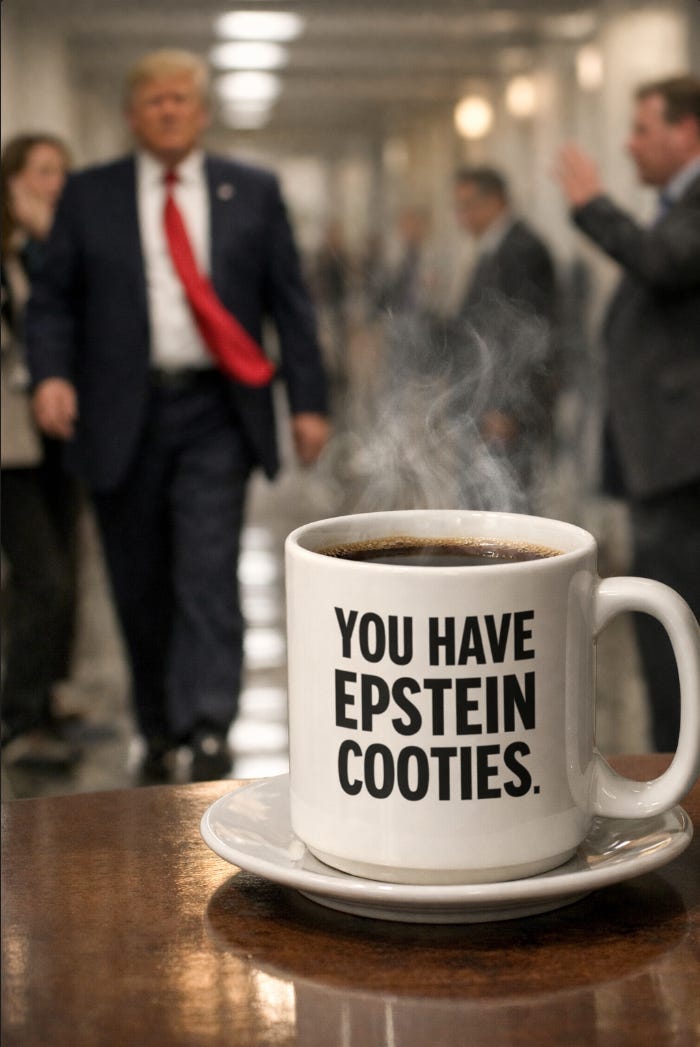
In the United States, by contrast, association is survivable, silence is strategic, and the loudest voices belong to people threatening lawsuits. Survivors are named while enablers are not. The president flies home on Air Force One insisting he’s been cleared by files he hasn’t read, while threatening “very serious force” against protesters and spinning legal fantasies in real time. In the same press gaggle where he declared himself “absolved,” Trump boasted that he is now suing the IRS and, having returned to office, may have to settle the case with himself. “I have to work out a settlement with myself,” he told reporters, explaining that the FBI’s Mar-a-Lago search had produced “a very good suit” and suggesting the resolution might involve him donating money to charity because “nobody would care.” Declaring vindication by hearsay, threatening critics with lawsuits, and musing about paying yourself damages feels like improv theater, performed by someone who no longer feels bound by the idea that rules apply to him at all.
That authoritarian muscle memory is on full display in Minneapolis, where the federal government insists it is restraining itself, even as it continues to deploy thousands of agents into a Democratic-led city without consent. Two U.S. citizens, Renee Good and Alex Pretti, are dead after encounters with federal officers. Video evidence undercuts official claims of self-defense. And now Minnesota is confronting something it has never had to do before: consider prosecuting federal agents for killing civilians without cooperation from the federal government.
The Minnesota Star Tribune lays out just how unprecedented, and grim, this moment is. State prosecutors are weighing criminal charges against federal agents without cooperation from the federal government, which is refusing to hand over evidence, refusing to name officers, and refusing to allow state investigators access to weapons, body-camera footage, or even basic facts. Former prosecutor Amy Sweasy described it bluntly: “If you can’t get the information you need, it’s all the more difficult to figure out what a charging decision is going to be and what the theory of the case is going to be.” Defense attorney Eric Nelson, who represented Derek Chauvin, called the breakdown between state and federal authorities “virtually unprecedented.” In federal court, Judge Eric Tostrud openly asked whether the government would even comply with subpoenas if the state brought charges. The response from a U.S. attorney? “I don’t know the answer to that.” The supremacy clause is being wielded here not just as a legal defense, but as a wall against scrutiny itself.
There is no statute of limitations on murder. Delay doesn’t erase liability. But delay does something else very effectively: it exhausts families, degrades evidence, and bets that political conditions will change before justice ever arrives.
This is part of a larger pattern. The Trump regime keeps testing the rule of law the way a burglar tests door handles, rattling everything, everywhere, all at once. If a door opens, it walks through. If it doesn’t, it moves on and tries the next one. Immigration detention was supposed to become indefinite; federal courts are now flooded with habeas petitions and quietly releasing people by the hundreds. Civil servants were pressured to break the law; those who refused were forced out. One of them was Kathleen Walters, a senior IRS official with nearly two decades of service, who resigned after being asked to facilitate what agency lawyers said would be an illegal transfer of sensitive tax data on millions of immigrants to DHS. “No other administration has ever personally asked me to do anything illegal,” Walters said. She left just 23 days short of qualifying for early retirement and lifetime health insurance, knowing exactly what it would cost her family. “If you lose a job, you can get another job,” she said. “But if you lose your integrity, it is very hard to get it back.” Federal force was unleashed in cities; only afterward did the White House announce new “rules” that carve out exceptions big enough to drive an armored vehicle through.
Sometimes the door holds. Sometimes it doesn’t. Either way, the damage is done. But not everything is moving in the same direction. Down in Texas, of all places, a crack appeared this weekend. A Democratic machinist and union leader, Taylor Rehmet, just won a Texas Senate seat in a district Trump carried by 17 points. Republicans panicked, Trump intervened, and Dan Patrick begged. Money flooded in, a lot of it. Rehmet spent roughly $70,000. His Republican opponent, Leigh Wambsganss, spent more than $736,000, backed by additional hundreds of thousands from outside groups, including a $300,000 infusion from Dan Patrick’s PAC alone. This wasn’t a fair fight; it was a financial steamroll, and voters still chose the underdog. It’s not a blue wave. It’s not Texas flipping overnight. But when nearly a million dollars can’t save a candidate in a deep-red district running on school-board extremism and culture-war grievance, it’s a warning shot Republicans can’t afford to ignore.
Does it mean the tide is turning? Maybe. Maybe not. A Melania Trump film is reportedly doing just fine in deep-red districts, which suggests American politics remains perfectly capable of holding multiple contradictory realities at once. But cracks don’t announce themselves as collapses, they start small.
Even in a collapsing political ecosystem people are still trying to take care of one another, let’s pause for this adorable story right here in rural Oregon, where local government failure met community ingenuity, and the solution was… tasteful nudity.
In Lakeview, a town of about 2,400 people staring down the very real possibility of bankruptcy, two women decided that if the state couldn’t fund basic services like snowplowing, they’d handle it themselves, with a calendar. A nude calendar. Margot Dodds pitched the idea to the town council last summer and was met, unsurprisingly, with “considerable skepticism.” But fellow council member Jess Calvin didn’t clutch pearls; she grabbed a camera. The result is the Outback Naked calendar, featuring twelve local volunteers, zero shame, no coherent artistic vision, and an overwhelming sense of civic goodwill. As Dodds put it, if someone was brave enough to send in a photo, they made the cut.
The calendars are selling so fast they’ve had to reorder printings, with all proceeds going to keep the town’s roads plowed through winter. And because Oregon never half-commits to a bit, next year’s sequel may feature octa- and nonagenarians in mink stoles and big hats, posing with classic cars. File this under: mutual aid, but make it naked. Or perhaps more accurately: what functional democracy looks like when it’s stripped down to its essentials.
So here we are: survivors demanding accountability while being exposed by their own government; courts struggling to restrain an administration that treats legality as optional; states contemplating prosecutions that may take years; foreign leaders acting with a seriousness that puts Washington to shame; and voters, in at least one red district, deciding they’ve had enough.
It’s messy, unresolved, and it’s very much not over, no matter how many times the president declares himself absolved.
Are there no heroes who have or can access the unredacted versions of these Epstein documents and will release them - redacted only to protect the victims? Are there no other means of credibly identifying the perpetrators? Details of the extraordinary money flow that made Epstein ultra rich?
Trump sycophant Todd Blanche, when questioned about the DOJ’s baseless revenge prosecutions at Trump’s demand, declared DOJ prosecutors must “follow the president’s priorities” regardless of evidence or law. His official ideology, manifestly that of all Trump DOJ appointees, is to obey the tyrant over the rule of law. He, Bondi and their corrupt DOJ allies need to be impeached.
While camping at Goose Lake, I spent a little time in Lakeview and the surrounding beautiful area and it was grand....I want one of those calendars, I guess I will have to order one, cool!! Thanks again, Mary!!!!!!