


Trump and Melania hosted a White House Mother’s Day event for military mothers, a concept that sounds normal until you remember this is a couple with all the military bona fides of a country club brunch reservation. Melania opened with a solemn, carefully scripted tribute to military families, talking about sacrifice, grief, motherhood, Dover Air Force Base, and the pain of families who lose loved ones in service. She framed military mothers as the emotional backbone of the nation, the women lying awake at night while their children serve overseas or come home changed forever. It was very First Lady stationery-card sincere, soft lighting, solemn words, and just enough “only mothers understand” gender essentialism to make the whole thing feel like a Hallmark card that got briefed by the Pentagon.
Then came the line where Melania described Trump as a “strong commander-in-chief” whose “empathy transcends the role,” and the room burst into laughter. Frankly, that laughter may have been the most accurate real-time fact-check of the day. She said he remembers that every American soldier is someone’s child, and then handed the microphone to the man who was about to demonstrate that every American soldier is also, apparently, a convenient segue into Iran, Venezuela, ballroom construction, missile defense, streaming numbers, “fake news,” and Donald Trump’s personal greatness.
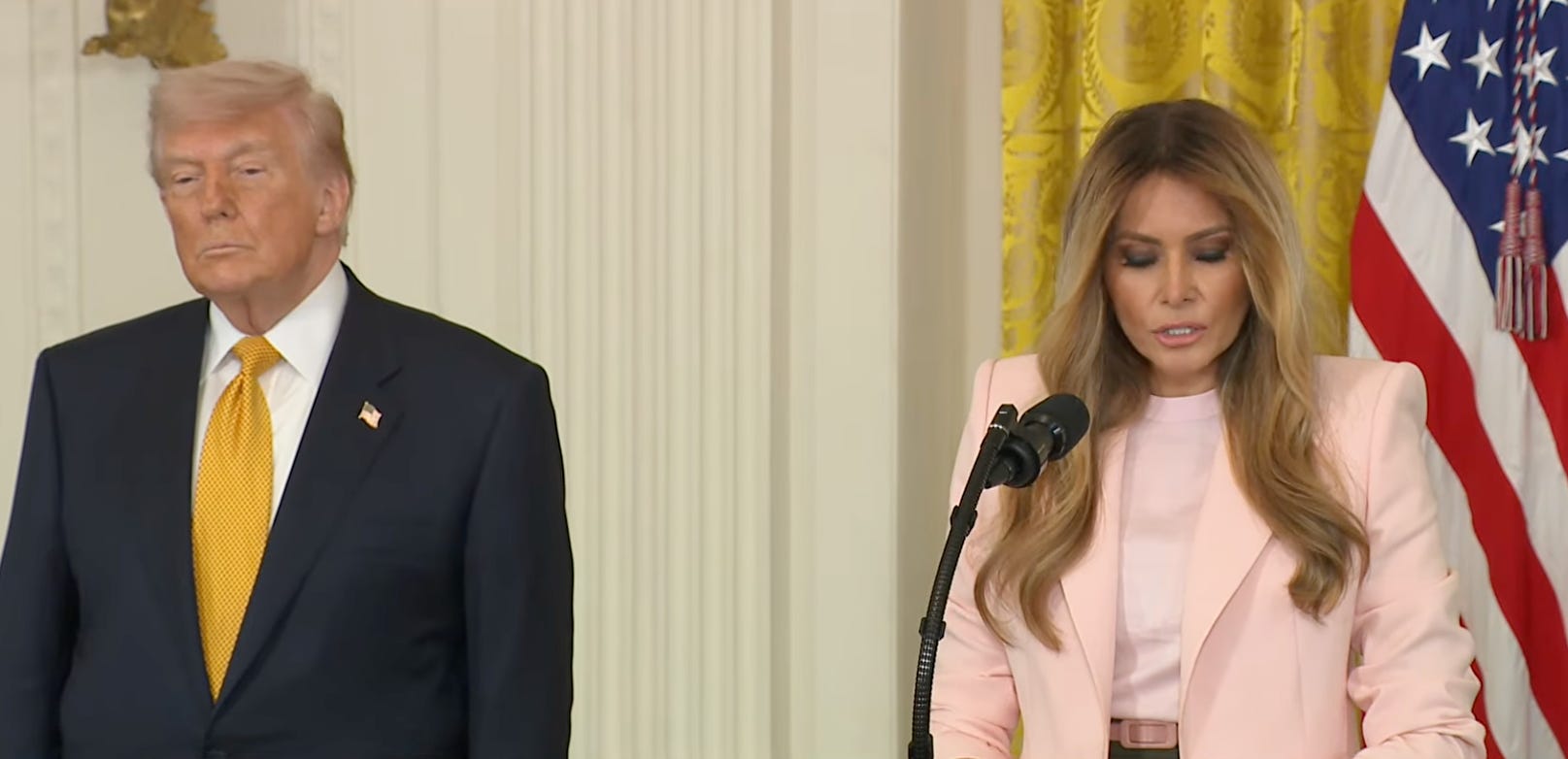
Trump began by thanking “honey” for doing a “great job,” then almost immediately veered away from military mothers into what he called a “skirmish,” talking about Venezuela and Iran, bragging that things were going “smoothly,” and insisting that military mothers would want to hear about it. This is classic Trump event logic: the occasion may be Mother’s Day, the audience may be military families, the emotional register may be solemn gratitude, but the actual speech is whatever cable-news monologue is currently buffering in his head.
He launched into his familiar “I rebuilt the military” routine, claiming the military was a “mess” when he inherited it, just like the border, and that he built it back into the strongest force in the world. From there, he slid into talk of a $1.5 trillion military upgrade, the greatest economic numbers ever, and how America is now respected again after allegedly being a global laughingstock two years ago. He was very clear about the timeline: he built the military in his first term, adding, with the breezy self-awareness of a man who has none, “I didn’t know we would be using it quite so much but that’s okay.” Remember, this was still technically a Mother’s Day event for military moms at the White House. Then again, why honor sacrifice when you can re-litigate your résumé in front of people whose children actually served?
Because no Trump speech can travel in a straight line for more than eleven seconds without medical supervision, he pivoted to Melania’s “amazing movie” and its streaming success. He congratulated her on being number one, praised her as a mother to their “little boy” Barron, who is, as Trump noted, “quite tall,” and then wandered into the White House décor. Specifically: the drapes, a window, a “knockout panel,” and the entrance to his new ballroom.
And oh, the ballroom. He was very excited about the ballroom. Presidents had wanted a room like this for 150 years, but he, being “a builder” and “good at ballrooms,” was finally making it happen. He bragged about the thickness of the windows, “about six inches thick,” supposedly able to repel “a lot of different weapons,” and declared it would be one of the most beautiful buildings of its kind anywhere in the world. So we moved seamlessly from military mothers’ grief to architectural ego cosplay with ballistic glass.
He introduced assorted administration figures and spouses, including Linda McMahon, Pete Hegseth’s wife, and the wife of the CIA director, while meandering through personal asides, awkward compliments, and little stories that may or may not have had a destination when they began. At one point, he joked about someone standing on a table while everyone else was under it, because apparently the Secretary of War energy he admires is “dinner party furniture incident.”
The speech did eventually return to actual military mothers. Trump acknowledged that military families miss holidays, birthdays, graduations, and first words because of service and deployments. That was the closest the speech came to the event’s stated purpose for more than three consecutive breaths. He thanked them for loving America and said the country respects them more than they know. Then, naturally, he started calling women up to speak with the casual spontaneity of a reality show host pulling audience members into the lighting grid.
One military mother, Brittany Stevenson, was called up after Trump described her Marine Corps family. She gave a short, graceful, unprepared thank-you, which was honestly more dignified than most of what surrounded it. Trump praised her for doing a good job, then moved on. It was a brief reminder that the actual families in the room had real stories, real service, real sacrifice, and real composure.
Then came one of the more chaotic segments: Trump told a story about autocorrect changing “Melania” into “Melody,” complaining that people “decimated” him when he accidentally got his wife’s name wrong. This led, by the most circuitous possible route, into an emotional story about a mother named Melody whose son Andrew, a 24-year-old service member, had been shot in the head while helping restore order in Washington, DC.
Trump described the injury, the bleak prognosis — doctors gave him no chance, he said, “maybe no chance, I hate to say it, but no chance” — and then Melody’s absolute refusal to accept it. She told Trump God was with her son, and she turned out to be right. Andrew survived. He came home. When Melody came to the podium, she spoke about her faith, the medical team, the community support, and her son’s recovery with a clarity and composure that made everything preceding her feel even more frivolous by contrast. She talked about his upcoming surgery, his return to golf and cornhole, her certainty that he’ll be fully himself again in a few years. It was the realest thing in the room — grief and faith and love and a mother who simply would not let the outcome be anything other than what it was. Trump nearly introduced it through a story about autocorrect making him look bad. The juxtaposition was, in its way, complete.
After that, Trump brought up an active-duty Air Force mom, Lieutenant Colonel Amanda, who spoke briefly and proudly about serving in the “world’s greatest Air Force.” Trump immediately suggested she would be running for office someday, because in Trumpworld even a military mother’s short thank-you becomes an audition tape.
Then he was off again: military spending, defense companies, stock buybacks, weapons plants, Patriots, Tomahawks, aircraft carriers, 111 missiles supposedly shot down, Iranian naval wreckage, and the brilliance of American missile defense. He claimed operators need high IQs, math skills, and sometimes come from MIT. This section had the unmistakable flavor of a man who has watched three defense contractor briefings, half-understood all of them, and decided to retell them as a bedtime story for Raytheon shareholders.
He praised the Space Force, claiming America had been losing to Russia and China in space before he created it, and now the U.S. is supposedly so far ahead it will never be caught. Then he pivoted to recruitment, claiming every branch is setting records and that after his election victory, people suddenly wanted to wear uniforms again. As always, the emotional arc was: America was broken, I arrived, everyone clapped, numbers became historic, and probably the drapes improved too.
The final section swerved into crime in Washington, DC, Memphis, New Orleans, Chicago, drug trafficking by sea, and alleged huge drops in crime and drug activity. He joked about trying to figure out who the remaining criminals were, praised military mothers again, and closed with a “Happy new— Happy Mother’s Day” that felt like it had survived a 37-minute obstacle course through Iran, ballroom windows, Space Force, Melania’s streaming career, and imaginary naval invincibility.
So the whole event was a perfect little Trump-era diorama: military mothers used as patriotic backdrop, Melania deployed as the solemn narrator, and Trump turning the occasion into a rambling infomercial for himself, his building projects, his war posture, his grievances, his fantasy statistics, and his need to be praised for things other people sacrifice for. The mothers in the room represented service, fear, grief, endurance, and love. Trump represented Trump.
He is such an A..
…ss-whipe