

Good morning! Nero fiddled, Trump has Truth Social. Sunday morning at 9:31, the president arrived at his golf club in Sterling, Virginia. By 11:16, he was posting.
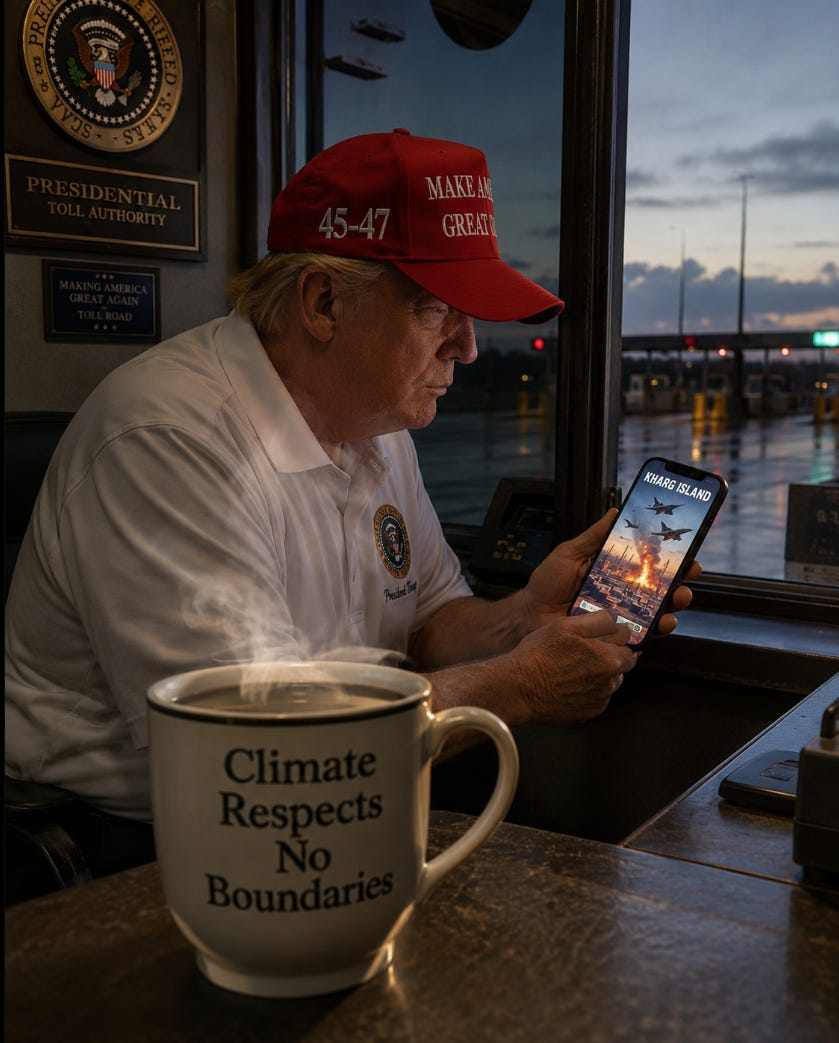
Over the next six hours, Donald Trump fired off 43 posts, sometimes several within a single minute, thick with offensive AI slop, “Trump 2028” fantasies and attacks on the usual enemies rattling around inside his phone. Among them was an AI-generated image of American forces striking Kharg Island, the terminal that handles nearly all of Iran’s crude-oil exports, one entry in a series of fabricated combat scenes the president presented to his followers that day.
It was fanfiction. The actual war, the one being fought with real aircraft, real cruise missiles and real human beings ordered into their path, had gone quiet. Three nights had passed without new American strikes, the longest pause since the daily bombing campaign began.
Trump told reporters that diplomacy was responsible.
“We’re locked and loaded and ready to go,” he said, “but we’re talking to them.”
True, the United States was indeed talking to Iran. It was simply not the whole reason the bombing had stopped.
Adm. Brad Cooper, who commands the campaign, had recommended the pause himself. The useful targets assigned to the two-week operation around the Strait of Hormuz had largely been exhausted. Going farther would mean returning to major combat operations to strike the roughly one-fifth of the original Operation Epic Fury target list still unfinished.
There was another problem. American stocks of defensive interceptors were running low enough that military leaders were increasingly concerned about leaving U.S. forces and allies exposed when Iran fired back.
The country was running short of both useful things to shoot and the things needed to stop the return fire.
Trump’s version was more cinematic: America stood “locked and loaded,” generously withholding its limitless power while the Iranians begged to negotiate. So the commander-in-chief retreated to his golf club and generated pictures of the war the military had recommended pausing.
So the commander-in-chief retreated to his golf club and generated pictures of the war he was no longer conducting.
That same week, the Pentagon rearranged the accounting.
Four deaths and 207 wounded since July 7 now appear on a separate page labeled “Overseas Operations Casualties,” apart from the 14 killed and more than 400 wounded listed under Operation Epic Fury. Anyone wanting the full toll, 18 American service members dead and 624 wounded, must stitch the two ledgers together by hand.
Nothing was deleted. It was merely filed somewhere a little harder to find, in the same week the commander-in-chief was captioning cartoon warfare for an audience of millions.
Nero’s fiddle was a legend. His kayfabe was real: he performed instead of governing, turning catastrophe into spectacle and himself into the central character in a disaster he had failed to stop. Trump has merely updated the technology.
Trump made sure everyone was looking at him while the ammunition dwindled, the casualty count climbed and the Pentagon quietly moved part of the bill to another page.
At least Nero’s instrument required practice.
The pause held through the weekend.
Iran, for its part, showed no interest in describing it as an act of American mercy. Tehran says the United States is “stuck and struggling” in a war it started and will “inevitably pay the price.”
Two capitals, two victory laps, and a war that has not actually ended. It has merely changed locations.
On Monday, Saudi Arabia said it intercepted drones launched from Iraq by Iran-aligned militias and aimed at petroleum facilities. Yemen’s Houthis separately claimed attacks on Saudi oil sites in retaliation for Saudi strikes on Hodeida.
The ceasefire, such as it is, covers exactly one axis of a conflict being fought across half a dozen.
That is the frame to hold going into Tuesday, when Benjamin Netanyahu arrives in Washington.
Both men will enter the White House with elections on the calendar and a war that accomplished neither of its stated objectives. Iran’s nuclear program remains intact enough to matter. Its clerical government survived the killing of Ali Khamenei and installed another Khamenei in his place. Five months of bombing proved capable of killing a supreme leader, but not the political order that produced him.
Trump now wants an agreement. Netanyahu does not.
Danny Citrinowicz, the former Israeli military intelligence commander now at Tel Aviv’s Institute for National Security Studies, put the divergence plainly: any American agreement with Tehran would strengthen the very regime Israeli leaders spent five months trying to destroy.
There is, he said, no alignment of interests.
On Tuesday, Trump and Netanyahu will nevertheless stand beneath the flags and perform alignment, because that is the appointment.
Both men need the photograph.
Netanyahu is trailing in the polls before Israel’s fall election and must show voters that he still possesses influence in Washington. He needs the handshake, the flags, Trump’s hand on his back — whatever disagreements may exist behind closed doors, Benjamin Netanyahu remains the man who can walk through them.
Trump needs a different picture.
He is heading toward the November midterms with an unpopular war that many Americans believe Netanyahu pulled him into. Trump must appear not as the ally who was used, but as the president issuing instructions. He needs Netanyahu beside him, though preferably half a step behind and looking grateful.
Netanyahu wants to preserve the possibility of renewed attacks on Iran. Trump wants oil moving through the Strait of Hormuz, prices falling and the entire catastrophe repackaged as another historic triumph before voters reach the polls.
The handshake must communicate perfect unity while each man tries to prevent the other from getting what he wants.
Trump has spent recent months calling Netanyahu a great wartime leader and, during the same stretch, “crazy” and “a very difficult guy.” At one point, he boasted that Netanyahu would do whatever he told him to do, which is how Trump describes every relationship until the other person demonstrates possession of an independent nervous system.
Netanyahu has responded with almost nothing — the diplomatic silence of a man who needs the photograph more than he needs the final word.
Analysts who study the relationship for a living say it can be nearly impossible to determine from the outside whether the two leaders are genuinely at odds or quietly coordinating.
That is Schrödinger’s War metastasized beyond the battlefield and into the alliance itself: a partnership simultaneously intact and finished, to be photographed Tuesday as though it were obviously the former.
Each man will use the other as a campaign prop while pretending to be the director.
Everybody has a fiddle this season.
Nobody has put out the fire.
The fires, plural, were already burning. Earlier this month, the National Academies of Sciences, Engineering, and Medicine published its first major update in a decade on how precisely a specific heat wave, flood, drought or hurricane can be tied to human-caused climate change.
NASEM is not an activist shop. It is a private nonprofit institution operating under a congressional charter signed by Abraham Lincoln in 1863, and its new report, Attribution of Extreme Weather and Climate Events and Their Impacts, is the sort of dry, methodical document normally read by scientists, policy specialists and the unfortunate staffer assigned to summarize it for everyone else.
This one is moving the needle because the science has moved.
Researchers have become increasingly capable of determining not merely whether climate change made a class of disasters more likely, but how much it altered the probability or intensity of a particular event. The National Academies found that confidence is now especially strong for extreme heat, extreme cold and large-scale heavy rainfall, while remaining more limited for localized events such as tornadoes and severe thunderstorms. The field is also beginning to estimate how much climate change contributed to the deaths, health effects and economic losses that followed.
That makes attribution science more than an academic exercise. It makes it evidence.
Here in Oregon, Multnomah County is suing ExxonMobil, Chevron, BP, Shell and a collection of other fossil-fuel companies, trade groups and consultants over the 2021 Pacific Northwest heat dome. Sixty-nine people died in the county as temperatures reached 108, 112 and then 116 degrees over three consecutive days.
The county is seeking $50 million for damage caused by the heat dome, $1.5 billion for future climate-related damages and a $50 billion abatement fund to prepare its health services and infrastructure for the extreme heat still to come. Its case uses attribution research as part of a larger causal chain linking fossil-fuel emissions and alleged corporate deception to a specific disaster, in a specific place, during a specific week.
That is more than $51 billion worth of reasons for the industry and its political guardians to become suddenly interested in methodological nuance.
The campaign to discredit the report began before the public had seen it. In April, Republican lawmakers wrote to the National Academies alleging bias and demanding details about the committee members’ affiliations and professional relationships. A conservative opposition-research firm called Argus Insight reportedly sent public-records requests to universities employing several panel members, seeking their internal communications.
Rather than conduct a competing scientific analysis, they were doing opposition research against the scientists. Why demonstrate their models were wrong when you can search their inboxes for an adjective?
Then came Ted Cruz. Cruz and three Republican colleagues introduced the Stop Climate Shakedowns Act, a bill that would prohibit climate lawsuits against fossil-fuel interests in either state or federal court, require pending cases to be dismissed and render state climate-penalty laws void.
The bill does not merely dispute particular studies or demand higher evidentiary standards. Congress would simply declare that efforts to connect local floods, droughts, hurricanes, wildfires and heat waves to companies in the energy business “lack scientific credibility” and are therefore “arbitrary.”
A scientific conclusion, legislated in advance of the science.
The bill’s immunity is remarkably broad. It defines prohibited climate suits to include cases involving alleged deceptive marketing, misrepresentation and failure to warn. Fossil-fuel companies would therefore be protected not only from claims that their products contributed to climate damage, but from claims that they misled the public about the danger.
Make the mess, lie about the mess and then have Congress make it illegal to hand you the bill.
The Trump administration has been working the same protection racket from the executive branch. The Justice Department sued New York and Vermont over their Climate Superfund laws and went to court to prevent Hawaii, Michigan and, more recently, Minnesota from pursuing climate claims against fossil-fuel companies.
Three fronts, one target: make the fingerprints inadmissible. The National Academies measures the damage, state and local governments calculate the cost, and Ted Cruz arrives at the courthouse with a padlock and calls the invoice a shakedown.
While Washington argues over whether the evidence should be allowed into court, the thing that evidence describes is already happening on two continents, to hundreds of thousands of people who did not wait for Congress to decide whether their suffering was scientifically credible.
In Arcachon, on France’s Atlantic coast, a 31-year-old butcher named Dylan Boudier watched his family evacuate one by one, his sister first, then his parents, while he stayed behind and waited to see whether his own home would be next.
“You can feel it’s a bit apocalyptic,” he said.
North of him and south of him, two fires were closing the distance between them. The fear was no longer really about either fire. It was about the moment they stopped being two.
By Monday, more than 325,000 people had been forced from their homes across France and Spain. In France’s Gironde region alone, 220,000 people had been evacuated as fire consumed roughly 42,000 hectares, more than 100,000 acres, and destroyed or damaged hundreds of homes. Emmanuel Macron convened an emergency cabinet meeting. Spain deployed soldiers and emergency crews as fires burned near Madrid and Valencia.
Then the fire began making its own weather. The Gironde blaze produced a pyrocumulonimbus cloud, a fire-generated thunderstorm that French officials say had never before been recorded in the country. The towering column produced lightning that ignited new fires and violent, erratic winds capable of changing the direction of the flames.
North America is not watching this from a safe distance. Canada has endured more than 800 active wildfires at points this month, with smoke spreading across the Great Lakes, Midwest and Northeast and triggering air-quality warnings from Michigan to New York. Millions of Americans have been advised to remain indoors, curtail outdoor activity or wear protective masks as microscopic particles settled into lungs hundreds of miles from the flames.
The exchange has not been entirely one-way. Smoke from fires in Washington and Oregon has also drifted north into British Columbia, because the atmosphere has once again failed to present a passport at the border. The prevailing winds remain stubbornly committed to free trade.
Beneath all of it, the Pacific is loading the dice higher.
The El Niño now strengthening along the equator is setting daily warm-water records and developing faster than the great 1997–98 event. Most major forecasting systems project that it will exceed the powerful El Niño of 2015–16. Berkeley Earth’s Zeke Hausfather says it is not only likely to become the strongest event in the reliable record, but could exceed the previous record by what he called a “mind-blowing margin.”
El Niño is a natural cycle. The climate onto which this one is being stacked is not.
Daniel Swain of the University of California describes the danger as an unprecedented combination: a potentially record-breaking El Niño arriving on top of global temperatures already elevated by human-caused warming. In the Atlantic, the pattern may suppress hurricanes even as it strengthens storms elsewhere. California could receive a wet winter while other regions face drought, crop failures, and wildfires. Fisheries, food production, and rainfall patterns may all be disrupted, with economic losses potentially measured in the trillions.
Michael Mann supplies the necessary caution. The trajectory points toward a historically strong event, but El Niño’s effects travel through atmospheric connections that do not always behave in simple proportion to the temperature of the water below. Small differences in where the greatest warming occurs, or in the strength of the trade winds, can substantially change what happens months later.
“Strongest ever” is increasingly likely, but not yet certain, and that caveat exposes the difference between what Ted Cruz’s bill claims attribution science is and what science actually looks like.
Science does not declare every connection proven. Instead, it measures confidence, separating what researchers know from what they strongly suspect and what remains genuinely uncertain. Some conclusions can be stated plainly; others require honest qualification. Uncertainty is not evidence of fraud. It is evidence that scientists are doing the work properly, rather than writing the conclusion first and stapling the method to it afterward, as members of Congress seem determined to do. Cruz wants to legislate that distinction out of existence.
The consequences are already sleeping in shelters outside Bordeaux, breathing smoke in Michigan and New York, and accumulating in Pacific waters warmer than any July in the modern record.
The planet is answering the question while Congress tries to disqualify the witness.
Give it a week. Somewhere between the AI-generated bombing of Kharg Island and the next round of golf, someone will suggest that smoke drifting toward Bordeaux is technically French, smoke drifting toward Sacramento is technically foreign, and foreign things that annoy the president are, by definition, tariffable.
The physics will not cooperate. American smoke drifts north into Canada just as readily as Canadian smoke drifts south, which would make a logically consistent smoke tariff a policy that eventually taxes itself.
Consistency was never the product. The toll-booth presidency does not need its logic to survive contact with the atmosphere. It needs only a grievance-shaped doorway wide enough to install a fee. A crisis becomes another border crossing, its consequences acquire an import duty, and the failure to govern is repackaged as proof that somebody else should pay.
Nero had his kayfabe. Trump has Truth Social, a tariff schedule and a government increasingly devoted to hiding the casualty ledger, discrediting the thermometer and billing the smoke.
Rome is not the only place where a ruler can build a toll booth in front of a burning building and call it governance.
I just wanted to say thank you. For every hour you spend writing, you must spend ten times that in research.
Depressing news, brlilliantly written. Every day, new horrors.