


Good morning! The United States has not bombed Iran for two consecutive nights. Tehran says it has stopped retaliating against American forces and allies. Mike Waltz, Donald Trump’s ambassador to the United Nations, says the president is giving diplomacy “a little bit of room.”
The room may need sweeping. Iranian media reported Sunday that an oil tanker exploded after striking a naval mine in the Strait of Hormuz. According to the Revolutionary Guard-affiliated Tasnim News Agency, the ship had strayed outside the navigation route designated by Tehran. The tanker was not immediately identified; Iranian authorities had not issued an official statement, and there was no independent confirmation of the cause, damage, or casualties.
The precise facts therefore remain uncertain. The message does not. Iran has repeatedly warned commercial vessels that passage through one of the world’s most important waterways must occur along routes approved by Iran, in coordination with Iranian authorities, and at the vessel’s own peril should anyone wander off the path. Freedom of navigation after being improved by nearly five months of American bombing: the tankers may pass, provided they follow Tehran’s instructions carefully enough to avoid exploding.
Iran and Oman are discussing a mechanism for managing traffic through the strait, and Iranian officials say progress has been made. Mediators are communicating with Washington. Tehran says its attacks were retaliatory and therefore stopped when the United States stopped attacking. The Guardian framed the moment Sunday as a diplomatic pause, while the Associated Press described the mutual lull as a potentially hopeful opening for reviving the collapsed ceasefire.
There is plainly a diplomatic break, but that does not establish that diplomacy caused it. The chronology suggests something less flattering than the administration’s preferred portrait of Trump voluntarily setting aside the world’s largest hammer because he had suddenly developed an appreciation for quiet conversation.
As recently as Thursday, Trump was telling Axios that he was considering a “massive attack,” bigger than anything the United States had launched before. On Friday, he told reporters that America was “locked and loaded” and ready to go. The Pentagon had rushed additional forces, weapons and supplies into the region and prepared a multistage campaign against Iranian coastal radars, antiship missile launchers, attack boats, bridges, energy infrastructure and nuclear facilities.
Then Trump met with his advisers. Gen. Dan Caine, chairman of the Joint Chiefs of Staff, told him that the operation was militarily possible, a fairly predictable answer from the world’s most powerful military when asked whether it can bomb more things. Caine also warned that doing so would dangerously deplete the Patriot interceptors and other defensive missiles protecting American troops in Jordan, Kuwait, Bahrain and the United Arab Emirates. Vice President JD Vance, who built his political brand on opposing exactly this kind of Middle East entanglement, reportedly raised similar objections in the same meeting.
Offense was never the issue. American aircraft could continue reaching targets across Iran and dropping comparatively plentiful bombs without immediately exhausting those inventories. Defense was the issue. Every Iranian missile fired back required an American interceptor that cost millions, took months to build and existed in a finite and shrinking supply.
Three American soldiers had just been killed in Jordan after an Iranian ballistic missile penetrated a defensive barrage of missiles and drones. A larger American assault would almost certainly produce heavier Iranian retaliation, placing even greater pressure on air defenses already operating with dangerously diminished inventories.
Few people in Trump’s inner circle reportedly thought another massive bombing campaign was wise. One senior official doubted it would force Iran back to the negotiating table at all. More bombing, the official argued, might accomplish the opposite by strengthening Iran’s internal cohesion and allowing its leaders to rally the country against an external enemy.
By Friday night, Trump had called off the planned strikes. By Sunday morning, Waltz was explaining that the president was giving diplomacy room.
Diplomacy may indeed have acquired room. But only after military arithmetic cleared it.
It is especially satisfying to remember how the war was sold in the first place.
On March 2, just days after launching the campaign, Trump announced that America’s munitions stockpiles at the “medium and upper medium grade” had “never been higher or better.” The United States possessed a “virtually unlimited supply,” he wrote, allowing wars to be fought “forever” and “very successfully.”
“The United States is stocked, and ready to WIN, BIG!!!” he declared.
Pete Hegseth joined the performance. The defense secretary insisted that there was “no shortage” of munitions and said America’s stocks of defensive and offensive weapons would allow the campaign to continue “as long as we need to.”
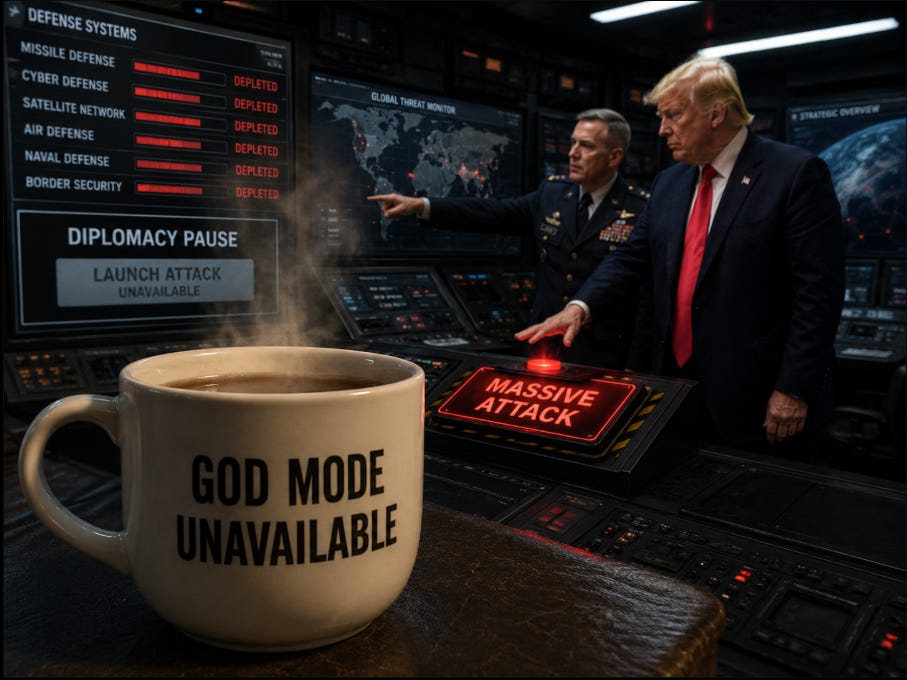
The country was being told that the Pentagon had entered god mode: infinite ammunition, instantaneous reloads and a supply chain apparently liberated from factory bottlenecks or the need to preserve weapons for Europe, Asia or the next war. America could simply keep pressing the fire button until Iran’s health bar reached zero.
This was a peculiar claim even at the time. Trump acknowledged in the same post that supplies of the highest-end weapons were “not where we want to be,” which should have been a clue. The weapons most urgently needed to protect American forces from Iranian ballistic missiles were precisely those expensive, sophisticated, highest-end systems that could not be manufactured quickly.
Bombs and shields are not interchangeable simply because both explode.
The United States retains enormous supplies of conventional bombs and shorter-range guided weapons. Once Iranian air defenses were degraded, American aircraft could move closer and drop cheaper munitions rather than rely entirely on scarce long-range missiles. The United States was never on the verge of becoming incapable of destroying another Iranian bridge, power plant or government building.
But every American attack invited Iranian retaliation. And every incoming ballistic missile required an actual interceptor built in an actual factory over an actual period of months or years.
God mode applied primarily to offense.
During the first 39 days of the campaign, the United States struck more than 13,000 targets. An analysis by the Center for Strategic and International Studies concluded that for four of seven critical munitions, the military may have expended more than half its prewar inventory. The Pentagon had fired more than 1,000 Tomahawk cruise missiles, around 1,100 long-range stealth cruise missiles and more than 1,200 Patriot interceptors. Each Patriot cost more than $4 million.
That is at least $4.8 billion in Patriot missiles alone, before adding the cost of the launchers, radar systems, aircraft, fuel, personnel or anything being defended. It is a great deal of money to spend discovering that Iranian missiles do not become less dangerous merely because Pete Hegseth speaks about them confidently.
The rate of consumption dwarfed the rate of replacement. The military fired more than 1,000 Tomahawks during the initial campaign, roughly ten times the number it had been purchasing annually. CSIS found that rebuilding the seven critical inventories to their prewar levels could take one to four years as missiles already in the production pipeline are delivered.
Prewar levels were not regarded as adequate for a conflict with China in the first place.
THAAD interceptors are especially scarce. No new THAAD missiles have been delivered since August 2023, and deliveries are not scheduled to resume until April 2027. Patriot production is supposed to expand dramatically, but the planned increase to 2,000 interceptors annually is not expected until 2030. Current production is closer to 600, and roughly half of that must serve allies and partners who also use the system.
The factory cannot be ordered to produce four years’ worth of missiles by Tuesday because Trump has become impatient with the inventory screen.
These systems require specialized components, trained workers, testing, congressional appropriations and manufacturing lead times that have stretched to 36 months or longer. CSIS estimates that completing some production lots can take more than four years from appropriation to delivery. The Pentagon was firing in weeks what American factories will need years to rebuild.
The administration has continued to insist that the military has everything it needs. Pentagon spokesperson Sean Parnell said America could act at the time and place of the president’s choosing. White House officials said the United States had more than enough munitions to accomplish all of Trump’s strategic goals “and beyond.” Karoline Leavitt blamed the Biden administration and aid to Ukraine for any shortages that might somehow coexist with Trump’s unlimited supply.
The usual rule applies: every problem is imaginary until it becomes Joe Biden’s fault.
The government’s behavior has been less confident than its press releases. Trump summoned defense contractors and demanded greater production. The Pentagon shifted weapons from Europe and Asia into the Middle East. Deliveries promised to allies were delayed. Hegseth asked Congress for tens of billions of dollars in supplemental funding. Military leaders warned that stocks would take years to restore. Unlimited ammunition requires an emergency appropriation.
The strategic consequences extend well beyond Iran. Patriots, THAAD interceptors, Tomahawks, and long-range precision weapons would all be required in a conflict with China. Russia and China do not need classified Pentagon inventory sheets to understand what has happened. They can count launches, study production capacity, and watch weapons migrate from the Pacific and Europe into the Middle East.
American officials are now openly worried that Vladimir Putin and Xi Jinping are incorporating depleted inventories into their own calculations.
The war has therefore created what CSIS calls a window of vulnerability. The United States may retain enough weapons to continue fighting Iran under most plausible scenarios. What it has lost is part of the margin needed to fight somewhere else at the same time.
Trump promised infinite ammunition, but neglected to mention that America had a finite number of shields, explaining why the Friday warning mattered so much. A military that can continue attacking but cannot confidently protect its troops from the retaliation does not possess escalation dominance. It possesses a very expensive vulnerability.
The limiting factor was no longer how much destruction the United States could inflict. It was how much retaliation it could still afford to absorb.
That constraint is only one part of the strategic trap Trump has built for himself.
He entered the conflict in February promising a swift end to Iran’s nuclear program and the overthrow of its government. Five months later, neither goal has been achieved. Iran’s government remains in place. Its near-bomb-grade nuclear material has not been secured. Shipping through the Strait of Hormuz has slowed to a trickle. Oil prices have risen, Gulf allies have been struck and a second chokepoint near the Red Sea is now under threat.
Trump has threatened to seize Kharg Island, capture Iran’s underground uranium stores and obliterate enough infrastructure to force Tehran’s surrender. He has also acknowledged that neither the American public nor his political allies have any appetite for the ground invasion and occupation that would be required to impose those outcomes.
The world’s largest hammer has proved very good at producing rubble. It has been less successful at producing obedience.
Jasmine El-Gamal, a former Pentagon official who worked on Middle East policy during the Obama administration, described the central problem plainly. The United States could theoretically reopen the Strait of Hormuz by overwhelming force, but only at a cost Washington is unwilling to pay. Doing so comprehensively could require an amphibious or land invasion involving enormous numbers of troops, prolonged occupation and casualties the American public would not tolerate. Iran understands and recognizes that ceiling.
Trump may threaten to destroy everything. Tehran knows which actions would require hundreds of thousands of American troops and which actions Trump is bluffing about. Once an adversary identifies the outer limit of a threat, repeated promises of annihilation merely advertise impotence.
Trump assumed that American military power was limitless because no one had ever made him read the resource requirements beneath the graphics. It is not limitless. It can appear limitless only when the human, economic, diplomatic and political costs of maximizing its use are excluded from the calculation. Trump launched the war while pretending those costs, and therefore those limits, did not exist.
He has now discovered those constraints all at once. The interceptor inventory is finite, replacement takes years rather than weeks, and oil prices can rise only so far before voters look for someone to blame. Gulf allies have their own tolerance for becoming targets, while every American casualty makes it harder for congressional Republicans to pretend they still oppose endless Middle Eastern wars.
House Speaker Mike Johnson said last week that the conflict had to be wrapped up, voicing a sentiment increasingly heard among Trump’s own supporters. Only 29 percent of Americans approved of Trump’s handling of the war in a recent Washington Post-Ipsos poll.
The man who entered office insisting that strength would solve every problem is now searching for a face-saving way to exit a war he had no strategy to win.
All available choices are bad. Trump can escalate, provoke larger retaliation and burn through more of the interceptors protecting American troops. He can tighten sanctions and wait, hoping that Iran’s economy collapses after eight years of predictions that Iran’s economy is about to collapse. Or he can declare victory, withdraw and leave Tehran with its government intact, its nuclear material unresolved and the Strait of Hormuz under something approaching de facto Iranian control.
Trump prefers options in which everyone else folds immediately after he makes a threat. Iran has declined to participate in that schoolyard strategy.
The negotiations now taking place reveal how thoroughly the war’s purpose has drifted. Trump began by promising to end Iran’s nuclear program and install a friendlier government in Tehran. The immediate American priority is now reopening the Strait of Hormuz and persuading Iran not to attack the ships passing through it.
The war began with Trump promising to dictate Iran’s future. It has arrived at negotiations over whether Iran will permit the world’s tankers to follow a designated lane.
Tehran says it has sovereign rights in the strait. Washington and Gulf governments reject any arrangement that effectively grants Iran control. Iran has reportedly demanded authority over which ships may pass and some form of payment. Iranian forces have fired warning shots, stopped vessels and threatened consequences for ships using routes Tehran considers unauthorized. The United States, meanwhile, has reimposed its own blockade of Iranian ports and disabled ships that ignored American instructions.
Everyone is defending freedom of navigation by ordering merchant vessels to go precisely where they are told.
Against this background, the reported tanker explosion on Sunday is the physical embodiment of the dispute.
Iran says ships departing from its approved route must bear the consequences. A tanker reportedly departed from the route and struck a mine. Even if the details remain unverified, the story serves Tehran’s strategic purpose: it reminds shipowners, insurers and governments that Iran can make the strait unusable without having to defeat the United States Navy in a conventional battle.
A few mines, drones, fast boats and missile batteries can raise insurance rates, frighten crews and keep tankers in port. Iran does not have to control every inch of the strait. It only has to make passage dangerous enough that commercial companies decide the voyage is not worth attempting.
The United States can destroy thousands of targets and still fail to make a shipping executive in Singapore comfortable sending a billion-dollar tanker through a minefield.
This is the real difference between firepower and control.
Iran’s army spokesperson said Sunday that Washington was experiencing “strategic decision-making fatigue.” This is propaganda, naturally, but propaganda becomes annoyingly effective when the other side keeps supplying the supporting evidence.
Trump has alternated between threats of overwhelming attack, boasts of imminent victory, temporary ceasefires, renewed bombing, contradictory negotiations and declarations that the next decision will be made very soon. He has repeatedly claimed that Iran is desperate to surrender, only to discover that Iran has resumed attacking American positions, threatening shipping and demanding control over the waterway.
Strategic decision-making fatigue may be Tehran’s phrase for it. In Washington it is usually called another successful week.
The next test arrives Tuesday, when Benjamin Netanyahu is expected at the White House.
Netanyahu helped persuade Trump to launch the joint war in February and remains deeply skeptical of negotiations that leave Iran’s nuclear and ballistic missile programs intact. He is also under considerable political pressure before Israeli elections scheduled for October and needs to show that months of war against Iran and Hezbollah have produced something beyond casualties, higher energy prices and an increasingly unstable region.
Trump’s immediate priority is reopening Hormuz. Netanyahu’s priority is preventing any agreement that allows Iran to retain its nuclear capability or rebuild its missile forces. Those objectives may overlap in theory. In practice, Netanyahu has rarely arrived in Washington to recommend that an American president bomb less.
Just as Trump appears to have located the pause button, Netanyahu is coming to ask whether he would like another turn at the controller.
He will arrive while Israeli forces conduct what they call an “extensive” operation in the occupied West Bank after armed settlers entered a Palestinian village and violence left four Palestinians and two Israelis dead. It is some of the worst West Bank violence this year, another reminder that the region’s multiplying wars do not pause merely because Washington would like to concentrate on one crisis at a time.
Iran has also summoned Ukraine’s diplomatic representative after an attack on an Iranian commercial vessel in the Caspian Sea reportedly killed one sailor and wounded another. The Ukraine war, the Iran war, the Gulf shipping crisis, the violence in Yemen and the conflict in the West Bank are no longer tidy files stored in separate diplomatic cabinets. They are bleeding into one another across waterways, alliances and weapons networks.
Prolonged regional war makes every conflict easier to enter and harder to leave.
For the moment, however, the American and Iranian attacks have stopped. Negotiators are talking. Oman is trying to construct a maritime arrangement that neither side will immediately interpret as surrender. Ships are being warned to follow approved routes. Trump says he remains ready to resume bombing. Iran says it remains ready to retaliate. It is a heavily armed pause in which everyone is checking the remaining inventory.
Diplomacy is taking place, and the absence of bombing gives it a better chance of succeeding. But the chronology matters.
Trump spent the week promising an attack bigger than anything attempted before. The Pentagon prepared to execute it. His advisers warned that the resulting Iranian retaliation could dangerously drain the missiles protecting American troops and allies. Trump called off the strikes. The administration then described the empty space left behind as a generous opportunity for negotiation.
When the war began, Trump promised that America could fight forever. Five months later, the government is rationing the weapons needed to protect its own forces, allies are absorbing attacks, oil is again above $100 a barrel and Iran is negotiating from a position in which it can claim practical authority over the world’s most important energy corridor.
Trump mistook the ability to begin a war for the ability to control one.
He believed the world’s largest hammer meant every problem would eventually agree to become a nail.
Mike Waltz calls the resulting silence diplomacy. Perhaps, but god mode did not end with a victory screen. Instead, it ended with the president staring at a depleted inventory and calling the pause menu peace.
He is so ignorant (as in not having learned anything) and so stupid (as in choosing not to learn anything), instead just narcissistically convinced he knows everything and is the only one who does.
The reason to have a cabinet and administration is to delegate departments of government to people with backgrounds, experience, and knowledge in those areas. He decided to use appointments to reward donors and sycophants, while the bobbleheads in Congress clapped like seals.
I know I'm preaching to the choir here, but it's all such a waste. Our wonderful country has become reviled and hated. Our people are so divided we're not far from a civil war.
So damned disheartening...
Wonderful report/essay-- You're the designated strategic military and diplomatic analyst in chief for those of us without official titles and government offices...
I think my initial responses to Trump are completely vestigial; as if I'm reacting to his behavior and his words on the antique assumption that he is connected to anything resembling reality--that he actually knows ANYTHING at all...
I was brought up--and learned through decades in our fine public school system--that what the President said, even it was a continuing big lie like the Vietnam years, was based on something real... That they acted on some semblance of REAL facts...
It's taken me some time to fully understand that Trump is just a mouth without a functioning brain attached--a combination of Alfred E. Newman and Pinocchio, a creature who only exists as long as he is standing/sitting in front of other people- On his own, by himself, he is nutty concoction of random fantasies, childhood fears and crazy lies..
Your analyses and subsequent essays have become essential for me to understand the truth of what's going on in the world... How sad it is that I STILL think--even for a minute--just by virtue of the fact that he is THE PRESIDENT, that he is anything but a third-rate carnival barker inviting us all into the freak show of his diseased mine...
He has lied to so many people about so much--for so long--that he has no conception of what's real and what's not-- And that's exactly what makes him so dangerous to this country and the whole world. As you said, he imagines in his little child's mind that because he wants something to be true, then it is!
For instance, The FACT (as you point out) is that our rapidly diminishing missile shield (leaving us open to the tender mercies of the Chinese and the Russians) is what is responsible for his latest "pause" in the war... He can't wave his tiny magic wand and magically create patriot missiles-- Maybe he still listens to someone who knows the truth about what's going on-- You can only hope so...