

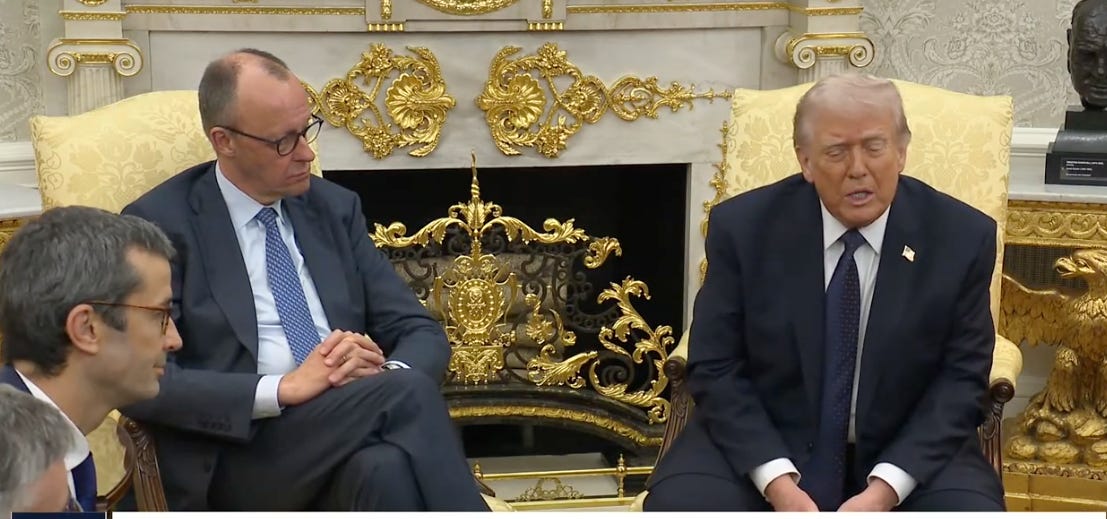
Donald Trump met with German Chancellor Merz and to spare you all I thought I’d publish a summary. So the meeting opens with Trump doing what Trump does best: aggressively complimenting someone while also complimenting himself. The Oval Office is beautiful. The White House is beautiful. The relationship is beautiful. The deal is strong. Everything is strong. Germany is strong. He is strong. It’s like listening to a carnival barker.
Chancellor Merz, meanwhile, speaks in calm, adult sentences, the kind that contain verbs, policy goals, and no references to windmills destroying civilization.
He opens with: “We are on the same page in terms of getting this terrible regime in Tehran away, and we will talk about the day after.” Note the phrase “the day after.” Planning, sequencing, governance. It’s almost soothing.
On trade, he says plainly, “We have to talk about our trade agreement which I would like to be in place as soon as possible.” Direct, boring, and functional. A sentence that would not trend on social media but might actually result in a signed document.
On Ukraine, he gently inserts the adult reminder into the room: “We all want to see this war coming to an end as soon as possible. But Ukraine has to preserve its territory and their security interests.”
There it is. Territory, security interests, and international law lurking politely in the background.
It feels less like a press conference and more like a split-screen moment: on one side, a head of government outlining objectives; on the other, a man about to announce unlimited ammo and embargo Spain because vibes.
Then we’re off to the races. On Iran, Trump casually declares, “I might have forced Israel’s hand,” before assuring everyone that “virtually everything they have has been knocked out now.” The air force? Knocked out. The navy? Knocked out. Radar? Knocked out. Leadership? Also knocked out, “49 people were taken out in the first hit… I guess there was another hit today on the new leadership.” Dead, possibly dead, maybe double-dead.
He then floats the idea that regime officials are lining up for mercy, saying “a lot of people… want to quit, want to have immunity. They are asking for immunity.” Meanwhile, he throws around staggering death tolls, “35,000 people killed over the last three weeks,” like he’s recapping box scores.
Worst-case scenario? After all this? “We do this and then somebody takes over who is as bad as the previous person… and in five years you realize you put somebody in who was no better.”
So reassuring. Truly a masterclass in long-term planning.
At one point the whole thing veers into full video-game logic. Trump assures us the U.S. military is unmatched and essentially running on cheat codes: “We have unlimited middle and upper ammunition… really an unlimited supply.” Not just some ammo. Unlimited ammo. The high-end stuff, the middle stuff, the upper stuff, all of it. If Call of Duty had a presidential expansion pack, this would be the trailer.
Everything, he insists, is both “decimated” and ongoing and completely under control at the same time. Then, because why not, Venezuela gets held up as the gold standard of tidy regime management: “Venezuela was so incredible… the relationship has been great. It’s been seamless. Nobody’s seen anything like it.” Yes. Venezuela. The word “seamless” doing heroic labor there.
Then comes the blame carousel.
Obama, of course. Biden. “Guys like Schumer who are losers.” Spain gets dragged for not hitting NATO spending targets, prompting Trump to declare, “We’re going to cut off all trade with Spain. We don’t want anything to do with Spain.” He adds that Spain has “absolutely nothing that we need, other than great people.” Comforting stuff for an ally.
And if Spain doesn’t cooperate? No problem. “We can use their bases if we want. We can just fly in and use. Nobody’s going to tell us not to use it.” That’s one way to describe international agreements.
The UK doesn’t escape either. Trump pivots from global warfare to British landscaping with the energy of a man personally betrayed by a turbine. He fumes that Britain has “wind mills all over the place ruining the country, ruining the landscapes, the beautiful fields,” and insists they should “open up the North Sea” instead. Subtle.
Then comes immigration. According to this Oval Office world tour, Britain, and much of Europe, is collapsing under it. And just in case anyone thought this was normal policy criticism, he adds: “You have a terrible mayor of London… you have Sharia courts. You don’t want Sharia courts.” That’s right. We’ve gone from NATO burden-sharing to an imaginary parallel legal system in about 45 seconds.
And then there’s… the island. Almost certainly Diego Garcia, the strategically critical UK-controlled base in the Indian Ocean that the U.S. has long used for military operations. But instead of a sober discussion of basing agreements or sovereignty disputes, we get theatrical indignation.
He fumes about “that stupid island that they have that they gave away,” grumbling that it took “three, four days” to sort out landing rights and sighing, “This is not the age of Churchill.” The implication being that somewhere between decolonization and modern diplomacy, Britain personally wronged him.
The tone suggests deep betrayal, as though the UK didn’t just navigate a complex territorial arrangement, but misplaced his favorite golf tee and refused to apologize.
So in one extended breath we move from NATO spending targets to windmills “ruining the beautiful fields,” to “a terrible mayor of London,” to warnings about “Sharia courts,” to Churchill nostalgia and a simmering grievance about Diego Garcia.
Then we enter full God-mode trade policy. Trump insists he “won” on tariffs, despite acknowledging that a court blocked part of his approach, because, in his telling, the loss actually proved he has even broader powers elsewhere. As he puts it, “We won on tariffs… we had a decision that was wrong… but it totally reaffirmed the fact we have all these various forms of tariffs.” Losing is winning, but stronger.
He then explains that even if one tool is limited, he can simply pivot: “The President, without going to Congress, has the right… to stop all business having to do with a certain country.” Embargoes, licensing, new authorities, it’s less a policy framework and more a weapons wheel selection.
And of course, the numbers inflate in real time. First it’s “hundreds of millions of dollars,” then suddenly “hundreds of billions of dollars.” Meanwhile, he assures us that “We instituted the 15% tariffs on everybody,” and that every country now wants to stay in the deal because it’s so successful.
So we’re left with a Schrödinger’s trade doctrine: simultaneously constrained by the courts and empowered by them. Limited, but also unlimited. Blocked, yet victorious. A tariff system that exists in a quantum state until observed.
Diplomacy? No. Think economic policy with cheat codes enabled.
On Russia-Ukraine, he says he’s settled eight wars (maybe more), thought this one would be easy, and that the hatred between Putin and Zelenskyy is off the charts. It’s very high on his list, but also very far away and not that impactful for the U.S. So, you know. Priority-ish.
He claims Iran would have had a nuclear weapon within a month if not for “Midnight Hammer” (which sounds like a rejected WWE pay-per-view), that Obama flew planes full of cash the size of Maryland to Tehran, and that he himself might try flying pallets of money somewhere someday because apparently that’s a transferable executive power.
There’s also a surreal aside where he recounts seeing what he thought was a protest in Los Angeles, only to discover, in his telling, that it was actually a spontaneous celebration of him.
He explains: “You see it in the streets of Los Angeles, they have thousands of people… and I say, oh no, it’s another protest… and then I saw a woman hugging the picture of me.” Plot twist. “It turns out these are Iranian people living in the United States… My picture is all over the place. People are happy what I did.”
Just a casual scene of thousands of grateful expatriates embracing his portrait in the streets. As one does. It lands like a campaign rally anecdote dropped neatly into the middle of a discussion about regime change and missile strikes.
Through all of this, Merz sits there like the designated adult at a children’s birthday party where someone handed the candy bowl directly to the five-year-old.
Wish it were farce. So much worse. The label doesn’t matter: idiot, demented, sociopath, narcissist…He’s dangerous to us and the world. He needs to be removed from office - lawfully, of course.
What an incredibly pathetic and embarrassing scene. A clearly unhinged and stupid old man, who has no idea what he's doing--he's just spouting whatever comes into his mind in his usual stream-of-consciousness fashion. A total embarrassment. No wonder the Europeans are going their own way.