


Good morning! Let’s begin with the claim that may finally have shoved even legacy media out of its usual polite trance. Earlier this week, Donald Trump announced that a former U.S. president privately told him he wished he had attacked Iran too. When asked which former president, Trump suddenly turned coy, saying he didn’t want to say. Mysterious, solemn, very “the girlfriend goes to another school.” There was just one problem: representatives for all four living former presidents Clinton, Bush, Obama, and Biden, denied having any such conversation. Every last one of them. The effect was less dramatic revelation than universal reputational self-preservation: a bipartisan chorus of absolutely not, leave me out of whatever this is.
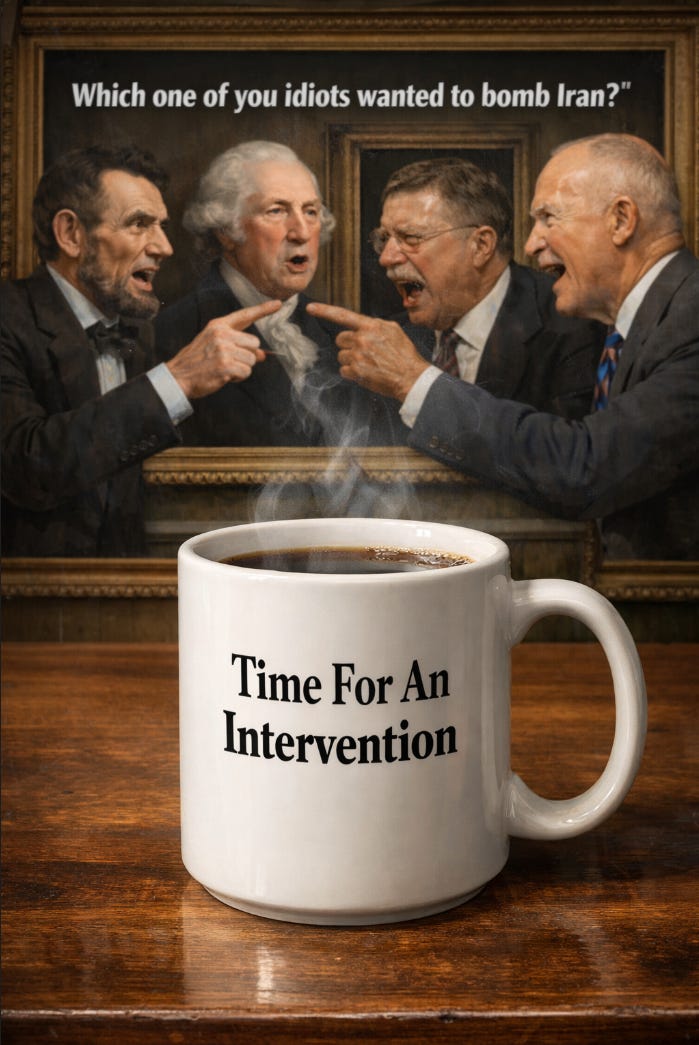
Once even the straight-faced press corps has to report, in serious institutional language, that the president appears to have invented a supportive conversation with an unnamed ex-president, the rest of the week starts to look different. The illusion cracks and the ceremonial backdrop no longer reads as authority, but as set design. Suddenly you have to ask: is Trump communing with the dead, chatting with portraits on the wall, or just workshopping foreign policy with the drapes? If Clinton, Bush, Obama, and Biden have all effectively said, “Do not drag me into this mess,” then the mystery former president exists only in one of two places: Trump’s imagination or the afterlife. From there, the bilateral meetings, the luncheon speeches, the shamrock bowls, the flags, the solemn podiums, the gold curtains, the diplomatic rituals, all of it feels less like a functioning presidency and more like a presidential charade, a costume drama in which the props are still expensive but reality has quietly left the building.
And what a week to prove it. Trump spent much of St. Patrick’s week wrapped in the soft green optics of Irish diplomacy, which was already jarring enough because I am not sure I had ever seen him voluntarily wear green anything before. There he was, in a green tie, beside Taoiseach Micheál Martin, trying very hard to look like a normal statesman participating in a friendly annual ritual of Irish-American symbolism. For maybe twelve seconds it almost worked. Then Trump opened his mouth and the whole shamrock stage set was immediately flooded with the usual slurry of Iran boasting, NATO resentment, tariff muttering, Europe-bashing, and complaints that allies are not sufficiently grateful for his latest military “success.”
The ties said St. Patrick’s Day. The remarks said grievance convention in a body-snatcher suit. Trump kept circling back to the same emotional wound all day: everyone supposedly agreed with him, everyone supposedly thought “it was a very important thing to do,” everyone was apparently calling to congratulate him on the “great job” he did with Iran, and yet, in his telling, those same allies still “don’t want to help us,” which he described as “amazing” and “very unfair to the United States.” That was the real heartbeat of the performance. No diplomacy, just hurt feelings. The president of the United States spent an Ireland meeting sounding like a guy who threw himself a war and is now sulking because nobody volunteered to bring the folding chairs. He insisted “we don’t need any help actually,” then kept complaining that allies should have sent “a couple of mind sweepers” because “they should have been there.” Strip away the green tie and the shamrock staging, and what remained was not a coherent foreign policy message but a very familiar Trump lament: I did something tremendous, everyone says it was tremendous, and now I am furious that other people are not proving their gratitude loudly enough.
Micheál Martin, meanwhile, performed the near-superhuman task of acting like the only adult in a room where the furniture had become sentient and resentful. Over and over, Martin tried to steer the conversation back toward peace, diplomacy, transatlantic cooperation, legal migration, economic ties, and reality itself. He pushed back gently but unmistakably on Trump’s caricatures of Europe. He talked about reconciliation, institutions, and de-escalation. Martin even managed, somehow, to correct Trump without turning the event into an international hostage situation. It was the diplomatic equivalent of trying to keep a shopping cart upright while a raccoon in a necktie keeps climbing out of it to shout about minesweepers.
The Friends of Ireland luncheon was no better. This should have been easy material even for Trump: heritage, friendship, shamrocks, Irish-American history, broad smiles, and maybe a few canned lines about how “the Irish did not come to America. They helped found America.” Instead, he turned the event into an open mic night at the grievance casino. He praised Mike Johnson as a man getting things done like “really nobody,” made those familiar creepy little detours into women’s appearance, “you’re not allowed to use the word beauty anymore,” he said, before doing exactly that anyway, marveled at his own political destiny, and reminded the room that he was not even “supposed to be president right now,” but here he is with the Olympics, the World Cup, and the 250th anniversary all under his watchful magnificence. Naturally, he plugged his golf property in Ireland while insisting, in the usual Trumpian way, that he has “nothing to do with it” even as he explained at length what a triumph it is. He bragged that “we hit 50,000 on the Dow” and “7,000 on the S&P,” then, because apparently no gathering is too ceremonial to escape him, lurched right back to Iran and to his grotesque little phrase for war: a “little excursion.” As he told it, the economy was soaring, everything was perfect, and he simply asked Susie Wiles, “Do you mind if I take a little excursion here?”, as though bombing a country were something between a side errand and a weekend golf detour. That phrase did all the work. In one breath he reduced war to a scheduling inconvenience, a brief interruption in his otherwise glittering success story, while the room sat there pretending this was a normal way for a president to describe military escalation.
Then came the Shamrock Bowl presentation, which should have been one of the simplest symbolic events on the calendar: a ceremonial gift, a few gracious words, a nod to shared history. Instead, Trump used it to say he should have been spending the day “with the Iranians,” boast that the U.S. was “knocking them for a loop,” hype a new White House ballroom, grumble about Ireland’s trade surplus, praise loyalists, brag about his health, and toss in more culture-war filler for good measure. It was less a diplomatic ceremony than a wandering monologue in search of a theme.
This is where the phantom-president story stops being just funny and starts becoming useful. Once even the press has to report that Trump appears to have invented a flattering conversation with an unnamed former president, the rest of the week snaps into focus. Every ceremonial appearance turns into a stage for his own mythmaking. For Trump, the presidency is not governance. It is atmosphere, an endless effort to use the room, the flags, the podium, and the ritual as proof that the fantasy in his head is real.
James O’Brien, to his credit, has been among the clearest voices on what all this actually feels like. His breakdown of Trump’s recent comments gets at the deeper point: this is not just routine lying. It is a sliding blend of derangement, fabrication, malice, and swagger, often compressed into the same sentence. You hear it when Trump confuses offices and titles while insulting Gavin Newsom. You hear it when he fantasizes aloud about “taking Cuba” as though sovereign nations are casino properties. You hear it when he sneers at Keir Starmer for consulting his team, because in Trump’s worldview, consultation itself is weakness. He cannot comprehend governance as a process. To him, power is a man barking until institutions stop objecting.
If you needed one more reminder that everyone around Trump is trapped in an ever-thickening fog of degradation, there was the Neil Dunn moment. During a public event, Mike Johnson was trying to praise Republican congressman Neil Dunn for continuing to show up to work despite serious health problems. Johnson called Dunn “a real champion and a patriot” and said that if other people had received the same diagnosis, “they would be apt to go home and retire.” Then Trump asked, “What was the diagnosis?” Johnson answered, “It was, I mean, I think it was a terminal diagnosis,” and that should have been the point where any normal person let the sentence die. Instead, Trump barreled right past the stop sign and added, “He would be dead by June.” Johnson then awkwardly tried to clean it up with, “Okay, that wasn’t public, but yeah,” and that was the moment you could hear the room groan.
That groan mattered. It was the sound of the mask slipping. For one split second, even the trained applauders and professional flatterers could not keep the revulsion from surfacing. They knew, instantly, that something private and awful had just been dragged into the room because Trump wanted one more grisly detail for the anecdote. That is what this presidency does. It drags everyone around it into a moral sinkhole where basic decency gets flattened by performance, and then expects them to smile through the stench.
Trump has spent the week performing presidential masculinity by free-associating through golf, war, and shamrocks, while Iran’s Foreign Minister Abbas Araghchi offered a very different kind of theater in a lengthy Al Jazeera interview: calm, steady, polished, and hard-edged. Speaking through a translator, Araghchi projected endurance above all else. He insisted the Islamic Republic is built on institutions rather than any one man, emphasized that assassinations and leadership losses would not collapse the system, and framed the war as an American-Israeli assault imposed on Iran rather than something Tehran widened on its own. It was a disciplined message aimed at several audiences at once: reassure the domestic audience that the regime is solid, warn regional neighbors that hosting U.S. forces comes with costs, and tell Washington that Iran will not be boxed into a narrow temporary pause dressed up as peace.
That interview mattered because of how controlled it sounded. Araghchi did not froth or rant, or sound cornered. He sounded like a man deliberately preserving ambiguity. On Hormuz, he hinted that Tehran may see the crisis not just as a military problem but as leverage to shape a future regional framework around passage through the waterway. On the nuclear issue, he maintained that Iran’s doctrine remains peaceful while leaving just enough shadow around the future of the regime’s religious prohibition to remind everyone that ambiguity itself is a tool. Think of it as a warning in a pressed suit.
The green ties, the shamrock bowls, the fake mystery ex-presidents, the wounded complaints about ungrateful allies, the smooth Iranian messaging, would already be enough for one morning. But because this administration cannot stop turning every scandal into a nested doll of corruption, there is also Pam Bondi, whose Epstein-files cleanup tour appears to have hit the point where even Congress is no longer willing to pretend the performance counts as transparency.
The House Oversight Committee has subpoenaed Bondi for a closed-door deposition on April 14, which is a problem for her because the whole routine works best on camera. Bondi thrives in the theatrical habitat of selective disclosure, sanctimonious scolding, and prop management. She likes burn-books, posture, and the general energy of a mean girl in legal drag. A closed-door deposition strips away the lighting, the rehearsed indignation, and the ability to wave around curated fragments while pretending they constitute openness. Under oath, without the usual production design, she may actually have to explain why the Justice Department’s idea of transparency keeps arriving with pages missing, names blacked out, and a suspicious odor of cleanup solution in the air.
Which brings us, finally, to the question of priorities. Because for all Trump’s giddy talk about “little excursions,” there is a material reality underneath this war fever, and it is obscene. The U.S. spent $11.3 billion in the first week alone of the Iran war. That is more than enough to fund the EPA for a year. More than enough for the CDC. More than enough for the National Cancer Institute. More than the annual federal research funding via the National Science Foundation. The numbers are not subtle. They are a slap in the face.
Budgets are values. They always have been, and this administration’s values are plain as day. There is always money for destruction, for spectacle, for war, for fossil-fuel fantasies, for culture-war theatrics, for gold drapery and ballroom dreams and military pageants and whatever fresh absurdity Trump decides will flatter him by sunset. But for clean air, cancer cures, scientific innovation, environmental safety, and public health? We are told to be realistic, tighten our belts, lower expectations, and maybe try not to get sick near the end of the fiscal year.
Meanwhile, in the real world, Marz once again submitted to the annual shamrock humiliation, despite his longstanding and deeply principled position that he is an Italian mastiff, not an Irish wolfhound. He expressed this objection not through protest, but through passive resistance, refusing to give us a single decent pose unless at least two people were involved and one of them was probably bribing him. So yes, the photo happened, but only after the usual negotiations.
And me, I am finally starting to feel a little more human again. Still not perfect, still not running at full speed, but better. Better is good. Better means I may manage to stay upright for most of the day, which lately feels less like a default setting and more like an achievement. We take the wins where we can.
Ah Mary, this was an excellent post ... the racoon in the shopping cart! brilliant I am still laughing. The strength of your writing gives no hint of your ill health. Take it easy, don't overdo it. We need you fit and fighting. :)
Was this ex-president who praised Trump about bombing Iran big and strong? Did he have tears running down his face? This "Gee, I wish I had done that!" hallucination is just a variation on Trump's classic "Sir" stories. Good on the ex-POTUSes for debunking it. Sheesh 🤦🏼♀️