


Donald Trump’s first real betrayal of OPEC didn’t come with bombs, seizures, or chest-thumping speeches about hemispheres. It arrived quietly, almost stupidly, in 2018, wrapped in a series of tweets and half-formed demands that revealed something oil producers understood immediately and Trump never did: the man does not keep faith, even when it costs other people hundreds of billions of dollars.
Back then, Trump wanted two incompatible things. He wanted to choke off Iranian oil with sanctions, and he wanted cheap gas for American voters. That math only works if someone else opens the spigot. So Trump leaned on OPEC, publicly, crudely, and incessantly to increase production. Saudi Arabia and its partners agreed on the clear understanding that the extra barrels would merely replace Iranian supply coming off the market. No glut of oil, just balance.
Then Trump did what Trump always does. After OPEC had raised production, after markets had adjusted, after producers had taken him at his word, he quietly issued waivers allowing Iranian oil to keep flowing. The market was suddenly awash in crude. Naturally, prices collapsed and OPEC producers lost staggering amounts of revenue, not because of war or recession, but because the President of the United States changed his mind mid-sentence.
There was no dramatic response, or emergency summit. OPEC doesn’t work that way. Cartels, it appears, don’t scream; they remember.
Two years later, when the pandemic cratered demand and the global oil system needed careful management, OPEC+, now fully aligned with Russia, chose the harshest possible reset. Production was slashed aggressively and locked into place. High-cost producers, especially U.S. shale, were left to bleed. Bankruptcies piled up, rigs went dark, and workers lost jobs. Americans paid more at the pump down the line and never quite understood why.
Trump, predictably, never connected the dots because why bother? But oil producers did. The lesson was pretty simple: Trump is not a partner; he is a risk.
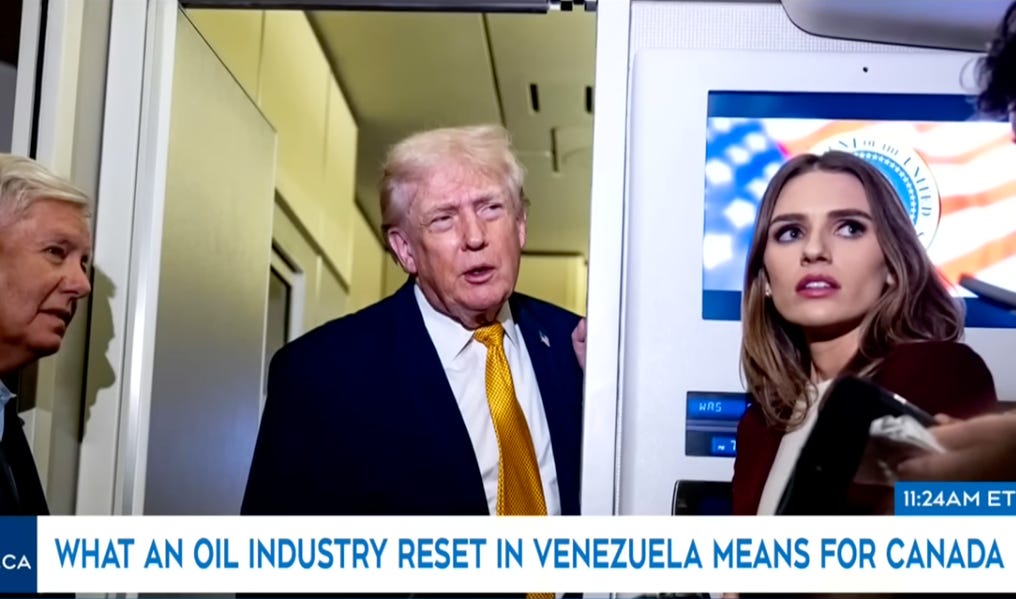
That lesson matters now, because fast-forward to today and Trump has escalated from breaking informal oil deals to outright seizing a country. Venezuela, a founding member of OPEC, was invaded. Nicolás Maduro was kidnapped and flown to New York. Trump announced, casually, proudly, that the United States would “run” Venezuela and that American oil companies would soon get rich off its reserves. The fantasy was delivered with all the usual Trump flourishes: bravado, ignorance, and the absolute certainty that everyone else would fall in line.
They didn’t. At the United Nations, the United States found itself alone, stripped of the moral fog it once relied on to soften illegal actions. Allies did not defend it. Denmark stood up for sovereignty, with Greenland suddenly no longer an abstract joke but a real anxiety. Spain condemned the aggression. Latin American governments issued joint statements. The UN Secretary-General reminded Washington, gently but firmly, that kidnapping heads of state is not, in fact, “law enforcement.”
Russia and China, both deeply cynical actors, barely bothered to hide their satisfaction. They didn’t need to invent a narrative. The United States handed them one. This, they said, is your rules-based order in action. This is what it always was.
Trump did what he does when faced with consequences: he posted. About the 2020 election, windmills, and Dominion voting machines. While diplomats spoke about sovereignty and international law, the President of the United States ranted like a man trapped in a Facebook comment section.
Even so, beneath all the noise, Trump kept insisting on the same thing: oil. Venezuelan oil. American oil companies rushing south, restoring production, making fortunes, bending global markets to his will.
This is where reality intervenes when Congress has not, mechanically.
Venezuela’s oil is heavy, sour, expensive, and infrastructure-dependent. Restoring production at scale would require something on the order of $100 billion over a decade, in a country whose legal system, political stability, and security environment remain radioactive. No amount of sanctions relief fixes expropriation claims, contract risk, or the simple fact that Trump himself cannot go five minutes without threatening the very leadership he claims to support. Oil companies are allergic to chaos. Trump is nothing but chaos.
More importantly, the barrels Trump is fantasizing about already exist, just not where he’s looking. When Venezuela collapsed in the late 2000s, oil companies didn’t mourn and move on; and relocated. They poured capital into Canada. Western Canadian Select, the heavy crude that flows from Alberta’s oil sands, became Venezuela’s replacement. Over the past fifteen years, companies have invested roughly half a trillion dollars building, expanding, and optimizing that supply. Refineries were configured, pipelines were fought over, and fortunes were staked.
Now Trump wants those same companies to revive Venezuelan production, production that would directly compete with their Canadian barrels, drive down heavy crude prices, and devalue the very assets Wall Street has spent a decade consolidating. In other words, he’s asking them to destroy one investment to satisfy his ideal headline.
They won’t. At most, they will do what big oil does best: diplomacy theater. Executives will visit Caracas, statements will be issued, photos will be taken, land memorandums of understanding will be signed and quietly ignored. A few hundred thousand barrels a day might be coaxed out of existing fields, just enough for Trump to declare victory and move on to the next distraction. It’s risk management. Capital will stay put, and the checks will remain uncut.
The world has learned how to deal with Trump. Not by confronting him directly, but by insulating itself from him. OPEC did it after 2018. Canada is doing it now.
The Canadian timber industry offers a perfect parallel. For decades, Canada aligned its lumber mills with the American market, even retaining imperial measurements long after the rest of the country went metric. Ninety percent of its softwood went south. The relationship was stable, if occasionally tense.
Then Trump imposed punishing tariffs on Canadian lumber, tariffs so high Americans could buy timber from Russia more cheaply than from British Columbia. Mills closed, laying off workers. Suddenly, Canada began discussing the unthinkable: retooling factories to serve Europe and Asia, markets that use metric dimensions and different standards.
That pivot is expensive, slow, and painful. It may never fully replace the U.S. market. But the point isn’t efficiency. It’s survival. The lesson Canada learned is the same lesson OPEC learned and oil companies internalized years ago: the United States under Trump is not a reliable anchor.
This is the damage Trump does that never shows up in his speeches. He turns trusted systems into risk variables, and teaches allies, producers, and investors to plan around him rather than with him.
Even when Trump is gone, whenever that is, the world will remember. OPEC and Canada will remember. Oil companies will remember. They will price American unpredictability into every decision, every contract, every long-term investment.
Trump can seize a country. He can kidnap a president and shout about oil until his voice gives out. What he cannot seize back is trust.
This is exactly the irreparable damage he is wreaking upon our global reputation. America is no longer a trusted partner. We are now the wealthiest banana republic in history.
Trump is one thing, and you've described him accurately. I think what many Americans may not realize is that Trump was (or should have been) a known quantity - career criminal, fraud, epically incompetent, serial liar, and insurrectionist. And then the American voters elected him again, with the popular vote, because ... I don't know. Black woman? Odd laugh? There was a choice between an epic disaster or someone you might have reservations about, and Americans chose disaster for the world. It's not just the regime that has earned our distrust, it's the voters who simply aren't serious enough about their votes.