


I had that déjà vu feeling again, reading the news, when the DOJ quietly acknowledged that the so-called “narco-terrorist” group it claimed Nicolás Maduro was affiliated with did not, in fact, exist. The moment echoed an earlier admission from another era, when the Bush administration conceded that no weapons of mass destruction had been found in Iraq.
In March of 2003, Americans were told a war was unavoidable. The case was delivered with certainty. Iraq had weapons of mass destruction, time was running out, and to wait was to invite catastrophe. The legal arguments were technical, the moral arguments sweeping, and the urgency unmistakable. Action was framed not as a choice, but as an obligation. Within weeks, Baghdad fell and within months, the story began to unravel.
More than twenty years later, as U.S. forces carried out strikes, seizures, and arrests tied to Venezuela, the language sounded different, but the shape of the argument felt strangely familiar. This time, it was not about nuclear weapons or mushroom clouds. It was about narco-terrorism, sanctions enforcement, and regional security. Not war, officials insisted, but law enforcement. Not invasion, but necessity, and yet, once again, force came first. Verification followed.
The Iraq War did not begin with tanks crossing borders. It began with briefings, speeches, and assurances that the evidence was solid and the danger imminent. Intelligence assessments were presented to the public as settled conclusions. Doubts were minimized and dissent was cast as irresponsibility.
After the invasion, investigators found no active weapons of mass destruction. The programs that had been described as urgent threats either did not exist or had long been dormant. The links to terrorism dissolved under scrutiny and what had been framed as certainty revealed itself as assumption layered upon assumption.
The consequences were not limited to embarrassment. The absence of post-war planning helped ignite years of violence that reshaped Iraq and destabilized an entire region. The war’s most enduring legacy was not the removal of Saddam Hussein, but the erosion of trust, in intelligence, in leadership, and in the rules meant to restrain power.
The intervention in Venezuela arrived wrapped in different language, but followed a similar sequence. The Trump administration framed its actions as a response to criminality rather than military threat. Indictments replaced intelligence dossiers, sanctions enforcement replaced regime change. The rhetoric emphasized legality, precision, and restraint. But the logic was the same: the situation was urgent, the authority sufficient, the alternatives inadequate.
Military force was used to seize vessels, strike targets, and detain a foreign head of state. Oil tankers were boarded on the high seas and sanctions were enforced not only through financial pressure, but through armed action.
Only afterward did the framing begin to soften. Claims of a unified, state-run narco-terror cartel gave way to more cautious descriptions of corruption networks and legal arguments began to narrow. What had been presented as clear became more conditional. As with Iraq, the strongest claims came before force was used, certainty retreating, afterward.
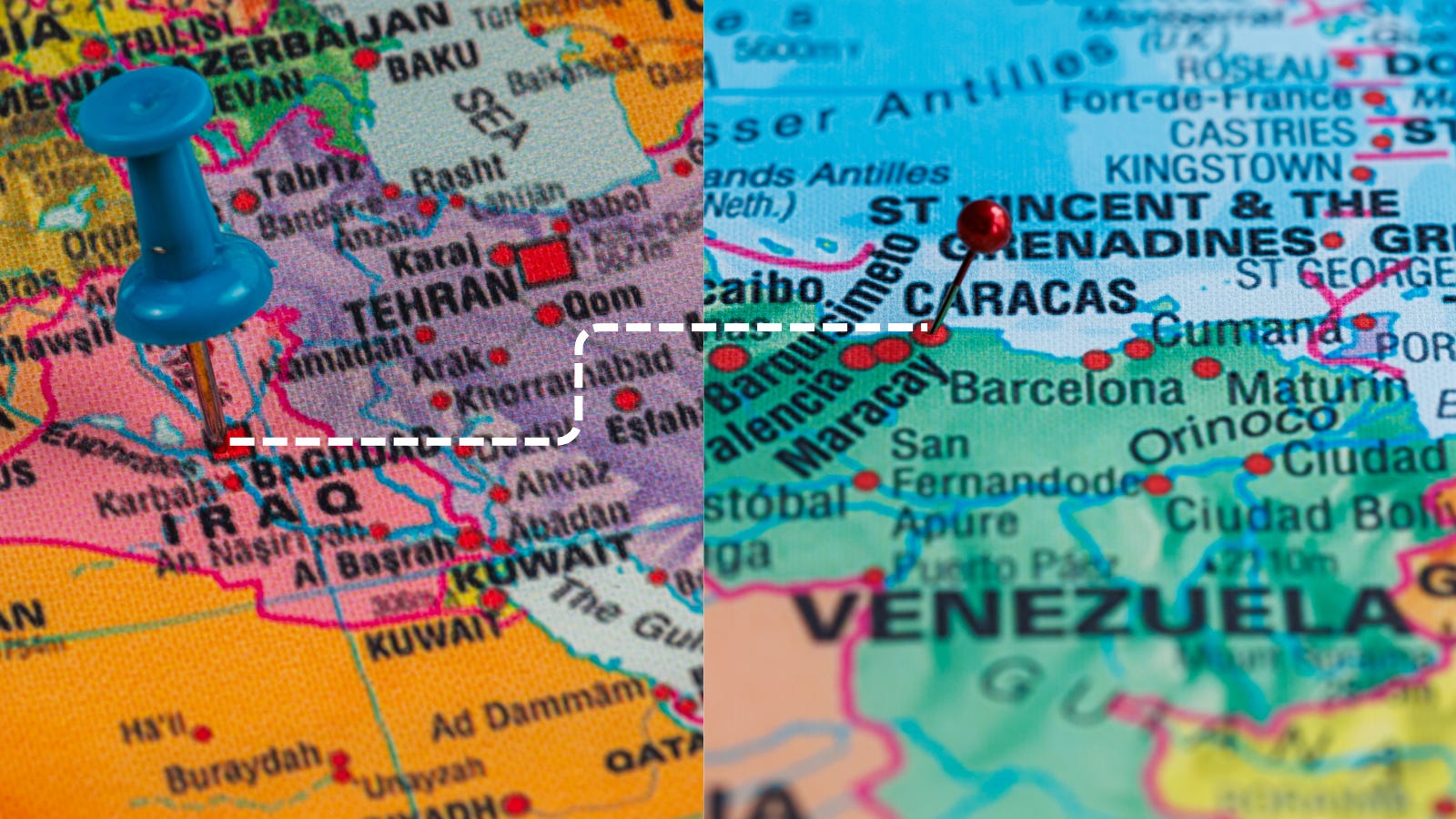
Both Iraq and Venezuela run headlong into the same legal boundary: the UN Charter’s prohibition on the use of force. International law allows military action only in narrow circumstances, self-defense against an armed attack, or authorization by the UN Security Council. This rule is not decorative, it exists precisely because powerful states, left unconstrained, will always find reasons to act.
In 2003, the United States lacked explicit Security Council authorization to invade Iraq. Resolution 1441 warned Iraq and demanded compliance, but did not authorize war. Years later, UN Secretary-General Kofi Annan would state plainly that the invasion was not in conformity with the Charter.
The Venezuela intervention follows the same legal fault line. Criminal indictments and sanctions violations, however serious, do not constitute grounds for armed intervention under international law. UN officials and legal scholars have said as much. The language is careful, but the conclusion is consistent: the legal justification is not there.
The seizure of oil tankers linked to Venezuela adds another layer to the story. Under maritime law, ships on the high seas are protected by flag-state jurisdiction. Boarding or seizing a vessel is lawful only under narrow exceptions: piracy, statelessness, flag-state consent, or UN authorization. Sanctions enforcement does not, by itself, appear on that list.
As with Iraq, the action moved faster than the law could respond. Disputes over legality may one day reach courts or commissions. For now, they exist mostly as statements, protests, and unresolved objections. Power fills the gap where enforcement mechanisms are weak.
In 2003, millions marched in the streets around the world. Major allies broke with Washington. The war fractured diplomatic relationships that took years to repair. The Venezuela intervention prompted faster, quieter reactions, but the substance was similar. UN bodies condemned the action. Emergency Security Council sessions were convened. Allies offered cautious silence or measured concern. Adversaries spoke openly of illegality. The scale differs; the pattern does not. It is tempting to see Iraq as a historical anomaly, a unique failure in judgment driven by fear after September 11. But Venezuela suggests something deeper and more persistent.
In both cases, the executive branch asserted urgency. In both cases, legality was treated as flexible rather than foundational. In both cases, facts were strongest before scrutiny, and weaker after. And in both cases, the world was asked to accept that this time was different. Different presidents. Different enemies. Different rhetoric. The same structure. Iraq was a catastrophe on a scale Venezuela has not approached. Outcomes may diverge, and consequences may be contained but history does not need to repeat to warn.
The consequences of these choices are often described as foreign, measured in destabilized regions, broken norms, or diplomatic fallout. But the most durable effects of disregarding law do not remain overseas; they return home quietly, embedded in precedent. When a president treats legal limits as inconveniences rather than boundaries, it alters the relationship between power and the public. The lesson is not absorbed only by adversaries or allies. It is absorbed by institutions, by future administrations, and by citizens who learn, slowly, almost imperceptibly, that legality is flexible at the top even when it remains rigid everywhere else.
This was one of the unspoken legacies of Iraq. The war did not merely damage U.S. credibility abroad; it reshaped expectations at home. Executive certainty replaced institutional restraint. Emergency reasoning became habitual. Oversight was reframed as obstruction. Once normalized, those habits did not disappear when the war faded from headlines. They became tools waiting to be reused.
The Venezuela intervention shows how easily that inheritance can be activated. Criminal indictments become casus belli, sanctions become justification for force, and domestic authority is treated as sufficient even when international law says otherwise. The mechanics differ, but the logic is intact: act first, explain later, and rely on power to bridge the gap where law resists.
For citizens, the danger is not immediate repression or sudden loss of rights, it is something subtler and more corrosive. The rule of law weakens not when it is openly rejected, but when it becomes conditional, applied selectively, defended rhetorically, and bypassed when inconvenient. Accountability still exists, but it arrives late, diluted, or not at all.
Perhaps most importantly, disregard for law narrows the public’s role in governance. Decisions justified through urgency, secrecy, or post-hoc rationalization leave citizens with fewer tools to question, challenge, or correct them. Oversight migrates inward, away from democratic institutions and toward executive discretion. What was meant to be exceptional becomes routine. This is how power outlasts any one president. Precedents do not vote, they simply remain.
Iraq taught, at tremendous cost, that certainty declared before proof invites catastrophe, and that legality treated as a technicality eventually collapses into disbelief. Venezuela tests whether that lesson was absorbed or merely archived. Between these two events, separated in time, one pattern remains stubbornly consistent: when law is treated as optional abroad, it does not remain optional only there.
What citizens inherit, in the end, is not just the outcome of a single intervention, but the condition of the system that authorized it. A system where force precedes justification, urgency overrides restraint, and where legality bends to power rather than containing it. That is the true thread running from from Baghdad to Caracas, and the part of the story that does not end when the operation does. History has already shown us where that road can lead, and how hard it is to find our way back.
In moments like this, it is easy to feel powerless, to believe that no protest is large enough, no argument sharp enough, no voice loud enough to alter the course already set in motion. That feeling isn’t the case, what remains of democracy in this country may be fragile, diminished, and strained, but it has not vanished. A narrow space still exists between resignation and responsibility and within that space, choices still matter.
History shows that accountability rarely arrives on its own. It must be forced into existence, by institutions, by pressure, and by voters who refuse to allow abuses of power to fade quietly into precedent. When accountability is ignored, it becomes permission. The coming midterm elections are not a solution to everything, but they are one of the few tools still available to slow the erosion, to reassert oversight, and to remind those in power that authority is not unconditional. Lawmakers who are willing to challenge executive overreach, defend the rule of law, and demand consequences must be elected by people like you and me, and that responsibility cannot be outsourced. It belongs to citizens willing to pay attention, to question narratives, to examine records, and to vote with intention rather than habit or despair.
The future is not rewritten all at once. It is altered incrementally, by decisions made when disengagement feels easiest. If there is still a chance to bend the trajectory of this country toward accountability rather than inevitability, it lies in refusing to look away now. Not because change is guaranteed, but because surrender ensures it never comes.
In 2003, I remember there was public input. In 2003 we were included and we did know what the stakes were. But, in 2003 we also were lied to and told there was really know other option.
As bad as that was, this feels so much more dangerous.
In Venezuela, there was a plan. The main plan. But no one admitted that. What we got was all the infrastructure of an invasion without anyone talking about invasion.
And you know what is really scary? It is how our Administration is talking about Greenland. Its the same way they started talking about Venezuela. Always probing, always testing for resistance. Its how bullies operate.
The more urgent a National Security crisis is, the more likely it is to be illegal.
Under the George W Bush Administration, the President went to Congress for their approval before going to war. Under the Trump Administration, the President not only bypassed Congress and lied about his intentions. Under the Bush Administration we had allies we depended on. Under the Trump Administrations we have no allies.