

Good morning! At Friday’s White House press conference, a reporter asked Donald Trump a simple question: did he believe Vladimir Putin was a friend to America?
“Uh, I can’t speak to America,” the president replied.
Instead, he spoke about himself. Putin, Trump explained, had been “very nice” to him throughout the “fake Russia Russia Russia hoax,” and the two men have “a very good relationship.” Asked about America’s interests, the president began with an account of his own.
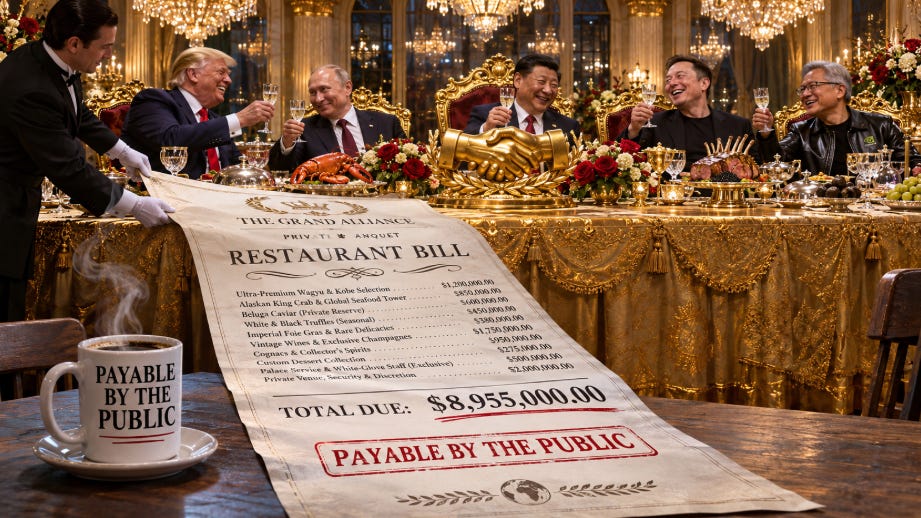
It was a fitting end to a week of celebrated friendships. In Shenzhen, Trump took his seat at an oversized table beside Putin and Xi Jinping, a man he praised from the White House podium as “a great man” who “runs 1.4 billion people.” Back home, he spent part of the same press conference lobbying Nvidia’s board to reinstate Jensen Huang, its recently departed chief executive, while Elon Musk signed a petition supporting his return.
So it’s worth asking what friendship means to men who already have more wealth or power than almost anyone alive. The answer begins with a simpler question, the one France 24 asked this week: who benefits? And just as important, who doesn’t?
* * *
Jim Townsend, a former Pentagon official who worked on Europe and NATO, watched the Shenzhen summit and called it “cosplay for all three of them.” Quite frankly, he said, it was theater: “a confection that was made for the cameras.”
Longtime readers will recognize a more precise word for it: kayfabe. In professional wrestling, everyone in the ring agrees to sell a staged event as real. And everyone in Shenzhen played their part. Xi met Trump’s plane with a hug, returning the favor of the greeting Trump gave him at Andrews Air Force Base a few months earlier. Putin got his three-man photograph, which, according to his former prime minister Mikhail Kasyanov, was his idea in the first place. Trump got to tell reporters it was the “first ever,” and that “they say it was the biggest of them all.”
For all the choreography, the published declaration offered remarkably little substance. The Financial Times’ Victor Mallet called the joint declaration “rather pathetic”: a vague call to reform the UN, an equally vague plan to increase petroleum supplies, which Mallet regarded as a concession to Moscow, an agreement that nuclear war would be bad, and a provision defending the immunity of state officials while warning the International Criminal Court against exceeding its jurisdiction.
That last item drew the week’s most telling moment. When Trump said the ICC had “gotten out of control” and “strayed far” beyond its jurisdiction, Putin, the only man at the table under an ICC arrest warrant, smiled. Then Trump turned to him: “It’s an honor to be with Vladimir.”
One British radio host captured Europe’s view of the scene: not at the table, but on the menu.
Wrestling has a second useful term. The staged action is “the work.” What’s real is “the shoot.” In Shenzhen, the match was staged. The benefits were real.
* * *
In October 2025, nearly three months after Trump agreed to let Nvidia resume certain AI-chip sales to China, the company committed $25 million to the president’s ballroom, according to the Washington Post. That tied Apple for the largest donation on the books. Nvidia had already given $1 million to his inauguration.
The New York Times reported that Trump was warned at least twice about the national security implications of Huang’s relationship with a woman whom, according to the New York Times, U.S. intelligence agencies had identified as a Chinese intelligence asset. He took no action. When Huang resigned amid the board’s investigation, the president began lobbying publicly for his return.
He has company. Musk, who has spent more than $700 million supporting Republicans across the last two election cycles, signed the petition to reinstate Huang and said it would be an honor to hire him. Musk’s commercial interest is not hard to find. Nvidia’s chips power Tesla, SpaceX and xAI, and by Musk’s own account many of those supply arrangements were “a handshake with Jensen, not a written contract.”
The Russian side of the ledger is murkier, and it’s worth being precise. There is no established evidence that Moscow has a financial hold on Trump. What analysts describe instead is an offer. Writing in Project Syndicate, economist Andrew Kosenko argues that Putin is dangling postwar energy profits to align Trump’s pecuniary interests with Russia’s strategic objectives. David Frum calls Trump’s “weakness for corruption” Russia’s most strategic asset. Whether those promised riches will ever materialize is another question. Nonetheless, the possibility of profitable business with Russia is already part of the diplomatic conversation.
Friends with benefits, then, doesn’t require a suitcase of cash. The benefits can be legitimacy, access, favorable regulation, protection from consequences, or the promise of deals to come. Some are tangible, others reputational, and a few are still only potential.
What they share is the direction they flow: toward a small circle of men with extraordinary power. The billions of people they govern, employ or claim to protect were never party to those arrangements. Yet, as the record shows, they can be the ones who pay the price.
* * *
The spectacle was theater. The records of the men performing it are not.
Begin with the host. In 2022, the UN’s human rights office concluded that China’s mass detention of Uyghurs and other Muslim minorities in Xinjiang “may constitute international crimes, in particular crimes against humanity.” Beijing answered with a 131-page rebuttal citing counterterrorism. In Hong Kong, the national security law Xi imposed in 2020 has emptied the city’s newsrooms and filled its courtrooms. In February, publisher Jimmy Lai, 78, was sentenced to 20 years, the harshest penalty yet handed down under that law. In 2018, China abolished the two-term limit on its presidency, removing a constitutional obstacle to Xi remaining in office indefinitely.
Putin arrived in Shenzhen as a wanted man. The International Criminal Court has issued a warrant for his arrest over the alleged unlawful deportation of Ukrainian children. A British public inquiry concluded that he “probably approved” the 2006 polonium murder of Alexander Litvinenko in London. This year, five European governments concluded that Alexei Navalny died in an Arctic prison from epibatidine, a poison derived from dart frogs. The Kremlin denies all of it and calls the court’s warrant “legally void,” while the war Putin started grinds through its fifth year.
Then there is the president who couldn’t speak to America. Since September 2025, the U.S. military has destroyed dozens of alleged drug boats in the Caribbean and Pacific, killing at least 157 people by the Pentagon’s own count in March and 227 by Human Rights Watch’s count a year in. The administration says the country is in an armed conflict with cartels, though Congress never authorized one and the Justice Department has never released its legal reasoning. In the first strike, two survivors clinging to the wreckage were killed by a second missile. Defense Secretary Pete Hegseth blamed “the fog of war.” UN experts say the campaign may amount to crimes against humanity.
At home, deaths in immigration detention reached record levels. ICE’s then-acting director blamed the increase on record detention numbers, but independent investigators found that deaths were rising faster than the detained population and raised concerns that many may have been preventable. The administration also acknowledged that it deported Maryland father Kilmar Abrego Garcia to a Salvadoran prison through “an administrative error,” in violation of an existing order protecting him from removal to El Salvador.
None of these records is equivalent to the others, legally or in scale. What they share is that in each case, people with little power to resist bore the cost of decisions made at the top.
Political leaders aren’t the only ones who hold that kind of power over millions of lives.
* * *
Elon Musk and Jensen Huang built two of the most consequential companies of the century, and their admirers have reasons. Nvidia’s chips power the AI boom. SpaceX rockets reach orbit and land again. That belongs in the record.
So does the rest of it. In 2021, a federal jury found Tesla liable for the racist abuse a Black contractor endured at its Fremont plant, where workers described slurs, swastikas and supervisors who looked away. The record award was later reduced and the case settled, but the federal government’s own discrimination suit is still pending. At SpaceX, eight employees were fired after circulating an open letter calling Musk’s public conduct “a frequent source of distraction and embarrassment.” The National Labor Relations Board charged the company with illegal retaliation, and SpaceX responded by challenging the board’s constitutional authority.
Huang has described his management style as a form of torture, although Nvidia’s employee retention has remained remarkably high. Recent reporting describes something more troubling. In a New York Times guest essay, Huang’s biographer Stephen Witt compared the atmosphere around him to the abusive instructor in Whiplash, describing executives afraid to contradict him. Separately, the New York Post reported that during a February meeting, Huang told senior executive Jay Puri, “I hope you die and put us all out of our misery.”
The workplace is not where these two men matter most, though. Their reach now extends into public life.
A federal judge found that Musk had “firm control” over DOGE when it dismantled the U.S. Agency for International Development, citing Musk’s boast that he had “fed USAID into the wood chipper.” A peer-reviewed study in The Lancet projects that if the cuts stand, they could cause more than 14 million additional deaths by 2030, including 4.5 million young children. Musk and Rubio have both dismissed claims that the cuts caused deaths, even as investigators documented disruptions to lifesaving assistance.
In October, Ukrainian drones began losing their satellite links as Russian missiles hit Kyiv. The Wall Street Journal reported that Musk ordered the slowdown; Musk said “ultimately POTUS” controls the system; the White House denied ordering it. Service was restored in October, but Ukraine reported renewed restrictions on November 12, allegations SpaceX denied. Earlier this year, SpaceX had worked with Kyiv to disable Starlink terminals used by Russian forces. One company’s technology had become so essential to a country’s survival that decisions about its availability carried consequences normally associated with military command.
Nothing in the record establishes that Huang knowingly compromised national security. But American intelligence officials reportedly warned Trump about Huang’s relationship with a woman they concluded was working for Chinese intelligence, and Nvidia’s board began investigating the national-security and governance questions. Trump, meanwhile, kept defending Huang and is now publicly urging his reinstatement. He has treated the question of the woman’s loyalties as an open one, “if the woman was a spy… if not,” which is how this column came to coin “Schrödinger’s Spy.”
When private power shapes public outcomes this directly, the line between running a company and governing gets hard to find.
* * *
Two years ago in Butler, Pennsylvania, Elon Musk bounded across the stage in a black MAGA cap, leaping high enough to bare his midriff, and told the crowd, “I’m not just MAGA, I’m dark MAGA.”
This week, at the New York Times DealBook Summit, he wasn’t so sure. “I’m not MAGA,” he said. “I’m not sure what MAGA means.” Then came the more revealing line: “I feel pretty foolish about having spent so much money and not seeing much for it.”
He spoke about the disappointing political return on his investment, not the human consequences of feeding USAID into the wood chipper. In kayfabe terms, the costume is off and the shoot is showing.
Costumes can be discarded. The record can’t. Xi and Putin aren’t constrained by the constitutional term limit that will end Trump’s presidency. Musk and Huang will keep shaping the technology billions of people rely on. The human consequences of a dismantled aid agency, a throttled satellite link, or a missile fired at men clinging to wreckage don’t end when the cameras move on.
Still, personal power is not the final word. Nvidia’s board has demonstrated that even a celebrated founder can be held accountable. Courts have affirmed that due process applies even to people a president wants deported. Investigators are assembling records that cannot be erased by a triumphant press conference. And on January 3, a new Congress takes office with the authority to demand documents, compel testimony, and investigate what has been done in the public’s name.
But subpoena power means nothing if it isn’t used. Congress needs to demand the legal justification for the boat strikes, a full accounting of USAID’s dismantling, the chain of command behind the Starshield restrictions, and the intelligence warnings delivered to the White House about Huang. Officials should have to testify under oath. The findings should be made public wherever the law permits. And evidence of wrongdoing should lead to consequences, not another round of televised outrage.
That is something the rest of us can demand, beginning now. Ask your representatives which investigations they will support, which witnesses they will call, and whether they will insist on answers when the administration refuses to cooperate. Ask again when the new Congress convenes. Follow the hearings. Demand the records. Do not allow another performance to substitute for accountability.
The men in Shenzhen got their photograph. They got their declarations of friendship, their applause, and their promises of future prosperity. The people who live with the consequences are entitled to something more. An accounting.
A brilliant encapsulation of how corrupt, nihilistic power metastasizes into a small circle of evil that plays to and with each other, the peasants and serfs be damned.
What struck me was Trump’s entrance into the meeting room where Putin stood several feet away. Trump’s face lit up like a child who just saw Santa Claus - the only time I’ve ever seen his eyes show delight. After joking “who is he?”, Trump moved forward proclaiming “he’s my friend!”. Trump’s heart belongs to Vlad.
Perhaps the most revealing moment in this piece is Musk’s admission that he feels foolish for spending so much money and getting so little in return. That's fine. We accept conversions. At least some of the rats are abandoning the ship-- but it doesn't mean they won't be held accountable.
Trump built his power on the perception of invincibility but that illusion is beginning to crack. The billionaires are questioning their investments, the courts are asserting their authority, and a new Congress will empower accountability.
The irony is that Trump’s power has always depended on convincing everyone else that resistance is futile. Once that illusion disappears, so does much of his leverage.