

Good morning! It is Monday, which means Donald Trump’s latest Middle East ceasefire has resumed exploding. The weekend brought roughly 140 U.S. strikes on Iran, followed by Iranian missiles and drones aimed at American facilities in Bahrain, Kuwait, Oman and Jordan. Commercial shipping responded to Trump’s assurance that the Strait of Hormuz remains open by declining to use it: 14 confirmed crossings on Sunday, down from more than 130 on an ordinary prewar day. Oil rose, stocks slipped, bond yields climbed.
This is being described as a ceasefire “unraveling,” which gives the agreement rather more structural integrity than it deserves. Both sides signed a memorandum each believed had preserved the power the other believed it had surrendered: Washington read “safe passage” as an open southern route; Tehran read “future administration” as a license to build a maritime tollbooth of its own. The document didn’t collapse from misunderstanding. It collapsed because both sides understood exactly how much remained unresolved and decided to settle it with weapons.
Iran does not need to defeat the U.S. Navy or seal the strait outright. It needs only to demonstrate that a relatively cheap drone might occasionally hit a tanker, and let insurers, crews and risk departments do the rest. Washington can destroy a hundred targets in a night and still fail to convince a shipping company that the next voyage would arrive intact. That asymmetry, not any battlefield outcome, is what’s actually driving the price of a barrel of oil this week.
Trump’s response to Iran’s tollbooth was to propose his own: America as “guardian” of Hormuz, with a 20 percent charge on cargo. Yemen’s government, meanwhile, bombed its own runway at Sanaa to keep an Iranian plane from landing, then closed every airport in the country. The war is not returning. It is spreading into whatever gaps the alleged peace left open.
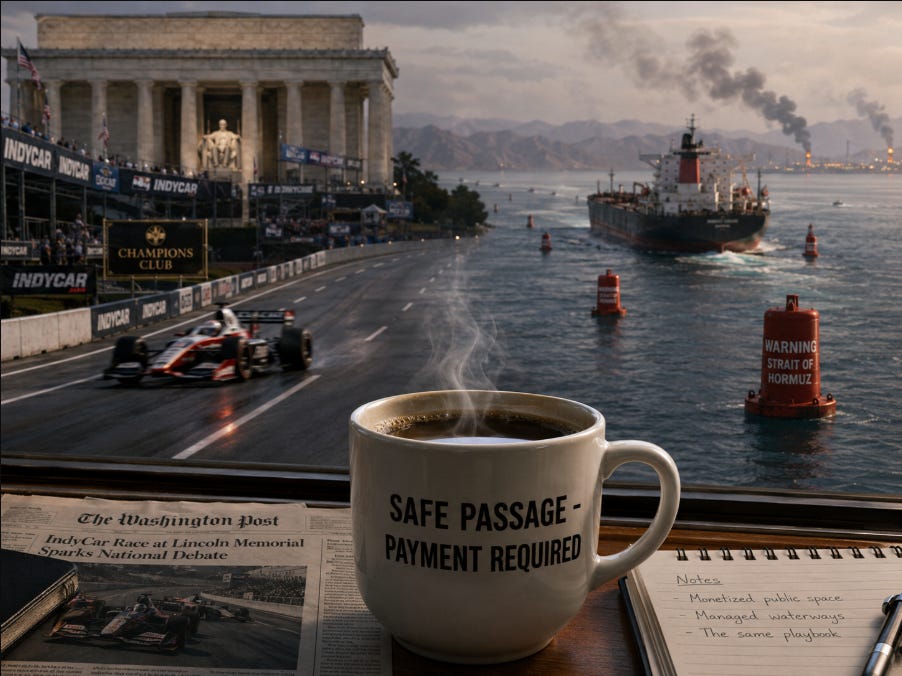
At 1:30 this afternoon, the president will turn from his proposed maritime tollbooth to a race-car showcase at the White House.
The Freedom 250 Grand Prix is scheduled to send IndyCars racing through the monumental center of Washington next month. Trump created the mechanism in January by signing an executive order titled “Celebrating American Greatness with American Motor Racing.” The order directed the Interior and Transportation Departments to designate a route through the National Mall, expedite permits and approvals, make federal resources available and coordinate access to controlled airspace for drones and aerial photography.
The race did not emerge from a civic planning process or an act of Congress. Executive authority cleared the road, opened the airspace and prepared the public commons for a commercially packaged event.
IndyCar then partnered with Monumental Sports & Entertainment, Ted Leonsis’s sports empire, to handle marketing, sponsorship sales and corporate hospitality. General admission was presented as free. Premium access, including the Champions Club, was not. Federal agencies provide the roads, monuments, permits, security coordination and promotional airspace. Private entities sell sponsorships and privileged proximity to the spectacle.
The public gets the grandstand view. The paying customers get the better chairs.
For a brief and revealing moment, IndyCar also sold an officially licensed shirt bearing the slogan “ONE NATION ONE RACE” and an image that replaced or transformed the seated Lincoln at his memorial into racing imagery. It was withdrawn after the public noticed that turning Abraham Lincoln into motorsports merchandise carried a faintly dystopian aftertaste.
The shirt disappeared. The governing model remained.
While Trump insists that Iran may not build a tollbooth at Hormuz, his administration has helped construct another kind of tollbooth in Washington. Public space is converted into a branded venue. Federal authority prepares the infrastructure. Corporate partners monetize the premium experience. The spectacle is described as a gift to the public, while the most valuable access is quietly packaged and sold.
At Hormuz, the proposed American toll comes with naval escorts. On Pennsylvania Avenue, it comes with corporate hospitality.
The race itself may be thrilling. The timing is satire delivered without an editor. American forces are bombing Iran. Iran is attacking American facilities and Gulf states. Commercial shipping is hiding. Oil prices are rising. The ceasefire has become a weekly subscription service to renewed hostilities. And the president will spend part of Monday admiring a race car before meeting with Speaker Mike Johnson and the chairman of the National Republican Congressional Committee.
The NRCC meeting should not be mistaken for direct evidence of a Republican scramble over Lindsey Graham’s death. The NRCC manages House campaigns; Graham’s seat is a Senate concern. Still, the meeting lands inside a broader political emergency that Graham’s passing has made more complicated.
Republicans have lost one of their most prominent advocates for the Iran war, one of Trump’s most persistent defenders and a senator who spent years positioning himself at the junction of foreign policy, defense spending and presidential flattery. Meanwhile, House Republicans are entering the midterms with a fragile majority, a president presiding over higher fuel costs and another peace agreement that lasted approximately as long as a supermarket avocado.
At three o’clock, after the race cars, Mike Johnson and the NRCC chairman will arrive at the Oval Office, nominally to discuss House campaigns. Graham’s death and Hormuz will nevertheless hang over a meeting the NRCC did not schedule to address either one. What they’re actually walking in to manage is a number: Navigator Research now tracks Trump-linked corruption as running nearly even with inflation and the cost of living as the top concern across 67 battleground House districts. That is not a message Republicans built. It is one they now have to answer for, the same afternoon their president is proposing a 20 percent toll on global shipping and racing IndyCars past the Lincoln Memorial.
The scale involved makes the old scandals look almost quaint. Teapot Dome, the textbook case, the one every American high schooler studies, involved about $400,000 in illicit benefits to an interior secretary, roughly $6-7 million today. The Financial Times estimates Trump made at least $2.2 billion in his first year back in office, nearly $1.2 billion of it from crypto deals alone, according to a disclosure filed just last week. Andrej Babiš, one of the closest living analogues, put his conglomerate into a blind trust as a condition of returning to power in the Czech Republic. Trump has not.
The partisan split on all this is almost a controlled experiment: 93 percent of Democrats call him corrupt, compared with 10 percent of Republicans, while 54 percent of all adults agree. But the number that should actually worry the NRCC chairman is smaller and closer to home. A May CoinDesk poll found that 59 percent of Republican voters disapprove of senior government officials maintaining personal crypto dealings, while 62 percent of all Americans distrust the administration to oversee an industry from which its members profit. Rahm Emanuel has already called the issue a “gem” for Democrats to mine; Jon Ossoff and James Talarico are already mining it.
That is the conversation happening behind closed doors at three o’clock, underneath a race car and above an oil tanker nobody wants to insure.
Which brings us back to the extraordinary Financial Times examination of Trump’s self-enrichment and its comparison to Robert Walpole, Britain’s first de facto prime minister. Walpole built a political order around patronage, personal loyalty, spectacle and the monetization of public office. He enriched himself and his family while arguing that corruption was simply the natural condition of government. His critics accused him of debasing public service by converting political power into private wealth.
The American Revolution was, in part, a rejection of that system. The Constitution’s checks and balances were designed by people who knew what happened when rulers blurred the boundary between the national interest and their own fortunes.
Trump has spent his second term testing how much of that boundary survives when nobody is prepared to enforce it.
His family’s ventures now span foreign real estate, licensing, crypto, private equity and investment arrangements involving countries whose governments also seek favorable treatment from Washington. The system was built to catch an Interior secretary accepting a suitcase of cash. It was not built for a president who maintains a global brand while his relatives operate funds, platforms and partnerships capable of receiving money from almost anywhere in the world.
Trump’s defense is not that the conflicts do not exist. It is that no one successfully prevented them.
He reportedly summarized the lesson with devastating clarity: nobody cared, and he discovered he was allowed to proceed.
That is the philosophy connecting the crypto fortune, the foreign developments, the National Mall race and the Strait of Hormuz.
Public authority is no longer treated as a trust exercised on behalf of the country. It is leverage waiting to be monetized: permits create commercial venues, military escorts become billable services, diplomatic relationships open investment channels, monuments turn into merchandise and international waterways become toll roads. At the center of it all, the presidency becomes the largest licensing opportunity on Earth.
Walpole had Houghton Hall, stuffed with paintings and diamonds. Trump has Mar-a-Lago, memecoins, foreign resorts, corporate hospitality and a proposed 20 percent charge on global shipping.
The instruments have modernized. The theory has not.
Public power belongs to the person bold enough to seize it, package it and send someone an invoice. Whatever remains afterward may be called freedom.
On that cheerful note, I will be taking a brief excursion into America’s health-care system today. I have been nursing a remarkably stiff neck of unknown origin, and writing has become more painful than usual. Marz, my 140-pound mastiff and the household’s newly appointed director of medical transport, will be taking me to the doctor in hopes that someone can persuade my neck to resume diplomatic relations with the rest of my body.
Unlike Trump’s ceasefires, I am hoping this intervention produces measurable relief.
Until then, please forgive any unusually rigid prose. The country may be twisting itself into knots, but this morning I am trying very hard not to.
Hope you find some relief. Well, this administration is certainly a pain in the neck....
Wishing you and Marz the best, Mary. Love your analysis and writing.